Most AI agents do not crash when they fail.
They quietly hallucinate a fact or grab the wrong tool, and you only find out when a user tells you.
Meng To ran into this while building his own AI products, including a job search tool with 16 different agents running inside it.
Everything passed in testing.
Then real users started hitting problems the tests never caught.
The fix came down to visibility. Trace every tool call and every decision the agent makes, the same way engineers trace a request through a backend system, then evaluate where it actually breaks.
One trace caught an agent that was supposed to pull a company's tech stack straight from the job posting. It said React.
The posting said Python. Reading the final output alone would never catch that. Only watching the steps that produced it would.
That exact failure was showing up in about 12% of runs. After tracing it, writing evals for it, and shipping a fix, the rate dropped under 2%. The whole loop took about 20 minutes, and now it runs on its own.
Software teams stopped shipping code without tests decades ago. Most AI products today are still shipping on faith.
Trace everything.
1. First principles thinking is a way of problem-solving by breaking down complex problems into basic elements and then reassembling them from the ground up.
Customer empathy and customer value has been OVERSOLD to Product Managers.
In this marco-economic environment where cash is no more cheap and layoffs become a common way for companies to get their P&L in order, Product Managers need to re-orient. Tough times teach us a lot.
Enter 'business value' - the obvious one, but the one from which PMs are farthest away from. Ask a PM 'Is this new feature touchpoint creating a value to customer?' , they will come up with metrics to prove it does or not, ask them 'Can you reduce cost by X% this quarter' - the problem may be too broad for them to impact or needs coordination of too many teams to make it happen.
P&L is hard, but P&L is what keeps your job safe. If there was one thing I would ask PMs to get coached on - Is how to ALWAYS have 'business value' in view when thinking about 'customer value'. I don't value one over another - they both are at equal weightage, but in hard times, business value can also take the front-seat.
JUST ANNOUNCED: @Microsoft has launched Microsoft 365 Copilot to uplevel business users with AI.
And as someone who has worked in AI for almost two decades and hates Outlook with a passion (I don’t think I’m the only one), this is exciting 😉
Based on their launch video, here are just some of the prompts you’ll be able to ask your personal AI business assistant:
👄 “Prepare me for my upcoming meeting”
👄 “Draft a product announcement based on X”
👄 “Create a 10-slide presentation based on X”
👄 “Based on this spreadsheet, what products were the most profitable this quarter?”
👄 “Draft an email with my approval”
👄 “Generate a meeting summary with action items”
👄 “Create a budget proposal for X”
👄 “Write a timeline for a product launch”
👄 “How does our best-seller compare to the competition?”
👄 “Create a SWOT analysis based on X”
Two things I’m most excited for with this launch: context and security. Unlike ChatGPT that works the same for everyone, Copilot will be able to take into account your private business data—your emails, your spreadsheets, your calendar, your meeting transcripts, and more. That’s a huge multiplier. And like all enterprise products should be, they’re doing it in a “secure, compliant, and privacy-preserving” way.
And the thing that caught my eye: the need for more product honesty. I noted with OpenAI’s GPT-4 launch yesterday that these AI products are being shared with more humility, potentially in the hopes of more open and honest public testing. Microsoft is still testing this product with a small group before expanding and are moving “quickly and responsibly, learning as we go”.
The next two years will be huge for B2B generative AI, and this feels like a big win.
What do you think?
ChatGPT is not new technology, just a new interface. You can replicate it pretty closely from existing APIs.
All you need is:
1. a good prompt
2. a memory window
Here's how to do it using @langchain: 🧵
The biggest lie in product management: If you make your users successful, the business will succeed.
1/14:
One of the toughest decisions in product management is optimizing for user love vs. optimizing for the short-term financial realities of the business.
A good solution here:
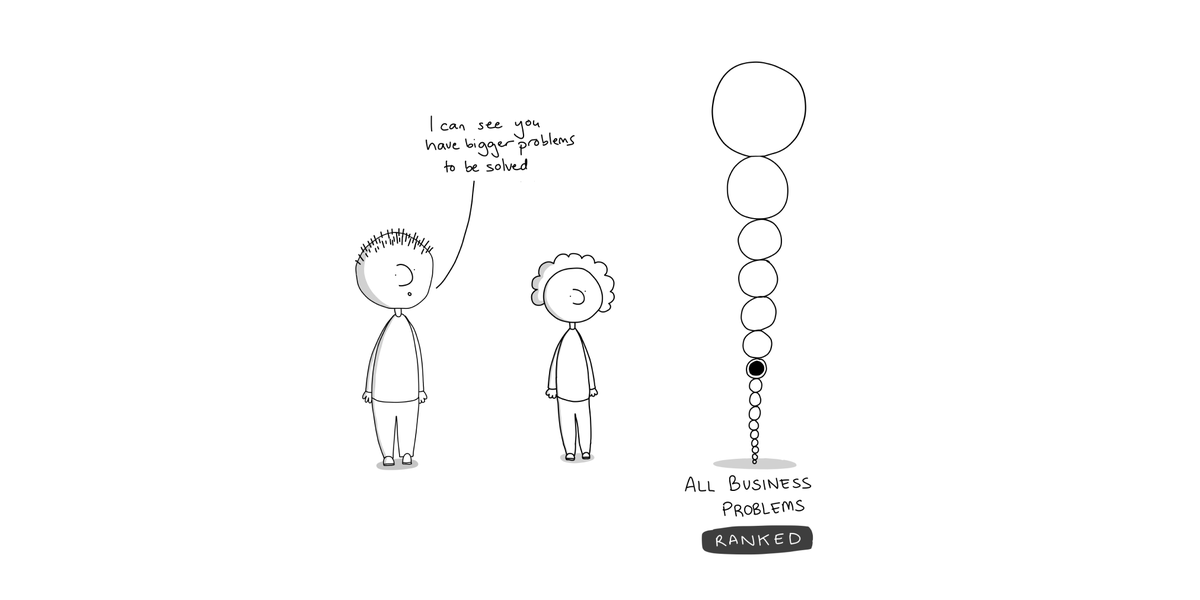
Customer Problems Stack Rank (CPSR)
Ask the customer to stack rank the problem vs. the other problems they are trying to solve for their business & org.
Also get the CPSR from other personas involved: VP Support, VP Mktg...
You are now closer to truth.
One of my biggest challenges in the startup journey was un-busying myself.
It felt good to always be scheduled and on calls, because I was being “productive” but it was a bad use of time.
Founders need to go for walks and stare at walls. Serendipity leads to breakthroughs.
An innovation in Japan which I think will arrive everywhere: double-blinded shipping, where neither the sender nor receiver know each other's address.
This was negotiated by a large marketplace (Mercari), which didn't want to have to walk so many users over the privacy hump.
Launching https://t.co/EVEEyj6X9s
If you hate writing marketing copy, it will blow your mind. We improved on GPT-3 to write copy for any product and for any audience in seconds.
Try it free for 7 days. Unlimited usage. No beta invitation needed.
@dhaber A founder's TAM analysis, no matter "good" (bottoms-up, explicit assumptions) or "bad" (top-down, hand-wavy), teaches me way more about how they view their market/opportunity--and about their level of intellectual rigor--than it does anything about the actual market being TAM'd
@dhaber Really enjoyed Bill Gurley's views on estimating Uber's true TAM. Speaks to issues of looking at the world's state today vs. the changes made by the company's entrance: https://t.co/cwE2TlC54q
Ukrainian businesses are using Tether, a US$ stablecoin, to pay for imports from Turkey. Interesting tidbit from @baidakova: https://t.co/gtknl2sRqo
[Tether is a way around Ukraine's strict foreign exchange controls, detailed here: https://t.co/blxkKKzUol]
[job ad, pls share] I'm looking to hire a postdoc and a PhD student for my new lab in Berlin starting January 2021. We'll be using behavioural and neuroimaging methods to find out how working memory is stored in the human brain. Info and contacts at https://t.co/IkN1jdjiRc 1/2





![jp_koning's tweet photo. Ukrainian businesses are using Tether, a US$ stablecoin, to pay for imports from Turkey. Interesting tidbit from @baidakova: https://t.co/gtknl2sRqo
[Tether is a way around Ukraine's strict foreign exchange controls, detailed here: https://t.co/blxkKKzUol] https://t.co/XIRVhxGpW1](https://pbs.twimg.com/media/EhpPN7qWoAE3V2R.png)
![tbchristophel's tweet photo. [job ad, pls share] I'm looking to hire a postdoc and a PhD student for my new lab in Berlin starting January 2021. We'll be using behavioural and neuroimaging methods to find out how working memory is stored in the human brain. Info and contacts at https://t.co/IkN1jdjiRc 1/2 https://t.co/EyPXbdbsyH](https://pbs.twimg.com/media/Egbtm0EU8AA-I2M.jpg)


