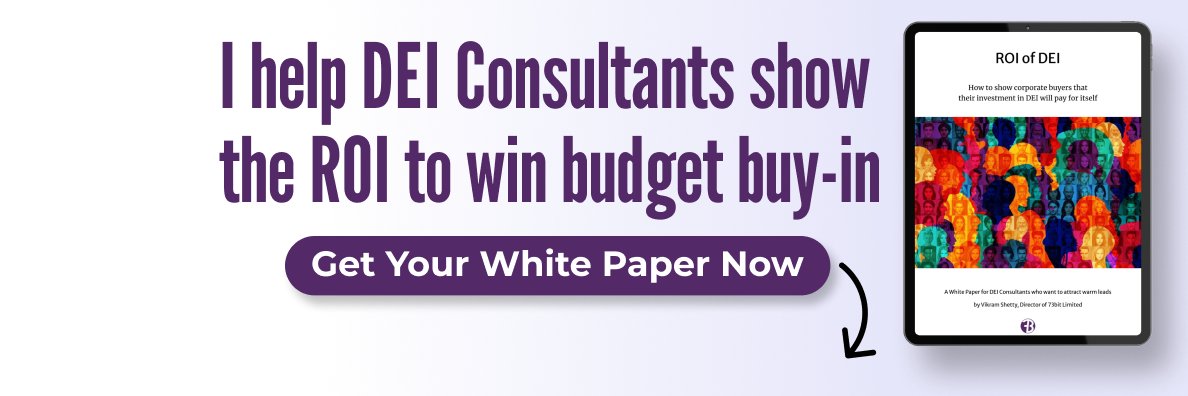
ROI of DEI - White Paper
For DEI Consultants, show the ROI to win budget buy-in without sparking backlash and survive the current climate.
Download Now!
https://t.co/k5qegUrudF
Most DEI consultants talk about culture.
The top performers measure it.
A scorecard that ties trust, safety, retention, promotion, and cost into one page?
That’s not a tool — that’s a conversion engine.
Your DEI offer becomes irresistible the moment you anchor it in money lost vs money saved.
People don’t argue with numbers — they adjust their budgets around them.
Raw DEI data is just noise.
A good scorecard turns noise into a narrative:
Problem → context → consequence → next step.
That’s the story leaders buy.
That’s the story that unlocks budgets.
DEI consultants who win in 2025 won’t be the loudest.
They’ll be the clearest.
Clarity = “Here’s the cost.”
Clarity = “Here’s the fix.”
Clarity = booked calls.
DEI dashboards with 22 charts and zero decisions are decoration.
Until you translate the data into:
→ where attrition concentrates
→ where progression stalls
→ what that costs in £
…nothing changes.
Your scorecard should be the one slide a CFO can act on.
Leaders don’t need another dashboard.
They need one page that says:
📍 Here’s where trust breaks
📍 Here’s where talent exits
📍 Here’s the £ impact
📍 Here’s the next step
That’s what a real DEI scorecard does.
19.
Attendance is applause.
Promotion rate is proof.
Stop reporting vanity metrics.
Start reporting value metrics — retention, progression, discretionary effort.
Your scorecard should make that shift unavoidable.
If your DEI report starts with “attendance,” you’ve already lost.
Attendance doesn’t change the business.
Retention does.
Progression does.
Risk reduction does.
Your scorecard should make that shift undeniable.
When someone risks honesty at work, they’re not giving you information.
They’re handing you trust.
If their manager fumbles that moment?
Say goodbye to performance, ideas, and retention.
Your assessment should measure those moments — because they decide everything.
Psychological safety isn’t a soft metric.
It’s a performance multiplier.
High-safety teams raise risks earlier, recover faster, and innovate more.
Your assessment should make this visible, not theoretical.
One badly handled disclosure can cost more than a year of DEI training.
Teams don’t fall apart from diversity — they fall apart from unsafe moments.
Your scorecard should expose those trust gaps before they become resignations.
One team with 2x higher attrition can sink the entire DEI narrative in a company.
A scorecard lets you isolate the hotspot — and price the damage — before it becomes a political storm.
“No budget” is never about budget.
It’s about no numbers.
Show a leader what their attrition, burnout, or trust gaps actually cost?
Budget appears. Always.
Every DEI consultant has one painful memory:
The workshop everyone “loved” but nobody renewed.
The fix?
Show the COI (Cost of Inaction) up front.
When leaders see the £, buying signals spike.
“We loved the session, but there’s no budget this year.”
Translation:
“You didn’t give us the math.”
One COI slide — or a scorecard showing where the culture leaks £ — flips that email into a yes.
Quiet quitting doesn’t start in disengagement.
It starts in one unsafe moment where someone realised:
“This isn’t a place where I can tell the truth.”
Your scorecard should be designed to catch those moments before the resignation letter does.
If your DEI work doesn’t show preventable-turnover £, it stays a “nice to have.”
Leaders don’t buy feelings.
They buy fewer resignations, lower vacancy cost, and faster ramp-up.
Retention is the #1 DEI money lever — always has been.
If your assessment can’t show a leader where their culture is leaking £, they don’t have a DEI problem.
They have a math problem.
Fix the math, and suddenly the DEI budget reappears.