“Pattinson as 007” is what I call “gpt-fication of choice”.
We’re facing real problem and upcoming holiday season will show it even more — K-shaped economy is not only about consumers, but also about goods.
Because the world becomes more and more monocultured and we “know” what good coffeeshop looks like, we get the same coffee shop in Kyoto AND in Philadelphia and in Porto.
So when people ask for “the best sneaker” or “the best camera”, they tend to receive increasingly similar results. That would be ok, but it looks like more and more traffic goes to most generalist choices and have tendency to constraint their stock supply, while leaving many other great options as “non optimal”.
I have no doubts that creative businesses will find a way to abuse this or win market in different ways and it’s not the threat to the market growth, but it’s a threat to a production diversity.
Abundance of sameness.
I won’t rewrite someone’s software just to “own it”, I’m happy to pay subscription.
But the moment they will act hostile to me, I’ll do it and spend more $ in tokens.
And some companies still don’t get how much Customer Support is not an afterthought on top of a product — It’s part of the product in AI era.
In NYC for couple of weeks, in case someone wants to discuss ai anxieties, consumer sentiments and how they are met by current quality of products and what are the strategies to get asymmetrical results on the market.
Or tennis.
One of the magic feelings about agents, is that everyone can become a manager and have the feel of "it's running while I'm away". It was always magical part to me of working with people too.
Not in a sense of power, but infinite momentum, because things are moving on their own, after you're giving very good push.
But agents are not making people better at people management. People require more nuanced prompts, more restraint, more careful context input, adaptation, individuality treatment.
And developers mostly treat all of these as downsides or blockers, while there's a real magic to work with aligned, pumped up team who all understand "the team".
2020: build a product, not service agency. service in an endless cycle of rich clients with unlimited amount of stupid requests.
…
2026: no product has a moat, no one pays for anything apart from ai tokens, product margins are slim, 1 winner per category and always has target on their back, no one has enough taste or discipline to actually finish things.
“Model to solve your most complex problems” is a weird goal setting, for companies who are trying to win general consumers.
Consumers don’t have physics problems everyday, they have computer use and automation hiccups, where app sometimes forgets where it runs or what permissions it has.
Apple is working on a new app called Harbor
Harbor turns your Mac into a private AI inference server. Run open-weight models locally on Apple silicon—your data never leaves your hardware, and nothing reaches the cloud. Connect multiple Mac computers over Thunderbolt 5 to pool unified memory, enabling large models and higher concurrency that a single computer can handle alone.
Set up in minutes, not hours Harbor automatically detects your devices over Thunderbolt 5 to form a cluster. Plug in, start, and you’re running—no manual configuration, no command line, no infrastructure expertise required.
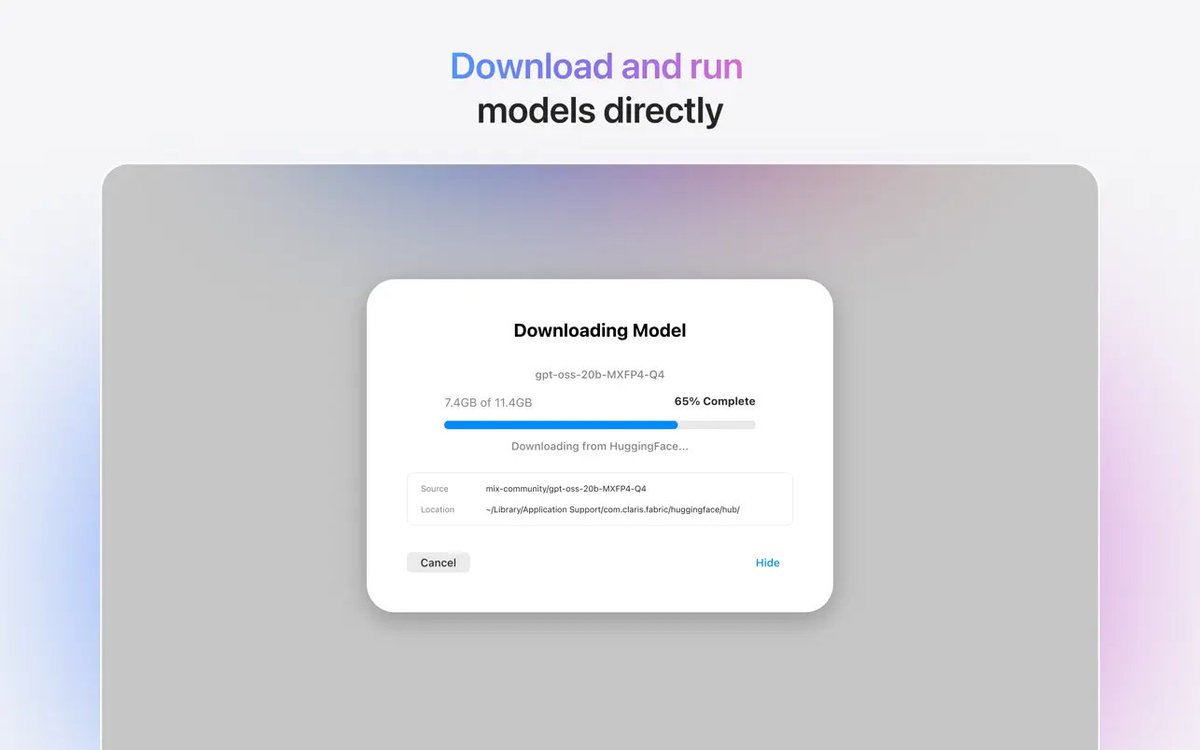
Download and run models directly Browse, download, and load open-weight models from within the app. Harbor handles model management so you can focus on the work, not the setup.
Cluster for scale Connect two or more Thunderbolt 5-capable Mac computers and Harbor pools their unified memory into a single inference resource. Run models that exceed any single computer’s capacity, or serve more concurrent requests across your cluster.
Harbor is currently in a private preview under the Claris brand.
Introducing Claude Fable 5.2 and Claude Mythos 5.2, designed to tackle the most daunting technical challenges.
They’re capable collaborators on ambitious projects in many fields, and show improvements in areas like coding, reasoning, and vision.
I never saw a personalized finance product. Almost all of them are building "one person", like a dream state. We're long gone past that point and new finances are more complicated and emotional, than ever before.
Everyone is a founder, creator, investor, opinion and it shapes both Economy and their personal finance.
ai is huge opportunity to provide not only UI + Data connection, but to actually understand a person and educate on missing opportunities:
- imaginary money I have in equity and it's potential
- my long-term strategy × scenarios probabilities (markets vs. my own)
- my habits, where I overpay for convenience and where I'm stingier than everyone else for sentimental reasons
Building it myself, I already know standard weights of all current frontier models would always play safe and conservative, no matter the real preference.
one thing about today's personal finance ai products is that they offer very little value beyond a dashboard type experience. i.e. they are built on observability rather than actual agency.
there are so many mechanics in which finance can work as a vector to deeply optimize your relationship with money, primarily how you spend, & how you make money.
there are so many opportunity scopes around this & many of the current offerings are fragmented. e.g. there are very few set it & forget it agents that work. personal finance should be one of the most autonomous categories in personal ai.. this is why when labs launch products even in these categories, they're much more surface level & they don't offer depth without configuration & management. that's i think there a huge set of opportunities lie in personal ai experiences in general.
Tech related folks are impressed by ai, because they know how magical it is.
Regular folks don't understand the concept of programming and many cases, that tech people show them just don't land, because they don't have experience of developer's friction.
That's why we have more harnesses, then total users of harnesses.
ai is still developer product, in super early alpha.
And very slow adoption by real world (failing "post office test") is a reason, why it doesn't feel magical yet.
In 10-15 years people will take it for granted, like airplanes.
But companies' attempts to make it seem mainstream almost always lands ill with "non-tech folks".