@OctavioDMA@LatEnvChemPSE Sin embargo, la introducción de la temperatura y presión crítica como variables de entrada al modelo, no contribuyeron a mejorar el desempeño del mismo.
@OctavioDMA@LatEnvChemPSE Sería interesante evaluar el desempeño del modelo si se introdujeran variables adicionales como el factor acéntrico y la temperatura de ebullición normal. Es algo que no he evaluado.
@RFonsPer@LatEnvChemPSE By combining multiple models, it reduces both bias and variance. This helps to create a more robust model that can generalize better to new data. This algorithm is less affected by outliers compared to other ML algorithms, minimizing the impact of atypical data points.
@RFonsPer@LatEnvChemPSE Gradient boosting algorithm combines different weak models (usually decision trees) to create a strong one. Each subsequent model aims to rectify the errors of the previous one, improving the prediction accuracy.
@Chalitogarnet@LatEnvChemPSE Hola, muchas gracias. Para el desarrollo de modelos termodinámicos he estado usando Matlab. Sin embargo, en este Review se abordan diferentes trabajos que utilizan distintos lenguajes de programación como python, entre otros.
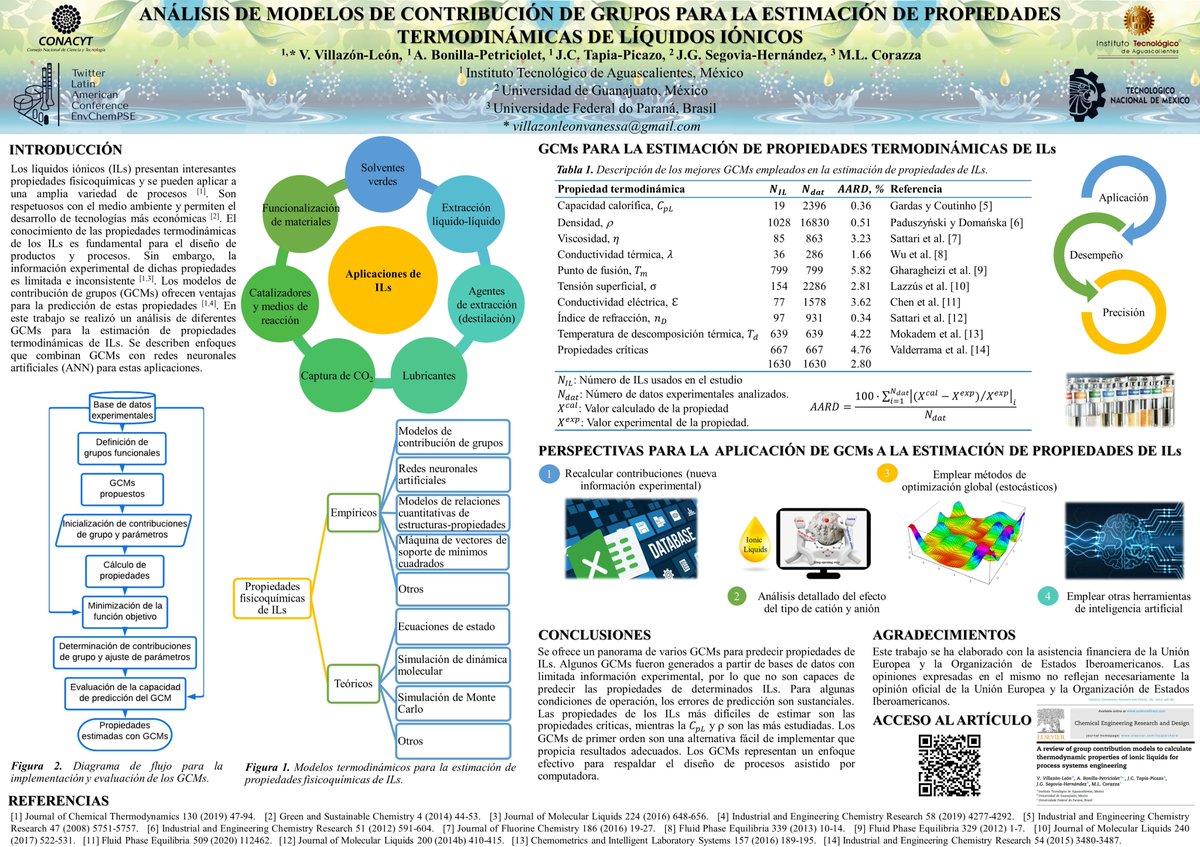
Hola, les comparto nuestro trabajo titulado "Análisis de modelos de contribución de grupos para la estimación de propiedades termodinámicas de líquidos iónicos" @LatEnvChemPSE#PSEModSimulatControl
Hello #RSCPoster community, I'm excited to share our poster entitled "Artificial neural networks and group contribution approaches for the estimation of heat capacities of pure compounds" @RoySocChem#RSCEng.
@RichBourne1981@RoySocChem 1. Thanks for your comments. Low molecular weight compounds often don't follow the general trend of the homologous series of a specific chemical family. This behavior has been explained by Nannoolal et al. (2007) and other authors in the estimation of different properties.
@RonaldMarq@RoySocChem Thank you, we should evaluate different machine learning algorithms in order to compare their performance with those obtained using ANN methods. In the next steps of our work we will do this.
Hello @LatEnvChemPSE community, it's a pleasure to share my poster entitled "Estimation of heat capacity of pure compounds using group contribution and artificial neural networks" #PSEFundComp
@EmanuelContC@LatEnvChemPSE Hello, there is no relation between the molecules used for the model development. We used both organic and inorganic compounds from different chemical families.