While we see a range of AI efforts to predict patients at risk, we don't often see all the work by the clinical + operational teams to implement and integrate the AI into practice. This paper tells our 3-year story to encourage advance care planning.
@EricTopol A nontrivial stepping-stone towards this dream is how we feed these data hungry LLMs. I was involved in setting up the FHIR app that enabled this prospective study and it is not easy. There are quirks on formatting and timing (eg cosigned notes), and hard to deliver in real-time.
I had a great chat with @techguy a few weeks back about my recent work and some of the technical aspects of how we implement Medical AI into Epic at NYU. Video up now: https://t.co/tIxz5WKe4U
The last mile might be the most challenging: just because the model works on paper doesn't mean it will change physician behavior. We need to build these systems to be lightweight in the EHR but also produce enough data so we can measure adoption and patient outcomes.
Really happy to see our #healthequity work in @JUrology! #AI has huge potential to help clinical decision-making but that does not mean it will benefit all patients/populations equally. In our case, only white patients receive guideline-exceeding care, other groups don't.
"Generalizing an Antibiotic Recommendation Algorithm for Treatment of Urinary Tract Infections to an Urban Academic Medical Center" 🔗 https://t.co/HVvbOIfu6B
By: Garrett Yoon, @RichMatulewicz, and @vincentjmajor#Urology#UTIs
On the practical side, we're working on dissemination routes to make these systems easier to deploy and 'downloadable' into your EHR just like smartphone apps. e.g. #FHIR and #EpicNebula.
@CMastication Try an anti-sleep app, I've used Caffeine for ~5 years. When the coffee cup is full it never goes to sleep, one click to go back to normal user setting.(https://t.co/ie1GWfOLDc)
@leorahorwitzmd@nyulangone@yindalon@narges_razavian An incredibly important part of MLOps which is only starting to arrive from other industries. Part of what makes this so challenging is that health systems have constant changes in orderables and documentation (e.g. the new EGFR formula) but AI is sensitive to these small changes
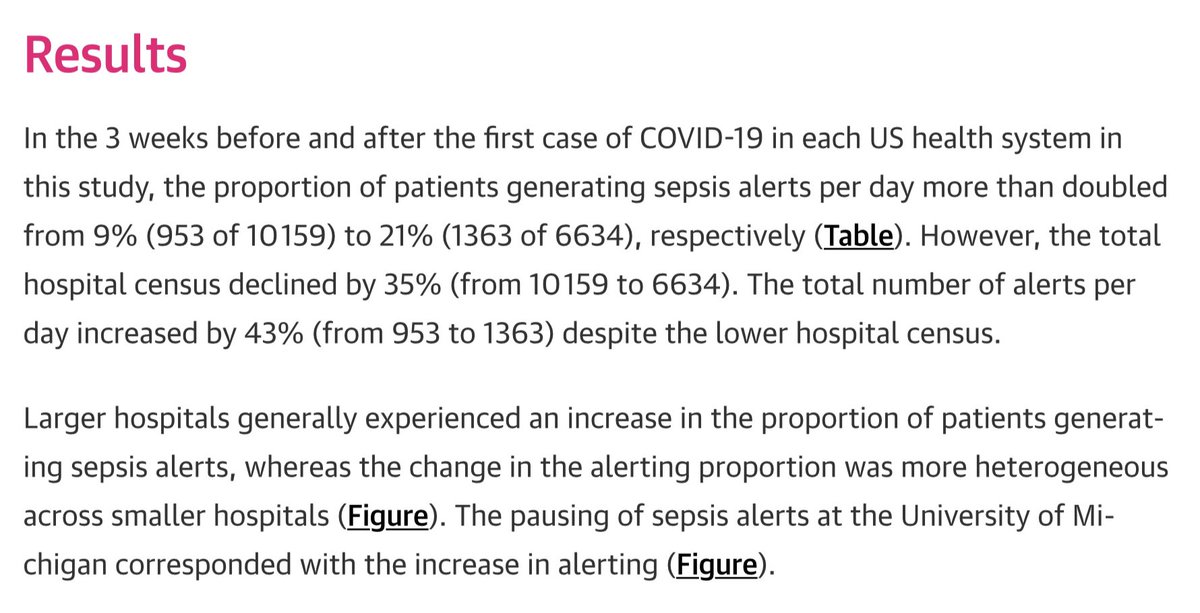
Answer: Total daily sepsis alerts increased by 43% even though hospitals had cancelled elective surgeries and reduced their census by 35% to prepare for the COVID surge. % of alerting pts/day more than doubled.
Paper: https://t.co/ekbYuDDsju
Thoughts: https://t.co/deBDAO6T6P
A fun session today at @AMIAinformatics's #CIC21, S02: Using Machine Learning to Improve Healthcare Processes and Patient Outcomes, including presenting our work using a RCT to evaluate our AI system for COVID.
Presented at Epic's XGM today but had the most fun in a post-session zoom chatting with attendees about our work. Not quite like mingling in person but was fun to meet some other AI specialists and talk shop.
A system more precise than “not being surprised” by a patient’s death in 6 months gives confidence to physicians @nyulangone in recognizing end of life and prioritizing #AdvanceCarePlanning conversations: https://t.co/kTBYW3MuZk
I'm so happy to see this multi-year effort finally together in one place where we can acknowledge all of the different people involved, in particular @Francois1Fritz, @Cerf_MD, @PaulTestaMD. Thanks @nejmcatalyst for supporting non-traditional articles.
While we see a range of AI efforts to predict patients at risk, we don't often see all the work by the clinical + operational teams to implement and integrate the AI into practice. This paper tells our 3-year story to encourage advance care planning.
ACP rates weren't perfect—even when physicians agree with a patient's risk, 72% vs 34% when they disagree—but were close to our 80% goal. Even with imperfections in the models, agreement, and adherence, we found meaningful improvement in the care of some of our most ill patients.