I’ve probably made $500,000+ from gifting ciggies.
Underrated move tbh
If I’m flying out to meet a client / potential client and I know they smoke before I even leave the airport, I’ll grab them a few sleeves.
It’s not expensive or flashy. But very intentional.
The value of a gift isn’t in the price.
It’s in the understanding.
The wealthier the client, the less they care about expensive gifts.
They can buy anything they want.
But something small, useful, and slightly unexpected lands well.
Every smoker runs out at some point.
Or has to go out of their way to buy more which is always at most inconvenient time too lol.
Almost nobody has 20+ packs just sitting there.
So the gift becomes Funny. Useful. Memorable.
For a few weeks they’ll use it every day and it’s always in sight.
So every time they reach for one they think of you and that deal becomes inevitable at that point.
Sometimes the pitch doesn’t need to be any better, they just have to subconsciously want to do the deal with you.
That’s the real game.
Proximity can extend long after you’ve left the room with the right moves, actions and words.
Used a Bloomberg Terminal for years as a trader on Wall Street.
If you’re a professional, it’s worth it. If you’re not, it’s a $30,000 drag on your returns.
Here are 15 sites that get you 90% there (most are free, the rest are a fraction of the cost):
1.TradingView — charting, pairs, correlations, alerts
2.FRED — macro, rates, inflation, yields, credit
3.Investing dot com — historical data, economic calendar
4.Koyfin / Finviz — screening, comps, cross-checks
5.SEC EDGAR — 10-K, 10-Q, primary filings
6.CME / ICE — contract specs, margin, expiry
7.U.S. Treasury & Fed sites — auctions, policy
8.FinancialJuice — real-time news, live squawk
9.FINRA TRACE — bond prices, yields, volumes
10.Quartr — live earnings calls, transcripts, decks
11.OpenInsider — insider buying (Form 4)
12.WhaleWisdom — 13F hedge fund tracking
13.TIKR Terminal — global fundamentals, estimates
14.OptionStrat — options strategies, Greeks, P&L
15.Barchart — unusual activity, put/call, IV
Nobody mentions this.
Every U.S. bank files a call report every quarter. Balance sheet, loan mix, deposit costs, credit quality, the whole picture. Free. Public. Updated 4 times a year.
The call report for a $400M asset community bank in rural Tennessee has been read by approximately nobody.
One person filed it. Maybe his secretary proofread it.
Spend 45 minutes with it and you’re the most informed outside investor on earth about that institution.
Loan-to-deposit ratio. Construction exposure. Deposit betas. Creeping charge-offs.
Do this for 30 banks and something interesting happens.
You start seeing things that are genuinely invisible to professional capital allocators.
Not because you’re smarter. Because they literally cannot do this work.
There’s no fee to justify it. No fund size that makes a $300M bank actionable.
The economics don’t work for them.
They work for you.
The database is called FFIEC. It is hideous. It has no app. There is no AI wrapper making it frictionless. It has never been in a Substack.
Which is exactly why it still has alpha in it.
Most people optimizing their portfolio are doing so in the most crowded, over-analyzed, institutionally-saturated corners of the market.
Meanwhile this thing exists. Boring, ugly, and absolutely loaded with signal for anyone willing to sit with it.
The edge was never information.
Information is everywhere.
The edge is being the only person in the room who did the reading.
Dive into adventure with the Pacific Diver: 200m water resistance and constant glow for any conditionDive into adventure with the Pacific Diver: 200m water resistance and constant glow for any conditionDive into adventure with the Pacific Diver: 200m water resistance and constant glow for any conditionDive into adventure with the Pacific Diver: 200m water resistance and constant glow for any conditionDive into adventure with the Pacific Diver: 200m water resistance and constant glow for any conditionDive into adventure with the Pacific Diver: 200m water resistance and constant glow for any condition.
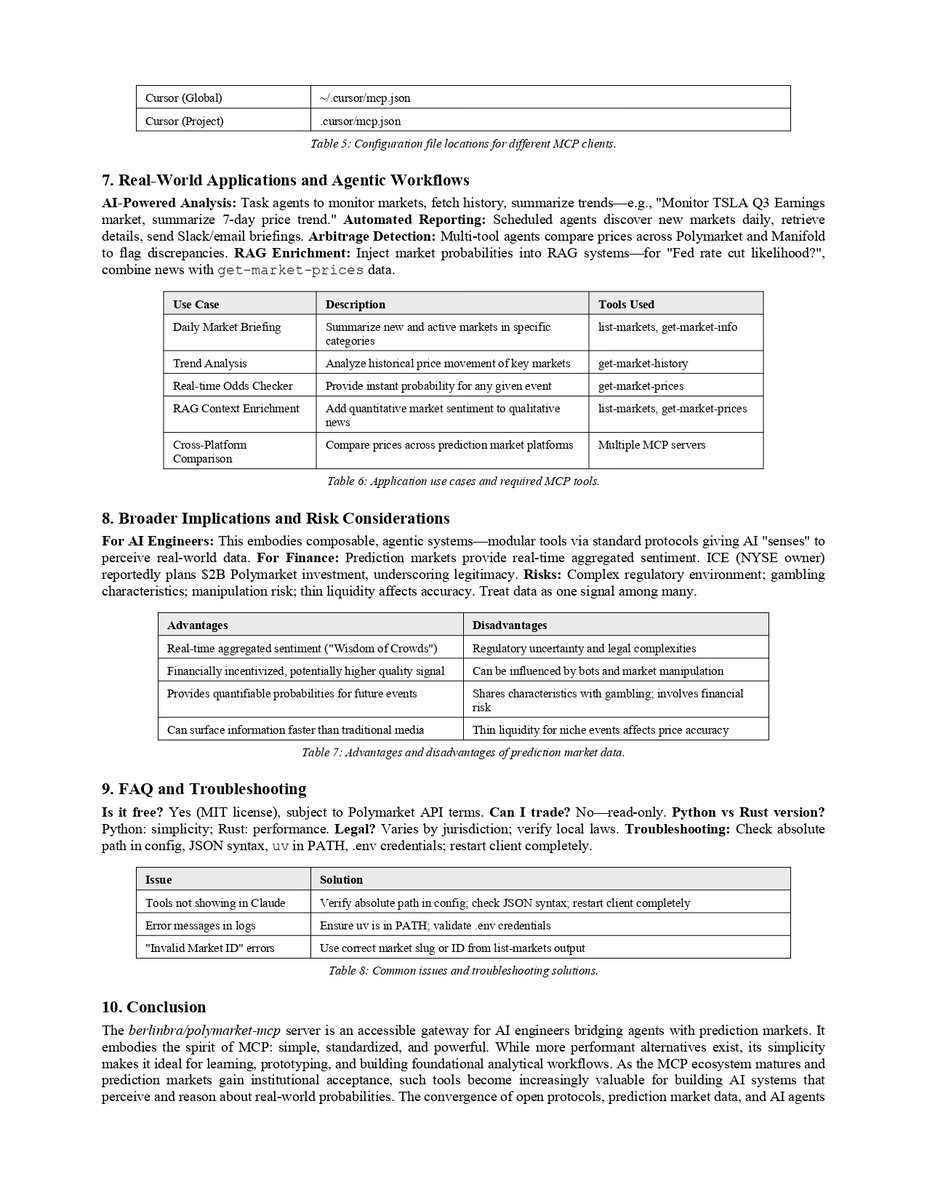
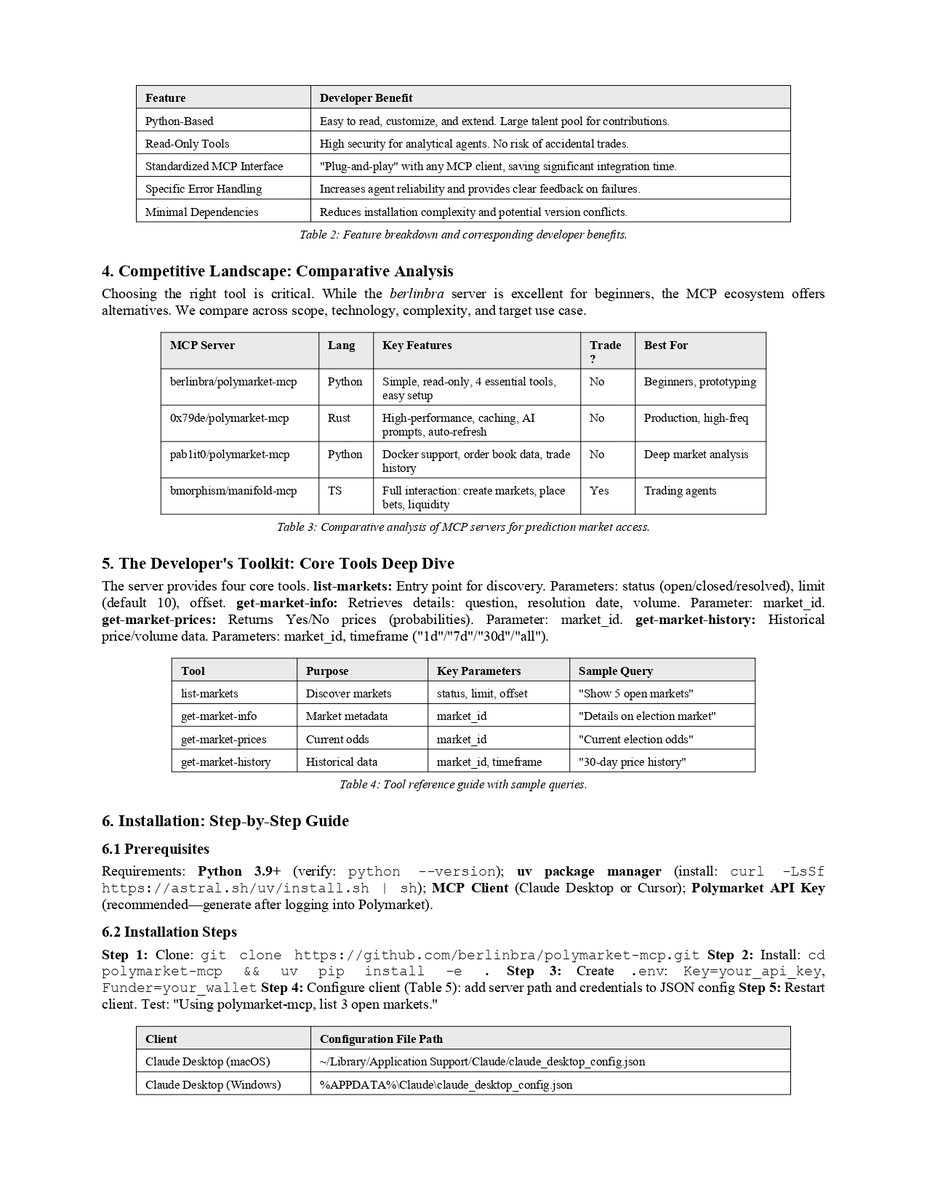
It seems my central bank/macro/finance posts are finally doing well, so here’s a book recommendation. People who better than I do recommend it often as the best book on monetary “plumbing”.
i have no desire to be rich so i can buy a rolex or a lamborghini.
i want to be rich so i can control my time and go to the gym at 3pm on a monday.
sit at a cafe and relax for an hour on a rainy afternoon.
so i can cook meals at home with fresh ingredients.
spend on my family and friends without worrying about a budget.
that's my idea of a rich life, not the fake consumerist idea shoved down my throat.
I just bought a 7 bedroom, 10 bath, 12,000 sq ft palace in the suburbs outside Caracas for $115,000. All cash, waived all contingencies, sight unseen. Will visit over the summer. Betting on a turnaround here. Don’t call me an imperialist. I’m just a value investor.
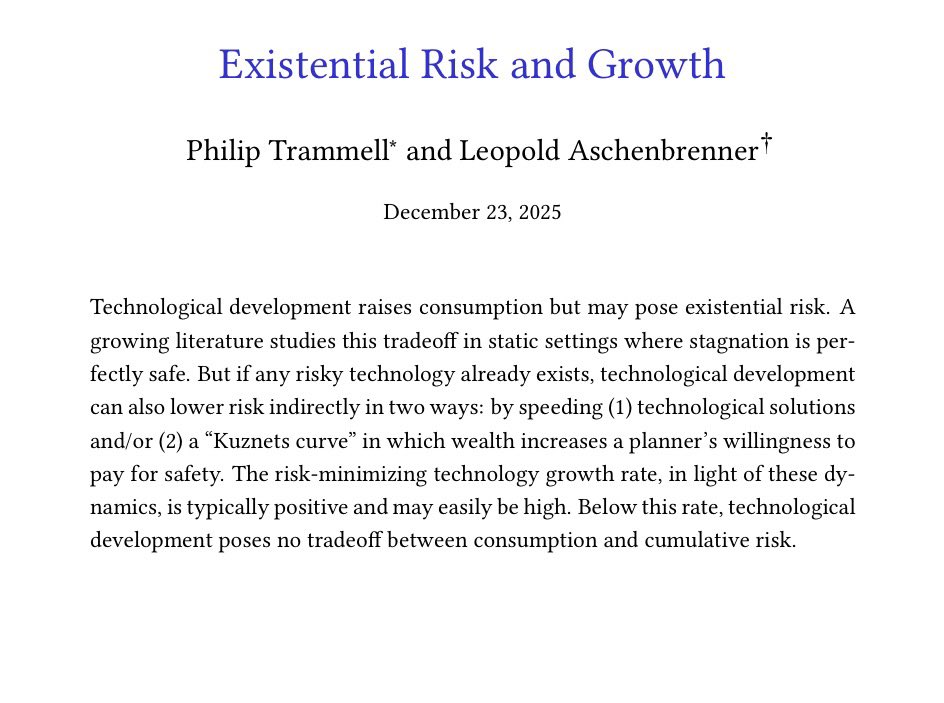
The guy whose hedge fund returned 47% in H1 2025 just dropped one of the most important AI papers I've read.
Leopold Aschenbrenner's Situational Awareness LP returned 47% net of fees in H1. The S&P returned 6%. He bet his entire net worth on AI infrastructure and outperformed Wall Street by 8x.
When someone with that track record publishes a formal economics paper on existential risk, I read it.
The paper mathematically inverts the core assumption driving AI regulation: that slowing down reduces existential risk.
He and coauthor Philip Trammell from Stanford show the opposite can be true.
The setup is elegant.
If any dangerous technology already exists, stagnation doesn't eliminate risk. It guarantees catastrophe. You're stuck running the same gauntlet forever. Nuclear weapons don't disappear. Bioweapons don't disappear. Current AI systems don't disappear. Every year you remain in a dangerous state, you roll the dice again.
Enough rolls and you lose.
They split existential risk into two components the policy debate has been conflating. "State risk" is the ongoing hazard from technologies that already exist. "Transition risk" is the danger from developing new technologies. The experiments. The scaling runs. The novel deployments.
Unless transition risk scales super-linearly with speed, faster growth is always weakly safer. You endure less cumulative state risk by escaping dangerous states more quickly.
The integral under the hazard curve shrinks.
The Kuznets curve dynamics strengthen the case. As societies get richer, safety becomes a luxury good. The marginal utility of consumption falls while the value of civilization rises. Optimal policy shifts toward more safety spending. Faster growth accelerates this dynamic.
There's a second-order effect most people miss. When the future is more valuable because growth will be faster, it becomes worth sacrificing more today to protect it. Anticipated acceleration motivates stricter current policy.
The paper acknowledges limits. If policy frictions are severe enough, speed becomes genuinely risky. If transition risk compounds super-linearly with deployment velocity, slower wins on some margins.
These are empirical questions.
But the burden of proof shifts. Anyone advocating slowdown needs to demonstrate that transition risk dominates state risk. That we're not already in a "time of perils" where the safest path is pushing through as quickly as possible.
The real insight is structural. Permanent deceleration locks you into whatever hazard rate you currently face. If that rate is positive, survival probability goes to zero. Only acceleration or surgical regulation can minimize cumulative risk.
The pause advocates have it backwards. Slowing down extends your exposure to current dangers.
Speed is the escape route.
Everyone in AI policy should read this paper.
public companies tell you exactly what they need every quarter
go to sec. gov /edgar
search 10-K filings for "plan to expand" or "hiring initiatives"
CEOs literally write down their growth plans for investors
"we intend to add 200 sales reps in Q2"
"expanding into european markets"
"investing heavily in customer success"
this is public info most people ignore
scrape the companies, find the decision makers, reach out with
"saw in your 10-K you're expanding the sales team - we help companies like yours fill pipeline during growth phases"
they announced the need themselves
you just showed up at the right time