OND planning starts with inventory, not last year's shipments. Reconcile stock, inbound supply, partner inventory, depletions, and placements.
https://t.co/JehvNiGP18
Most distributors aren't reactive because they're bad at planning. They're reactive because they don't have the information that proactive decisions require. That's a very different problem — and it has a different fix.
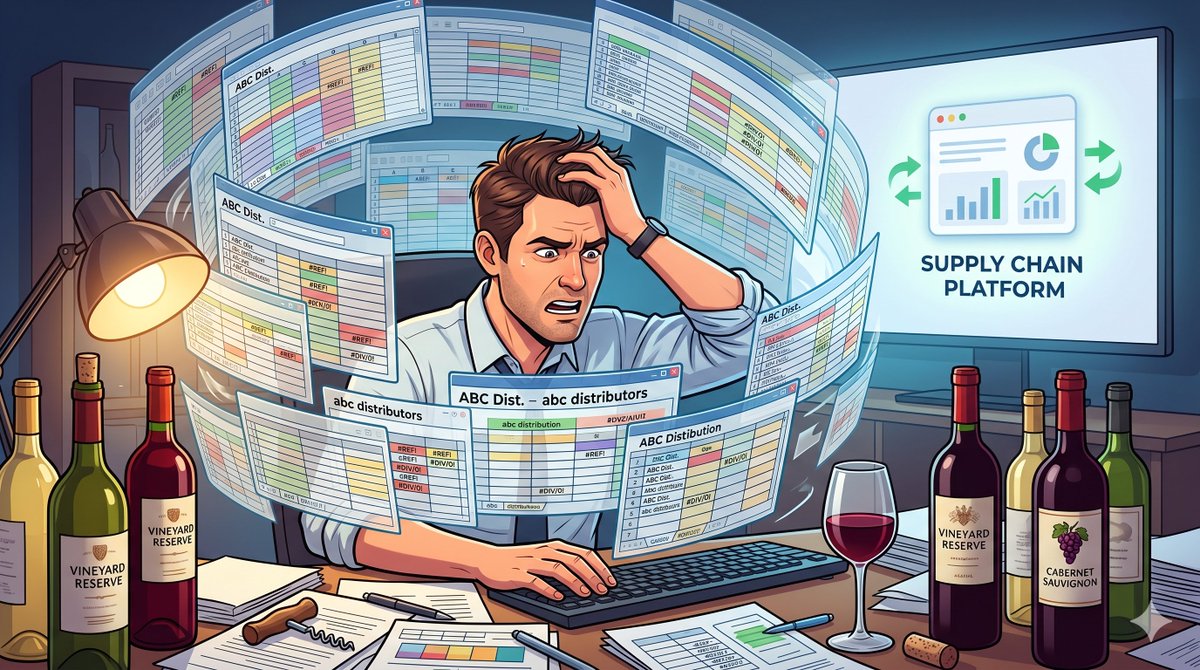
The shift holds when: → The platform is the single source of truth (no shadow spreadsheets) → Inputs are automated (EDI or API, not manual entry) → Alerts are event-based, not email-based
Change the conditions. The proactive posture takes care of itself.
Most wine businesses forecast by dividing last year's sales by 52. I've seen it at every tier — producers, importers, distributors, retailers. The problem isn't the number. It's the timing. 🧵
The answer isn't a more accurate forecast. It's an earlier one. Seasonal patterns in wine are actually quite stable. What's missing is upstream visibility early enough to act on them.
Most wine supply chains don't break suddenly.
They break through accumulation: a tab added here, a reconciliation call there, a hire to manage the coordination overhead that's quietly taken over.
https://t.co/dh8K52gMgH
Southern Glazer's VP of Supply Chain just spoke at MODEX on AI and automation in beverage distribution.
When @SGWineSpirits is sending senior supply chain leadership to a major logistics tech conference, the rest of the industry should be paying attention.
A producer ships 10,000 cases and plans for 10,000 more. A retailer three tiers away sold 3,000. The other 7,000 are sitting in the supply chain. Nobody upstream knows it.
We've seen this happen. Wrote about why it's structural, not accidental: https://t.co/jNTVFsGaoi
The three-tier system means you can't simplify the chain. The complexity is structural.
The question isn't whether silos cost money. It's how long you absorb that cost before building shared visibility.
That's why we built @vintaflow → https://t.co/johN07zmUD
We talk a lot about supply chain visibility. But there's a cost nobody names: the coordination tax.
Here's what it actually looks like in wine and spirits distribution. 🧵
And it's not just labor. Inventory carrying costs run 20-30% of total value annually. When demand visibility is siloed, teams hold more safety stock defensively.
Across SMBs, excess stock now sits at ~38% of total inventory. In complex supply chains, it's worse.