EMI will soon be the only way most people can afford to buy new phones
Samsung and IDFC FIRST Bank have introduced a 30-Month No-Cost EMI with ₹0 Down Payment on the Galaxy S26 & Galaxy S26 Ultra
so by now, everyone must’ve heard about SAVWIPL reportedly selling a stake to JSW.
& well, this is both good news... and bad news.
after spending billions, building factories, developing the MQB-A0-IN platform & investing over two decades in India, Skoda VW have ended up with barely a 2.5% market share. so it’s hardly surprising that the big daddy in Wolfsburg now wants a local partner to help turn those investments into an actual business. there were earlier talks with Mahindra & Tata as well but they failed.
good news for SAVWIPL, because it finally gets a partner with deep pockets, manufacturing muscle and an understanding of how this market actually works.
bad news for enthusiasts, because whenever a global automaker hands more control to a local partner, the fear is always the same: cost-cutting. more localisation should mean lower prices, better parts availability and higher production volumes. but it could also mean cheaper suppliers, subtle compromises in material quality and cars that lose a bit of that over-engineered German feel.
on the flip side, scale changes everything. a healthier SAVWIPL could finally justify a broader product lineup, faster launches, EVs, more powertrain options & better after-sales support instead of surviving on three SUVs and two sedans.
so yes, this could be the beginning of a less *German* Volkswagen.
but with the backing & expertise of JSW, VW Group in India might actually survive the wrath of Indian consumers. we’ve seen several global brands fail to survive india’s cut-throat competition and the strong moats built by established players.
so hopefully, with JSW’s support, VW Group in India can not only survive, but finally flourish in one of the toughest automotive markets.
How car taxes work in India:
Sonet = 18% GST (sub-4 meter)
Seltos = 40% GST (4.3 meter)
Just 30 cm extra, and the GST doubles.
On top of that:
- 10-15% RTO
- 18% GST on insurance
- 18% GST on servicing & repairs
The sub-4 meter rule was introduced in 2006.
If you've built ₹1 crore, read this slowly.
You're in the top 1.5% of India.
Nobody claps for you, because the internet has convinced everyone that a crore is normal.
It's not. It's exceptional.
The internet won't tell you this - it profits from making you feel poor.
Truth: Once you hit 1 crore, the game changes:
→ Next milestones get easier (compounding is real)
→ You gain confidence on multiple fronts
→ You start making decisions from strength, not fear
Big money is made by solving real life problems.
Zerodha solved high brokerage.
Zomato made food delivery easy.
Policybazaar made insurance easy to compare.
Urban Company made it easy to find home services.
IndiaMART connected buyers and sellers.
BookMyShow simplified movie ticket booking.
The more people you help, the bigger the business you can build.
Mukesh Bansal wrote a ₹5.15 cr cheque into Skyroot Aerospace on 23rd July 2018.
He was the only investor to back ISRO scientists Pawan and Naga.
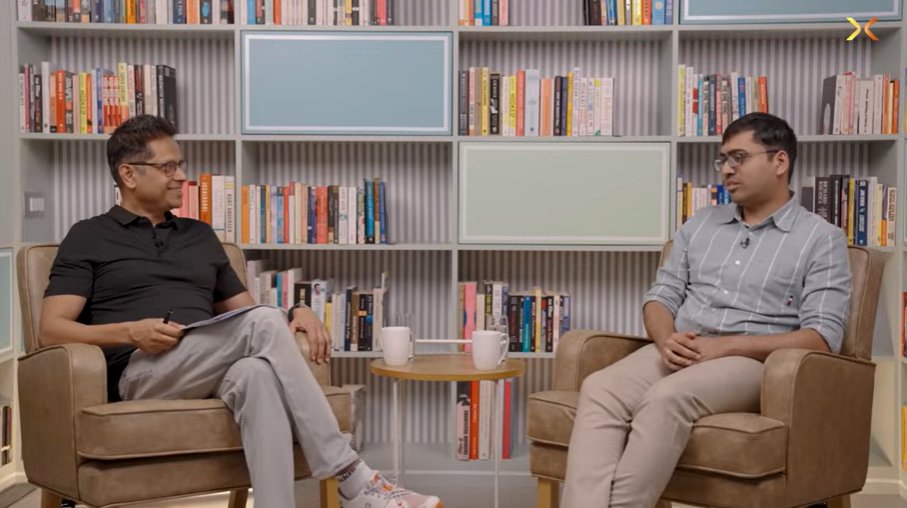
During the ET Young Turks interview, Pawan described this as “I remember googling how to raise capital. I didn't even know what equity was. I sent a LinkedIn message to Mukesh Bansal.”
Mukesh would add more capital twice - another ₹5.15 cr in April 2019 and ₹2 cr in Nov 2020.
In 2019, he was once again the ONLY investor. In 2020, he was the largest cheque.
Deep conviction demonstrated across 3 rounds - his peak ownership in the business was ~28.1%.
Mukesh’s total holdings in Skyroot Aerspace is worth ~₹708.99 crore as of Skyroot’s Series C funding round on 7th May 2026
I visited an egg cart near my home.
He sells: • Omelette – ₹60 • Egg Bhuji - ₹80 • Boiled Egg – ₹10 • Raw Eggs - ₹8
I talked to him and he told me something interesting.
He owns his own poultry farm.
Every day, around 120 trays of eggs (≈3,600 eggs) come from his farm.
Around 90–100 trays are supplied to hotels, restaurants and local shops.
The remaining eggs are used for his own cart.
I asked him how much he earns.
He said,
"After all expenses, I usually save around ₹2.5–3 lakh a month."
That's roughly ₹30–36 lakh a year.
That's when I realized...
The cart is just the showroom.
The real business is the supply chain.
One belief I still follow.
Whenever I visit someone in the hospital, I prefer giving money instead of fruits.
At weddings and family functions too, I usually give cash instead of gifts.
It gives people the flexibility to use it where they need it the most.
US showed the world why it is THE best country in the world !
They did not build a single stadium for the football World Cup , the altered NFL stadiums , fully air conditioned took the world by surprise !
Football - world’s greatest sport !!
The real car ownership review begins after 30,000 km. Everything before that is just a first impression.
Any new car feels smooth, silent and exciting in the first few months. That’s exactly how it’s supposed to feel.
The real questions come later.
Has the suspension developed noises?
Has the cabin started rattling?
Has the clutch, gearbox or electronics remained trouble-free?
Does the service experience still make you smile?
A test drive tells you how a car drives. 30,000 km tells you what it’s like to live with. That’s the review that actually matters.