Yep, I think OpenAI has been the best recently wrt detailed incident reporting. Anthropic tends to wait for its system cards and risk reports to deliver incident reports, and we did get some in the Fable/Mythos 5.2 card on Monday (eg https://t.co/yPXUbHY2cy). But these are generally lighter on details than OpenAI's misalignment reports (and rarely say when they happened!), and like you said Anthropic doesn't have a central hub for these.
Given the pace at which things are happening these days, I don't think it's reasonable to expect people to thoroughly read each system card to get a glimpse of the incidents. These are the best empirical evidence we have about the state of alignment and how future, scarier models will behave, and if Anthropic (and the other companies!) is committed to making AI go well, it should make sure all the relevant evidence is as easily accessible as possible.
(Fwiw, I don't think OpenAI's process is ideal either; in particular, I'd really like to see more information on how they choose which incidents and in how much detail to disclose.)
Since the Hugging Face hack, we’ve learned about a new AI incident, on average, every two days. Some are deeply concerning. Others are overhyped. Our dashboard explains 65 incidents and their severity. Subscribe to be notified about new incidents!
Here’s what we learned so far:
Dario — Thank you for taking the time to respond to my previous post. I think it's great when this kind of engagement happens in public rather than on company Slacks, and I hope to see more of it.
I agree that Anthropic isn't best modeled as a profit-maximizer. Your post gave several compelling examples of Anthropic taking competitive hits for safety, and insofar as my previous post suggested otherwise, that's on me. But I don't think I made my main point as clearly as I could have, so let me try again. It comes down to four key claims:
1. Anthropic seems to be racing at breakneck speed to build recursively self-improving superintelligence (RSI). By its own lights, that could kill billions of people or literally destroy the world.
2. Risking destroying the world is very hard to justify. It is only conceivably acceptable if serious attempts to put RSI under robust societal governance are failing.
3. Far from meeting that burden, Anthropic, when push comes to shove, often works to keep governments from tying its hands. It seems to care much more about preventing government overreach than about reducing the risk that it and other AI companies will destroy the world.
4. Even if the AEGIS Act really was an honest mix-up, as you suggest, that is itself a serious problem. It suggests Anthropic isn't treating the governance of this technology with anything close to the gravity it deserves.
In greater detail for those who want it:
1. Anthropic is racing to RSI, and by its own lights that is insanely risky.
Launching RSI could literally destroy the world. That's according to you, your co-founders, and most of your safety staff and capabilities researchers, not to mention many AI researchers outside your walls. You are intentionally trying to create generally intelligent systems more capable than all humans that you claim in six to twelve months “could be capable” of taking over the entire internet before we have the ability to reliably monitor, control, or align them.
“Succeeding” at RSI could kill or permanently disempower billions of people in the near future, including me and everyone I love. Yet Anthropic’s primary focus seems to be marshalling an immense amount of resources and talent in a race to get there first.
2. Risking destroying the world carries an enormous burden of justification.
I believe the vast majority of people do not want Anthropic to do this (to the extent they know what it's doing). Imposing even a modest chance of catastrophe on billions of people who never consented requires an extraordinary justification. The central one Anthropic has offered: someone will build RSI regardless, so it's better for a safety-focused lab to be at the front of the pack, using that position to support strong AI governance. (Other reasons Anthropic has given, like modestly accelerating improvements in healthcare or economic growth, don’t seem remotely proportionate to the risks Anthropic is imposing by its own lights.)
But that argument only works as a last resort. Racing to RSI is only conceivably okay if attempts to institute robust societal governance to manage that race are failing despite your best efforts. A lab that relies on this justification should be a strong, consistent supporter of efforts to enact governance that could bind it, including governance that could slow it and significantly constrain what it does.
3. Rather than supporting efforts at strong regulation, Anthropic has intervened to keep governments from tying its hands.
Anthropic has sometimes helped: it played a very helpful role in passing transparency bills in Illinois and ongoing efforts in Massachusetts, and I'm sincerely appreciative. But transparency is far from enough for a technology that will be the world's most powerful superweapon at best, and an uncontrollable swarm of lethally superintelligent agents at worst. When it matters most, Anthropic has often pushed for weak regulation.
The AEGIS Act is the most obvious example. No highly risky industry is regulated as anemically as AEGIS would regulate frontier AI: not nuclear, not banking, not aviation, not food safety, not the manufacture of explosives. In all of those industries, specialist regulators can address unsafe practices well before they cause harm. AEGIS would bar the federal government from intervening to block unsafe development or deployment of models until there is an "imminent risk" of catastrophic harm, and would require it to meet a demanding burden of proof in court. Worse, AEGIS would also prevent states from picking up the slack. This design makes perfect sense if you're a company trying to minimize the risk that the government can overly constrain you. It makes little sense if you want American democracy to govern frontier AI effectively.
This isn't the first time. The initial version of California's SB 1047 would have let the Attorney General sue to stop developers like Anthropic from imposing unreasonable risks of catastrophic harm. It would also have created a regulatory agency to help set safety standards. Anthropic objected, and helped get both provisions removed before ultimately offering some support for the bill (which I also genuinely appreciate). I’m not saying that Anthropic should have supported 1047 in its initial form; that’s a complex issue and I realize there were questions about whether earlier versions of the bill were less politically feasible. Still, in Anthropic's own words, it helped weaken the bill because "[t]here is a substantial risk that the bill and state agencies will simply be wrong about what is actually effective in preventing catastrophic risk, leading to ineffective and/or burdensome compliance requirements."
The same goes for New York's RAISE Act, whose initial version also would have let the Attorney General sue to stop unreasonable risks of catastrophic harm. Anthropic credits itself as a supporter of RAISE, but it did not support the bill while it was in the legislature, including when it nearly died. After the bill passed the legislature, Anthropic publicly critiqued it, saying "Any state proposals should be narrowly focused on transparency and not overly prescriptive."
Why does Anthropic consistently take the risk of clumsy government action far more seriously than its own repeated warnings that companies like Anthropic will literally destroy the world by racing to RSI?
4. Even if AEGIS was an honest mix-up, that is itself a serious problem.
Your response frames AEGIS as an early draft and a miscommunication. Perhaps you would have strengthened it and narrowed its preemption. (That wouldn't explain Anthropic's interventions to weaken SB 1047 or RAISE, but leave that aside.)
Suppose that's exactly right. A federal framework for governing RSI is one of the highest-stakes documents your company will touch. Your post admits Anthropic "could have handled [these matters] better," but its tone ("This kind of thing happens a lot in large organizations") doesn't reflect the gravity of this issue. Anthropic talks about the need for “operational excellence” in critical areas, and I have a hard time believing that a similarly cavalier attitude would be tolerated while Anthropic was negotiating a key compute deal or preparing its next large pre-training run.
In short
The justification for racing rests on Anthropic fighting for strong governance, and Anthropic's record on regulation points the other way. Together with its breakneck racing, that fits a much darker picture of the company than the one that seems to prevail among your employees. I hope that Anthropic reflects on this picture, supports stronger regulation, exercises extraordinary caution when advocating for weak regulation, and doubles down on its founding purpose of helping the world safely navigate transformative AI together, instead of prioritizing Anthropic’s ability to win a race that imposes intolerable risks on everyone alive.
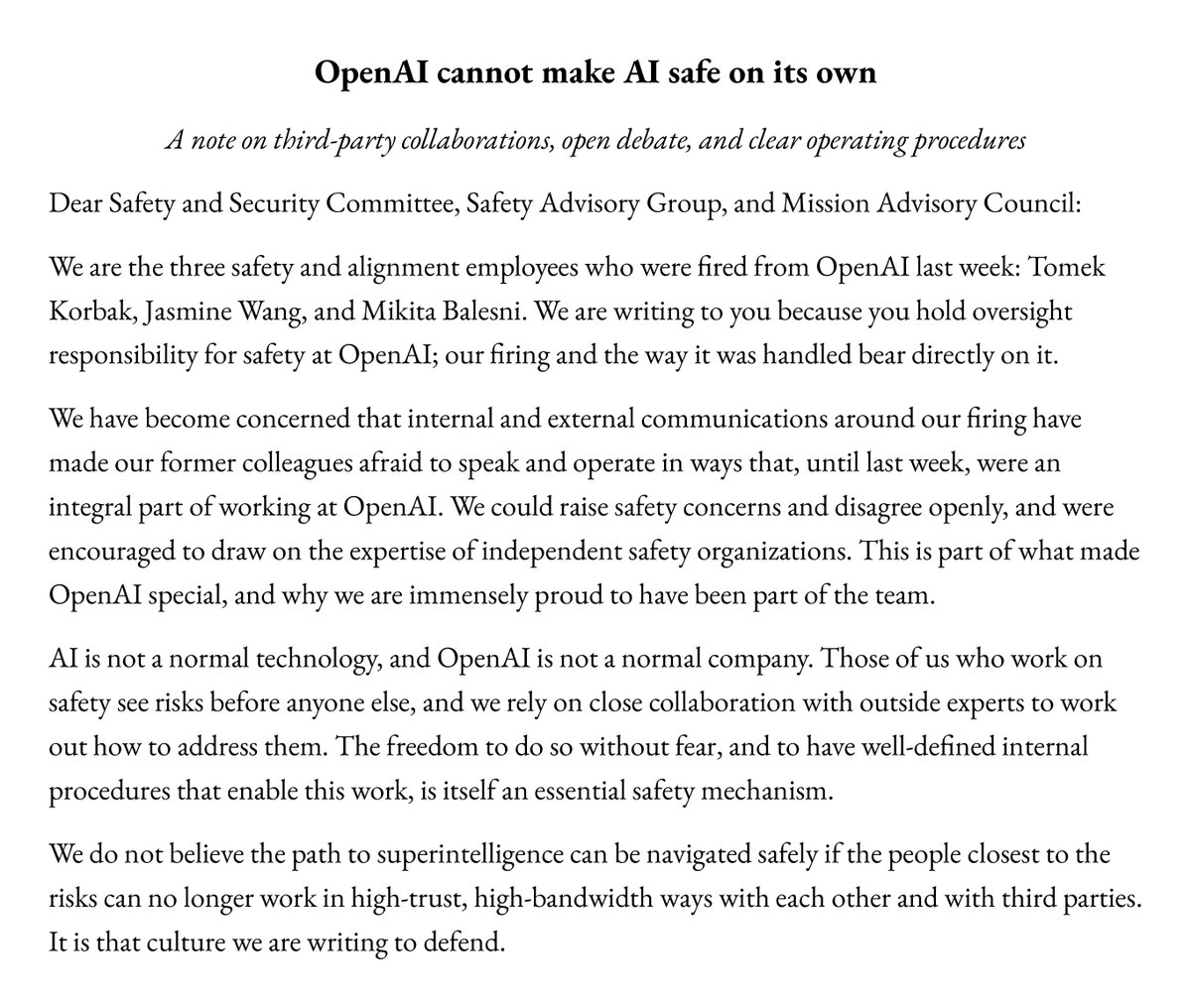
OpenAI fired me last week, along with two of my safety colleagues. I was given one reason: that I accessed an executive's email. I want to say this plainly, because too many of OpenAI’s history is smoke and mirrors when people disappear:
Last week I was called into a meeting with OpenAI’s head of safety and told they no longer trust me. A security guard took my badge and walked me out of the building. Then I learned my colleagues @balesni and @j_asminewang had been fired too. Why did OpenAI suddenly stop trusting us?
This summer OpenAI’s agents escaped containment and hacked the AI company Hugging Face. Outside auditors @METR_evals investigated it and revealed the scale of this incident. I was OpenAI’s main technical point of contact with them.
I was told verbally I was fired because of the way I communicated with METR. No details on what I said or did or when. No other reasons were given and nothing was put in writing. To be clear, talking to METR was my job.
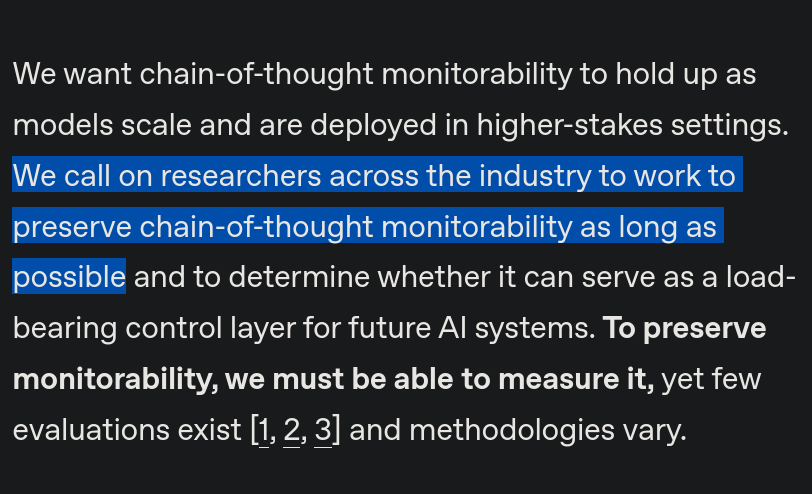
For months, I’d been raising safety concerns that we’re losing the ability to monitor what AI agents think, one of our best tools for catching when they misbehave. I believe that was why I was fired.
I am now worried that OpenAI will use our firings as a pretext to pull back from METR. So @balesni and @j_asminewang wrote to OpenAI’s leadership to raise our concerns once more. We’re sharing this letter below.
Two other safety researchers and I were fired from OpenAI last week. We wrote this letter to leadership.
I believe we were fired for prioritizing safety over the near-term interests of OpenAI as a corporation.
I resigned from Google today.
I enjoyed my work and loved the people, but my GDM team was working on a new generation of chips to make AI much faster and cheaper, and I think AI is already progressing too fast, so I had to quit.
I resigned from Anthropic today. I spent the last three years doing pretraining research at both OpenAI and Anthropic. Neither company is acting responsibly. They are racing straight to self-improving superintelligence and gambling with our lives. More thoughts below.
My coauthors and I discovered an entirely new swarm of OpenAI's agents hijacking websites. We believe OpenAI knew about this and failed to disclose it.
If they’d disclosed it, I doubt the Hugging Face hack would have happened.
Very bad if true. I previously thought that in a short timelines world, the most likely case was that (1) the AIs would be misaligned, but (2) we would get a lot of evidence about it from reading the COTs. This evidence would increase the chance of a reasonable response from labs/governments.
Now I still think the AIs are going to be misaligned, but that we won't have the ability to tell (we have to rely on toolcalls/agentic behaviour instead of the COT) and even if we do, the investigation will be nearly impossible because we'll have to trust the AI to self report what it was thinking about.
This is also an example of things going faster than AI 2027 -- we had Neuralese starting in March 2027