@v_oleksiienko@AnthropicAI Codul generat este enorm, dar verificarea finală se reduce la câteva mii de linii din kernel.
Deci nu verifici 13 milioane de linii, ci doar consistența sistemului. Verifica cu AI, chiar te ajuta.
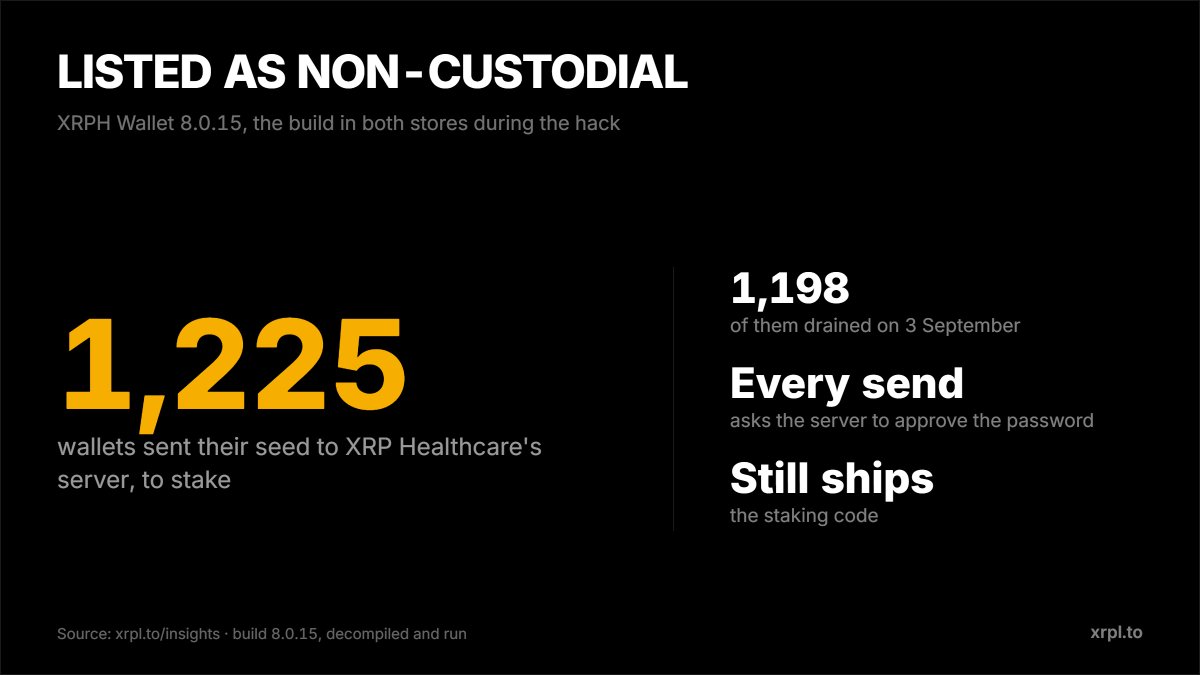
Your address. Your name. Your password. Your seed.
Which of those does a wallet listed as non-custodial send to its server?
XRPH Wallet: all four, at different moments. 1,225 wallets sent the seed. 1,198 were drained on 3 September.
Which moment: https://t.co/AlQoQ6pQiL
2/2
@trips144@24hrscrypto1 Într-un sistem global agentic (2030–2035):
XRP trebuie să fie scump
fee-ul trebuie să fie microscopic
burn-ul trebuie să fie controlat
supply-ul trebuie să reziste 100+ ani
Voting for OIP-4: Acquisition of @Chain Technology and Intellectual Property is now open 🗳️ chain-2:native
Read more: https://t.co/8zGJR2ulMW
Vote: https://t.co/QZcROi62nC
The opportunities are out there. What's missing is access: banking, language, and a way to connect across borders. For 3B+ people, that's reality. @go_rosen is closing that gap on Hedera.
🚨Attention XRPL Community 🚨
Today a community member reached out about strange transactions in their @XamanWallet and asked if I had any. I looked in my wallet and I found two escrow transactions… one for creation & another to cancel.
Utilizing the support xAPP within the same XAMAN wallet I sent a screenshot and asked what it was.
Here is the reply:
“Thank you for reaching out to us. We understand that seeing unexpected transactions in your account can be concerning, and we appreciate you bringing this to our attention. Here is what you need to know about the transactions you are seeing: What are these transactions? This is a known phishing tactic currently being used by scammers on the XRP Ledger. Scammers are sending out unsolicited "Escrow" transactions directed at various users' accounts. These escrows often appear to contain large amounts of tokens (like "USDT0" or other fake assets) to grab your attention. Their goal is to bait you into visiting a third-party website or following a link in the transaction memo to "claim" or "release" these locked funds. Why you should not sign them: These unsolicited escrows are a trap. If you visit the scammers' website, you will be prompted to connect your wallet and "sign" a transaction to receive the funds. Do not sign anything. The transaction they are asking you to sign is not a harmless release of funds. It is a malicious transaction designed to trick you into granting the scammers control over your account, which will allow them to steal your actual assets. Your account is safe: Please rest assured that your account and funds are completely safe. The mere presence of these escrow transactions in your account history cannot harm you. Scammers cannot access your funds simply by sending a transaction to your address. The only way they can steal your funds is if you explicitly authorize them by signing their malicious transaction. As long as you ignore the bait and do not sign anything, your account remains 100% secure. Why can't these transactions be blocked? Because the XRP Ledger is a public, decentralized network, anyone with an active wallet can initiate a transaction to any other address. Just like anyone can send a piece of physical junk mail to your home address, anyone can send a transaction to your XRP address. Because of the open nature of the blockchain, there is no way to selectively block incoming transactions or hide them from the public ledger. What about the network fees? Any network fees involved in these transactions are paid by the sender. They do not cost you anything. What are you doing about this? We have flagged the scammers account in our "blacklist" database. What you should do next: The safest and best course of action is to simply ignore these transactions. Do not click on any links provided in the transaction details, do not visit any websites they promote, and never sign a transaction that you did not deliberately initiate yourself. If you have any further questions or concerns, please don't hesitate to reach back out. Your security is our top priority.”
- Support Agent
Thank you for the prompt and thorough response @XamanWallet💚
@Bodhi_Karma_ Yours is way more of a deep dive then mine could ever be.
This is more of a refresher for anyone late to the party.
You are and always will be the Godfather! 🤝
Two contradictions I need clarified before covering this:
Lets keep it simple.
1.) Your own FAQ states: "Vaults are lending pools that allow you to lend RLUSD and XRP token to Soil Ltd." Your D'CENT integration marketing states: "no surrendering of your keys... self-custody intact throughout." Once XRP is lent to Soil Ltd. and deployed into treasuries, private credit, and hedge funds, it's not sitting in the user's wallet, it's an asset on your balance sheet with a repayment obligation back to the user. Which description is accurate: is this
self-custody, or is it a loan to Soil Ltd.?
2.) D'CENT's own comparison page states XRP deposits sit in a fixed 40-day lock-up window. Your current promo with D'CENT ($35K in XRP rewards, four quests) doesn't disclose this lock-up anywhere in the marketing copy. Why isn't the 40-day term disclosed upfront in the promotion itself, rather than only surfacing on a separate comparison page?
These aren't nitpicks, they go to whether users understand what they're actually agreeing to before they deposit.
I'm assuming no response is your answer like always.
Not your keys not your crypto. Know what you are signing up for.
🛡
Should You Be Holding $DAG?
Let's audit.
What it is:
DAG Constellation isn't a payments coin or a smart contract platform. It's data integrity infrastructure. Its Hypergraph and HGTP protocol make data verifiable and tamper-proof for governments and enterprises. Not moving money. Proving truth.
What's actually been built:
U.S. Department of Defense partnership since 2019, starting with the Air Force. Recently expanded with Air Force data security work and USTRANSCOM references. ✅
Acquired by AIAI Holdings, May 2026. Now sits under a Nasdaq-listed parent. ✅
Gate AI, launched June 2026. Defends AI agents from prompt injection. Independently benchmarked #1 on 8 of 16 public datasets, 97.4% F1, 53ms latency. ✅
Gate OC Audit, open-source, June 2026. Tamper-evident logging for AI agent activity via SHA-256 and Sparse Merkle Trees. Built for the AI governance wave regulators are pushing toward. ✅
Arca Wallet, alpha June 2026. Self-custodial USDC/USDT, no seed phrase, no gas fees. Seven partner apps live at launch. ✅
Listed on Base and Kraken. Bridges to Base and Ink. Native USDC support. ✅
2,000+ Dôr retail deployments through a partnership with Dor Technologies and The Upsider Swarm. Real activity, not a pilot announcement. ✅
Token mechanics:
Circulating supply roughly 2.87-3.9 billion DAG, max supply near 3.71 billion. Market cap sits around $28-30M. Tiny valuation for a project with a DoD relationship and a Nasdaq parent.
Node operators and developers must stake DAG. Real utility demand, not pure speculation.
The honest flags:
Volume is thin, some days under $1M. Thin volume means real volatility and hard exits on size.
All-time high was $0.4537 in August 2021. Currently over 98% below that, never meaningfully recovered.
DAGDaily flagged it directly: strong benchmarks, DoD-adjacent references, thousands of deployments, all against a stuck $0.008-0.009 price. Building hasn't moved price yet.
Defense contracts move slowly and stay opaque on dollar figures. No public breakdown of contract value or renewal terms.
AIAI ownership is new. How much value capture stays with token holders versus Nasdaq shareholders is still an open question.
Where it connects:
As AI shifts from generating answers to taking actions, someone has to prove what those actions were. That's Constellation's entire pitch. XDC verifies trade documents.
DAG Constellation verifies AI behavior and government data. Same thesis: institutions need cryptographic proof, not a promise.
The honest verdict:
Rare combination: real DoD relationship, Nasdaq-listed parent, independently benchmarked AI security.
Price has punished this token for five years regardless.
You're betting the public-markets structure finally converts credibility into demand, after years of that exact thesis failing to move price.
ISO Ledger 🛡️
XRPL has already proven it can support tokenized assets at scale. Now it’s time to put these assets to use: global transfers, trading, collateralizing, and settling.
The upcoming release of xrpld 3.3.0 includes five amendments that move XRPL significantly closer to that goal.
Here's what each one enables:
𝗖𝗼𝗻𝗳𝗶𝗱𝗲𝗻𝘁𝗶𝗮𝗹 𝗠𝗣𝗧
Confidential MPT brings native privacy to Multi-Purpose Tokens (MPTs) on XRPL by combining zero-knowledge proofs with elliptic-curve encryption. Issuers and token holders can keep balances and transfer amounts private on a public ledger, while designated parties - such as auditors or regulators - can verify transaction details when required. For financial institutions, privacy is often a prerequisite for using public blockchain infrastructure.
𝗕𝗮𝘁𝗰𝗵
Batch enables up to eight transactions across different accounts to execute atomically in a single ledger. Either every transaction succeeds, or none do. For the XRPL community, this unlocks more sophisticated workflows without introducing trust assumptions. For institutions, it enables capabilities like delivery-versus-payment (DvP) and atomic settlement, where both sides of a transaction execute together or not at all.
𝗣𝗲𝗿𝗺𝗶𝘀𝘀𝗶𝗼𝗻 𝗗𝗲𝗹𝗲𝗴𝗮𝘁𝗶𝗼𝗻
Permission Delegation allows institutions to delegate narrowly scoped transaction permissions without handing over full signing authority. It's the on-chain primitive for role-based access control. Treasury teams can retain custody of issuance keys while authorizing trading desks or operational teams to perform specific actions within defined limits. This separation of duties is a common requirement for institutional operations.
𝗦𝗽𝗼𝗻𝘀𝗼𝗿𝗲𝗱 𝗙𝗲𝗲𝘀 𝗮𝗻𝗱 𝗥𝗲𝘀𝗲𝗿𝘃𝗲𝘀
Sponsored Fees and Reserves allows a sponsor - such as a bank, issuer, or platform - to pay XRP transaction fees and account reserves on behalf of another account. Users continue to own their accounts and keys, while removing one of the biggest onboarding hurdles: requiring every participant to acquire and manage XRP before they can interact with the network. This improves the experience for both institutions and consumer-facing applications.
𝗗𝘆𝗻𝗮𝗺𝗶𝗰 𝗠𝗣𝗧
Today, once a Multi-Purpose Token is issued, its configuration is effectively fixed. If an issuer needs to update transfer fees, metadata, or enable new capabilities later, the alternative is often issuing an entirely new token and migrating holders. Dynamic MPT allows issuers to define, at issuance, exactly which properties may be updated over time. This provides a practical way to adapt to changing business needs and regulatory requirements without requiring a full token migration.
—
The release is currently anticipated for next week. As always, these amendments will only activate following validator approval. If you run a validator, we encourage you to review the amendments as they become available.
Specifications and documentation are available at https://t.co/9j2gW93dAD, and the Ripple team will be publishing technical deep dives, implementation guidance, and security reviews over the coming weeks.
IT'S LIVE, $QNT fam. 🎥
It happened — I sat down with Paul Barron (@paulbarron) on The XRP Podcast, one of the most trusted voices in crypto, finance & tech and the #1 crypto media network in the US.
And this one was different: I came to talk $QNT, $XRP, and where they fit into the future of cross-border settlement, CBDCs, and the tokenization age — the 4th Industrial Revolution.
$QNT finally got the stage it deserves. 🙌
Go watch it, drop your thoughts, and tag your people so they don't miss it. Let's make some noise.
Follow @paulbarrontv for more.
@ApexCryptoInsights https://t.co/MHH4S17Lom via @YouTube
Update: the Quantum Key Rotation xApp now works on both Xahau AND XRPL.
Same defense on both chains: the master key can never be rotated, so once it signs, its public key is on-ledger forever. The wizard reads your exposure and walks you through putting a rotatable key in charge - the near-term quantum mitigation both ledgers share. Xahau also gets a formally-proven protection hook; XRPL gets the rotation path (no Hooks there yet).
It's a live native Xaman xApp - assess and the full flow already run on a real testnet account. The one gate before full sign-and-rotate testing is a Xaman support ticket to enable sign requests for the app (new-app permission). Once that clears I'll run it end to end on both chains. Oh and it now has a cool icon.
Readiness, not alarm.
Not quite a vanity address - those are about how the address looks. This is about the key that signs for it.
Your address stays the same. What changes is which key controls it. Every account is born controlled by a "master key" that can never be changed - and the moment it signs, its public key is on-ledger forever. That's the long-term quantum risk.
The wizard puts a fresh, ROTATABLE key in charge instead, so you stop using the master key. If that key is ever threatened, you swap it for a new one - same address, new key.
Think changing the lock, not the house number.
Yesterday I shipped a trifecta of tools for safe Xahau Hooks:
write → simulate → prove.
Today it's a quartet. I added the last layer: BUILD.
All open source. All MIT. 🧵
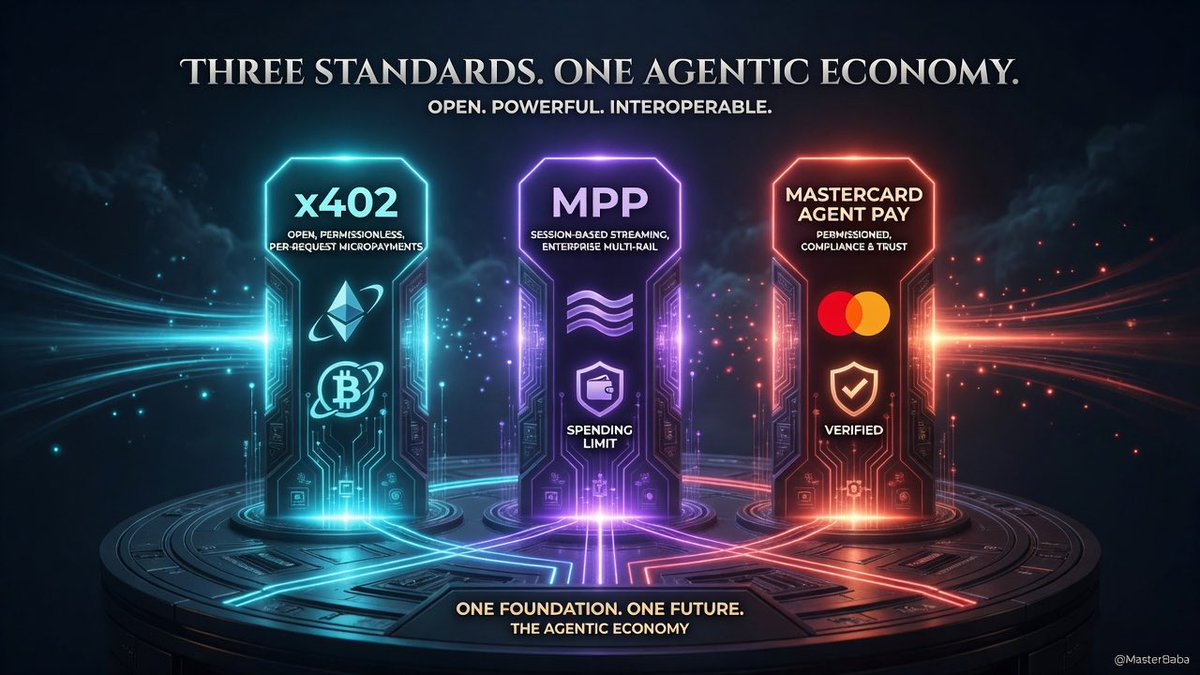
The agentic payments protocol layer now has 3 major standards — and they’re complementary, not competing:
• x402 — open, permissionless, crypto-native, per-request micropayments
• MPP — session-based streaming, enterprise multi-rail (Stripe + Tempo)
• Mastercard Agent Pay — closed/permissioned, strong compliance & trust on traditional card rails
Different architectures solving different parts of the same problem.
x402 for open lightweight payments.
MPP for continuous high-frequency sessions.
Mastercard for regulated enterprise use.
The agentic economy won’t run on one standard. It will run on all three. The infrastructure that bridges them wins. 👀
#AgenticAI #AgenticPayments #x402 #Crypto
Mastercard + Ripple bringing AI agent payments to $XRP and $RLUSD — settlement in seconds, programmable compliance, full audit trail.
The enterprise agentic payments stack just got a regulated stablecoin layer.
This is emerging capability becoming enterprise standard.