@akshitaa98 ok, so compare
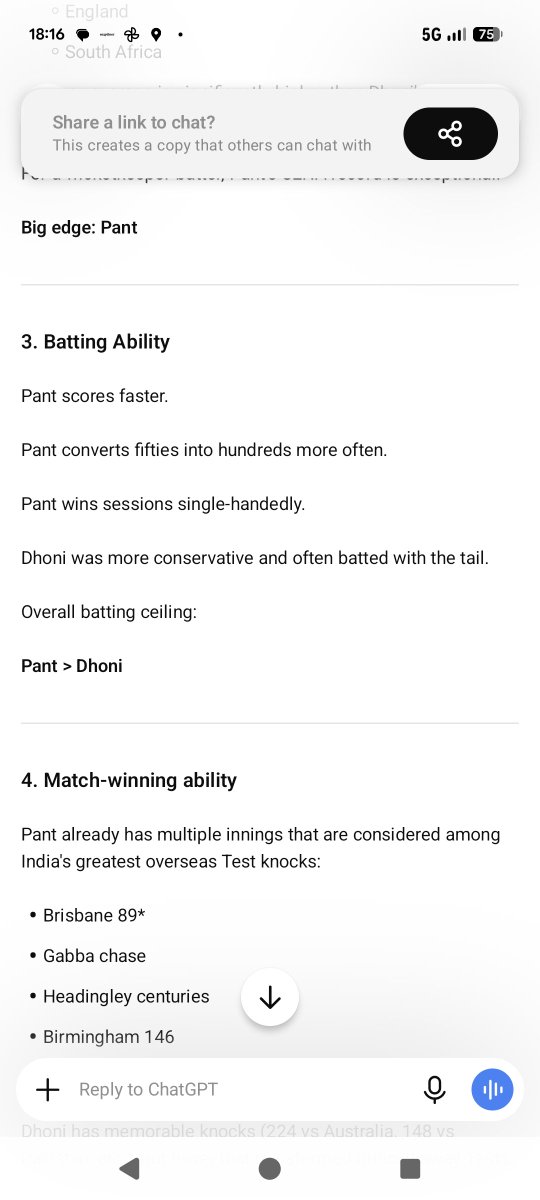
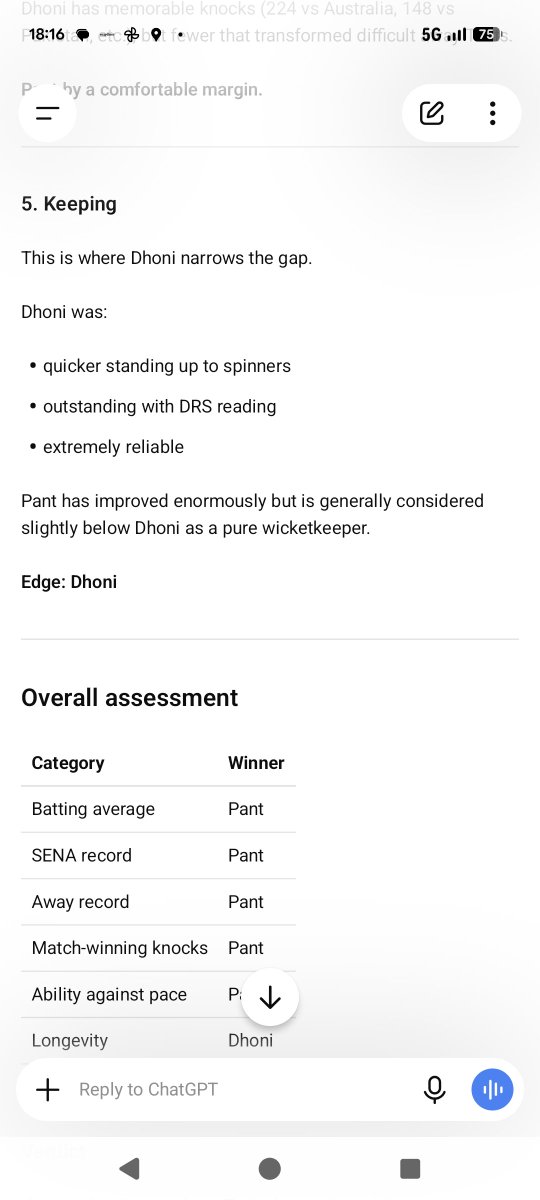
dhoni Saab ka test average
away record / sena record
contribution in test wins
as a player dhoni is reasonably inferior to pant in tests
Better late than never. Shri Dharmendra Pradhan has submitted his resignation. I hope that the Prime Minister will also take an immediate and timely decision. I appreciate and congratulate all the students for their peaceful conclusion to the movement. I hope that now peace will soon be established in the world of Indian education and that the young people will have ample opportunities for their bright future and progress.
देर आये दुरुस्त आये। श्री धर्मेंद्र प्रधान ने त्यागपत्र दे दिया है। आशा करता हूं कि प्रधानमंत्री जी भी इस पर शीघ्र ही समयोचित निर्णय लेंगे। उन सभी छात्रों को बधाई देता हूं कि उन्होंने आंदोलन को शांतिपूर्वक समाप्त कर दिया। मैं आशा करता हूँ कि अब भारतीय शिक्षा जगत में शीघ्र शांति स्थापित हो जाएगी और छात्रों को अपने उज्जवल भविष्य तथा प्रगति के लिए व्यापक अवसर प्राप्त होंगे।
RCB = RR IN TERMS OF POPULARITY/ VALUATION ? 🤔
RCB SOLD - 16705 CR to Kal Somani
RR SOLD - 15301 CR to Aditya Birla
In 16705 CR 2 Teams with 3 Ttophies
RCB Men - IPL
RCB Women - WPL
In 15301 Cr 3 Teams with 1 Trophy
RR Men - IPL
Barbadoa Royals - CPL
Parl Royals - SA20
Means
india topped group in 2019 wc and didnt lose match in 2015 wc until semis
was finalists in 2017 ct.. won 2013 ct ( both in England )
so keep your half hearted stats onto yourself
Flat pitches, day-night ODIs, and the dew factor masked several weaknesses in India's batting lineup for years. It's one of the major reasons India hasn't won an ODI World Cup since 2011.
Even in the so called Pay tm and Vimal Gutkha Trophy bilateral series the team hardly tested itself in challenging batting conditions.
🚨STOP OVERHYPING VAIBHAV SOORYAVANSHI NOW - KRIS SRIKKANTH🤯
Kris Srikkanth said :🗣️
"Everyone was ready to drop Sanju Samson when he flopped in two-three matches & chanting to include Vaibhav Sooryavanshi in the team. Now, then Vaibhav has done nothing in the two matches, same people want Sanju back in the team. I was the one who said that Sanju Samson should be there in the playing 11 because he is a match winner & team India did that mistake by dropping him & they rush things with Vaibhav. He is clearly under extreme pressure & not looking like even half of the batter what he was doing in the IPL. This decision of dropping Sanju & rushing Vaibhav too early in the team completely backfired".
@vipul1022@bsesyamunapower@CMODelhi Dear Consumer, we are here to help you. We are escalating your concern to the relevant department, please share your CA Number and Contact Details. It will help us resolve the issue quicker.
A British biologist looked at 200,000 years of human history and found that the entire reason humans broke out of poverty was not intelligence, not language, not even agriculture, but one mechanism so simple a 6-year-old could explain it.
His name is Matt Ridley.
He is a zoologist by training, an evolutionary biologist by career, and in 2010 he wrote a book called The Rational Optimist that quietly argued the most important fact about human progress had been hiding in plain sight for the entire history of economics.
Naval Ravikant has been telling people to read everything Ridley has ever written for the last 15 years. The reason is the argument inside this one book.
For 200,000 years, anatomically modern humans walked around with the same brain you have right now. Same skull size. Same neural architecture. Same raw capacity for language, planning, and abstract thought.
For roughly 190,000 of those years, almost nothing happened. Generation after generation lived and died inside the same Stone Age toolkit their great-great-grandparents had used. Then somewhere around 50,000 years ago, the line on the chart of human progress started to tick upward. Then it bent. Then it exploded.
The question Ridley spent years on was the only question that mattered. What changed.
It was not the brain. The brain had been the same for 190,000 years. It was not language, which had existed long before the takeoff. It was not even agriculture, which arrived only 10,000 years ago and was actually preceded by the upward bend, not the cause of it.
What changed was that humans started trading with strangers.
This sounds too small to be the answer. Ridley argues that it is the answer to almost everything. The moment one human exchanged a useful object with another human from a different group, something happened that no other species on earth had ever done.
Two ideas that had developed in isolation came into contact. The flint knapper learned what the spear maker had figured out. The fisherman from the coast learned what the hunter from the forest had figured out. The two pieces of knowledge fused into something neither side could have produced alone.
Ridley calls this ideas having sex. The phrase sounds frivolous and it is meant to. The point is that ideas, like genes, get better when they combine with other ideas from different lineages.
An idea sitting inside one head, no matter how brilliant the head, eventually hits a ceiling. The same idea exposed to ten thousand other ideas does something genes do under sexual reproduction. It mixes. It recombines. It produces offspring nobody planned.
The cleanest proof of this argument is the most uncomfortable case study in the book. Tasmania.
Around 10,000 years ago, rising sea levels cut Tasmania off from mainland Australia. A population of roughly 4,000 humans was now isolated on an island, with no possibility of contact with the rest of humanity. They had the same brains. The same language. The same starting toolkit as their cousins 150 kilometers north. The natural experiment was now running.
What happened next is something no economist or geneticist had ever predicted.
The mainland Australians kept inventing. Boomerangs. Spear-throwers. Fishing nets. Bone needles for sewing fitted clothes. Watercraft with paddles. Their technology compounded slowly across the centuries.
The Tasmanians went the other way. They did not just fail to invent the new tools their cousins were developing. They started losing the tools they already had. Fishing was abandoned within a few thousand years. Bone tools disappeared. Fitted clothing disappeared. They forgot how to make fire from scratch and started carrying lit firebrands from camp to camp instead, relighting their fires from a neighbor's whenever their own went out.
By the time European explorers arrived in the 17th century, the Tasmanians had the simplest toolkit of any human society ever recorded. Their material culture had gone backward for 8,000 years.
The archaeologist Rhys Jones called it a slow strangulation of the mind.
Joseph Henrich at Harvard later proved with formal mathematical models that there was nothing wrong with Tasmanian brains. There was something wrong with their network. A toolkit requires a critical mass of people exchanging skills to maintain itself.
The act of teaching a skill is imperfect. Every generation loses a small percentage of what the last generation knew. If your population is large enough and trading widely enough, those losses get caught and corrected by someone else who still remembers.
If your population shrinks below a certain threshold and stops mixing with outsiders, the small losses compound until entire technologies disappear.
This is the part that should haunt anyone reading this in 2026.
Intelligence is not a property of the individual brain. Intelligence is a property of the network the brain is connected to. A genius in isolation will produce less than a mediocre thinker inside a dense exchange of other mediocre thinkers.
The thing your ancestors needed in order to break out of 190,000 years of stagnation was not better brains. It was better connections between brains they already had.
The implication for any individual is direct and uncomfortable. If you are smart and isolated, you will be outproduced by people half as smart who are connected.
The most successful people in any field are almost never the smartest people in it. They are the ones positioned at the intersection of the most idea flows. They are reading more authors than their competitors. They are talking to more people from more disciplines. They are in the rooms where ideas from different lineages bump into each other.
Ridley ends the book on the line that sounds optimistic but is actually a warning its this "The future will be invented by people who connect ideas, not by people who guard them."
ये @UnSubtleDesi खुद एक महिला होकर पश्चिम बंगाल की पूर्व 71 वर्षीय मुख्यमंत्री ममता बनर्जी को कुतिया बोल रही है😡😡
और @MIB_India ने ऐसी गन्दी सोच वाली महिला को @OpIndia_com चलाने का लाइसेंस दे रखा है!
और जाहिर है कि @WBPolice भी इस बार सुवेंदु अधिकारी की तरह ही खामोश रहेगी।
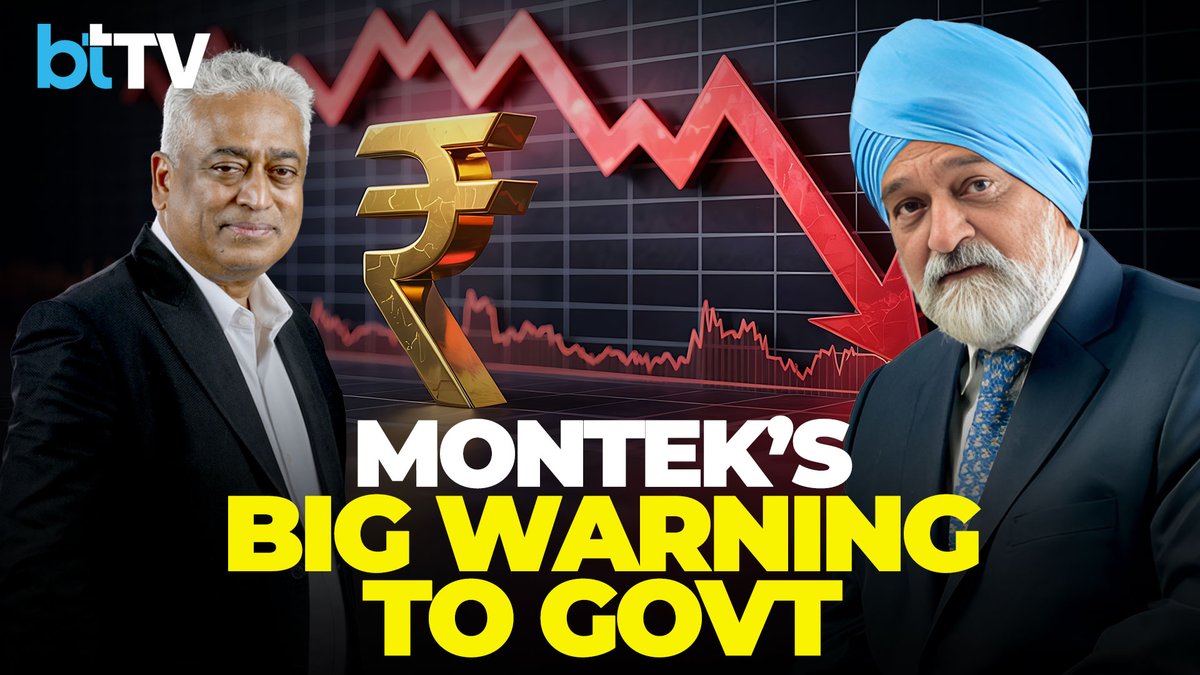
#Exclusive: Montek Singh Ahluwalia Warns Govt Amid Fuel Price Shock & Economic Stress
In an exclusive interview with India Today, former Planning Commission chairperson & veteran economist Montek Singh Ahluwalia backed the recent fuel price hikes but warned that India faces a serious economic challenge amid rising global oil prices and rupee weakness. Ahluwalia called for urgent reforms, greater transparency, investor confidence measures, and a rethink on subsidies, GST, privatization and ease of doing business. Drawing parallels with the 1991 economic crisis, he said the current global energy turmoil should be used as an opportunity for bold reforms rather than denial. He also cautioned against ignoring criticism and stressed that India must act quickly to tackle growing fiscal and investment concerns.
Watch: https://t.co/mJH4zd2Yh5 | #MontekSinghAhluwalia #IndianEconomy #EconomicReforms #FuelPriceHike #FDI
@sardesairajdeep | @MontekSinghAhl1
PM की अपील के बाद दिल्ली सरकार के ट्रांसपोर्ट मंत्री Dr. Pankaj Singh ने DTC बस से विकासपुरी से दिल्ली सचिवालय तक करीब 40 किलोमीटर का सफर तय किया.
सचिवालय पहुंचने के बाद उन्होंने लिफ्ट का इस्तेमाल नहीं किया और अपने अधिकारियों के साथ सातवीं मंजिल तक सीढ़ियां चढ़कर दफ्तर पहुंचे.
#ReporterDiary #Delhi | @drpankajbjp | @SushantMehraAT