Okay, I think I understand the basics of datacenter economics and here's a thread to explain.
First, to build a data center, you need four things: compute (chips/GPU), land, water, and electricity. In other words, it's capital intensive and takes about 2 years to build. If you got land and water and no chips or no electricity, you got a problem.
Now, let's talk about scale and competitiveness. America is where it's happening. Why? The US got land (esp states like Texas etc), got natural resources like natural gas to power cheap electricity, and under Trump (before Blue Wave), got pretty willing investors and regulators, and finally, it got chips (Nvidia and also others). We'll talk about outside of America soon (Asia).
Okay, what is the scale we are talking about here?
i’m sure you’ve heard of the theory that the brain is a receiver of consciousness, much like a radio tuning in to a station. in that way, consciousness does not originate in the brain but outside the body.
but what if i told you that not only could that be true, but that you don't just receive this signal through your brain? what if your whole body was actually a liquid crystal?
your consciousness permeates you through the water in your connective tissues, and this water allows your body to operate like a quantum system. that’s what geneticist and biophysicist Mae-Wan Ho proposed in "The Rainbow and The Worm".
the basis of her theory is quite magical if you ask me. under a polarizing microscope, living organisms light up in rainbow colors, and so do slices of skin, cartilage and tendon. from this, Ho showed that connective tissue, which holds the body together and surrounds every cell, is essentially like liquid crystalline: its molecules are ordered like a crystal, but can still move like a liquid. these rainbow colors come from molecules moving coherently, including the body’s water, which makes up about 70% of its weight. water and proteins then form one liquid crystalline continuum through every tissue in the human body.
the thing is, the body coordinates its functions instantly, but nerves pass signals from point to point, which takes time. Ho proposed this constant coordination happens through that liquid crystal rather than the nerves. a coherent network acts as one unit everywhere at once, so signals don’t need to travel cell to cell. the water makes this possible: in its liquid crystal form, it lets every molecule communicate with every other molecule. at a large scale, this kind of wholeness is a feature of quantum systems. she called it quantum coherence.
her central proposal was that this network is the body’s consciousness and the basis of sentience. it has the three properties she considers the marks of consciousness: it senses, it communicates and it remembers. it came before nervous systems in evolution, spans the whole body, and works both with the nervous system and independently of it. the brain is one part of this matrix, and its consciousness is coupled to the body’s, so each constantly shapes the other. a unified conscious experience needs both to be fully coherent. as evidence, she cited findings that anesthetics push bound water off proteins and cell membranes. she also cited Robert Becker’s finding that general anesthesia shuts down the body’s DC field, a steady electrical field across the body.
she used an idea from physicist Emilio Del Giudice to support the argument of the water in your body receiving the signal of consciousness: water has tiny pockets, called coherent domains, where all the molecules vibrate together. these pockets can pick up frequencies from around you and use them to start specific chemical reactions in your body.
she also believed every living being exists in two different ways at the same time: as a body in one place, and as a wave that spreads out through the whole universe. because of this, all beings are entangled and help make each other up. the water in your body keeps you together as one connected whole, and that whole stays linked to literally everything else that exists.
she firmly believed there is no separation between science and spirituality.
Had fun writing this. Feel free to drop comments, thoughts, corrections, etc
Note that I'd refrained from writing about MegaSpeed / SpeedMatrix, and other speculations (e.g. on YTL)
The three takeaways from the post:
1. Malaysia's AI data center space is getting very crowded, especially in Johor
2. Demand for AI compute, infrastructure, and powered shells from Chinese customers, anchored by tech giants, ByteDance, Alibaba and Tencent, as well as adjacents such as Bitdeer, has been the key growth driver behind the rapid AI data center buildout in Malaysia
3. Stranded capacity and/or pipeline growth risk is very real, with the latest rules announced by the US BIS, to be effective immediately once they are officially published on the Federal Register on Nov 19 (Thursday)
Questions that we should ask:
1. Will the Chinese customers stay, or leave?
2. For the capacity slack (if any), will there be replacement demand, and from who? How much AI compute does Malaysia need for themselves (from their enterprises, government and sovereign AI initiatives)? Will we see demand from the West, particularly the US where data center approvals and new starts are expected to slow with the new Congress setup?
3. How much of the planned capacity (including those currently under construction, approved but not started) will eventually be completed, energized and ready for service (RFS)?
4. Will there be changes to hardware/system configurations at the existing facilities, and those in the pipeline? For the Chinese customers who choose to stay, will they bring in Chinese AI hardware? What happens to the US AI hardware already deployed, in transit, and / or committed?
Alright folks, here's my writeup on the data center market in Malaysia. This is by no means exhaustive. There are still lots of known unknowns, unknown unknowns, and moving parts, as we would expect with the new IFR released by the US BIS yesterday https://t.co/babLDrYNmT
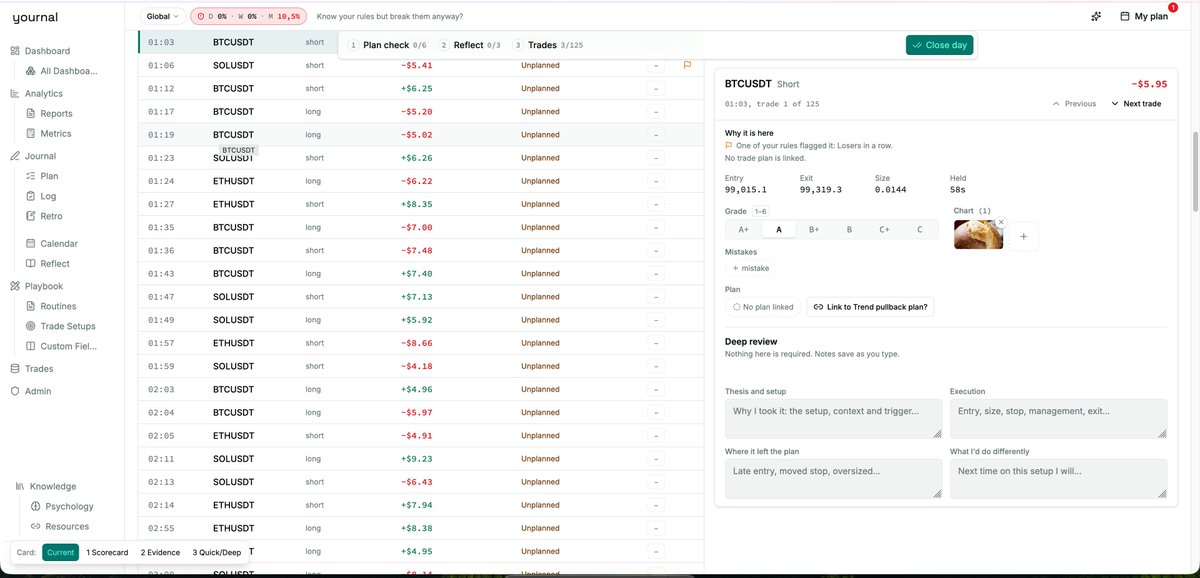
year ago started building own trading journal app;
all the solutions out there focused way to much on analytics and did not really give any help on developing your own process, your own 'edge';
due to my fucked retarded perfectionism, got caught up in it, and never shipped it;
... and still not ready to ship lol;
I wanted something that is:
- privacy focused, E2EE encrypted directly on the user client (browser)
- extremely customisable
- big focus on the journaling aspect
- being able to build out your own analytics from scratch to see exactly what you want to see
- granular AI access, so that you can chose to what parts of your data the AI has access to or completely opt out of AI usage
---
but will start sharing bits here of my workflow, what I did and how - what I use, and it might help someone who is trying to do their own thing with using AI;
as building it is not that hard nowadays. Doing it properly, and being able to debug the code when shit hits the fan on prod. Having it all secured, knowing how to restore backups, etc... - that's where the fun begins.
I got knowledge of how enterprise SaaS software works on the inside, so trying my best to apply these principles;
---
Currently working on 2 things;
1. FE - UX of the 'daily' journal where the trader can see the trades and reflect on them, which then build into an aggregated weekly/monthly/yearly reflections
- trying to fit the best layout, and also include a view for scalpers, 'high frequency', so that you can journal based on session, not individual trades
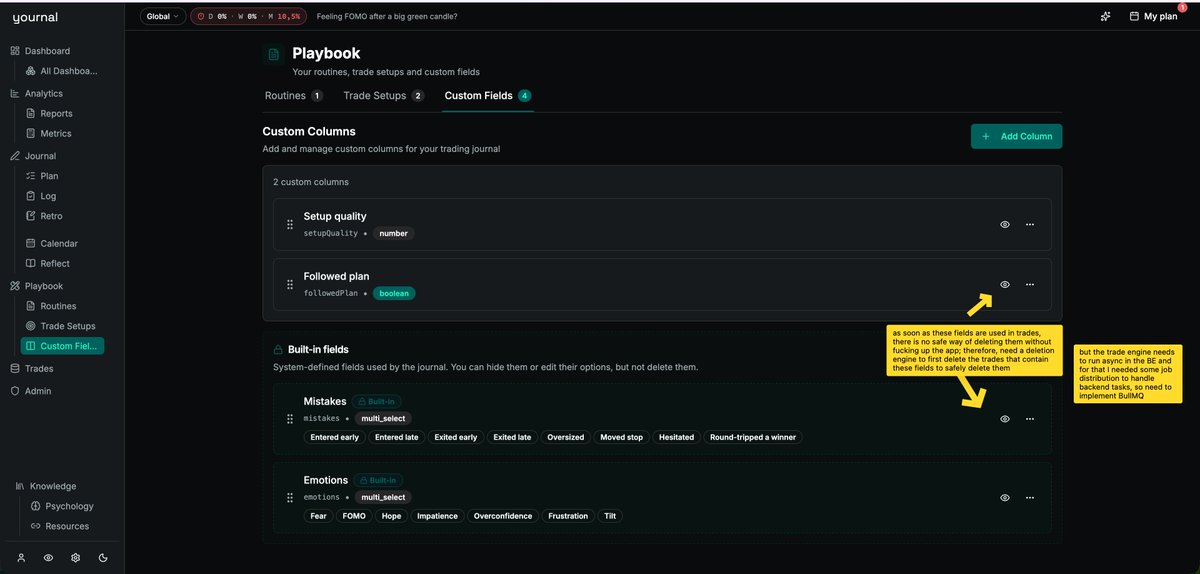
2. BE - the yournal allows the users to implement their Custom Fields (this can be text or numbers format, for example 'R') and these can be then used in analytics and also journal reflections.
Issue is, that if the user decided to delete one attribute form these or the whole field, it will fuck up the app. But having no ability to delete is also bad. So needed a new backgroudn deletion engine, that will first delete the trades that contain these fields, and for that I needed to implement BullMQ to handle the tasks. Since deletions needs to have the lowest priority in the app, to not drain resources from the analytics engine for example.
Later on I will specify how exactly I am working with LLMs to actually build it, while you know what the code is doing.