Poor eye health isn't because of a kale deficit.
It's because of a sunlight deficit.
Those macular pigments (lutein and zeaxanthin) from kale, spinach, corn, orange peppers, and egg yolks do help filter blue light and act as antioxidants, that is legit.
But treating them as the main solution is incomplete and often impractical. Not every climate or traditional diet has those specific plants growing year-round.
And human eyes evolved across deserts, high latitudes, and tropics long before supermarket greens were an option.
Sunlight does the heavier lifting: its UV and infrared wavelengths improve blood flow to the retina, support the retinal pigment epithelium, help regulate dopamine that keeps the eye the right shape, and protect against the thinning and degeneration driven by modern indoor blue light.
Sunlight >>> mass produced "ancient herbs"
For anyone dealing with gut issues, regular and strategic sunlight exposure is a much better solution than buying gut health supplements on amazon.
What you need is the UVB part of sunlight.
When it hits your skin, it triggers vitamin D production which has been shown to reshape the mix of bacteria living in your gut by raising overall variety and boosting the good kinds tied to better metabolism and less inflammation.
Vitamin D also works right inside the gut. It helps the cells that line your intestines form a tighter seal so fewer harmful toxins leak into the bloodstream.
It also increases the natural protective compounds your gut makes, and it cuts down on bacteria and toxins slipping through into the rest of the body.
Finally, the daily cycle of natural light and darkness, sensed by special light-detecting cells in your eyes, keeps your body’s main internal clock in sync. That clock then keeps the clocks inside your gut running on schedule.
This helps food move through at the right pace, keeps the protective mucus layer healthy, and keeps the bacterial populations rising and falling in a healthy daily rhythm. Too much artificial light at night or living indoors most of the time throws those clocks off, weakens the gut lining, and lets the bacterial balance go sideways.
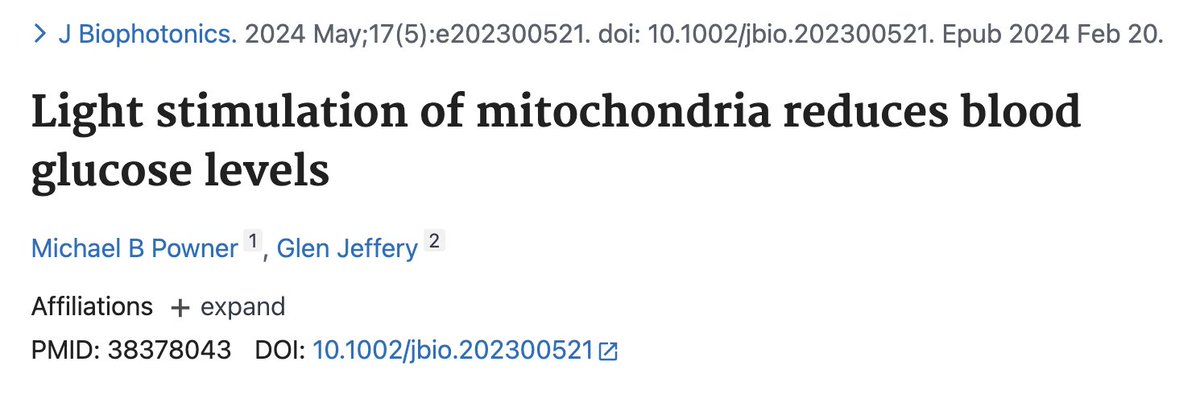
EAT ALL YOUR MEALS OUTSIDE: Red light from the sun blunts your blood sugar spike after a meal by 27%.
A study from Glen Jeffery's lab found that people exposed to 670 nm red light had a 27% lower glucose spike after eating, without changing the meal itself.
This works via your mitochondria, the tiny energy-producing engines inside almost every cell.
Red and near-infrared wavelengths can penetrate tissue and interact with cytochrome c oxidase, an enzyme embedded in the mitochondrial electron transport chain.
This enzyme helps your mitochondria convert oxygen and nutrients into ATP, the energy currency your cells use.
When these red wavelengths interact with it, they can alter how efficiently the electron transport chain operates, increasing ATP production and changing how efficiently cells handle glucose.
Red and near-infrared light can also affect the physical properties of mitochondrial membranes, making it easier for the machinery embedded in them to move electrons and carry out its job.
More efficient mitochondrial function means your cells are able to process incoming fuel more effectively.
So remember, where you eat is just as important as when or what you eat. EAT OUTSIDE!
No matter what the issue, everyone just wants to shill an easy "fix" via a supplement.
To heal your vision, you need SUNLIGHT (specifically morning sunrise).
Morning sunrise light supplies the precise electromagnetic spectrum (balanced red, blue, and UV/IR frequencies) that the eye requires to function optimally as a camera.
This natural light “sculpts” the retina and retinal pigment epithelium (RPE), improving their ability to process incoming light signals and act as expert refraction devices.
Red and near-infrared wavelengths also support mitochondrial energy production in photoreceptors.
Consistent exposure at this time of day will prevent photoreceptor atrophy caused by artificial blue light and insufficient natural spectrum, allowing the eye’s visual machinery to regenerate and maintain better performance.
I see so many hair-loss posts on here, yet none of them recommend the fundamental piece of the puzzle: sunlight.
In her post, she recommends:
Low-histamine diet → Sunlight is better.
Vitamin D helps regulate mast-cell activity and immune signaling, both of which can influence scalp inflammation.
Instead of eliminating entire categories of food, sunlight supports the underlying biology involved in maintaining a healthy follicle environment.
Vitamin C → Sunlight is better.
Vitamin D receptors are present in hair follicles, where vitamin D signaling helps regulate the hair-growth cycle.
Vitamin C supports collagen formation and iron absorption, but it doesn't provide this direct signaling role in the follicle.
Quercetin/Bromelain → Sunlight is better.
Vitamin D influences immune regulation throughout the body, helping maintain a more balanced inflammatory response.
Quercetin and bromelain may have anti-inflammatory effects, but their evidence for improving hair growth is far less established.
Local raw honey → Sunlight is better.
Vitamin D isn't simply a nutrient you consume. Your skin can produce it through UVB exposure, allowing your body to regulate vitamin D status through its own biological pathway.
Honey has no comparable role in follicle signaling.
Herbalism → Sunlight is better.
Vitamin D signaling is involved in follicle cycling, including the transition between growth and resting phases.
Herbs like Astragalus, Nigella, Stevia, and Stinging Nettle don't have comparable evidence for regulating the hair-growth cycle.
DAO enzyme → Sunlight is better.
DAO acts primarily on histamine in the digestive tract.
Vitamin D operates much more broadly, with receptors throughout the body and in hair follicles themselves, linking vitamin D status to immune function and follicle biology.
The point isn't that these things are useless.
It's that we're constantly looking for another supplement, food restriction, or herb while overlooking one of the most fundamental environmental inputs humans evolved with (which is sunlight).
The culprit might not have actually been the popcorn... eating this popcorn indoors under isolated blue modern lights and tech screens would have caused her glucose to spike significantly higher.
Artificial blue light from LEDs and screens acts as a false daytime signal that hits your eyes at the wrong times.
This keeps your stress system activated, raising or mistiming cortisol release.
The elevated cortisol then pushes more glucose into your bloodstream and reduces insulin sensitivity, so the same meal produces a higher blood-sugar spike.
So when you can, eat outside, because sunlight lowers your blood glucose.
You know what else removes toxic heavy metals like lead, mercury, and nickel? MELANIN.
The same pigment that colors your skin, hair, eyes, and even the special form in your brain is a highly effective natural binder and absorber of heavy metals.
Studies show melanin can soak up 76–95% or more of metals like lead, mercury, nickel, cadmium, and copper from solutions.
This is possible because melanin is a complex chain of molecules loaded with reactive chemical groups (phenolic OH, carboxyl, amine, catechol, and related sites).
These groups form strong bonds, traps, and attractions that lock onto metal ions.
The structure can expand, pull the metals deeper inside, and hold them in stable forms that keep them from causing harm.
In the brain, this specialized melanin concentrates environmental toxins like mercury (up to thousands of times higher levels) and lead, acting as a protective sink so they don’t trigger oxidative damage.
On the skin, something even more practical happens: as outer skin cells naturally shed, the melanin carrying the bound metals leaves the body with them.
This is one of the few dedicated routes for clearing certain toxic metals that the kidneys and liver don’t handle well. That’s also why hair and pigment tests have long been used to detect metals like arsenic or lead.
Your skin health is not determined by your expensive skincare routine or your "cutting edge" copper peptide stack.
It's controlled by how much morning sunlight you get.
Here's why:
Skin cells run on their own 24-hour clock, and that clock helps regulate things like cell turnover, hydration, barrier function, collagen production, and inflammation.
Morning sunlight is one of the signals that helps set this clock.
Sunlight hitting your eyes in the morning tells your master clock what time it is, and your peripheral clocks, including the clock in your skin, synchronize to that signal.
Miss that morning signal, and you can disrupt the timing of the biological processes your skin relies on to repair, regenerate, and maintain its barrier.
So before you spend another $200 on a skincare routine:
Get outside in the morning.
Let natural light hit your eyes.
Give your skin the timing signal it evolved around.
Sunlight is also a great tool for blood pressure management.
Here are three widely recognized studies that clearly show sunlight can lower blood pressure:
1. Opländer et al. (2009) – Circulation Research
Whole-body UVA exposure in healthy volunteers dropped systolic and diastolic blood pressure by ~11% within 30 minutes. The effect lasted up to an hour and was caused by nitric oxide released from stores in the skin.
2. Liu et al. (2014) – Journal of Investigative Dermatology
UVA irradiation of 24 healthy people lowered mean arterial pressure by 3.5 mm Hg and diastolic pressure by nearly 5 mm Hg. The drop happened independently of vitamin D and the body’s normal nitric-oxide enzymes.
3. Weller et al. (2020) – Journal of the American Heart Association
In a large group of hemodialysis patients, higher daily solar UV radiation was linked to lower systolic blood pressure, even after adjusting for temperature.
Interesting data on PDE5 inhibitors for sure.
But the far older, free, zero-side-effect version of “systemic nitric oxide + improved perfusion + better cellular signaling” has been available every morning for the entire history of our species.
Sunlight (especially morning full-spectrum + modest UV) triggers the release of nitric oxide stores from the skin, improves local blood flow, supports circadian regulation of hormones that influence hair cycling, and carries broad metabolic and immune effects without requiring a daily pharmaceutical.
Folks. Can I explain something about world models? Seems like today might be a good day for that.
Advances in large-scale “world models” — whether developed by partners like Google or others — materially expand the frontier of interactive content creation. These models can generate high-quality, interactive, video-like experiences from natural language or minimal input.
Today, they are primarily editable through prompting, which limits the level of determinism and precision required for production-grade game mechanics. As a result, their outputs remain probabilistic and non-deterministic, making them unsuitable on their own for games that require consistent, repeatable player experiences.
Rather than viewing this as a risk, we see it as a powerful accelerator. Video-based generation is exactly the type of input our Agentic AI workflows are designed to leverage—translating rich visual output into initial game scenes that can then be refined with the deterministic systems Unity developers use today. Our agents already generate high-quality scenes from static video. Interactive, camera-controllable video from world models would further enhance this pipeline and materially improve the fidelity and speed of early-stage content creation. We believe this represents a meaningful step forward for AI-driven development across the industry.
Unity’s role is to operationalize these advances. Outputs from world models are ingested into Unity’s real-time engine, where they are converted into structured, deterministic, and fully controllable simulations. Within Unity, creators define physics, gameplay logic, networking, monetization, and live-operations systems to ensure consistent behavior across devices and sessions.
This combination enables developers to move faster from concept to scalable product: AI accelerates environment and asset generation, while Unity provides the execution layer that transforms generated content into reliable, monetizable experiences.
As a result, world models expand content supply and reduce development friction, while Unity remains the system of record for runtime, distribution, and long-term operations. This dynamic broadens Unity’s addressable market and reinforces its central role in the interactive ecosystem.
@amznsellerhelp Please help me understand why is it so difficult to get a resolution my case, Id: 15528923301
It’s my first time selling on Amazon and this delay is so disappointing and discouraging. I am being told an internal team is looking into it but it’s been so long now.🙏
Thank you everyone for your incredible messages of support and encouragement.♥️
Many of you asked what it was like in the ER right now. I want to share a bit with you. Please RT:
A Day in the Life of an ER Doc - A Brief Dispatch from the #COVID19 Frontline:
@msonenote I really want to use OneNote for Android wear. Can you tell me (and others), if we are going to get a working app anytime soon? As of now the app that is suggested to download when OneNote Android app is installed, it keeps crashing. Looking forward to your reply.
@EdwardTerry @lanillapuppia @mentorboxonline They we're slow, but I got the refund and everything sorted out. so yeah, at least not cheaters. But, the way I was signed up for and the delay in responses. I am sure I won't be willing to try this service in near future.
@EdwardTerry @lanillapuppia @mentorboxonline I was tricked and charged a 199 $ with all the pop up videos for up-sell which I did not even want to subscribe.
@lanillapuppia @EdwardTerry@mentorboxonline Just waiting for their action first, and then cancelling my card for sure.. I read at so many places including Quora, that they charged them again and again. Even after confirming that subscription is cancelled..
@EdwardTerry@mentorboxonline I will do that if I don't hear from then in some time.
But this is so bad, they have a check box image which says, add Entrepreneur Academy, If you try to uncheck, you actually get charged for it. basically they make a button look like a checkbox.. and there no mention of money.