Looking to learn how to code?
This blog post is packed with great advice and practical tips to help you get started on your coding journey. Don't miss out! 🌟 Check it out here: https://t.co/hBSQWwjlYs
#Coding#javascript
5/ Why It’s Important?
Abstraction: Standardizes the way requests and events are handled across platforms.
Reusability: Simplifies writing reusable logic in Guards, Interceptors, and Pipes.
Flexibility: Enables platform-specific behavior when needed.
1/ What is Execution Context in NestJS?
The Execution Context is a powerful abstraction in NestJS that provides insights about the current request/event lifecycle. It acts as a bridge between platform-specific implementations(HTTP, WebSocket, etc.)and application logic.
#Nestjs
4/ Key Utility Functions
Switching Context:
- ctx.switchToHttp() for HTTP-specific access
- ctx.switchToWs() for WebSocket access
- ctx.switchToRpc() for gRPC calls
Handler Details:
- Use ctx.getHandler() to retrieve the current method
- Use ctx.getClass() to get the controller
✨Ever wondered what executes before a route handler in #NestJS? Here's the flow:
1️⃣ Middlewares – Preprocess requests
2️⃣ Guards – Handle access control
3️⃣ Interceptors – Transform requests/responses
4️⃣ Pipes – Validate and transform data
Clean, modular, and powerful! 🚀 #NodeJS
Express vs. Nest.js 🌐
Similarities:
1. Both are Node.js frameworks for building server-side apps.
2. Both support TypeScript (Nest.js natively, Express with config).
3. Both can be used to build REST APIs, MVC, or microservices.
#NestJS#NodeJS#ExpressJS
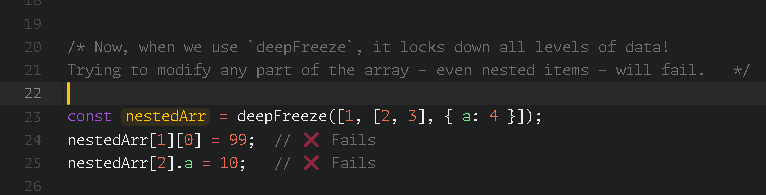
Ever needed to make data truly unchangeable in JavaScript? 🔒 That’s where Object.freeze() comes in! It prevents modifications to an object or array, perfect for constants or settings. Here’s how it works…
#JavaScript
With deepFreeze, you can ensure immutability in complex structures! 🚫🔄
✨ Use it for data integrity when working with deeply nested configurations or constants. Just remember: this is best for data that truly needs to stay unchangeable! #JavaScript
🚀 Node.js 23 is here! 🚀
New features, performance boosts, and a smoother developer experience. With better compatibility and stability, Node.js 23 delivers more power for building efficient apps.
Read here: 👉https://t.co/eQPMJSOuPH
#NodeJS#JavaScript#WebDevelopment
6/6 🔍 When to Use:
call() and apply() are used to immediately invoke a function with a specified this value.
bind() is used to create a new function that permanently binds this to a specific object, allowing you to call it later.
📌 Understanding call(), apply(), and bind() in JavaScript:
1/6 🧑💻 Ever wondered how to control the this context in JavaScript functions?
Here's where call(), apply(), and bind() come in handy! Let's break them down.👇
#javascript
5/6 💡 Key Differences:
call(): Invokes function with this and individual arguments.
apply(): Invokes function with this and array of arguments.
bind(): Returns a new function with this, to be called later.