It's interesting to watch the validators and wonder why they are not approving "banking privacy," "XLS-65," and "XLS-66." The SWITCH will probably not flip until these are accepted by the validators.
🚨UPDATE: $XRP Ledger’s BANKING PRIVACY Amendment Is STILL Awaiting Approval — 7 Votes LEFT! 🏦🔥
👉 Banks could transfer tokenized assets WITHOUT exposing transaction AMOUNTS or BALANCES publicly! 😳
👉 Authorized auditors could STILL verify the information. ✅
WHAT’S NEXT? 👀
The amendment needs MORE THAN 80% validator support for 14 CONSECUTIVE DAYS before activation!
A bank CEO just told his own customers: do not trust anyone with your crypto. Not even us. Read that again. 👇
SMQKE brought the documents again, and this time they are about Old Glory Bank ~ a real, regulated US bank building something I have never seen a bank build.
Here is the heart of it, from their CEO, Mike Ring, in his own words:
> It's your crypto. Keep it in your wallet. I tell customers all the time ~ do not trust anyone with your crypto.
Family, sit with that. A bank ~ an institution whose whole business is holding people's money ~ telling the world that the safest place for your crypto is in YOUR wallet, under YOUR keys.
Now let me explain what they are actually building, because the headline alone does not do it justice. Their platform is called NxtGen Banking, targeted for early 2027:
~ One dashboard where your bank account and your own self-custodial wallet sit side by side. Your checking, your savings, your loans, and your crypto ~ one screen.
~ You link YOUR wallet to the bank. The bank never takes your keys. Their own FAQ says it plainly ~ no one should ever need or want the keys to your wallet, including any bank.
~ Move between dollars and crypto inside one app ~ their own stablecoin, on and off ramps, no third party exchanges in the middle.
~ Credit lines backed by your crypto ~ borrow against your assets without selling them.
~ And yes, a custodial wallet option is planned later, around Q3 2027 ~ but even then, the bank itself keeps recommending self-custody as the safest way. They said publicly they were the first to talk about self
@NERO_bx I am still not clear on how this will work. An XRP owner places their XRP in an XLS-66 vault, and an institution/corp borrows it. QUESTION: Are they getting RLUSD as liquidity? What are they getting when they borrow?
I don't think that we can even comprehend what collateral will do for XRP. For example, a company might want to buy a new $70 million jet without liquidating its XRP. The company uses $70 million + as collateral for a loan, and their $70 million worth of XRP is tied up for years
Ripple plans to use $XRP as collateral for payment credit, targeting 2027. Payments use XRP for seconds. Credit locks it up for the life of the loan.
The more credit grows, the more XRP sits still. Its value comes from the volume it moves and the supply locked as collateral.
Have you heard about weekend at Bernie’s yet wtf lol 🤷♂️ 😂
MALE PROSTITUTE FOUND DEAD IN BERNIE SANDERS' BURLINGTON HOME AS BERNIE'S TEAM CLAIMS NATURAL CAUSES !!!
Burlington, Vermont - November 21, 2026.
A male prostitute was found dead in Bernie Sanders home early yesterday morning.
Sanders team reports the man was a Democrat socialist who "worked for the campaign" and died of natural causes.
His OnlyFans account shows a very different story, and lots of questions need to be answered.
People are questioning the assertion that the man worked for the campaign, while maintaining an OnlyFans account that tells another tale entirely.
The home in Burlington is now the focus of growing scrutiny.
‼️JUST IN: EUROPEAN CENTRAL BANK EXPANDS ACCEPTANCE OF DLT-BASED COLLATERAL UNDER PILOT REGIME‼️
Remember:
XRP-based project Axiology is a regulated securities settlement system under the EU DLT Pilot Regime Regulation.✅
XRP is taking another step closer to being used as collateral💯
Collateral = The Missing Piece 🧩
This is all documented below.📝👇
@TheChiefNerd Tommy Turtle taught me to Duck and Cover on the event of a nuclear event. If I am with a girl, I should lay on top of her and make sure she is protected. That is what Tommy Turtle says. 😳
🚨 BEARABLEGUY123, XRP & QNT! DID WE MISS THE BIGGER PICTURE?! 🧩👀
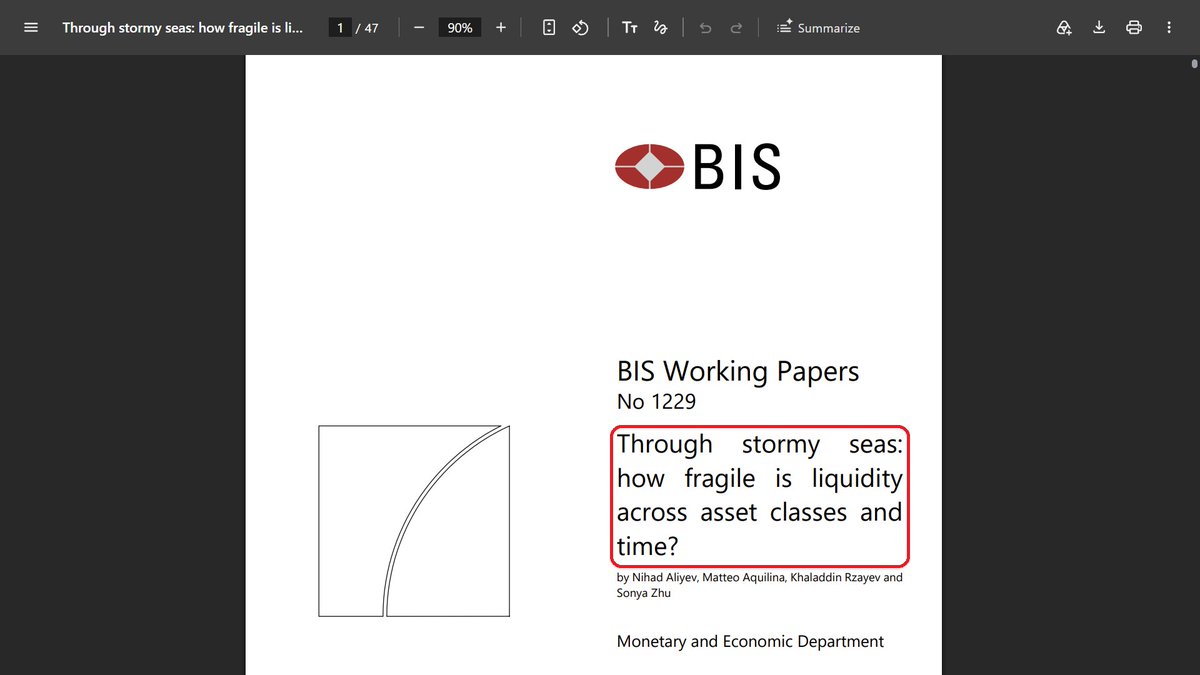
🌊 THE STORMY SEAS: BG123's mysterious ship sailing through turbulent waters. Meanwhile, BIS Working Paper #1229, titled "Through Stormy Seas," exposes how liquidity can suddenly DISAPPEAR from financial markets.
💧 THE XRP CONNECTION: XRP's potential role as an on-demand bridge asset could help move value across borders without requiring enormous amounts of prefunded capital.
🌻 THE SUNFLOWER: Remember BG123 watering sunflowers? The BIS introduced the "MONEY FLOWER" in 2017, illustrating how traditional and emerging forms of money fit together. Quant CEO Gilbert Verdian has discussed that VERY concept!
🔗 THE QNT CONNECTION: Quant's Overledger focuses on interoperability, connecting fragmented financial networks, while its programmable settlement technology addresses another critical piece of the puzzle.
🚀 THE ELON CONNECTION: X Money uses Cross River Bank, which has a longstanding relationship with Ripple. Another intriguing overlap, but NOT confirmation of XRP integration.
🔥 NOW CONNECT THE DOTS!
What if BG123's riddles weren't necessarily about XRP reaching $589, but symbolically pointed toward the transformation of the ENTIRE GLOBAL FINANCIAL SYSTEM?
🔑XRP moves value. QNT connects networks. Paolo Tasca (Quant co-founder) co-wrote the book "Enabling The Internet of Value" and David Schwartz wrote the foreword (abstract). Plus The BIS identifies the challenges.
Coincidence? Possibly. The technological overlap? Worth investigating!
⚠️ None of these riddles proves a coordinated plan or future adoption.
👀 WHAT DO YOU THINK?!
*A special shoutout with thanks to @ProfRipplEffect, @SMQKEDQG, @NFAdotcrypto, and @bearableguy123 for some of the research used in this outline. Full video 👇*
https://t.co/V3arHyOdYQ
I think that most people have very little idea what this means. If I use XRP as collateral for a $10 million, that XRP is out of circulation. If XRP is priced at $10,000.... that is 1,000 XRP out of circulation.
Banks do not take money on deposit and lend it out. They create it, from nothing, with a few keystrokes, and the entire system depends on you never noticing.
When you deposit $10,000 in cash at JPMorgan Chase, the bank records a liability to you and an asset for itself. Under fractional reserve banking, the Federal Reserve requires banks to hold only a fraction of deposits as reserves. For decades, that requirement sat around 10%, and in March 2020 the Fed dropped it to zero. That means JPMorgan can lend out the full $10,000 you deposited, while still owing you that $10,000 on demand. The borrower who receives that $10,000 deposits it elsewhere. That bank then lends it out again. The same dollars multiply through the system, spawning new purchasing power at each stage without a single additional dollar being printed.
Murray Rothbard called this counterfeiting conducted through respectable institutions, and I think that word fits. If you printed money in your basement and spent it, you would transfer real wealth from later dollar-holders to yourself. Banks do precisely this, they just call the process "credit creation" and charge interest for the privilege of doing it.
The price you pay seems hidden at first. Every new dollar dilutes your "old" dollars. When credit expansion drives a housing boom, as it did between 2003 and 2007, asset prices rise first for the people closest to the new money, the borrowers, the developers, the leveraged speculators. By the time ordinary wages and savings adjust, you have already been taxed by dilution of purchasing power without a single congressman casting a vote.
This system contains the seed of every business cycle. Cheap credit manufactured by banks sends false signals to entrepreneurs, who invest in projects that the real pool of savings cannot support. The boom turns to bust when reality reasserts itself, usually violently, usually on your tab through bailouts.
Fractional reserve banking is state-licensed privilege, enforced by deposit insurance and central bank backstops that socialize the losses while the gains flow upward. This is how the rich become richer, and the poor get poorer, not "capitalism," as economically illiterate politicians like to claim.
🧵 STRONGHOLD JOINS THE WORLD ECONOMIC FORUM’S NEW CHAMPIONS COMMUNITY.
This week, @strongholdpay was in Geneva. But to understand who just joined @wef, rewind to OpenCoin, the launch of @StellarOrg and a gateway built within hours of launch. 👇
In 2012, the XRP Ledger went live. Chris Larsen became CEO of OpenCoin, and Jed McCaleb was its co-founder and CTO. The company had briefly been called NewCoin. In 2013, it took the name Ripple Labs.
That same year, @ItsSeanBennett started building a gateway on @Ripple
In 2014, @JedMcCaleb co-founded @StellarOrg. Within hours of the network going live, Bennett launched Coinex, its first anchor. It gave users a way to move value between the network and the outside world.
Stellar’s Head of Growth at the time? @TammyCamp.
The first WEF connection shows up in 2015. The Forum named @Ripple Labs a Technology Pioneer. That September, Chris Larsen wrote for @wef about a problem he knew firsthand: why was sending money across borders still so much harder than sending information?
In 2017, Camp and Bennett founded @strongholdpay. They had met through Stellar three years earlier. Now they wanted to connect the settlement systems businesses already used with blockchain payments.
According to Stronghold, their very first client was @IBM.
In 2018, Stronghold launched Stronghold USD on Stellar and began exploring business uses with IBM. By 2019, participants in IBM Blockchain World Wire could use the dollar-backed token to settle cross-border payments.
@IBM is also a Strategic Partner of the WEF.
Stronghold also issued a separate token in 2018: $SHX. Merchants could earn it based on the payment volume they processed through Stronghold and use it to offset transaction fees. Its uses grew to include liquidity for merchant financing and a vote on governance proposals.
By 2021, @StellarOrg had its own WEF connection. SDF CEO @DenelleDixon co-authored a report from the Forum’s Global Future Council on Cryptocurrencies. In 2022, SDF also documented its work with the WEF’s Crypto Impact and Sustainability Accelerator.
Then look at who backed Stronghold. The company named Xpring, now RippleX, among its investors.
In 2013, @ItsSeanBennett was building on Ripple. Years later, Ripple’s investment initiative was backing the company he co-founded with Stellar’s former Head of Growth. 👀
In 2023, another familiar name appeared in the WEF’s Davos materials:
@bgarlinghouse, representing @Ripple as CEO. @chrislarsensf had written about payment standards for the Forum in 2015. Eight years later, his successor was there representing the same company.
What could $SHX holders actually decide? One vote changed who received the origination fee on a merchant cash advance. Under the approved rule, 70% of the fee paid in SHX is burned and 30% goes to pool contributors. Stronghold records completion on April 1, 2024.
In August 2024, @NachaOnline named Stronghold a Preferred Partner for ACH Experience and ISO 20022. Nacha points to two things merchants use: pay-by-bank at checkout and standardized payment messages that help businesses accept payments and report to treasury.
Stellar kept a specific role as $SHX expanded. Holders approved recording votes from Stellar and Ethereum in one smart contract on Stellar. Later proposals let holders lock SHX for more voting power or delegate their vote while keeping their tokens.
Then came the XRP Ledger. In governance vote 8, the community chose XRPL as its next destination. Squid and Axelar powered the bridge. Solana followed, bringing SHX to four ecosystems.
Bennett built on Ripple in 2013. His company’s token found its way back to XRPL.
Back to Geneva. When @strongholdpay joined the WEF’s New Champions Community, it brought a particular kind of payments experience to the table. Its founders helped people move money onto Stellar, worked with IBM on dollar settlement and built pay-by-bank tools for merchants.