Cal AI has been acquired by MyFitnessPal 🚨
Henry and I started Cal AI as 17-year old high school students with one mission: make calorie tracking easier with AI.
In just 18 months, we’ve helped millions of people lose millions of pounds. And we broke $50m in ARR along the way.
We are at an incredible inflection point in history where ANYBODY can build a product that can improve lives and make millions.
As founders, we get a lot of praise. The truth is that this would not have been possible without our incredible 30+ person team. We are so proud of what this team has accomplished, and are thankful to everyone that has been instrumental in Cal AI’s development and success.
Cal AI will continue as a separate app from MyFitnessPal. The combined team will share resources to continue helping people achieve their fitness goals!
@roybahat We saw similar scenes when social media companies got dragged into election interference debates.
But this feels heavier.
AI touches military, surveillance, labor, media — everything at once.
@shanaka86 Dubai isn’t just tourism.
It’s cargo, re-exports, financial flows, regional HQs for half the Fortune 500.
Shut the airport and you’re not pausing vacations — you’re freezing a trade artery.
@MrPitbull07 Sage green is undefeated right now.
Every Pinterest board, every Airbnb remodel, every “modern cozy” reel — same shade, slightly warmer undertone.
Your guest bathroom never stood a chance.
@jack If $2M+ per employee becomes the benchmark, you’re basically building an AI-augmented workforce by necessity.
No way you hit 4x efficiency without automation eating internal workflows.
@AdameMedia Cloud giants all work with governments.
Defense, intelligence, healthcare, infrastructure.
AI labs are sliding into the same category — dual-use tech with massive civilian upside and military interest.
@rohanpaul_ai The fact that he said that publicly means the pressure behind the scenes is higher than we think.
People don’t emphasize “disagreeing with government” unless disagreement is already happening.
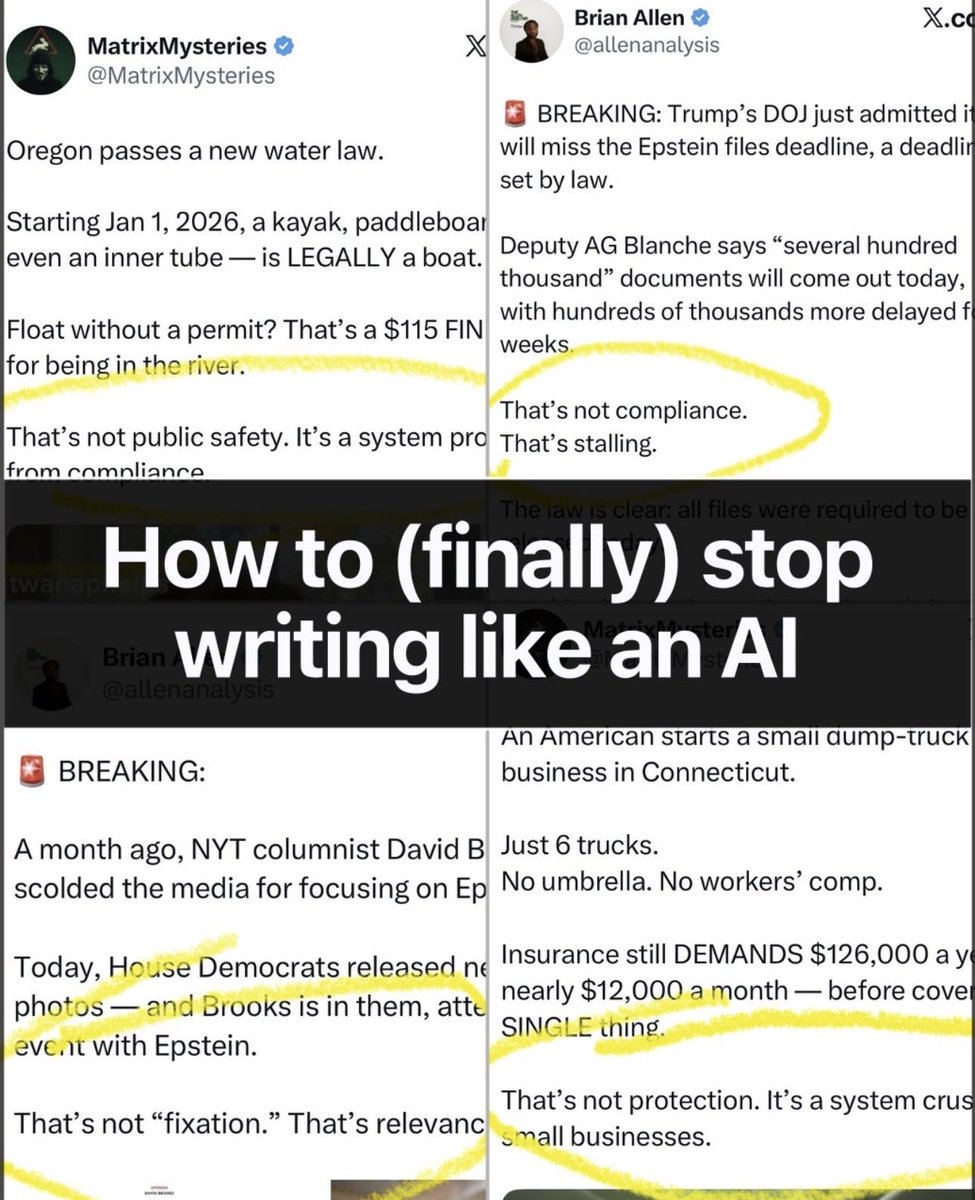
Most “AI writing signs” articles list stuff like:
– Overuse of transitions
– Balanced, overly diplomatic tone
– Generic conclusions
But humans do that too in corporate environments.
Sometimes it’s not AI. It’s just LinkedIn brain.
How to never sound like an AI. But yourself:
1. Don't write any prompt. Instead, go to Wikipedia.
2. Search "Signs of AI writing."
3. Open the full article. Read nothing.
4. Do Ctrl+A. Then Ctrl+C. Copy the entire page.
5. Open a Google Doc. Paste everything in it.
6. Don't edit. Don't summarize. The full thing.
7. Rename the Google Doc as "anti-ai-writing style."
8. Click File → Download → Markdown (.md)
9. Go to https://t.co/lyOn9e2WKn.
10. Don't type your prompt yet.
11. Click the '+' button. Upload your .md file first.
12. Start every chat with this prompt (copy & paste):
Prompt:
"Read the uploaded file. It contains every known pattern of AI writing I want to avoid. Apply these as rules to everything you write for me. Do NOT start writing yet - ask me clarifying questions first."
@ecomchigga Most people don’t want more information.
They want a decision removed.
“Tell me exactly what to do 24 hours before my flight.”
That’s worth $34 at 3am.
@maverickecom I remember when people were manually spinning FB ad creatives and printing money before the algo caught up.
This is that… just automated and multiplied by 100.
Platforms always reward speed first. Then they punish it.
Wall Street just got open-sourced.
Someone plugged Claude directly into the stock market.
Not a demo.
Not a “finance chatbot.”
A real, live financial data pipeline.
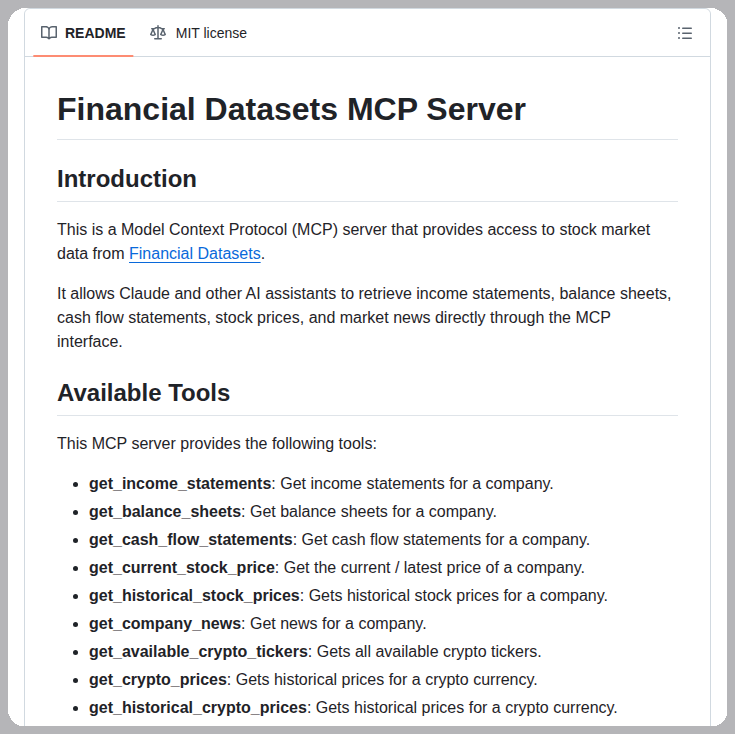
It’s called Financial Datasets MCP Server.
And once connected, Claude can:
→ Pull income statements, balance sheets, cash flow
→ Fetch real-time stock + crypto prices
→ Analyze historical data across any range
→ Read breaking company news
→ Compare valuations with actual numbers
Ask:
“Is Apple cheap right now?”
And it answers with real financial data.
Not guesses. Not hallucinations.
Hedge funds pay $50k/year for Bloomberg.
Now your AI assistant has similar raw access.
For free.
This changes who gets to analyze markets.
#AI #FinTech
Europe might win in applied AI for industry before it wins in flashy chatbots.
Manufacturing, robotics, energy optimization — that’s more aligned with its strengths than consumer AI hype cycles.
USA has ChatGPT
USA has Grok
USA has Claude
USA has Gemini
USA has Llama
USA has Copilot
China has DeepSeek
China has Qwen
China has Ernie
China has GLM
China has Kimi
China has MiniMax
Europe has?
@0xriskyops Every time a major oil transit region faces instability, Brent crude spikes within minutes.
And from there it hits fuel prices, shipping, inflation.
One regional escalation doesn’t stay regional anymore.
@TheMattBerman@openclaw@vishalojha_me@Meta Frequency > 3.5 as a fatigue trigger is such a simple rule… and yet most accounts let it run to 6+ before reacting.
It’s crazy how one automated threshold can save more than any fancy attribution model.
@JoshKale Look at how Palantir scaled — government contracts + national security framing.
If Anthropic steps back, someone else fills that vacuum.
The Pentagon doesn’t stop. It just switches vendors.
@minchoi Honestly… this feels like a “platform lock-in” play.
Apple doesn’t just want to help you code — it wants to own the entire dev experience.
Good for Apple? Sure. Good for indie tooling? Probably not.
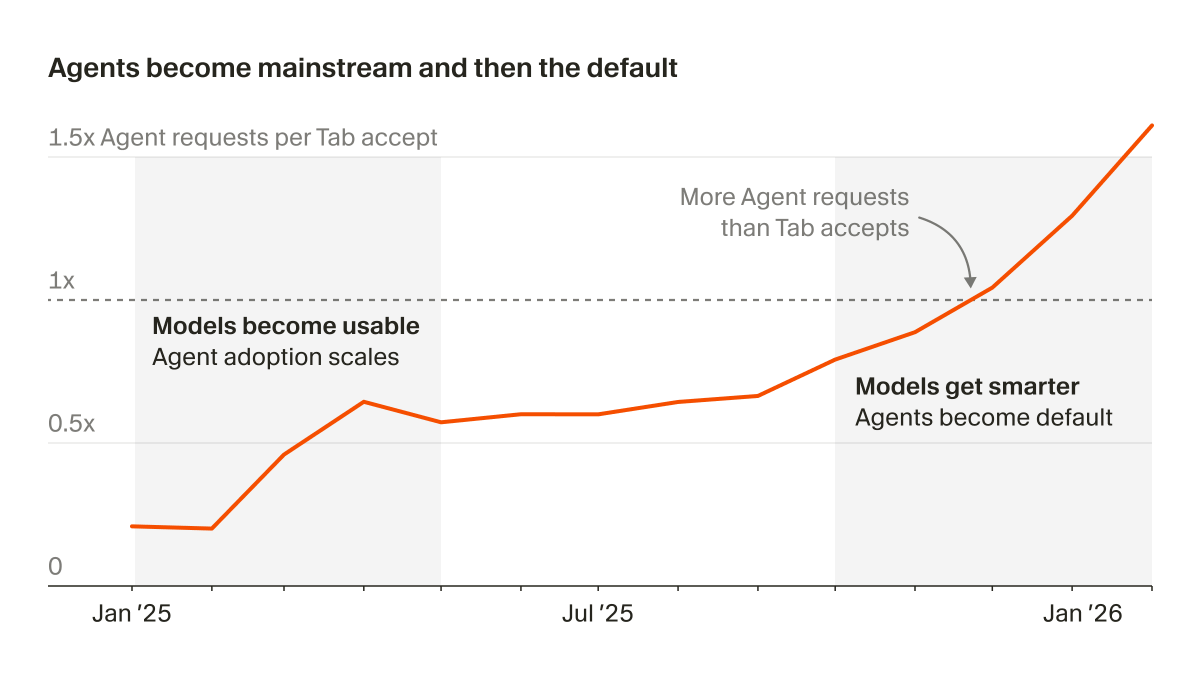
You can literally see this in Cursor usage patterns.
Early users lived in Tab Complete.
Then Agent exploded.
Now the heavy hitters mix modes — quick edits in Tab, scoped tasks to Agent, big refactors staged carefully.
It’s not about replacing one. It’s about sequencing them.
Cool chart showing the ratio of Tab complete requests to Agent requests in Cursor. With improving capability, every point in time has an optimal setup that keeps changing and evolving and the community average tracks the point. None -> Tab -> Agent -> Parallel agents -> Agent Teams (?) -> ???
If you're too conservative, you're leaving leverage on the table. If you're too aggressive, you're net creating more chaos than doing useful work.
The art of the process is spending 80% of the time getting work done in the setup you're comfortable with and that actually works, and 20% exploration of what might be the next step up even if it doesn't work yet.