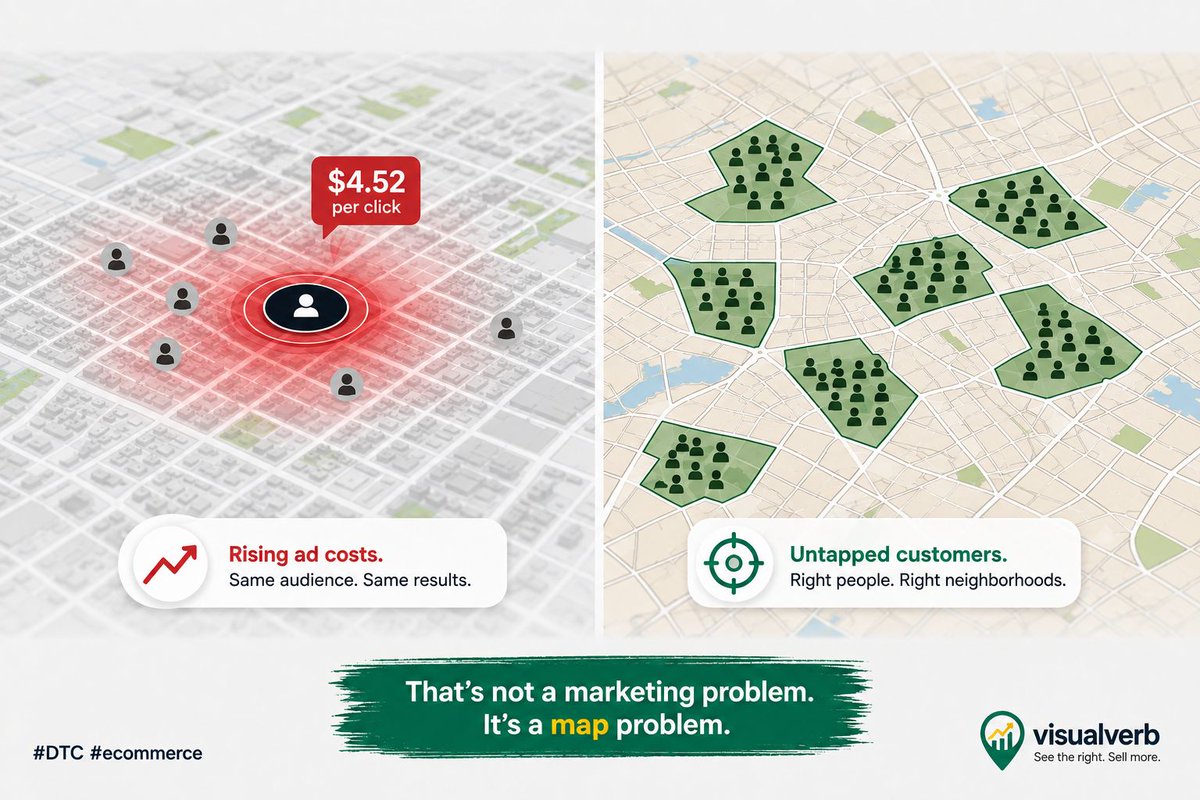
Your top-selling ZIP isn't your best market. It's just your most-marketed-to market.
I'll build you a free US map showing:
- Which ZIPs are maxed out
- Which untapped ZIPs look like your best customers
- Where you're wasting ad spend
Reply MAP or DM store URL. 48-hour turnaround
We are building a product where we help the brands to grow better with Geo-Intelligence data, you can read more about the whole these here on our blog
https://t.co/Bvk4Pacjj6
Can we help DTC brands figure out where they can grow next?
A market could be a city, a ZIP code, or an area defined by activity around POIs.
That's the core of VisualVerb:
Geo Intelligence=understanding the physical & human context of a location to make better biz decisions.
This is New York - Not the NYC on the Shopify dashboard.
This map (based on median income) gives you a completely different picture.
Each ZIP behaves differently, & you are not selling to a single city. It's ~180 micro-markets stacked on top of each other.
#NYC#GeoData
→Right income + LOW penetration = go here. Your buyer lives here and barely knows you.
→Right income + HIGH penetration = stop spending. You've already won it.
→Wrong income = investigate further, and if required, skip this geo
That's your next-market list, sorted.
#DTC
Two numbers:
Median income: Do people in this area make enough to be your buyers?
Penetration: what % of them already buy from you?
Most founders only look at sales. Combining sales with these two tells you far more. 👇
The uncomfortable question for any brand:
Name the 3 geographies where you’re winning today.
Now name the 3 you should be winning next.
Can’t answer both in 5 seconds?
You’re running your brand half-blind.
#DTC#ecommerce
**The uncomfortable question for any brand:**
Name the 3 geographies where you’re winning today.
Now name the 3 you should be winning next.
Can’t answer both in 5 seconds?
You’re running your brand half-blind.
#DTC#ecommerce
You know exactly what your customer clicked on but not what their neighborhood looks like.
You optimized last 2 inches of the journey while ignoring the world they live in.
Your breakthrough may come from understanding where your customers live, not just what they click.
#DTC
Your sales map shows where you’ve already won.
It doesn’t show where you could win next.
Most DTC brands double down on saturated markets instead of finding high-potential neighborhoods with room to grow.
The next customer may not be where sales are highest.
#DTC#Shopify
You're paying more and more to reach the same people.
Meanwhile, there are hundreds of neighborhoods full of your exact customer -who've never seen your brand once.
That's not a ROAS problem; it is a geography problem. Time to find the next geography to sell.
#DTC#ecommerce
Every purchase has a location. Almost no D2C brand uses that.
Your dashboard knows what they bought and how they found you.
It has no idea what neighborhood they live in - or which ones you've never shown up in.
#DTC#ecommerce
Two ZIP Codes sent you the same sales last month.
In one, nearly everyone who'd want your product already has it.
In the other, almost no one's heard of you - but they're a perfect fit.
One's tapped out. One's wide open.
Your dashboard shows them as identical.
#DTC#ecommerce
🚀New Feature Launch
In today’s world, #spreadsheets (#csv) are still the go-to tool for data #analysis.
Yet, I see people spend countless hours on routine tasks for a small analysis.
To solve this, built new automation components that simplifies this
#data#prep#automation
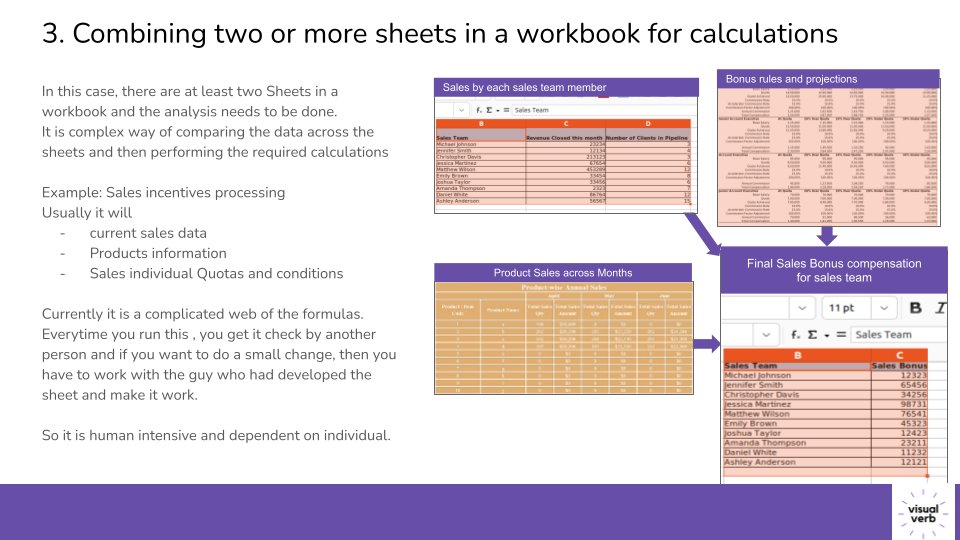
3) Combining sheets for calculations? Complex analysis across multiple sheets in a workbook. #DataAnalysis#Excel
Example: Sales incentives processing
Currently, it's a web of formulas, requiring checks and collaboration for changes. Human-intensive and dependent on individuals.
Continuing from previous tweets, the following are the solutions that we are working.
1) Need to add new data to existing data regularly? Users often get updates from others and need to append it to previous data. #DataManagement#DataAppending
2) Converting template data to columnar data? Data from multiple users is aggregated for analysis or action. #DataConversion#DataAnalysis
example: Employee Reimbursements