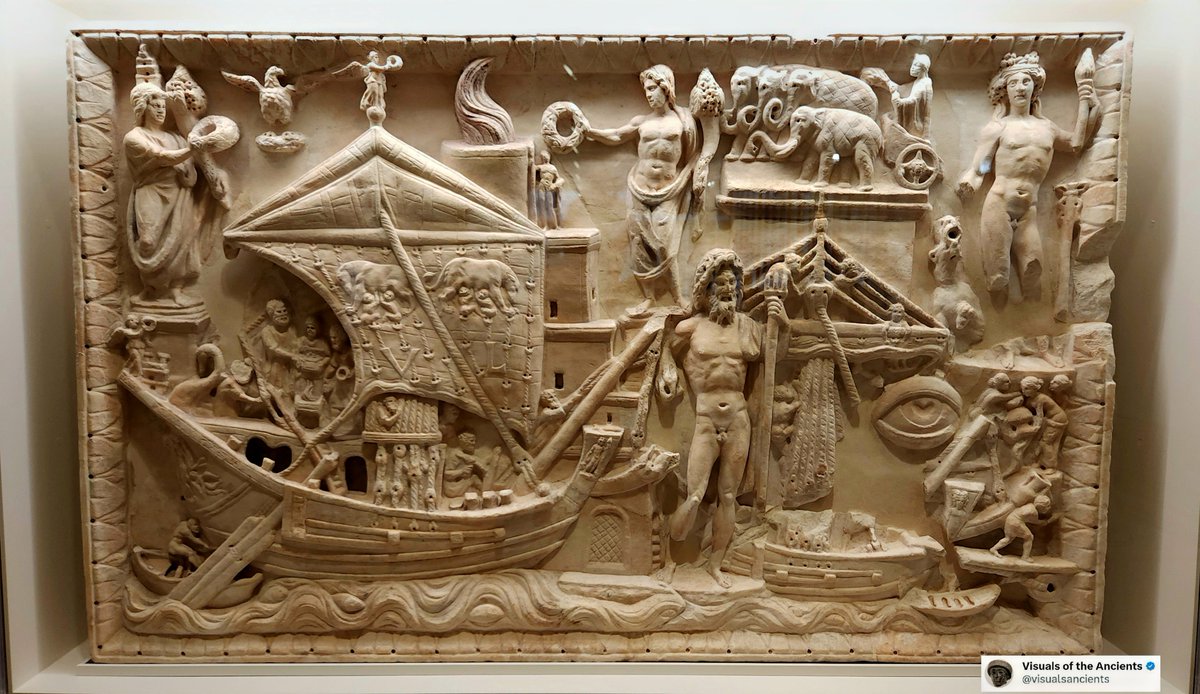
1/ By the 1st century AD, approx. 800k inhabitants lived in the "Eternal City." The imperial grain dole went to 200k of them every month. This was a logistical nightmare for the port city of Ostia.
The solution? The Harbour of Claudius.
A feast to the eyes, 🧵 of 📸 below!
1/5 Carved three and a half millennia ago from a piece of black steatite, this bull-head rhyton is today one of the symbols of the Minoan civilization. It's an image replicated in books and souvenirs everywhere.
Let's see this marvel of ancient art in 8 close-up📸.
5/5 In addition to black steatite, aka soapstone, the eyes are inlaid with rock crystal painted in black, white, and red on its back flat surface. The rim is red jasper. The right eye below is the original! The snout is made of white seashell.
📸 by me. Like and Share for more!
4/5 A rhyton was a ritual vessel for pouring liquids (libation) during sacred ceremonies. The drawing shows the inlet hole at the top behind the horns, and the outlet at the bottom of the muzzle.
The back of this piece is flat for lying on a surface, and it's 10 in (26cm) high.
Some close-ups from posts from the last couple of months. My dream is to flood this app with more of these to bring you closer to ancient history and beauty, away from the bitterness of the news cycle. Follow for more if you agree!
It may resemble a typical piece of ancient Indian art, but this statuette found in Pompeii reveals a world more interconnected than we typically think of.
Let’s talk in this peculiar 🧵about ancient trade between Rome and India, religious iconography, and Pliny the Elder!
First 📸 by me. Our piece is currently on display at the National Archaeological Museum of Naples, specifically in the Gabinetto Segreto.
End. If you enjoyed this post, please share and follow for more content like this. Cheers!
The “Pompeii Lakshmi” was buried in Pompeii in AD 79 when Mount Vesuvius erupted. In a stroke of (bad) luck, Pliny the Elder also lost his life that same day in Stabiae, not that far from the “Pompeii Lakshmi.”