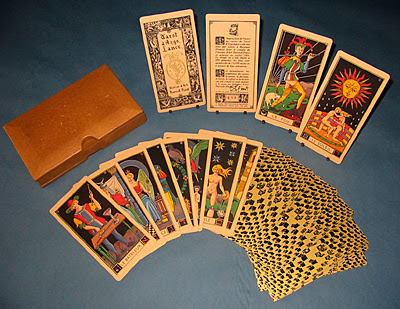
Tarot isn't prophecy—it's a mirror for the esoteric subconsciousness that you already know but refuse to face.
Cards don't tell the future, but they expose the games your mind runs on autopilot. Divination? More like self-incrimination with pretty pictures.
The Magician—dude stands there with infinity over his head like a halo of borrowed time, one hand jacking a divine signal down, the other shoving it into dirt. Vibe much? “As above, so below"—full Hermetic flex.
All four “tarot” tools are laid out on the table like he's got the cheat codes for reality: will (wand), mind (sword), emotion (cup), and body/money (pentacle). Everything magic needs is already in the room.
God warns, “Don’t learn the ways of the nations… for these nations… practice divination and sorcery” (Deuteronomy 18:9–12; see also Jeremiah 10:2). He calls divination, sorcery, fortune-telling, and magic detestable (Leviticus 20:6, 1 Samuel 15:23, Micah 5:12, Galatians 5:19–21, Revelation 21:8).
You're not lacking power—you're just lacking knowledge, and God says that ‘His people are destroyed by a lack of knowledge’ (Hosea 4:6). We can add they might be too distracted to pick up the tools and stop pretending manifestation is magic—it has nothing at all to do with faith in God.
By the way, the lemniscate (that sideways ∞ loop over The Magician's head) is a classic occult nod to eternal potential, infinite flow, and "as above, so below" energy. It's no stretch to see it in modern branding—homage to the occult. Technocracy chasing manifestation of limitless connectivity, mind expansion, or endless innovation.
El proceso de estudiar Tarot está relacionado con estudiarse a uno mismo por eso el Tarot es un medio autoconocimiento q busca la transformación del ser .
Y estos son los cinco principios del Tarot :