This might be the most uncomfortable prediction you read this week.
Anthropic's CEO Dario Amodei believes 50% of all entry-level lawyers, consultants, and finance professionals could be wiped out in the next 1 to 5 years.
In a 47-minute conversation, he breaks down exactly which skills will survive the AI shift, and which professionals are about to become far more valuable.
Here's the part worth sitting with: the real divide won't be AI versus humans.
It will be the people who learn to leverage AI versus the people replaced by those who did.
The gap is already forming. Start learning AI now, not later.
Si vives con la mente acelerada, estresado y con la ansiedad siempre de fondo...
El creador de Dilbert 7 trucos mentales para desactivarla al instante:
1. Piensa en tu lecho de muerte
Muscle aging is usually described as a function of time. In these adults, half of it tracked training history instead.
Researchers sampled muscle from young and older adults across a range of fitness levels, before and after one bout of exercise, measuring gene activity, lipids and metabolites in the same tissue. The age comparison held daily activity constant, matching older adults against young adults doing similar amounts. That matters, because the same group previously found that aging erodes mitochondrial capacity, walking stability and insulin sensitivity even in people who stay adequately active.
What had fallen in older muscle was cellular respiration, the reactions by which mitochondria turn fuel and oxygen into usable energy. Mitochondria sit between the contractile filaments of a muscle fibre, and their capacity sets how much work the fibre can do before it fails. The analysis tied the age differences to mitochondrial respiration, lipid handling, the stress response, and NAD, a molecule those reactions cannot run without.
In older adults who had kept training, half of those age-related differences were simply absent, and their profiles resembled those of young adults. The other half remained regardless of fitness. After the single exercise bout everyone mounted an immune and stress response in gene activity, and among the older adults the size of that response rose with fitness.
Nobody was assigned to train. Older adults who still train are the ones whose joints, health and circumstances allowed it, so part of what looks like a training effect is the reason they could train at all. Gene activity is not strength, size or function, and none of those were outcomes here. One muscle group, sampled once, in people compared against each other rather than followed over years.
Two studies that did assign the exercise point the same way. Melov trained fourteen older adults for six months and the mitochondrial gene signature shifted toward the younger profile, while their strength went from 59 percent below young adults to 38 percent below. Robinson gave twelve weeks of interval training and many age-related differences in muscle proteins reversed. Both assigned the exercise, which is what this study could not.
What nobody has established is which half is which. If the unresponsive half governs strength and function, training buys less than fifty percent suggests. If it is largely inert, the responsive half is the half that counts.
This suggests half of what gets measured as aging in muscle tracked whether someone kept training, and half did not move at all. Both numbers are worth carrying. Train for the half that answers, and plan around the half that will not.
Janssens et al., Nat Aging 2026;6(7):1482-1500 · PMID 42399371
Melov et al., PLoS One 2007;2(5):e465 · PMID 17520024
Robinson et al., Cell Metab 2017;25(3):581-592 · PMID 28273480
หนี้สินจีนในตลาดตราสารหนี้ตลาดเกิดใหม่
หนึ่งในเรื่องที่ From the Sell Side ได้ยินเป็นประจำจนเบื่อคือ จีนไม่ทำการกู้ (leverage) ที่สูง เนื่องจากจีนระมัดระวังและมีความฉลาดทางการเงินมากกว่าสหรัฐอเมริกา ที่กู้หนี้ยืมสินจนจะถล่ม ฯลฯ เพราะข้อมูลไม่ได้บ่งบอกอย่างนั้นเลย
🧠 Una de las mejores formas de comprender conceptos estadísticos es experimentar con ellos: cambiar parámetros, observar qué ocurre y construir la intuición a partir de la práctica.
Los mejores recursos:
https://t.co/nNRtZszFu3
#stats#cienciadedatos#Estadística#DataScience
ANTHROPIC LEAKED A 4-AGENT SETUP THAT CUTS A CODEBASE AUDIT FROM 3 DAYS TO 20 MINUTES
you point it at a repo and walk away - it comes back with what breaks, ranked, patches already tested.
repo → map → 4 auditors → rank → fix → verify → report → back into the map
the map cuts the repo by blast radius, not by folder - skip it and four agents audit the same three files and miss the one that ships broken.
4 auditors run in parallel with separate contexts - deps, secrets, dead code, hot paths, and none of them sees another's findings.
rank is code, not an agent - sort by what breaks production, drop the duplicates, zero tokens.
the fixer only opens patches for the top slice - a hundred findings nobody acts on is a report, not an audit.
verify runs the suite on every patch and red goes back to the fixer - that patch only, never the whole batch.
the back edge into the map is the whole trick - accepted findings become rules, so next week starts where this one ended.
one human step in all of it: which fixes ship - 20 minutes instead of 3 days.
save this and read the full graph engineering course below ↓
Siempre considera la #Desvenlafaxina cuando tengas como paciente a una mujer con síntomas de perimenopausia, con #SíntomasVasomotores y #SíntomasAfectivos
Una excelente opción clínica
No aumenta de peso
Ayuda a #Bochornos
No afecta función sexual
100 mg
Siempre en la mañana
Andrew Ng: "RAG" is becoming a "Graph" problem
This 1-hour deep dive shows why. Once agents can retrieve, judge, retry and call other agents, a simple RAG pipeline becomes something very different
Here are the 4 steps you must watching:
• 00:00 - Andrew Ng on why agents need iterative workflows
• 12:40 - turning RAG into a self-correcting retrieval loop
• 31:20 - building cyclic graphs with generate → critique → refine
• 55:40 - connecting specialized agents inside one shared graph
The steps: RAG → Self-RAG → Loops → Memory → Multi-Agent Graphs
Start learning it today, so you're building with it while everyone else is still catching up tomorrow
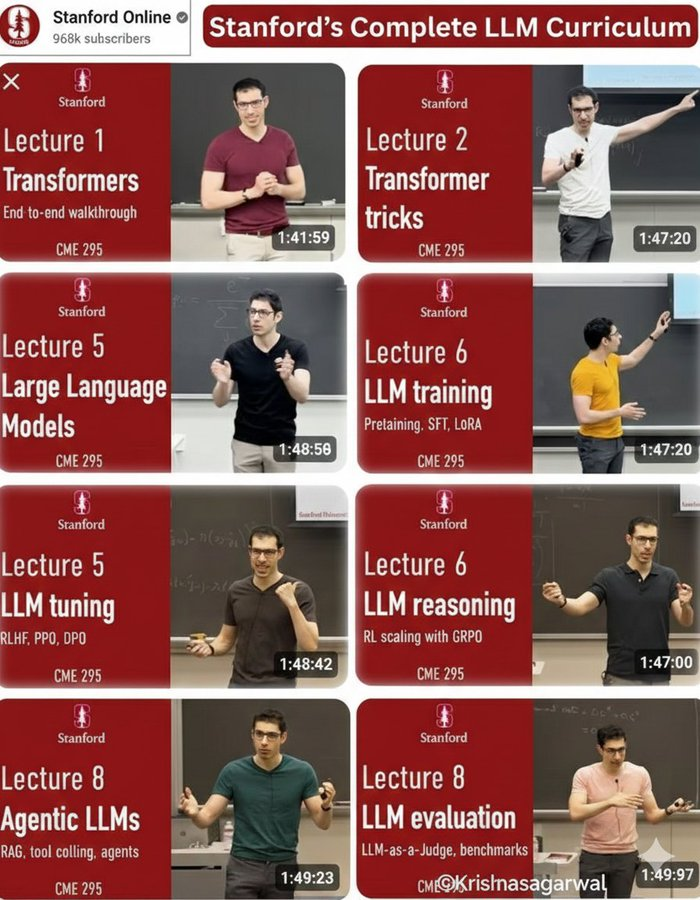
Most people use LLMs.
Very few actually understand how they work under the hood.
If you want to go from prompt user → real AI engineer, study these 9 concepts in order:
1️⃣ Transformers — attention, tokens, self-attention basics
https://t.co/65pkMfS4og
2️⃣ Transformer tricks — what makes them stable & scalable
https://t.co/mnUQYpQ9q2
3️⃣ From Transformers → LLMs — how scale changes behavior
https://t.co/uXOVnCsmGA
4️⃣ LLM training — where “intelligence” actually emerges
https://t.co/RFkBljQ8Pi
5️⃣ Instruction tuning & alignment — why fine-tuning matters
https://t.co/nmZB6JE0NK
6️⃣ LLM reasoning — why models fail + what improves them
https://t.co/UY8V9bZjAU
7️⃣ Agentic LLMs — models that plan, call tools, and act
https://t.co/EZbxuxBimR
8️⃣ LLM evaluation — measure beyond demos & vibes
https://t.co/yZ4Uig7uGw
9️⃣ What’s next — trends that actually matter
Bookmark this. Study step-by-step. Your prompts will level up — and so will your builds.
CC: Author
DeepSeek has open-sourced DeepSeek Harness.
(crossed 35k stars in a few hours)
it is built around one core idea: everything is a plugin
let me explain what that means:
the model adapter, the tool registry, the session log, and the agent loop itself are all plugins in DeepSeek Harness (dsh). every one of them can be swapped for your own.
that matters because changing how an agent assembles context usually means editing the framework's own source, or forking it and paying for that fork on every upgrade.
the mechanics that make it work:
→ a plugin claims a stable key like ctx .tools or ctx .llm, and other plugins find it by that key instead of importing a concrete implementation.
→ dependencies are declared rather than hand-sequenced, so load order falls out of what each plugin requires.
→ registrations are reversible, so unloading a plugin unwinds everything it registered.
→ one event, agent/pre-step, decides what the model sees. listeners can rewrite the claimed messages or reject them, which is where nearly all custom context engineering would land.
→ the session log is append-only and covers system prompts, reasoning, tool calls, subagent scheduling, and every context injection.
that last one is what i would actually reach for.
logging tool calls is standard, and when an agent misbehaves you are still guessing at what was in the window. here, model-visible means logged, asserted at runtime, so a new model-visible input requires a new session event.
deepseek was the last major lab shipping coding-grade models without a first-party harness to train against, and it now ships one that can delegate subagent work to Claude Code and Codex.
link to GitHub repo: https://t.co/Q7jrt6qxvk
if you want the full anatomy of what a harness actually contains, the article is quoted below.
El CEO de Google dándose cuenta de que uno de sus propios ingenieros de Cloud se subió a un escenario a construir una app entera con Claude en 26 minutos y acaba de filtrar todo el proceso gratis