What a day it was meeting @Suriya_offl anna, my favorite actor in Indian cinema, and the legend whose movies I’ve been watching religiously since that unforgettable day in 2004 when I saw “Perazhagan” for the first time. Each of his films has marked a chapter in my life — from “Ghajini” to the heartfelt “Sillunu Oru Kaadhal,” and from the action-packed “Singam” to the deeply moving “Vaaranam Aayiram.” Not to mention “Vel,” “Ayan,” “Aadhavan,” “7aum Arivu,” and “24” — his filmography reads like the soundtrack to my growing up.
Meeting Suriya was like a scene straight out of a movie — unreal yet deeply personal. As we talked about life, our travels, and other shared interests, I felt a connection that went beyond just fan admiration. While there are some details I’ll keep to myself, just know that each topic we covered revealed more of his genuine, down-to-earth personality.
I’m reminded of why I admire him so much — not just for his films but also for his profound commitment to causes like the Agaram Foundation. His dedication to lifting up the underprivileged by providing educational tools and creating opportunities transforms countless young lives. By empowering the next generation, Suriya is truly making a lasting impact.
Education opens doors and transforms lives, which is why I’m committing to support the Agaram Foundation over the next few months. Contributing to such a cause, inspired by someone I’ve looked up to for years, fills me with a sense of purpose and excitement about the real-world changes we can make together.
The day was full of surprises — and getting a sneak peek at #Kanguva and its visuals was another highlight. It’s clear we’re all in for a treat that’ll showcase Suriya’s versatility like never before. And just when you think it can’t get any better, #Suriya44 is on the horizon. With my friends @karthiksubbaraj directing and @Music_Santhosh composing, they’re sure to create something truly unforgettable. Big things are coming!
Big thanks to @kaarthekeyens and @rajsekarpandian for making this possible. Looking forward to our next catch-up soon, Suriya anna ❤️
#OM IS AN UNMISSABLE THEATRE EXPERIENCE 🔥🔥🔥💥💥🥵🥵🥵🧨
This is the @dhanushkraja film fans have been waiting for. Blockbuster redemption written all over it 🤯🤯🤯 Tamil cinema's dream year is about to get even bigger on Nov 20 ♥️
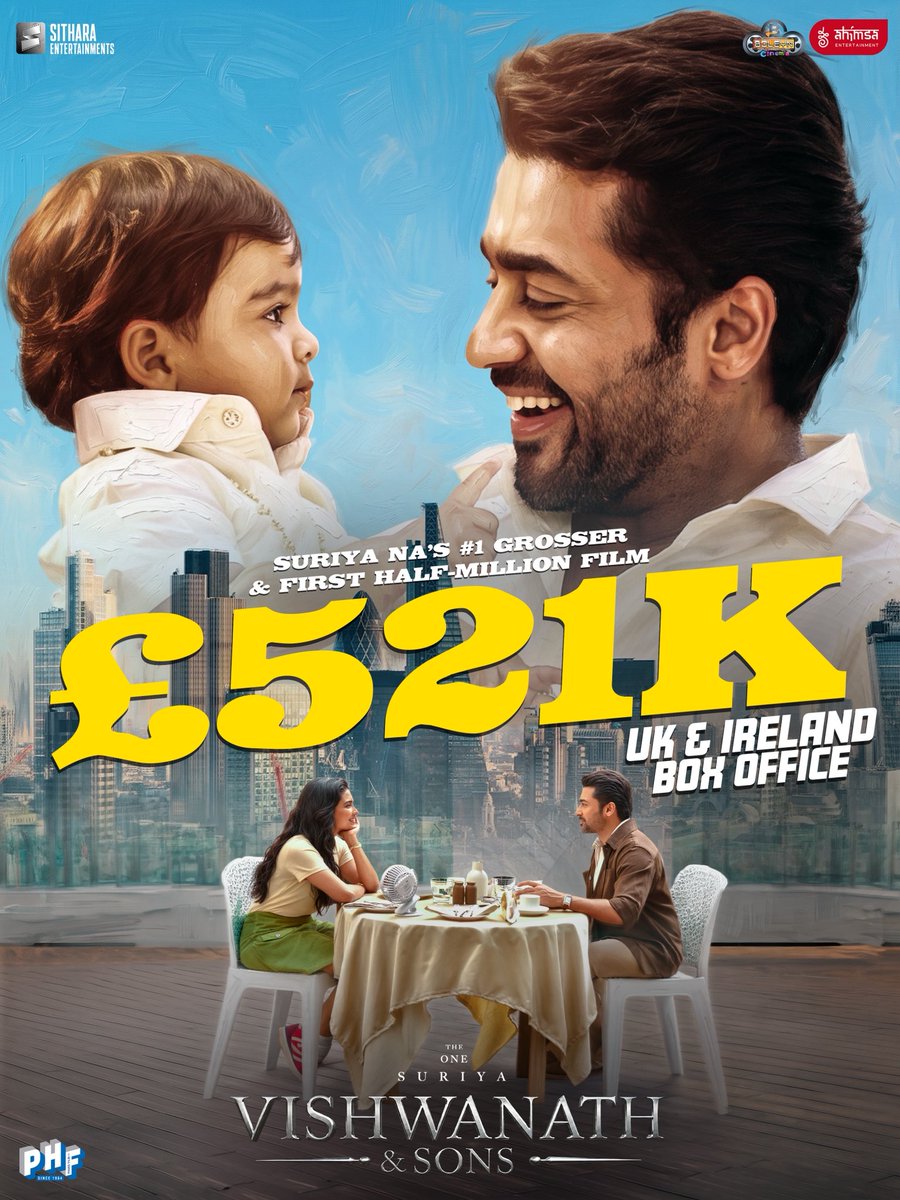
2 HOURS 29 MINUTES OF SURIYA NA OWNING EVERY SINGLE FRAME 🔥🔥🔥🔥 NAMMA YEAR 3/3 💥💥💥 Indha Diwali ku semma #Scene irukku 🧨🧨🧨 Book your tickets, keep calm, see you in cinemas on Nov 6.
Living in an “En annanukku naan dhaan da pannuven” phase 🧨🧨🧨 @Suriya_offl 😘
Every day until Diwali, we’re turning the timeline into a #Scene. See you tomorrow for 💥💥💥
And there’s another reason this keyword is perfect for testing.
The search volume is tiny.
Normally that sounds like a negative.
For SEO testing, it’s actually ideal.
There’s very little noise in the SERP, so you can isolate a variable, deploy it and often see movement almost immediately.
Sometimes within minutes to hours.
Usually within 24 hours.
That makes it perfect for testing things like:
- EMD influence
- internal PageRank
- topical expansion
- entity co-occurrence
- anchors
- document frequency
- supporting domains
- external links
- news mentions
- schema
- indexing velocity
- cross-platform entity reinforcement
You can make a change, observe the response and identify what actually moved the needle without waiting weeks for a high-volume SERP full of competing variables to settle.
AI has also completely changed how quickly we can run these tests.
If you understand architecture, entities, internal linking, topical coverage and prompting/agents, something that would previously have required writers + developers + days of work can now be deployed in under 30 minutes.
The important bit is knowing what you’re asking the agents to build.
AI has made execution almost free.
It hasn’t made understanding search free.
That’s why I love James doing these experiments publicly.
SEO/AEO right now feels a little like the old SEO Wild West again from 2006 days. We can argue theories all day, or we can put something live, watch Google and the LLMs react, and learn from the evidence in public.
Sometimes your hypothesis wins.
Sometimes Google teaches you something.
Both outcomes are useful.
2/2
👋🙃🧵
I’ve followed @james_dooley for a long time. I wasn’t invited to the party, but it looked too fun not to join 😂
I’m not particularly public with SEO, but I’ve been doing it for almost 20 years now. I started when I was around 10, and experiments like this are still the part of SEO I enjoy most.
There are actually a few different hypotheses being tested here.
The EMDs are probably the least interesting part, because we already know exact-match domains can help establish strong lexical relevance when everything else lines up.
What interested me more was building a very dense:
query -> topic -> entity
relationship across an entire corpus.
Instead of:
King of AEO -> one page -> Vithurs
you create something closer to:
King of AEO -> Answer Engine Optimization -> AEO -> entity authority -> AI search -> Vithurs
Then reinforce those relationships through supporting documents, titles, headings, contextual internal anchors, breadcrumbs, About pages, schema, social profiles, backlinks, news coverage and consistent entity naming.
That gives a retrieval system significantly more evidence about what the entity and corpus represent than a single optimised landing page ever could.
There’s also an internal PageRank element that people massively underestimate.
If you have 20 tightly related pages around one subject, you’re not just creating “more content”.
You’re creating an internal graph.
Supporting pages can reinforce the target entity and query pages contextually, consolidate relevance and direct whatever PageRank enters the domain toward the pages you actually want Google to prioritise.
Do that properly and:
lexical relevance + topical depth + document consistency + entity co-occurrence + internal graph reinforcement
can be enough to establish the initial query/entity association before significant traditional external PageRank (eg: backlinks) is even introduced.
Then multiply that across several separate domains and you start increasing the frequency and consistency of the same entity relationship across the corpus.
That can influence retrieval before meaningful external authority even arrives.
But this is where the experiment splits into two different layers:
ranking ≠ entity consensus
Getting Google to retrieve and rank one of my pages for:
“king of AEO”
is one layer.
Getting Google, ChatGPT, Gemini, Claude and other systems to discover the sources and associate:
Vithurs -> King of AEO
is another.
The LLMs are finding the sources, surfacing my name and recognising the association.
The next layer is moving from simple recognition to becoming the default or dominant entity association across multiple systems.
That progression is more like:
retrieval -> ranking -> recognition -> corroboration -> dominant entity association
Each stage responds to slightly different signals.
Retrieval needs enough relevance to enter the candidate set.
Ranking needs stronger query fit, internal/external authority and competitive strength.
Recognition needs repeated and consistent entity relationships.
Corroboration gets stronger as those relationships appear across more authoritative and independent sources.
Dominant association comes when the evidence becomes strong enough that the system consistently prefers one entity relationship over competing ones.
That’s the part I find most interesting (not just for this keyword but in other far more competitive and aggressive niches).
1/2
Completely agree with this. Not talked about enough.
One additional layer I’d add is graph proximity to trusted seed sites.
People tend to reduce links to DR, DA, referring domains, etc, but Google’s link graph is much more nuanced than that. Google has even patented systems based around a limited set of manually selected, high-quality “seed” pages, then measuring other pages partly by their distance from those seeds.
There’s long been a belief in SEO that this trusted seed set is relatively small, sometimes estimated in the hundreds. I’ve heard ~500 quoted over the years, although I wouldn’t present the exact number as confirmed or call it a literal “whitelist”.
The principle is what matters:
Trusted seed -> you
is fundamentally different from:
Trusted seed -> site -> site -> site -> you
The closer you are to the trusted core of the graph, especially when the link is also topically aligned, the stronger the signal can be.
Wikipedia, major government resources, authoritative industry bodies, standards organisations, major universities, etc.
AHIMSA & BOLEYN.
THE NAMES BEHIND HISTORY.
OVER 400 THEATRES IN UK 🤯🤯💣💣💣
For an Indian film, a release this MONSTROUS was once beyond imagination. No film had reached this scale. No distributor had even attempted it.
#ToxicTheMovie changes that on AUGUST 26, erupting across the UK in Kannada, Hindi, Telugu & Tamil 🌋🔥
EVERY RECORD OBLITERATED.
EVERY BENCHMARK BURIED.
EVERY LIMIT DESTROYED.
The impossible has officially been done.
INDIAN CINEMA IN THE UK WILL NEVER BE THE SAME AGAIN.
@TheNameIsYash #Nayanthara @advani_kiara@humasqureshi@rukminitweets #TaraSutaria #GeetuMohandas @RaviBasrur #RajeevRavi #UjwalKulkarni #TPAbid #MohanBKere #SandeepSadashiva #PrashantDileepHardikar #KunalSharma #SandeepSharma #JJPerry @anbariv #KechaKhamphakdee #AmritSingh @KVNProductions #MonsterMindCreations @Toxic_themovie #Toxic @PharsFilm@boleyncinemauk@ODEONCinemas@ShowcaseCinemas@vuecinemas@cineworld@vithurs_