Slag Heaps Have Eyes: From Secret Operative to Frontline Fighter
A rare firsthand account of war and resistance from a Donbas native who lived under Russian occupation
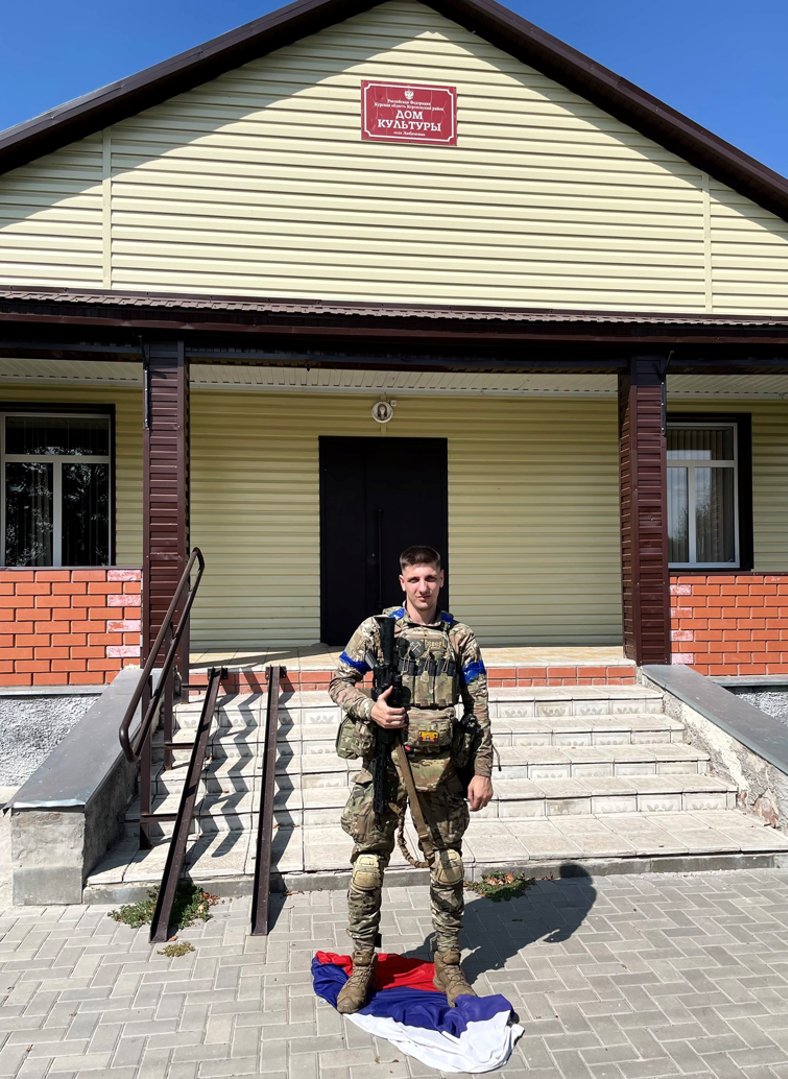
A native of Donbas and veteran of Ukraine’s fiercest battles, Artem Karyakin, better known by his nom de guerre, Skhidnyi (@samotniyskhid), offers his firsthand view from the front lines of the war. For years, he operated in secrecy as a spotter for Ukrainian intelligence deep inside occupied territory. When the full-scale invasion began, he joined the ranks of the Ukrainian forces and has since fought without pause - from the defense of Kyiv to the grinding battle for Bakhmut and the incursion in Kursk.
1. Frontelligence Insight (hereafter FI): You are originally from Donbas and witnessed the unfolding of Russian aggression in the region. How exactly did it happen, and what were you doing in 2014?
Artem ��Skhidnyi” Karyakin (hereafter - A): It’s important to note that the Russians began preparing for the seizure of Donbas well before 2014. This was especially evident to us—the residents of the region. For example, in my hometown of Kadiivka (formerly Stakhanov) in Luhansk Oblast, a certain “Don Cossack” organization appeared in the early 2000s. It consisted of marginal figures dressed in red Cossack hats and carrying whips. It looked strange, as our city had always been known for its mining industry and had no historical connection to the Don Cossacks.
This organization attracted people with chauvinistic views, fanatically devoted to the idea of reviving the USSR and uniting the "Slavic peoples." For instance, in 2012, a march commemorating the Ukrainian Insurgent Army was held in our city, in which I also participated. The march was disrupted when we were attacked by the same Don Cossack group, along with paid activists from the “Party of Regions.” Even back then, these “Cossacks” were confiscating our Ukrainian flags. That moment was very telling.
By 2014, the same “Cossacks” in red hats were seizing government buildings in our city - only now they were armed and operating under Russian flags. Many of them weren’t even born in our city - they came from the Russian Federation, as did some of those who helped them seize power by force in the spring of 2014.
We — the pro-Ukrainian residents of the city — were organizing events in support of Ukrainian unity at that time. Our first event was a memorial rally honoring the “Heavenly Hundred” (Editor’s note: The Heavenly Hundred refers to those who were killed during the 2014 protests against the Yanukovych regime in Ukraine). That was in late February 2014. Later, we held car rallies for Ukrainian unity, events on the birthday of Taras Shevchenko, and actively distributed pro-Ukrainian leaflets and stickers around the city, and painted Ukrainian flags.
All our activities in the spring of 2014 were dangerous, as there were already armed Russians and local pro-Russian militants in the city.
The point of no return came in late spring 2014, when two young guys — still in school — put up a Ukrainian flag on a slag heap in the center of town. They were fired upon with a handgun for doing so. After that, many pro-Ukrainian residents began leaving the city, as it had become clear that they could simply be killed for their love of Ukraine.
2. FI: What happened to the pro-Ukrainian activists? Are there still people who maintain a pro-Ukrainian stance under occupation?
A: I remained in my occupied city until the end of 2021, as did many others who loved Ukraine but, for obvious reasons, could not express it publicly. Today, the situation has worsened for those who support Ukraine in the Russian-occupied cities.
There are still many such people, but they are forced to live in fear, expecting to be arrested at any moment. Russian security services have dedicated significant resources to identifying and detaining pro-Ukrainian residents in the occupied territories. There are constant filtration procedures and ongoing inspections. Special attention is given to public sector workers and even to children. For example, in schools, there are mandatory checks of students’ mobile phones to look for subscriptions to Ukrainian media or messages expressing pro-Ukrainian views.
To love Ukraine under Russian occupation is already an act of courage.
Nevertheless, even today, a large number of true Ukrainians remain in the occupied territories: people who, risking their lives daily, help us in the fight against Russia by sharing intelligence, carrying out sabotage, and participating in other acts of resistance against the Russian army. This is true heroism and further proof that this land is rightfully Ukrainian.
3. FI: You continued to support Ukraine even when your city was already under occupation. What exactly did your activities involve?
A: In July 2014, while already living under occupation, I created my first Twitter account. The goal was to shed light on the situation in the occupied territories from the perspective of a pro-Ukrainian resident who hadn’t left their home. At the time, neither people in Ukraine nor the rest of the world fully understood what was actually happening. Many believed that all the locals who had stayed supported Russia. I wanted to show the world that our city was occupied by Russia, and that there were still Ukrainians there who were not happy about it and were waiting for the Ukrainian army.
In addition to general updates, I also posted information about the locations of Russian troops in my city. These were public tweets, sometimes with maps marking where Russian military equipment was stationed. In the fall of 2014, I was contacted via direct message on Twitter by representatives of Ukrainian intelligence services as well as acquaintances from the Ukrainian army. They explained to me that it was better to share intelligence privately rather than posting it publicly on Twitter.
Since then, I began secretly passing on various types of information to the Ukrainian army and intelligence services - details about the movements, positions, and firing points of Russian forces in my city and surrounding occupied areas. Over the years, this also came to include information about factories and enterprises operating under Russian control, the socio-political climate under occupation, local sentiment, and data on collaborators - those who had joined the Russian side in combat or taken positions in the Russian-controlled security services.
4. FI: In 2021, you moved to Ukrainian-controlled territory, and the full-scale invasion began the following year. How did you join the Armed Forces, and what was your first battle?
A: From the very first days of Russia’s full-scale invasion, I began looking for a unit where I could fight against Russia. The early days of the big war were chaotic—there was disorganization and confusion everywhere. I was living in Kyiv, and in one of the first days of March, I simply approached some guys with rifles and offered my help. That very same day, I was already standing night watch with Kalashnikov's hand-held machine gun in my hands.
It was one of the Territorial Defense Force units. We took up a defensive position on the outskirts of Kyiv, on the Bucha-Irpin side. In the summer of 2022, I joined the fighters of the 8th Regiment of the Special Operations Forces, where my friend was already serving and had invited me to join his group.
My first combat deployment was in August 2022 in Bakhmut, which at that point was already under assault by Russian forces, including Wagner PMC fighters. Shortly after Bakhmut, we took part in the liberation and clearing of the city of Lyman, in Donetsk Oblast. For me and many of my fellow soldiers, it was our first experience liberating our native land - a moment we will remember forever.
5. FI: You’ve taken part in important operations - both in Ukraine and on Russian territory, specifically in the Kursk region. Did you notice any significant differences between combat operations in Ukraine and in Kursk?
A: The Kursk operation was unique in every sense and differed from my past experiences in Ukraine in many ways. It was in the Kursk region that I first encountered the concept of maneuver warfare, and I can say that, personally, combat along a clear front line is easier for me.
It was also in Kursk where we first faced FPV drones connected via fiber optics and a new Russian tactic—using specialized FPV drone teams to strike our logistics routes from as far as 10–15 km deep. This tactic is now widely used by Russian forces along nearly every front.
In this operation, we also faced the enemy’s best FPV crews, all concentrated in one relatively small sector. These teams had been withdrawn from other areas and redeployed to Kursk specifically.
Another major difference was that, for the first time, we were acting as a “foreign army” in populated areas. Each soldier had their own reaction to that: for some, it felt like justified revenge; others felt a strong pull back toward our own land and a kind of inner resistance to advancing on foreign soil.
I count myself among the former. For me, it was an act of rightful retribution and a way to shift the war onto the aggressor’s territory. Yet I constantly reminded myself that I didn’t want to behave like the Russians did in my hometown. On Russian territory, I acted very differently than they had in ours. To every civilian I encountered in the Kursk region, I explained why we were there, how it all began, and that we simply want to liberate our own cities - not seize theirs.
The Kursk operation was very well planned and executed at the outset, but unfortunately was marred by a series of key mistakes and issues at various levels. These mistakes must be carefully analyzed so they are never repeated. I sincerely hope this experience proves useful in the future—it was unique in many respects.
Regardless, everyone who took part in that operation became part of history. We shattered the myth of the invincibility of a nuclear power and the so-called greatness of the Russian army. We drew significant enemy forces away, slowing their advance on our territory. And we were also the ones who fought against the armies of two different totalitarian states. The experience of facing North Korean forces is also something that sets this apart from the war in Ukraine—even though their tactics in Kursk didn’t differ much from what Wagner used in Bakhmut.
6. FI: Assuming that Russia eventually loses control over Donbas - how do you envision the process of reintegrating these territories? How deeply has Russian propaganda taken root there over the years?
A: The most important thing is to drive the Russians out of our land. And with Ukrainians, just like us, we’ll quickly find common ground.
The main issue with those who fell under the influence of Russian propaganda during the occupation is that they know very little about the rest of Ukraine. Many have never been to other regions and know nothing about them. Everything they do know about Ukraine comes from what they’ve seen on Russian TV channels.
Another problem is that Russia created conditions in which every second family in occupied Donbas has lost a relative in the war. This is a direct result of the forced mobilization of men from the occupied territories into the Russian army.
But you have to understand — Donbas, especially the part that’s been under occupation since 2014, is a region where people generally lack any strong civic engagement or passion. Their opinions and actions are shaped entirely by the environment they live in.
If Ukraine returns to these territories, people will quickly adapt to new rules and new flags flying over their homes. And soon, they will realize that life under Ukraine is freer and more breathable. Without the presence of Russian troops, these people would never have fought for the Russian flag. I know them — I lived among them for most of my life.
Even now, many of them no longer see Russia as something positive. After living under the Russian flag long enough, they’ve come to realize that there’s little good there, and that the sacrifices they were forced to make for that flag were not worth it.
7. FI: When the war ends, what do you see your life looking like? Do you have any dreams or plans for peacetime?
A: The most important thing is for the war to end with our victory. We must preserve Ukraine and bring back our land and our people. I’m turning 28 this year, and I’ve spent 11 of those years living through war — it’s hard to imagine myself without it now.
But of course, I have a personal dream as well: to start a family of my own. During the years of occupation, I lost my parents and my grandmother, and since then, the feeling of loneliness has never left me. My dream is a family… my children, who will never know what war is.
Thank you for reading to the end. If you enjoyed this story, please like, share, and leave a comment. If you'd like to show support, you can also contribute directly to Skhidnyi via PayPal: [email protected]
På en provisoriskt ihopsnickrad uteplats precis intill hamnbassängen i Visby sitter Vladyslav och Malik. Varken jag eller någon annan i Almedalen kan nog fullt ut förstå vidden av vad de har varit med om och utsatts för. Efter en timmes samtal frågar jag dem om jag får försöka återge vad de har berättat och de svarar jakande.
- Det är därför vi har kommit hit, för att låta omvärlden veta vad vi har varit med om, säger de båda.
Vad de kommit till Almedalen för att berätta om är tiden som ukrainska krigsfångar i Ryssland. Under två respektive två och ett halvt år tvingades de uthärda vad som hade fått varje krets i Dantes helvete att framstå som en semesterresa. Malik inleder.
- Vi blev väckta klockan 6 varje morgon. Dagen började med att vi blev misshandlade med käppar över hela kroppen, sedan tvingades vi tillbaka in i cellen. Åtta till tio personer i varje cell, övervakade av en kamera. Från klockan sex på morgonen tvingades vi sedan stå i enskild ställning helt stilla fram till klockan tio på kvällen. Ingen fick röra sig, ingen fick prata, ingen fick göra någonting. Om en enda person rörde sig, ramlade eller på något sätt föll ur ramen så öppnades dörren och alla i cellen togs ut för att utsättas för kollektiv bestraffning. Vi fick elchocker och misshandlades över hela kroppen.
När jag frågar hur det ens är fysiskt möjligt att dag ut och dag in stå upprätt på exakt samma position dygnets alla vakna timmar svarar Malik;
- När du har upplevt att först bli nedblött och sedan angripen med en strömförande stång som sitter i vägguttaget så kommer du att stå upp tills det är det sista du gör. Vissa dog, vissa tappade fattningen.
De som blev galna, som Malik uttrycker det, försvann. Han fortsätter;
- Ryssland kommer aldrig att skicka tillbaka dem, de vill aldrig visa upp vad som har hänt med dessa människor.
I två och ett halvt år var detta varje dag i Maliks liv.
- De sa till oss att Ukraina inte längre fanns kvar, att landet hade fallit och att vi aldrig skulle få komma tillbaka. Nya krigsfångar placerades omsorgsfullt på andra platser för att inte kunna ge uppdateringar om utvecklingen på marken i Ukraina. Men en dag placerades av misstag en nyligen tillfångatagen ukrainsk soldat i deras cell, som kunde berätta om hur det verkligen låg till. Det fria Ukraina existerade fortfarande i allra högsta grad och Ryssland hade tryckts tillbaka i inledningen av kriget. Det gav styrka att fortsätta uthärda, avslutar Malik.
Vladyslav placerades i ett annat fängelse och i ett annat helvete. Här fick fångarna straffarbeta, men nästan ingenting att äta.
- Vi åt möss som vi kunde hitta och fånga, vi åt tvål, vi åt allting vi kunde komma över.
Jag frågar om de inte fick någon mat.
- Jo ibland, men i små ransoner och mat som var beredd på ett sätt som syftade till att göra den nästan oätlig. Vi fick bröd som var utblandat med jord. De misshandlade oss dagligen, de skickade sina vakthundar på oss som fick bita oss. Ibland tvingade de in oss i ett litet torkskåp. 5 personer åt gången packades tätt sammanpressade in i ett torkskåp, sen stängde de dörren och vred på värmen tills vi nästan förlorade medvetandet. Så höll det på, dag efter dag, berättar Vladyslav.
När han utväxlades två år senare hade han tappat 60 kilo i vikt och hälften av medfångarna som återlämnades med honom hade drabbats av tuberkulos.
Vi andra besökare i Almedalen kommer aldrig fullt ut att kunna ta in vad dessa två av tusentals unga män med samma erfarenheter har fått uppleva i Ryssland. Men vi har alla en plikt att inte blunda för det som skett och förstå vad som står på spel. Detta är sättet på vilket Ryssland behandlar det man brukar beskriva som ett broderfolk. Detta är sättet på vilket Ryssland behandlar krigsfångar som på pappret skyddas av folkrätten.
Samtidigt i vad som ibland känns som ett parallellt universum som vi skulle kunna kalla den svenska förvaltningsapparaten så kliar vi oss fortfarande i huvudet kring frågor som rör vilka funktionärer i olika myndigheters personal som ska ha, respektive inte ha, kombatantstatus enligt folkrätten. Jag säger inte detta som ett argument för att folkrätten skulle vara oviktig, tvärt om, men det är uppenbart att våra kategoriseringar skulle ha mycket liten betydelse för vilka bedömningar Ryssland gör i detta hänseende eftersom de uppenbart flagrant struntar i hela konceptet folkrätt.
Vi behöver snarare fokusera på att stärka vår förmåga i totalförsvaret, för att avskräckning är det som skyddar oss mot detta vansinniga barbari. Vi söker inte konflikt, men vi kommer aldrig att acceptera att bli utsatta för påtryckningar eller krigshandlingar. Vi behöver fortsätta stötta Ukraina, både militärt och civilt. Vi behöver hjälpa dem som utsatts för dessa fasor och vi måste förstå att det vi just nu bygger upp i Sverige syftar till att skydda oss mot denna typ av ogreppbara övergrepp.
Tack till den Ukrainska hubben i Almedalen för att arrangerandet av detta möte och tack till Malik och Vladyslav för att ni uppbådar kraften att berätta för världen. I utställningen ”Do not forget” i den Ukrainska hubben i Almedalen visas den brutala sanningen med bland annat bilder på Ukrainare som utsatts för rysk hänsynslös tortyr.
The #Kakataibo people face narcotrafficking & violence without government protection. Since 2014, 6 leaders have been killed defending their land. ✊🏽 Demand action! Share https://t.co/7pKCC99nQx
Tag @GobiernoUcayali & @HuanucoGobierno
Snake on land or underwater? We pick neither! Wait — sorry, we panicked. Which is *the opposite* of what you should do when you see one in either scenario. We’d pick both, because if you’re calm, cool, and collected, wildlife usually follows your lead.
🎥: @__naagaa_____
“If you talk to the animals they will talk with you and you will know each other. If you do not talk to them you will not know them, and what you do not know you will fear. What one fears one destroys.”
― Chief Dan George of the Tsleil-Waututh Nation
🚨 25,000+ barrels of oil. Rivers turned black. Ecosystems poisoned. Communities abandoned. Ecuador just suffered its worst oil spill in 30 years – and the gov’t still plans to drill more.
#EndAmazonCrude. ✊ 📖 Read more:
https://t.co/JAw1KvaVby
@AmazonWatch was in the courtroom for the SLAPP trial against @GreenpeaceUSA. It was a sham: biased jurors, judicial misconduct, and erasure of Indigenous voices.
Read why this matters for us all.
👉 https://t.co/dRLpkpXMUk
#StandWithStandingRock#DefendFreeSpeech
🚨Bottom trawlers devastate "protected" EU waters. Nets as big as football pitches scrape away reefs and destroy marine life. Urge Commissioner @CostasKadis to take action now and truly protect the ocean. #BanBottomTrawling https://t.co/u15I6v0I7o