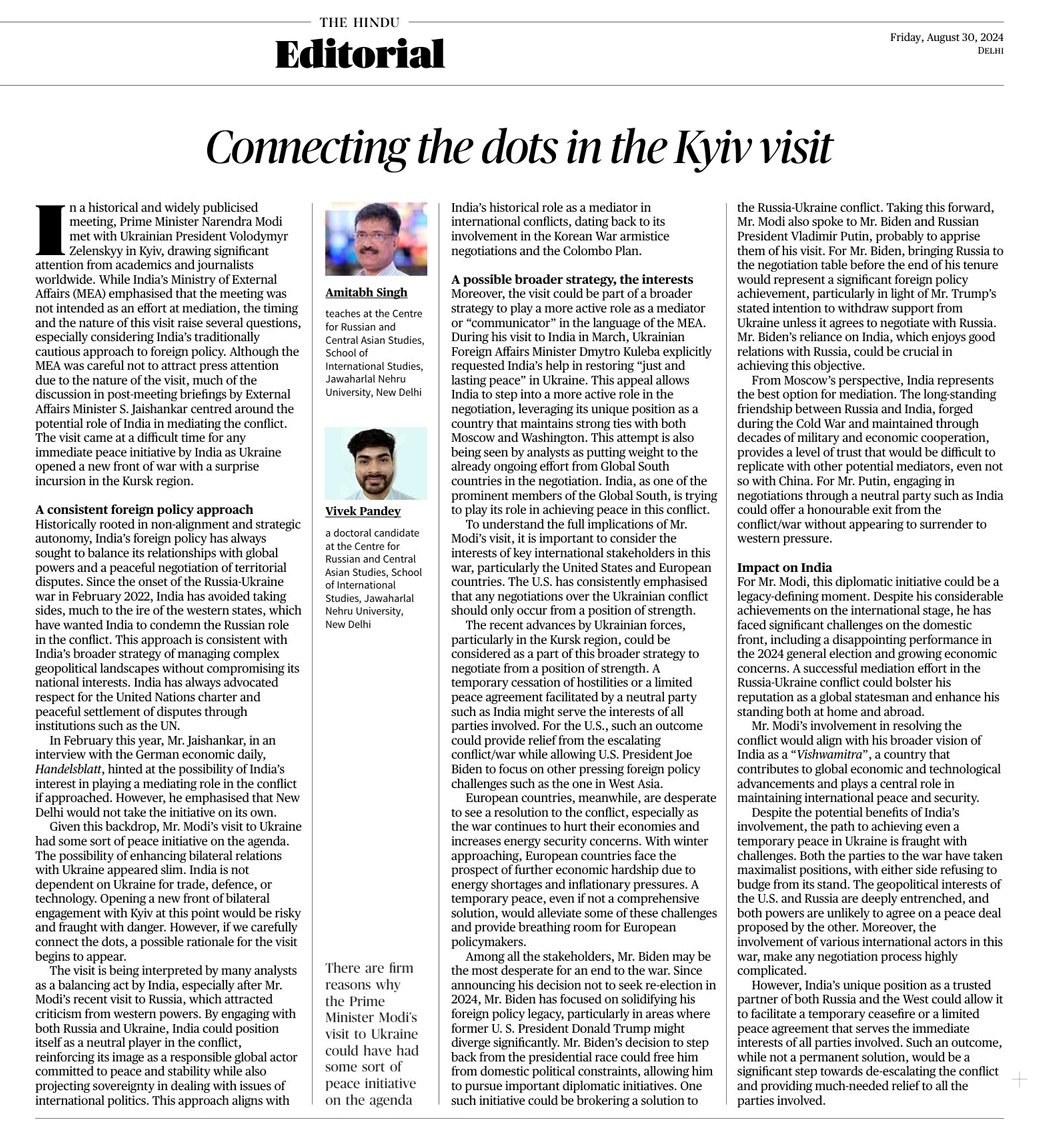
In today’s opinion piece, co-authored by Dr. Amitabh Singh for @the_hindu, we argue that leaders often prioritize their legacy above all else in the final days of their administration. We would appreciate it if you could read the article and share your opinion and feedback.
China is on a trajectory to lead the world in science, a development that will reshape technological advancement, innovation and the balance of global power
https://t.co/TrhgfDC22o
Semantics aside, I think India is a middle power for 4 reasons:
1. Weight: Sitting at #6 in nominal GDP—comfortably in the middle tier of global power.
2. Blocs: Balancing between US–China and US–Russia.
3. Bridge: Straddling the rich North and poor South.
4. Capability: Neither too weak to depend entirely on others, nor powerful enough to do without them.
Presently, this is the most plausible framework to understand India’s foreign policy and posture in the world today:
India follows a policy of alignment with the U.S. and EU, and, strategic autonomy is a parallel life jacket that is used with caution and much restraint only when a fire is about to break out in and around India. For the most part, however, strategic autonomy is not even pursued in a performative way because that undermines the natural evolution and legitimacy of the dominant policy of alignment.
Why did private firms, not state-owned enterprises (SOEs), come to dominate China’s EV sector?
My new @ChinaJournal article (co-authored with Xiao Ma @maxiaoalex) challenge the "top-down industrial policy" narrative.
The real engine? Strategic alliances between local governments and private capital. 🧵
Based on 3+ years of fieldwork, 60+ interviews (with officials, entrepreneurs, and engineers), and rich first-hand accounts, we show how strict central regulations inadvertently drove local states to bet big on private EV players.
Here is the story: (1/15)
1/
For nearly 60 years, the chip industry followed Moore’s Law: make transistors smaller, fit more onto a chip, and computing power increases.
Huawei’s new Tau (τ) Scaling Law asks a different question: what if future gains come from moving information faster inside the chip?
3/
Why it matters:
• A new approach to chip design
• Potential implications for AI and high-performance computing
• A sign that the semiconductor race is increasingly about architecture, efficiency, and system design
One of the most interesting tech developments to watch.
News! Secretary Marco Rubio extended an invite on behalf of President Donald Trump, for Prime Minister Modi to visit the White House in the near future! 🇺🇸🤝🇮🇳
9/ Can a partnership based largely on common opposition to the West survive if China’s growing role begins to restructure Russia’s own sphere of influence in Central Asia and Eurasia?
1/ @RajanKumarJNU Sir,
I went through your article in the @IndianExpress Explained section on Russia-China relations. It was very informative, especially the way you traced the relationship from the pre-Soviet era to the Soviet period and then the post-Soviet phase.
8/ So my question is:
Can the Russia-China partnership remain stable in the long term when China’s economic rise in Central Asia directly challenges Russia’s traditional influence in a region it considers strategically vital?