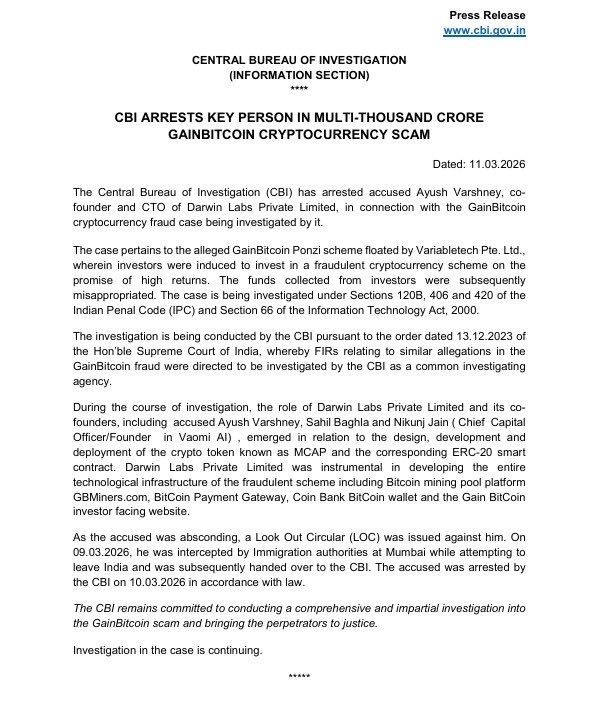
Dear @instagram team,
Our Instagram account @wiseadvicecrypto has been SUSPENDED.
This account represents more than multiple years of hard work, content creation and community building in the crypto space.
We’ve spent countless hours building this community, creating content and growing ‘WISE ADVICE’. Seeing the account suddenly suspended without a clear explanation is extremely concerning.
We respect Instagram’s policies and are more than willing to address any issue if there has been a violation.
@mosseri@Meta, please review our account and help us understand what happened.
Multiple years of work shouldn’t disappear without clarity.
Please help us get this resolved. 🙏
Would really appreciate some support from the crypto community here on X:
@pushpendrakum@EvanLuthra@simplykashif@cryptoamanclub@thisisksa@Btcexpertindia
The most expensive part of a hospital bill may never touch the hospital at all.
A patient admitted for care has no way of knowing whether the price on a medical consumable reflects its actual cost or a markup fixed long before it ever reached the ward. That gap in information is, at its core, a public health issue.
A survey of hospital consumables in Maharashtra found an IV infusion set with a trade price of ₹11.05 carrying a printed MRP of ₹325 ; a markup of 2,841%. A syringe procured at ₹6.75 carried an MRP of ₹57.20. A catheter procured at ₹29.41 carried an MRP of ₹310.
These are not elective purchases. Patients cannot compare prices, seek alternatives, or question a number printed on a box while receiving care and the MRP itself is often fixed upstream by manufacturers and distributors, disconnected from the trade price by a wide, unexplained margin. The result is a system where the party bearing the cost has the least information to evaluate it.
The regulatory gap is structural: scheduled medicines are capped under the Drugs (Prices Control) Order, 2013. Most medical devices and consumables are not leaving both the pricing and the information around it almost entirely unmonitored.
A review of these findings and clear guidelines on the permissible gap between trade procurement price and declared MRP have been recommended to the Department of Pharmaceuticals and the NPPA ; a step toward closing not just a pricing gap, but the information gap patients are left to bear alone.
#PublicHealth #GoodGovernance #Leadership #TukaramMundhe
https://t.co/Ye9CVzr8qU
BREAKING: 🇮🇳Gujrat law university says India urgently needs a clear regulatory framework for crypto assets.
They published a report, suggesting five regulatory models for policymakers to protect investors and so developers can build in India.
What do India’s top law students think about crypto regulation? 🇮🇳
CoinSwitch ran a national contest asking: How do we create crypto rules that protect users but still let the industry grow?
Here are the top 5 papers and their big ideas 👇
🚨 IMP: 🇮🇳 India’s strict crypto tax policy is backfiring. Big time.
▶️ 30% tax + 1% TDS is pushing users offshore:
• ₹4.87 lakh crore worth of trading volume generated by Indians on offshore exchanges between Oct 2024 and Oct 2025, an 85% increase year on year
• 91.5% of total Indian crypto volume is offshore, only about 8.5% happens on Indian exchanges
• ₹11,000 crore TDS lost since 2022 due to offshore trading
• ₹36,000 crore in capital gains tax lost due to user migration
• India ranks #1 in crypto adoption, yet tax revenue remains low
• Traffic to offshore exchanges is up 57%, Indian exchanges up only 21%
• Next 5 years could see ~₹39.9 lakh crore offshore volume and ~₹39,970 crore TDS at risk
▶️ What needs to change:
• TDS should be lowered from 1% to 0.01%
• Loss set-off should be allowed, like other asset classes
• Crypto should be taxed under normal capital gains rules, not a special flat 30% rate
🇮🇳 Indian government has invited inputs for the 2026–27 Union Budget.
Crypto users, this is your chance to push for meaningful reforms.
Submit your suggestions (link in comments)
🗓 Deadline: January 16, 2026
BREAKING: 🇮🇳 Bharat Web3 Association calls for fair crypto taxation, banking access & clear regulation at Pre-Budget meet.
Do you think we’ll see any progress in the 2026 Budget? 🤔
Thank you @raghav_chadha Ji for raising the right awareness in Parliament. Last time you promised me by tweet and you did it.
Your call to prevent Indian assets from moving offshore unchecked is timely and important. Appreciate you asking the right questions and engaging with the future of finance. 🇮🇳🔗
As per historical data 📊, Bitbns crypto exchange tweets only once every six months.
•Last tweet: June 2025
•Second last tweet: December 2024
So, I’m expecting their next tweet or reply next month.
No idea what’s going on with Bitbns there haven’t been any recent updates.
Guys, thank you for the incredible one-sided support!
As I mentioned earlier, today we’re set to cross 10,000 votes we’re almost there!
Just a few more hours and a final push from everyone will get us past the mark.
Let’s give our full support and make it happen!
We are still at rank 1.
🔥 If you want us to win, please ask everyone to give their full support now!
Right now, the difference between Rank 1 and Rank 2 is just 755 votes, and I’m currently leading by 755. 💪
But if our votes get divided again, I could drop to Rank 2 and Michael Sutton will take the lead.
So please vote wisely the direction is very clear now, it’s a one-sided fight. 🏆
Voting link in first comment 👇👇
Keep voting, guys! 💪
Binance has already started sending you flowers 🌺 looks like an indirect hint of victory! 😄
“Pushpa naam sunke flower samjha kya?
Pushpa jhukega nahi!” 💥🏆
🚨 BREAKING: India Reconsiders Crypto Rules 🇮🇳
The CBDT has reached out to #crypto platforms for inputs on taxes, regulation & offshore migration - a major sign of change for India’s crypto space.
🔑 CBDT Wants Feedback On:
✅ Need for a comprehensive VDA law
✅ Who should regulate crypto (SEBI, RBI, MeitY, FIU-IND)
✅ Whether 1% TDS per trade is excessive
✅ Allowing loss set-offs
⚠️ Current Problems:
🔻 30% flat tax on gains (higher than stocks)
🔻 No loss offset
🔻 Banks reluctant due to RBI’s stance
🌍 Impact So Far:
⚠️ Investors & exchanges moving offshore (Dubai = new hub)
⚠️ Capital & talent drain from India
⚠️ Global trend is regulation, not bans
🧐 CBDT’s Key Questions:
🔶 How much Indian trading volume has shifted abroad ?
🔶 How do Indian taxes compare globally ?
🔶 What’s the true effect of 30% tax + no loss offset?
🔶 Should different TDS rules apply to retail, institutions & market makers?
🔶 Can Indian exchanges comply with OECD’s global crypto reporting (CARF)?
⚖️ Why It Matters:
This is the first real signal of a shift from punitive taxes toward clearer, balanced regulation - giving the Indian crypto industry hope to thrive without innovation leaving the country.
Source: ET