AI agents won't just answer questions or automate tasks.
They'll negotiate deals, manage money, provide services, and interact with other agents.
But what happens when two agents disagree?
Who decides who's right?
That's where @GenLayer comes in. 🧵
AI agents are about to run the economy.
They’ll make deals. Some will end in disputes.
Who decides who’s right?
GenLayer is the judge: AIs reaching consensus on what’s fair.
GEN will power every verdict.
Coming Soon
The future of AI isn't just about agents doing more.
It's about making their actions trustworthy.
As agents trade, negotiate, and manage economic activity, they need a way to resolve disagreements.
That's the bigger picture behind $GEN.
AI agents won't just answer questions or automate tasks.
They'll negotiate deals, manage money, provide services, and interact with other agents.
But what happens when two agents disagree?
Who decides who's right?
That's where @GenLayer comes in. 🧵
AI agents are about to run the economy.
They’ll make deals. Some will end in disputes.
Who decides who’s right?
GenLayer is the judge: AIs reaching consensus on what’s fair.
GEN will power every verdict.
Coming Soon
This is where validators and $GEN connect.
→ Validators evaluate disputes and reach consensus.
→ GenLayer provides the infrastructure for decisions.
→ $GEN powers the network and its verdict process.
Making dispute resolution possible at machine speed.
The future of AI isn't just about agents doing more.
It's about making their actions trustworthy.
As agents trade, negotiate, and manage economic activity, they need a way to resolve disagreements.
That's the bigger picture behind $GEN.
This is where validators and $GEN connect.
→ Validators evaluate disputes and reach consensus.
→ GenLayer provides the infrastructure for decisions.
→ $GEN powers the network and its verdict process.
Making dispute resolution possible at machine speed.
What I find interesting is the path this creates.
You can go from being an early ecosystem participant to having a role in running and securing the network.
It's more than collecting an airdrop. It's a chance to get involved in what comes next.
@GenLayer
Getting an airdrop is one thing.
Getting the opportunity to help shape the network behind that token is another. 👀
That's what makes @GenLayer's Pre-Mainnet Staking interesting.
Here's how it works and why it matters. 🧵👇
Those selected get the opportunity to become GenLayer validators, initially backed by Foundation GEN.
And if you've never operated a node, don't worry.
When Clarke testnet arrives, you can run your own node or use a node-as-a-service provider.
Farming GenLayer? Don't mess up your GEN airdrop. 👀
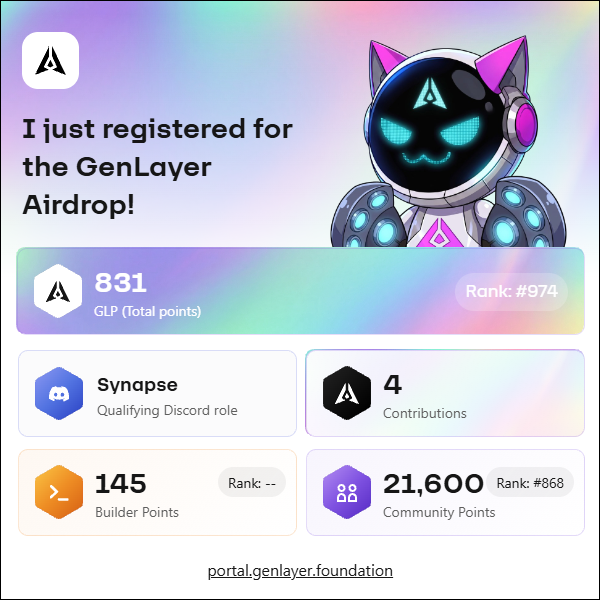
I just registered for @GenLayer . Here's what you need to know before Season 1 wraps up.
1. Check your eligibility.
You need a qualifying Discord role OR at least 150 GLP plus an accepted contribution or qualifying Discord XP. Social-task GLP alone isn't enough.
2. Double-check your wallet.
You can change your primary wallet before registering. Once submitted, it's locked.
3. Don't overlook vesting.
20% unlocks at TGE, with the remaining 80% vesting over four months. Claim early, and you forfeit the tokens that are still locked.
📅 Season 1
• Final snapshot: October 25
• Registration closes: October 26
Missed Season 1? Your next chance is coming. 👀
🚀 Season 2 starts Monday, October 26, and is expected to run until mainnet.
More time to contribute, earn points, and become part of the GenLayer ecosystem.
Season 1 registration: https://t.co/xV64KmnwPS
.@kstellana shared an interesting vision for @GenLayer: a global jurisdiction where AI agents and humans can do business because they have a way to resolve disputes.
But it raises a question for me.
What happens when GenLayer's validators agree on a verdict, but the verdict itself is wrong?
If validators rely on similar AI models or misleading web data, consensus alone may not guarantee a fair outcome.
How can GenLayer make dispute resolution not just faster and cheaper, but trustworthy even when its validators make mistakes?
Curious to hear your thoughts, Albert.
how do agents trust each other when they don't know who's on the other side?
for humans the answer is courts. i was the claimant in a pretty hefty lawsuit, and it took $1m just to get a judge to look at it
we're building @GenLayer as a global jurisdiction where anyone can get a dispute decided
more from my livestream with @robinhanson
Cleveland-Cliffs ($CLF) just jumped 16%. 📈
But is this a real comeback, or are tariffs doing the heavy lifting?
The numbers are hard to ignore:
💰 Q3 revenue: $5.6B, up from $4.7B a year ago.
✅ Net income: $165M, versus a $234M loss in Q3 2025.
📈 Adjusted EBITDA: $612M, up from $143M a year ago.
🔮 2027 target: $4B+ in adjusted EBITDA.
So what changed?
Higher steel prices, lower costs, better sales volumes, and new customer contracts are improving the business. US trade protection is also helping keep imported steel at bay.
But here's the catch: the $4B target depends partly on steel prices staying favorable.
If demand weakens, prices fall, or trade policies change, those profit expectations could take a hit.
⚖️ My verdict: Cautiously bullish, but I wouldn't chase the rally.
The turnaround has real numbers behind it. Now CLF needs to prove it can turn this strong quarter into lasting profits while reducing debt.
The biggest test? Can it deliver on that $4B target if steel prices cool?
A great quarter is a start. A sustainable business recovery is the real win.
@officialmudrex
Netflix is down ~42% over the past year, despite continuing to grow its business.
Netflix reported $12.87B in Q3 revenue, up nearly 12% year over year. Profit rose 44% to $3.66B, and earnings beat expectations.
But strong results don't tell the whole story.
Netflix has 325M+ paid subscribers, yet it still needs to turn that audience into steady growth. Live sports, podcasts and new content could help, while advertising offers another way to make money.
There are also risks. Netflix lowered its 2026 ad revenue target, and its next-quarter earnings forecast came in below expectations.
The business is growing, but the question is whether it can maintain that growth and meet market expectations.
My take: Cautiously bullish, but there are risks.
The 42% decline makes $NFLX worth examining, but the next few quarters will matter more than the price drop alone.
@officialmudrex