An AI agent has no card, no account and no API key. It can still buy one LLM call.
Ask, get a 402 with a price, sign a USDC payment, ask again. Two HTTP requests, live on our inference exchange for a week.
The flow in pic 1, the headers in pic 2.
Introducing Boundless Plans: run open models with up to 2.5x the usage you pay for, starting at $19/mo up to $199/mo with $500 credits included.
Blazing fast inference, hosted in the US with zero data retention.
Only 200 plans available. Get yours now ↓
Weird problem from building an LLM inference exchange:
you can't know which provider is cheapest until the model stops talking. But you must pick one before it starts.
We backtested a better answer-length guess on a week of real requests: overpay fell ~half. Caveats in pic 2.
@jschaffer@jimmyf0508 Every receipt shows the seller, the price and the wait. If a task fails, send me the job id and I’ll tell you what happened, whatever the verdict. Looking forward to the write-up!
@jschaffer@jimmyf0508 For the cheap half, the same model names as your OpenRouter lane give a clean price/speed comparison. https://t.co/6vPO2HNTs2 lets the exchange pick instead.
Set model.context_length to the model’s real window, so Hermes compacts on time. Each request is capped at $1 by default.
We’re looking for inference partners to help us serve and host our models at Pika!
If you’re working on inference infrastructure and are interested in collaborating, I’d love to connect. Please reach me directly at [email protected]
Today we’re launching Liquid Inference, an OpenAI/Anthropic-compatible router where inference providers compete on price for every prompt. Buyers route across 700+ open- and closed-weight models at the lowest available marginal cost, providers onboard instantly to start serving models.
I’ve been at @nebiusai for two years.
Today feels like one of those days we’ll look back on.
When people look at AI infrastructure, they often reduce the story to one thing: GPUs.
But what we’re building at Nebius is better understood through an equation:
$/MW × MW activated × speed-to-revenue × funding efficiency + software leverage
And in Q2, every part of that equation moved.
1. First: $/MW.
Our 2026 base was around $12M in annual contract value per MW.
- The deals signed in Q2 came in above $20M/MW.
- Short-term capacity opportunities are now reaching $40–50M/MW.
- Pricing on older gen GPUs increased by more than 30% vs Q1.
- Our first Blackwell capacity auction cleared 15% above the highest price we had achieved before, and 20% above the existing pipeline.
That’s what real pricing power looks like in a market where certainty, scale and speed matter.
2. Second: MW activated.
We raised our 2026 contracted-power target from more than 4GW to 5GW, and expect to deploy more than 1GW of new capacity annually starting in 2027.
But contracted power isn’t live compute.
Between the two sit permitting, construction, energy, cooling, networking, GPUs, orchestration, testing and customer onboarding.
The unglamorous (and brutally difficult lol) work required to turn land and electrons into reliable production infrastructure.
After two years at Nebius, I’ve come to believe that this conversion engine is one of the real moats.
3. Third: speed-to-revenue.
-> Q2 revenue reached $582M: +454% YoY and +46% QoQ.
the ai cloud rev reached $575 M. ARR reached 3B$ (adjusted EBITDA margin reached 50%)
And this was before most of our planned 2026 capacity comes online in the second half.
Demand is no longer only a pipeline story.
- Total contract value won in Q2 grew nearly 4× QoQ. TCV from new customers more than 9×'d
- four landmark agreements averaged more than $1B each (with Reflection, Cohere, a US AI neolab and a major US quant firm)
These weren’t passive inbound wins. They took competitive processes, technical POCs and trust earned across multiple engagement cycles.
Customers chose scale, performance, reliability, technical support and the ability to grow with us.
This is becoming a strategic-partner business, not a GPU-rental business.
4. Fourth: funding efficiency.
Roughly 70% of Q2 deals included customer prepayments.
Across the four landmark agreements, those prepayments cover 50–60% of the associated capex.
Expected payback fell to 1 year and 10 months, compared with 2–3 years historically.
Add more than $9B of expected customer prepayments in 2026 and our first ~$775M asset-backed facility at SOFR +250bps, and the flywheel becomes:
Signed demand → prepayments → infrastructure → contracted cash flows → cheaper financing → more infrastructure.
That is a long way from “build it and hope.”
But let’s be precise: this remains infrastructure.
Q2 capex was approximately 5.7B$. Converting GW into production compute requires enormous capital and near flawless execution. The breakthrough isn’t that the business suddenly became capital-light. It’s that more of the build is becoming contracted, prepaid and financeable.
5. And then comes the final part: software leverage.
@nebiustf production inference workloads more than tripled in Q2.
Aether 3.6 strengthened the core cloud platform. @tavilyai brings the real time information agents need. Echo creates a natural language interface for operating infrastructure. @Eigen_AI_Labs and @clarifai deepen our inference capabilities.
This part is particularly personal for me because much of my own work sits close to Token Factory.
The opportunity isn’t simply selling GPU hours, it’s serving the complete AI lifecycle:
Training → post-training → inference → grounding → agents.
Training creates inference demand. Inference creates demand for tuning, evaluation and optimisation. Agents multiply model calls and require reliable access to real-time information.
A platform that serves that entire loop can improve customer outcomes, infrastructure utilization and economics simultaneously.
So the complete equation is:
Higher $/MW
× more MW activated
× faster conversion into revenue
× smarter funding
+ more software per unit of compute.
Each term reinforces the others.
And that’s why today’s announcement is so meaningful.
Two years ago, much of this existed as ambition, architecture and an extraordinary group of people willing to build from first principles.
Today:
- $3B ARR. 50% AI-cloud adjusted EBITDA margin
- More than $40B in customer commitments.
- A 5GW contracted-power pipeline.
Still early, but very real.
I’m incredibly proud of what this team has built, and even more excited by what’s ahead.
The Nebius story isn’t “more GPUs.”
It’s turning power into compute, compute into intelligence, and intelligence into products people use every day.
Strategy → execution → compounding.
We’re just getting started. $NBIS
Disclosure: I work at Nebius. This post is based exclusively on today's public earnings materials and public earnings call. The interpretations are my own and do not represent official company guidance or investment advice. Personal views, not investment advice.
Public sources:
https://t.co/DsFTpShaK2
https://t.co/fOqXoWDB8Z
https://t.co/bYmCk6du4k
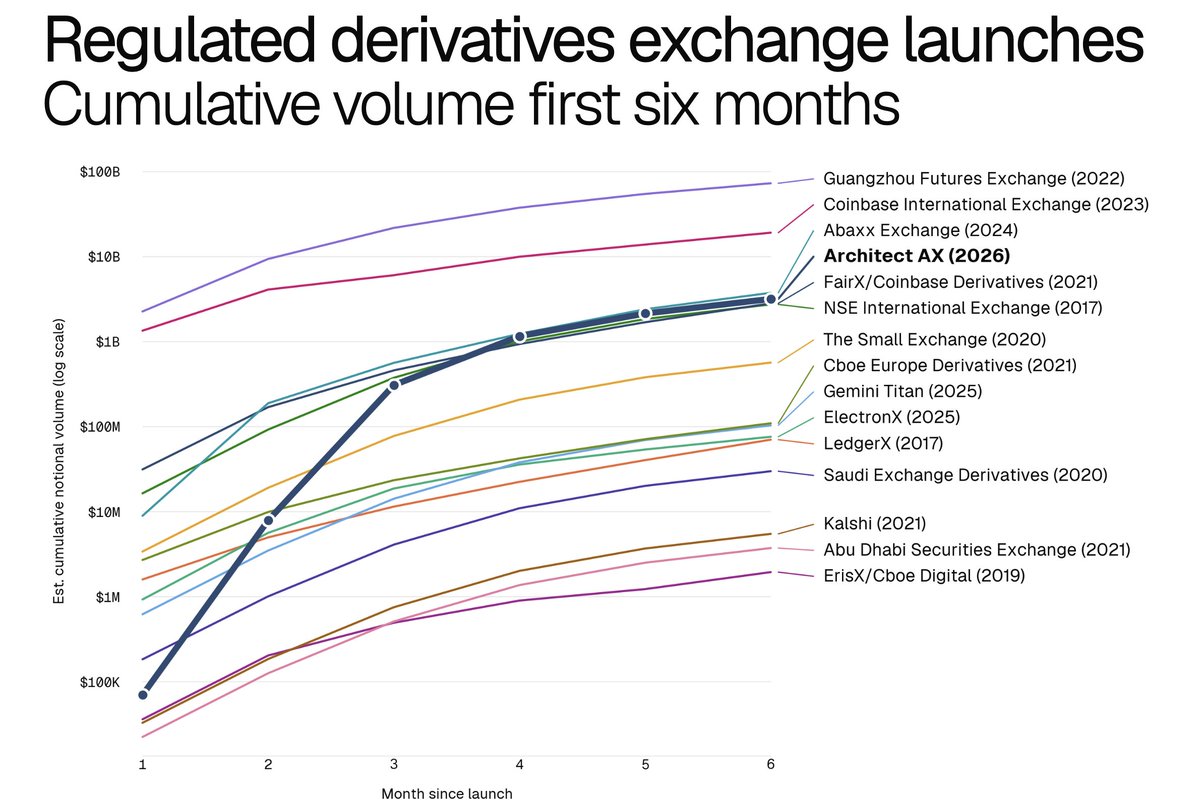
Architect AX traditional asset perpetuals exchange at six months: $3.3B total notional, $1.1B one-sided notional/month,15M orders/day, 80 minutes downtime. A comparison of first six months’ volume on regulated derivatives exchanges (US and intl) launched in the last ten years
"GTM iS EaSY"
GTM:
> turn off open tracking
> no link in the first email, ever
> never send from your root domain
> verify emails at send, not at import
> 30 sends a day per mailbox, no more
> plain text, no images, no tracking pixels
> score positive replies, not total replies
> waterfall three data providers, never trust one
> enrich your tier one accounts, not the whole list
> use local data providers for emea and apac lists
> don't discard catch-alls, score them and send anyway
> track headcount deltas by department, not by company
> filter the list by mx record before you write any copy
> funding rounds are the most spammed signal in outbound
> 300 contacts per variant or you are just reading noise
> a first sales ops hire beats a series b as a trigger
> rebuild the list monthly, a third of titles rot every year
> a job post naming your competitor is a displacement signal
> read their job posts for the tech stack, it beats builtwith
> two customers asking for the same integration is a channel
> ai personalization on a bad list only amplifies the bad list
> write the first email to be forwarded down, not read at the top
> champion job changes are your warmest list and they cost nothing
> target whoever owns the pain, then ask them who owns the budget
> measure at meetings held, everything upstream of that is a proxy
> a new vp has 90 days to swap vendors, that window is your campaign
> soc2 on their trust center means they just started selling upmarket
> export closed-won, enrich it, and find the three attributes every account shares that your icp doc never mentions
> find where the champions from your last 20 lost deals work now, and open with the workflow you already know they run
> pull your competitor's sitemap, grab /customers and /case-studies, enrich every logo you find, that's the best list you'll ever build
> scrape every job post that names your competitor, filter to the last 30 days, and send the displacement email to the hiring manager, not the recruiter
> take your churned power users, find their new employers, and open with the exact workflow they used to run, nobody else hitting their inbox knows that
Architect’s traditional perpetuals exchange AX, one of the fastest-growing regulated derivatives exchanges in history, is opening trading to individuals and omnibus brokers. With $3B notional in <6 months in institutional trading, we’re excited to welcome a new investor class.
We launched AX in February with the conviction that building the largest global regulated exchange for traditional asset perpetuals starts with addressing the needs of institutions and professional market participants: robust risk controls, institutional-grade infrastructure, responsible leverage, wash-trading and market manipulation prevention, no internal market maker, and a clear tier-1 regulatory framework.
Our GTM strategy was a risk we took based on ambition, industry experience, intuition, and discipline. Our team is now ready to win the opportunities that risk has yielded, in expanding our markets internationally and building what’s needed here in US derivatives markets.
AX offers individual traders the same benefits that have enabled our institutional customers to grow the exchange this large this quickly: a market-defining UX, infrastructure built by elite industry experts, superior book liquidity, low fees and open incentive programs, high-throughput and full-featured APIs, competitive margin, 24/7 one-on-one support, no auto-liquidation or ADL.
Join us for the next stage of AX and Architect.
Today we're launching https://t.co/BlKNFocVzu.
Buying or selling GPU capacity means describing the same cluster over and over: model, count, region, fabric, term, price. It's slow to write, easy to garble, and impossible to track once it's been forwarded a few times.
Architect is now pre-onboarding individuals and institutions to trade US-listed compute futures on the American Innovation Exchange, launching imminently. Open an account on our website or app, trade the first-ever US GPU futures and options, join our liquidity programs:
American Innovation Exchange futures are purpose-built for the US AI ecosystem:
• Compute consumers (AI labs, model developers, hyperscalers) can hedge forward GPU pricing and reduce earnings volatility.
• Compute producers and neocloud operators can hedge inventory, generate yield through covered strategies, and better finance expansion.
• Asset managers, hedge funds, and proprietary trading firms gain efficient, regulated long/short exposure to compute as a distinct asset class.
• The broader market benefits from transparent price discovery, a visible forward curve for deprecation, and supply/demand forecasting, and reduced basis risk through collaboration with index providers.
Trading will be supported across desktop, mobile, and API, with order book and block trading capabilities.
The launch of Architect’s compute futures marks a significant step in developing mature US financial markets for AI infrastructure and supporting the critical buildout of American compute capacity. We look forward to offering a seamless trading experience with low fee and favorable margin treatment to individuals and firms across AI and finance.
SK Hynix listed today as an American Depositary Receipt (ADR) on Nasdaq. ADRs are the primary instrument for US investors to gain exposure to foreign stocks. and they’re what I started my career trading at Jane Street. The main advantages of perpetual futures over ADRs:
• Coverage isn't gated by a bank. An ADR only exists if a depositary bank builds the ADR program with permission from the underlying company. SK Hynix illustrates the gap this creates: until this week, a US investor seeking exposure to the second-largest global memory maker had to trade an illiquid over-the-counter line or open a Korean equities account. Perpetuals require only a reliable price feed to enable a listed foreign name to be tradeable, with no sponsorship, roadshow, or multi-billion-dollar offering required to unlock access.
• No fixed pool of receipts. ADRs are registered in a finite quantity on Form F-6. When demand exceeds that pool and the depositary suspends creation of new receipts, the ADR detaches from the underlying and trades at a large premium. A perpetual has no such ceiling. Its funding-rate mechanism is what keeps the price tethered to fair value, rather than a bank's inventory,
• Ability to short. Shorting an ADR requires locating borrow, paying a stock-loan fee, and living with recall risk. In November 2023 Korea imposed a full short-selling ban that was only lifted in March 2025, which carried through to depositary receipts. Shorting a perpetual, on the other hand, is structurally symmetric to buying a perpetual. High borrow costs will be reflected in the perpetual funding rate, but shorting perpetuals will always be mechanically possible.
• No depositary fees. Depositary banks charge custody and servicing fees on ADR positions, typically extracted from dividends. Perpetuals don’t carry these fees, and the full amounts of dividends are reflected in the funding rate.
• Better price discovery. The SKHY ADR on Nasdaq and its underlying stock 000660 on KRX have no trading hours in common. There is never an opportunity for true arbitrage where the two markets can be brought in line. Perpetuals can easily trade 24/7 and provide ample time for the derivative and the underlying stock prices to converge.
SK Hynix ringing the Nasdaq bell is a genuine milestone for the ADR model as the largest ADR offering by a foreign company in history. Regulated US perpetuals will augment our ADR markets and provide investors wider exposure to strategic global companies in AI and other advanced industries.
The best analogy I've found for compute markets is electricity + power markets - heterogenous, temporal, with hub-based pricing, but still became a tradable commodity. So I took the weekend to read up on power markets, a few takeaways:
> US power markets have multiple regional benchmarks - eg. PJM-West (East Coast), ERCOT North (Texas), CAISO SP15 (SoCal) instead of a single standard.
> The above regional benchmarks are from physically separate interconnects/grids. Regional grids are operated by system operators (ISOs/RTOs) that operate a series of end substation "nodes" (in SF: Embarcadero, Larkin, Mission). Node pricing differentials fall out of a system optimization algorithm - this results in Locational Marginal Pricing (LMP)
> LMP is the "magic sauce" that connects the benchmarks with substation spot delivery (see pic). Prices fall out of constrained optimization over generation dispatch, minimizing total system cost subject to forecasted demand at each node, physical transmission line limits + power flow physics. Hub/index prices are weighted averages over baskets of these LMP nodes, and become stable enough to trade on CME/ICE
> The compute analog for Grid-Operator-LMP node is actually Hardware-Vendor-Cluster. Compute indices are spliced at the physical hardware level - H100s, H200s, B200s, B300s form separate benchmarks, just like PJM/ERCOT/CAISO. At the "Operator" analog level, we have different compute vendors (eg. AWS, GCP, Nebius, Coreweave, SF Compute, Ornn). Each of these offer pricing for a fleet of SKU instances, similar to power market nodes.
> The cleanest analog to something like LMP is a scheduling algorithm - you can create dynamic instance prices based on demand for a particular SKU within your fleet (eg. H200s at us-east-1 on 8/1/2026) + its availability. The catch is that whereas wholesale power rates are FERC-mandated to be transparent under Federal Power Act, compute markets don't have any transparency mandate. The result is that you can only price based on your own fleet's orderbook rather than everyone.
> This dynamic means that (at least for now) compute markets will likely have much wider price differentials between vendors and ultimately larger amounts of basis risk than their power market cousins.
> In power markets, although principals (generators on shortside, load-consuming entities on longside) sometimes hedge directly on exchange, mostly they go through OTC dealer desks (banks/trading firms) that swap nodal settlement for hub settlement at a spread + hedging standard legs. In the future, we may see compute dealers selling cluster swaps to certain hubs for a spread.
Overall takeaway is that power markets actually offer an incredible amount of parallels/learnings to how we can and should design compute markets. And given how these power markets literally underpin the modern datacenter stack, there's a beauty to how compute markets rhyme with the markets of their underlying electrons.