FREE Math Book.
"Games & Puzzles: Discovering the Art of Mathematics" by Volker Ecke et al.
Mathematical inquiry in the liberal arts: Rubik's Cube, Rattler Wooden Puzzle, Sudoku, Kakuro, Radon/Kaczmarz Puzzles, Hex, Latin Squares, Tomography, John Nash, Game Trees – Complexity, etc.
"Empowers you, the explorer, to investigate connections between mathematical ideas and concepts and the structures and patterns found in games and puzzles. Pick up a Rubik's Cube and explore group theory while analyzing the powerful moves that you discover. Investigating puzzles like Sudoku, you will come to understand the intricate mathematical structure to allow you to create your own puzzles, and learn about deep connections to the mathematics of medical imaging. Inquiring into good moves and strong positions in connection games like "Hex" reveals mathematical patterns for your own strategies for being successful in this game. A seemingly simple game of piles can help you explore connections to how computers think. "
Link: https://t.co/Yy5WwR8PKe
🚍 SERVICIO DE AUTOBÚS NOCTURNO
Con motivo de las fiestas patronales, se prestará un servicio especial de autobús las noches del 27 al 28, del 29 al 30 de junio y la del 4 al 5 de julio de 2026.
+Info programación de Fiestas 👇
https://t.co/OiqQ8xeddj
#Ramales#Fiestas
🚨 They are bringing back #ChatControl 🚨
Metsola doesn't understand that no means no.
Discussion is scheduled for Monday, so act now: https://t.co/UvGWz3neTJ
#No2Surveillance#Privacy#Security
🚨 THIS COULD BE THE LAST PAPER EVER WRITTEN BY HUMANS — FOR AI TO READ.
A groundbreaking new paper co-authored by 37 researchers from Stanford, CMU, Michigan, and other top institutions—titled *The Last Human-Written Paper*—delivers a provocative wake-up call: the traditional academic paper format, largely unchanged for centuries, is rapidly becoming obsolete in the age of AI.
The authors expose two hidden—but enormous—costs baked into every modern paper:
**1) The Narrative Tax:**
To deliver a clean, compelling story, researchers erase failed experiments, dead ends, overturned hypotheses, and messy detours. What AI gets is a polished “victory lap”—a streamlined walkthrough of success—while the truly valuable “pitfall logs” that reveal what doesn’t work are lost forever.
**2) The Engineering Tax:**
Papers contain just enough detail to pass peer review, but far too little for an AI agent to faithfully reproduce the work. Critical insights, subtle tricks, and practical wisdom remain locked away in authors’ minds, undocumented code, and private Slack threads.
Their bold solution? Move beyond static papers to ARA: rich, executable “research packages” built specifically for AI agents.
These packages would deliver not just conclusions, but the complete journey—full code, reproducible pipelines, evidence chains, and transparent documentation of every path explored, including failures.
What makes this paper truly compelling is its forward-looking lens. It doesn’t focus on how AI can help humans write papers. Instead, it poses a deeper, more urgent question:
When AIs become the primary readers and executors of research, should our research outputs still look like traditional papers?
In the near future, the true measure of great research won’t be how closely it resembles a classic paper, but how effectively it can be understood, reproduced, traced, and iteratively advanced by AI agents.
For centuries, humans have written papers for other humans. The next era may center on crafting powerful, living research packages for AI to consume, execute, and build upon.
THEY ARE GOING TO BAN VPNs
THEY ARE GOING TO BAN VPNs
THEY ARE GOING TO BAN VPNs
THEY ARE GOING TO BAN VPNs
THEY ARE GOING TO BAN VPNs
THEY ARE GOING TO BAN VPNs
THEY ARE GOING TO BAN VPNs
THEY ARE GOING TO BAN VPNs
THEY ARE GOING TO BAN VPNs
THEY ARE GOING TO BAN VPNs
The UK government spyware demand means that the government decides exactly what should be censored on every mobile device. They say they will start with nude pictures (if you don’t identify yourself as an adult). But it could at any time be expanded to anything the government disapproves of. Today, 30 people are arrested every day in the United Kingdom for writing something online that the government classifies as "grossly offensive". It is obvious that they will use this tool to restrict free speech.
Currently, there appears to be no requirement to report findings outside the device. However, with both legal and technological decision-making power taken away from individuals and transferred to the government, that is only a pen stroke away.
This means that the government could also use this system for total mass surveillance.
And they can do so in secret.
The government recently, in secret, tried to pressure Apple (which is now agreeing to client-side scanning) to build backdoors into its end-to-end encrypted cloud service. They can do this under the Investigatory Powers Act 2016, also known as the "Snoopers' Charter" – a law that makes it illegal for tech companies to disclose secret demands from the government.
📌 Toda la programación de fiestas patronales y eventos de carácter cultural y deportivo para el año 2026 en el municipio.
Ya está disponible en:
También puedes descargártelo en formato PDF
👇👇👇
https://t.co/OiqQ8xeddj
🎺🎊🕺🎈¡¡¡ FELICES FIESTAS!!!
#Ramales#Fiestas
Este editorial de NATURE sostiene que la forma en que las nuevas generaciones consumen información está cambiando radicalmente. Concluye que si los científicos quieren seguir influyendo en el debate público, tienen que adaptarse a ese nuevo formato del ecosistema informativo y que la comunicación científica del futuro deberá ser cada vez más breve y visual.
Cada época moldea los instrumentos con los que busca la verdad, pero eso, a su vez, también transforma la capacidad para atenderla. En la cultura contemporánea, la atención parece dispersarse en haces cada vez más breves. Y el riesgo de que eso cambie nuestra forma de pensar es elvado. N. Postman advirtió que una sociedad puede llegar a preferir lo que entretiene a lo que explica. Así que el verdadero escollo estará en lograr que la búsqueda de la verdad sobreviva al cambio de formato. Habrá que ver si seguimos siendo capaces de distinguir entre información -que puede consumirse en segundos- y conocimiento -que exige concentración y tiempo-. Ninguna revolución tecnológica debería volver obsoleta esa importante diferencia
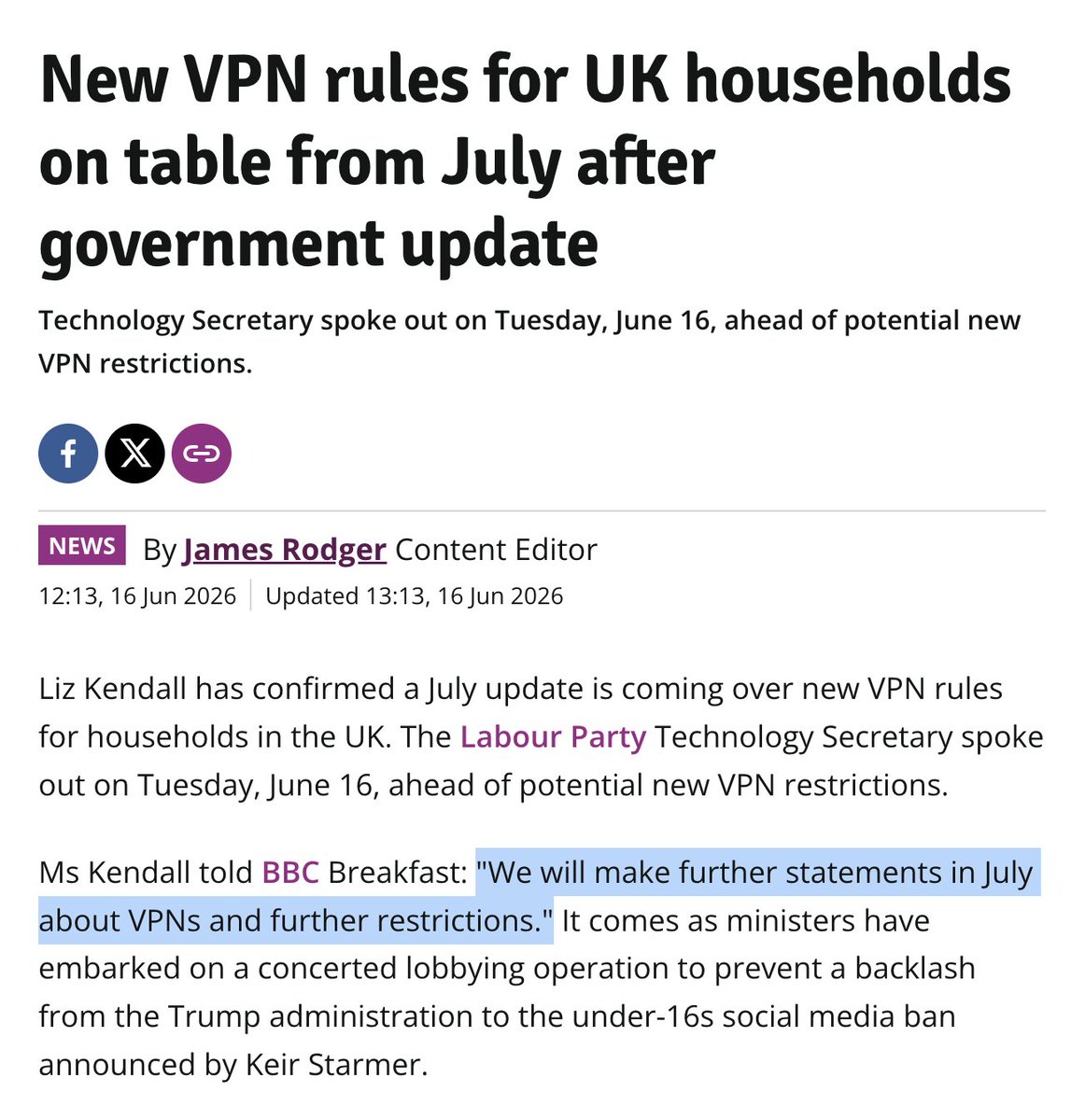
Is the UK on the verge of banning VPNs?
On May 26, the consultation intended to help the British government make decisions on age verification for websites, digital services, and social media platforms came to an end. Some form of restrictions regarding at least age limits for social media already appear inevitable; government officials have confirmed as much. The only question is what kind of restrictions will be imposed.
For example, the age verification restrictions could end up including VPN services. National restrictions for websites and social media can be bypassed using tools such as VPNs, virtual phone numbers, eSIM cards, Tor and dedicated services. It is therefore unsurprising that politicians have begun looking toward VPN services, which are the most common and accessible method of changing one’s geographic location.
In early 2026, the House of Lords sent an amendment(regarding the Children’s Wellbeing and Schools Bill) to the House of Commons, proposing an 18-year age limit for using VPN services. The House of Commons rejected the House of Lords amendment four separate times. However, the House of Commons instead introduced its own proposal, which was passed and has now become law. This agreement grants the government the power to introduce restrictions through secondary legislation, with only limited parliamentary scrutiny.
Unfortunately, the risk that the UK government will crack down on VPN services is real – effectively joining countries such as China and Russia in opposing VPN services. Officials have already hinted that they may consider introducing age restrictions for VPN usage under the slogan “No platform gets a free pass”.
If VPN services were to implement identity verification, this would mean collecting data that could be abused through either malice or incompetence. It would, for example, make such services risky for whistleblowers and activists, make it harder for journalists to work with sensitive information, and create a chilling effect on online debate (VPNs can help people post anonymously on social media). In a society like the UK, where 30 people are arrested every day for writing something online that authorities classify as “grossly offensive”, VPN services are an important tool for free speech.
If VPN providers were to impose an age limit on their service, this would also mean that underage users would effectively lose their right to online privacy. Ironically, one consequence would be that social media companies mapping people’s lives through third-party trackers on websites could continue monitoring young people’s online behavior via their IP addresses without any interference. In other words, politicians would remove one of the protections children have against the very companies they claim to want to protect children from.
Some politicians in the UK think it is a good idea to introduce identity verification for using VPN services.
It could be that these politicians do not understand what they are proposing. The alternative, that they do understand, would be even worse.
Whistleblowers, activists, and journalists depend on anonymous VPN services. Requiring identity verification for VPN services would put them at risk. It would also have a chilling effect on online debate (VPNs can help people post anonymously on social media).
In authoritarian countries, VPN services are crucial forcriticizing the government. That is precisely why such governments seek to ban or restrict them. Hopefully, the UK will not join that list.
So-called age verification for social media is spreading across the world, framed as an effort to create a safer internet for children. In reality, age verification lays the foundation for a fully controlled internet.
The age verification rush must be slowed down, and politicians need to recognize the consequences of different types of legislation and systems.
Age verification is the wrong approach to fix “the social media problem”
The big tech social media companies are bad. Their business model is bad; it is based on mass surveillance and manipulation, and they cooperate with governments in mapping entire populations. But age verification is fundamentally the wrong approach to preventing children from using big tech social media platforms. Introducing age verification is based on coercion; the state forces social media companies to verify their users’ identities. But the big tech social media platforms already know which of their users are children. Their business model depends on knowing this. They know how old users are, and they know exactly what type of person they are. As age verification is based on coercion, politicians could instead force platforms to stop doing the things politicians consider harmful to children, or force them to block children (again, they know who they are) from using their services. But instead, politicians seek to massively invade everyone’s privacy and undermine democratic rights on a global scale. In other words, the latter is the real objective – they do not want to protect children; they want to impose control.
Slippery slope of age verification
It is undeniable that age verification threatens freedom of expression, risks increasing mass surveillance, and is likely to lead to censorship. It will not only shrink the online world and reduce young people’s right to privacy (for example, if VPN services were to be restricted); but also risks becoming a significant step toward a controlled internet for everyone.
Most age verification is identity verification
Most countries are now considering introducing age verification systems, meaning that everyone would have to identify themselves either to the service/website they want to use or to a third party capable of linking them to their activity on that service or website. This is not age verification but identity verification, and the consequence is therefore that freedom of information is restricted (you can no longer visit regulated websites anonymously) and that you can no longer post anonymously on social media. This is a major problem in countries like the UK and Germany where the police conduct raids on people’s homes for posting content on social media that the authorities dislike. Or in the United States, where authorities are trying to pressure tech companies into revealing the identities behind accounts protesting ICE. Social media identity verification removes important tools for activists in countries where criticizing those in power is dangerous.
Restrictions on app store or operating system level
Some countries are looking to impose identity verification at the app store level or even within the operating system itself. This is an exciting experiment, since this is possible to circumvent using open-source operating systems. Some countries are already looking to include open-source systems. Since open-source systems cannot be controlled, politicians would ultimately need to ban devices that are not controlled by the state. The end point: telescreens like those in Orwell’s 1984, devices that both monitor you and broadcast only the information approved by the state.
The Zero-Knowledge Proof (ZKP) alternative and the EU
The EU has presented its own age verification app as “completely anonymous”. The idea is to use Zero-Knowledge Proof (ZKP) cryptography to break the link between the age credential issuer (EU governments) and the regulated services/sites. Currently, the EU app does not have ZKP functionality, contrasting Ursula von der Leyen’s claim that the app ”is technically ready to be used”. But more importantly, the app is currently designed to always function without ZKP technology; if ZKP is unavailable, the app falls back to a non-ZKP model. Even if fully developed ZKP technology could be implemented in the future, it would remain an optional extra feature that countries may choose to disable and that the EU could remove at any time.
Read more on our site.
https://t.co/wTVKHMS1zg
On March 20, 2026. GrapheneOS came out and said they won't comply with age verification laws. Worldwide.
Apple and Google complied. ID scans and facial recognition is now required to download an app.
Makes sense why GrapheneOS has 400k users without marketing.