Post No.251#GOBACKFAIRFAX
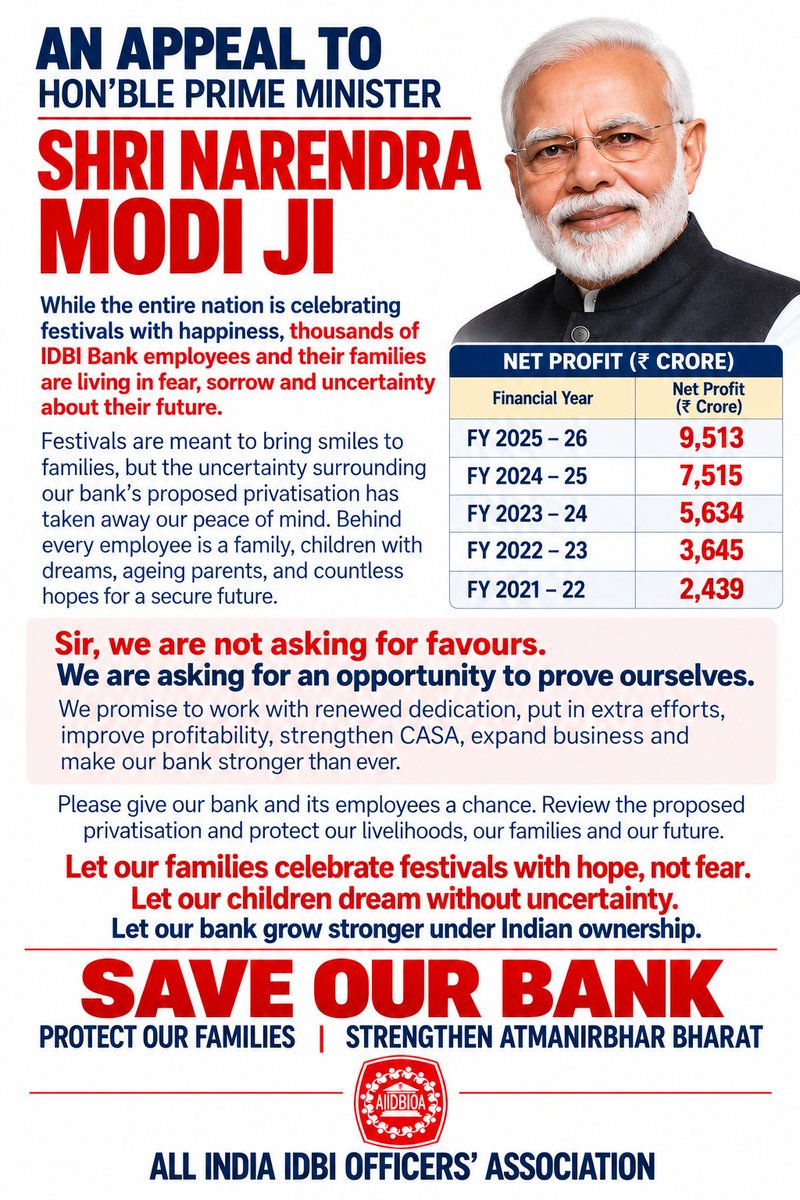
WE, THE EMPLOYEES OF IDBI BANK, OPPOSE PRIVATISATION!
IDBI Bank is not just a financial institution,it is our livelihood, our professional identity, and a legacy built through decades of dedicated service @narendramodi 🙏
Amid the rhetoric of self-reliance, why transfer control of a public financial institution to a foreign group, asks Devidas Tuljapurkar.
“On October 14, 2026, the Union government approved the sale of a combined 60.72% stake in IDBI Bank, held by the government and the Life Insurance Corporation of India, to a company associated with Canada’s Fairfax Financial Holdings.
“This clears the way for a foreign private group to acquire a majority stake and management control.
“This decision cannot be viewed merely as the sale of shares in a bank. At stake is the future of an institution built with public resources that played an important role in India’s industrial development. The decision requires scrutiny in the context of public investment, parliamentary accountability, social justice and economic sovereignty.”
https://t.co/vG3mPzXLbp
#GOBACKFAIRFAX@ShashiTharoor Sir,
IDBI Bank has proved its mettle by rising from huge losses and mounting NPAs to a sustained rally of profitability.
Selling an institution that has fought its way back to strength means surrendering a strategic asset built through collective effort. Wouldn’t strengthening and retaining control of such an indigenous institution be the true spirit of Atmanirbhar Bharat (Self-Reliant India)?
#IDBINotForSale #SaveIDBI #AtmanirbharBharat #StopPrivatisation
https://t.co/6tJfAdetAW
IDBI Bank has proved its mettle by rising from huge losses and mounting NPAs to a sustained rally of profitability.
Selling an institution that has fought its way back to strength means surrendering a strategic asset built through collective effort. Wouldn’t strengthening and retaining control of such an indigenous institution be the true spirit of Atmanirbhar Bharat (Self-Reliant India)?
#IDBINotForSale #SaveIDBI #AtmanirbharBharat #StopPrivatisation.
@INCIndia@ashwani_mahajan@timesofindia@DainikBhaskar@EconomicTimes@RahulGandhi@DFS_India@FinMinIndia
Cleared a tough government competitive exam, celebrated with family, secured an IDBI job—only to face the sudden threat of privatization, job insecurity, and shattered futures. This is unfair to banking aspirants and employees who served with dedication.
#IDBI#IDBINotForSale
Read Prof. Arvind Panagariya's piece in ET today, "Pivot to Privatisation 2.0". With all respect to the Chairman of the 16th Finance Commission, I did not need a single outside fact to answer it. His own article does the job!
He says there is "enormous wisdom in transferring the bank to private hands now, when its healthy books enable it to attract buyers". Healthy books made by whom? By his own figures, gross NPA fell from 21.25% to 2.32% and CRAR rose from 10.7% to 26.65% while LIC and the Government owned the bank. So the "healthy books" are the proof that public ownership worked, not a reason to end it.
He says it is best to close or sell PSBs "that regularly drain government finances". His own article says IDBI made a record profit of ₹9,513 crore in 2025-26. By his own test, IDBI does not even qualify for sale!
He says repeated support "amounts to throwing good money after bad". His own numbers: GoI put in ₹27,441 crore and LIC ₹26,367 crore. That money did not go waste, it built a bank earning ₹9,513 crore a year. Good money after bad is when the patient dies. Here the patient walked out of the hospital, and we are selling him at the gate.
He says GoI and LIC, with 15% and 19%, "stand to share in the benefits almost certain to accrue". If the benefits are almost certain, why sell 60.72% of them? And the sale brings ₹52,879 crore against roughly ₹53,800 crore of public money put in. Where is the fiscal gain?
He says worker and wage concerns "lacked empirical support", citing a study of 14 Vajpayee-era privatisations. Not one of them was a bank. And if he is so sure employees will be better off, the government should have no hesitation in giving IDBI staff written statutory protection. The union is asking for exactly that.
He compares it with Air India, sold with ₹61,000 crore of debt settled at taxpayers' expense. IDBI carries no such burden. One was bleeding, the other is earning.
His subheading says "non-strategic PSBs", yet his own last paragraph lists "banking, insurance and financial services" among the four strategic sectors of the 2021 policy, and his own caveat says "provided national security or strategic concerns are not at stake". So we must ask, who examined that before handing an Indian bank to a foreign group?
In 2018 I wrote about "अश्वत्थामा हतः" and how nobody hears "नरो वा कुंजरो वा". Today also, "biggest FDI" is announced loudly, while the turnaround under public ownership is said softly. And in December 2003 Parliament was assured majority ownership would stay. "रघुकुल रीति सदा चलि आई। प्रान जाहुँ बरु बचनु न जाई॥"
Keep 51%.
@DFS_India@narendramodi@nsitharaman
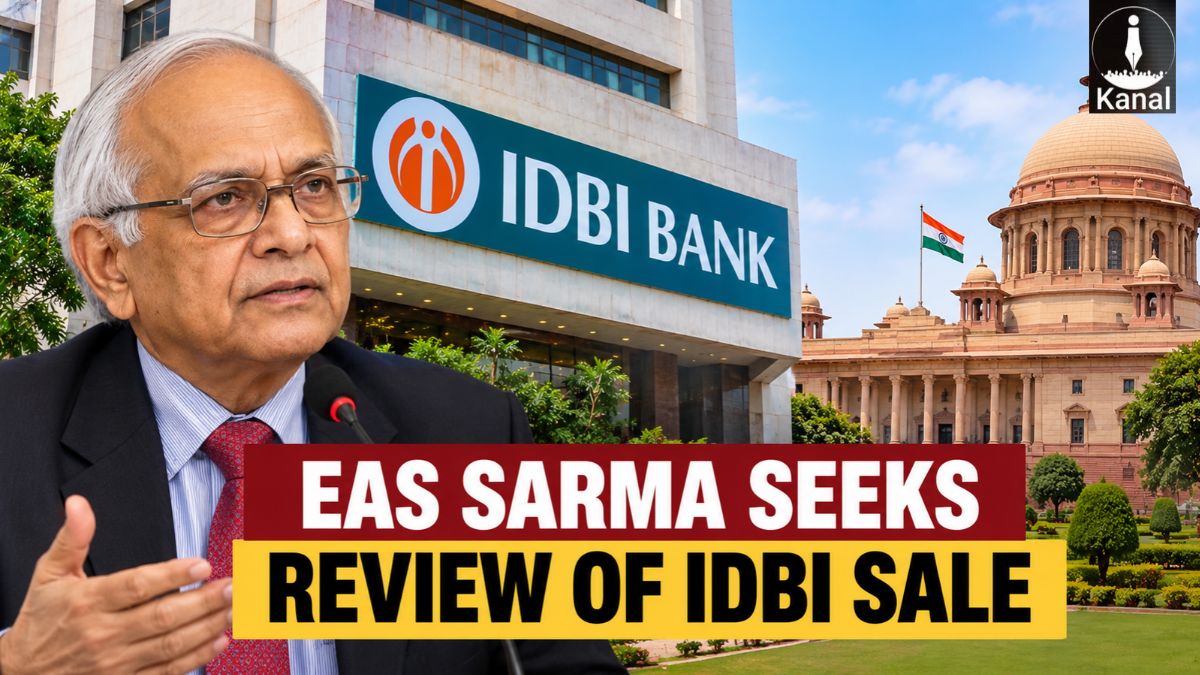
EAS Sarma Urges President to Review IDBI Bank Disinvestment
Read More: https://t.co/SwLt7FisZV
#EASSarma has urged the President of India to review #IDBIBank’s #Disinvestment and order an independent inquiry into the sale of a 60.72% stake to Canada-based Fairfax Financial Holdings for ₹52,878 crore. He raised concerns over the valuation process, transparency, bidder participation and the interests of LIC policyholders and bank depositors.
#SaveIDBIBank
गुस्सा है?
हो सकता है।
निराशा भी है कि इतनी मेहनत के बाद ये फ़ैसला आया।
पर एक बात सोचिए, गुस्सा अगर आपस मे बँट गया तो किसी काम का नहीं।
साथ मिल गया तो ताक़त है।
आज कौन IBPS से आया, कौन पहले से था, ये बहस करने का दिन नहीं है। फ़ैसला सब पर एक साथ लागू होगा, तो जवाब भी एक साथ देना होगा।
हार अभी हुई नहीं है।
अभी RBI की मंज़ूरी बाकी है, सवाल पूछने का वक़्त बाकी है, और हम सब बाकी हैं।
एक दूसरे को ताना नहीं, हाथ दीजिए।
DIPAM claims discussions were held, but UNIONS say no such discussions took place.
How can DIPAM and the Finance Ministry sell a Public Sector Bank without even discussing it with the employees and officers’ unions?
How can they take such a big decision affecting thousands of employees and their families without even hearing their views?
IDBI Bank is not just a business deal. It represents the hard work of employees, public trust, employment opportunities, and the interests of the nation.
IDBI Bank has the potential to generate earnings equivalent to its sale value in just three years, why sell it instead of allowing the nation to benefit from its future growth?
✊ PROTECT IDBI BANK. PROTECT EMPLOYEES. PROTECT PUBLIC INTEREST!
#IDBINotForSell
#IDBINotForSale
THE DISINVESTMENT OF IDBI: CAPITALIZING ON PUBLIC RECOVERY TO ENRICH PRIVATE EQUITY
Amidst prevailing national rhetoric championing self-reliance, the rationale behind relinquishing sovereign control of a premier financial institution to a foreign conglomerate demands rigorous examination.
At the core of this transition lies the destiny of an institution constructed through collective public resources, which historically served as a vital catalyst for India’s industrial evolution. This strategic pivot warrants profound scrutiny through the lenses of fiscal prudence, parliamentary accountability, socio-economic equity, and national economic sovereignty.
Historical precedent underscores this commitment: during the institution's corporatisation, the then Finance Minister, Jaswant Singh, offered explicit assurances to both Houses of Parliament that the government would permanently retain a minimum 51 per cent equity stake, thereby safeguarding its public sector integrity. Yet, the foundational safeguards established through decades of national ownership are now being systematically dismantled.
THE ECONOMICS OF RESCUE AND RECOVERY
IDBI Bank's turnaround:
📈 2020–21: Net profit stood at approximately Rs 1,359 crore.
🚀 2025–26: Net profit surged to approximately Rs 9,513 crore.
💰 Cumulative Performance: Over this six-year horizon, aggregate net profits reached approximately Rs 30,106 crore.
This exponential financial recovery prompts a fundamental question: when the institution faced acute vulnerability, public capital shouldered the burden of its rehabilitation. Why, then, should the trajectory of its future profitability be ceded to private entities precisely at the moment of harvest?
This paradigm exemplifies the contentious dynamic wherein public balance sheets absorb systemic risk while private capital reaps the dividends of institutional revival—a textbook manifestation of privatizing profits while socializing losses.
BEYOND THE BALANCE SHEET: THE IMPERATIVE OF SOCIAL BANKING
The intrinsic value of a public-sector financial institution transcends standard profit-and-loss metrics. Its mandate encompasses an indispensable social architecture
Initiatives such as Jan Dhan accounts, Jeevan Jyoti and Suraksha insurance schemes, Atal Pension Yojana, Mudra financing, PM SVANidhi for street vendors, agricultural credit, and direct benefit transfers rely fundamentally on an expansive, resilient banking network accessible to the citizenry at large.
PSBs account for over 90% of the execution of these inclusionary mandates.
Crucially, this raises unresolved questions:
🌾 Rural Reach: Who will service economically marginal rural territories?
👥 Inclusive Focus: Who will dedicate institutional resources to low-income clientele?
🌱 Credit Cultivation: Who will cultivate the creditworthiness of smallholder farmers & nascent entrepreneurs?
SOVEREIGNTY, ACCOUNTABILITY, AND THE NATIONAL INTEREST
Established in 1964 as a development financial institution, IDBI’s statutory origins are tethered to binding legislative assurances. Commitments articulated on floor of parliament are not ephemeral political statements bounded by temporal context; they embody enduring executive accountability.
The administration’s stated vision of an Atmanirbhar Bharat (Self-Reliant India) appears fundamentally incongruous with transferring a publicly resourced financial institution to foreign private stewardship. The contention surrounding IDBI extends far beyond labor interests; it strikes at the heart of how national savings are deployed and who dictates the trajectory of strategic national infrastructure.
Utilizing public capital to resuscitate a struggling asset only to divest control upon its maturation is a policy trajectory that invites profound critique.
Advocating for the preservation of IDBI’s public character is, at its core, a defense of inclusive banking, democratic governance & India's long-term economic autonomy.
🚨 IDBI BANK FOR SALE — WHERE IS UFBU? 🚨
A FOREIGN ENTITY taking control of an Indian bank, yet WHERE IS THE INDEFINITE STRIKE CALL?
UFBU, are you here only to call off strikes, or to fight for the future of Indian banking?
Is 5-DAY BANKING more important than stopping the PRIVATISATION of our banks?
THE FUTURE OF INDIAN BANKING IS AT STAKE. SILENCE IS NOT LEADERSHIP!
#IDBIBank #UFBU #StopPrivatisation #BankersUnite
DFS ने तसल्ली से @yadavakhilesh जी के पिछले सवालों का जवाब दिया। ये भी है कि कई तथ्य उसमें भ्रामक भी थे और काफी खूबसूरती से अपनी कमियों को छुपाने की कोशिश भी की गई।
अब आते हैं दूसरे पक्ष की ओर, बैंकर्स दिन रात DFS, माननीय प्रधानमंत्री जी और माननीया वित्तमंत्री को टैग करके बैंकर्स के ऊपर हो रहे हमले, एग्जिक्यूटिव्स के अत्याचार से हो रहे सुसाइड्स, बैंको में सुरक्षा कटौती आदि बातों से अवगत कराते रहते हैं, मगर कोई सुधार तो हुआ नहीं उल्टा स्थिति बद से बदतर हो गई है। अब अगर कहें तो जुल्म की इंतहा हो गई है, ये सबसे बुरा समय है बैंको में काम कर रहे स्टाफ्स की। ऐसा नहीं है कि इन तक हमारी बातें नहीं पहुंचती। हर चीज इन्हें बहुत अच्छे से पता है, फिर भी कोई सुधि नहीं लेता।
हमारी एक महत्वपूर्ण मांग #5DaysBanking की भी है, जिसपर 8 मार्च 2024 के Bipartite समझौते में आम सहमति बनी, उसकी फाइल भी DFS के पास 1000 से भी ज्यादा दिनों से लंबित पड़ी है और उस पर भी कोई निर्णय नहीं ले रहे। एक हाई लेवल कमिटी भी बनी एक महीने पहले, जो एक मीटिंग तक नहीं कर पायी।
निष्कर्ष यही है कि आम बैंकर सिर्फ़ सरकारी स्कीम्स को लागू करने, मुनाफा कमाने और सरकार को डिविडेंड देने का एक साधन भर बनकर रह गया है, लेकिन वो सरकार के लिए है बस अछूत हीं।