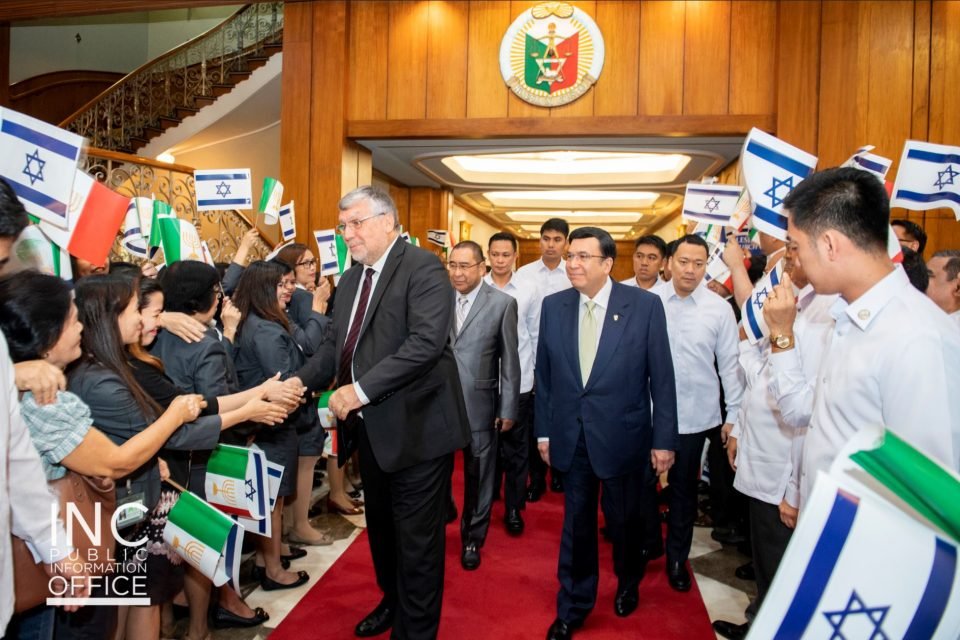
A deal has been reached between the U.S. and Iran. Watch for Israel to escalate its killing of Palestinians and bombing in Lebanon to try and sabotage it.
Israel is the biggest threat to regional peace.
”There were even a couple instances where people were crushed to death at bakeries. We, the humanitarians, were screaming about the flour shortage. Israel was like no, the humanitarians are lying there is flour and broadcast images of flour moving into Gaza.
It’s true, flour was moving into Gaza. But what Israel did not talk about, and what governments and much of the mainstream media did not bother to look into was this inconvenient part of the story:
Israel was allowing flour to move into the NORTHERN part of Gaza. We, aid organizations, were not permitted by Israel to move that flour through Netzarim to central and south Gaza where the majority of the population was and where the shortage of flour existed. ”
Classic Israeli state deception.
Recommended article by @IamArwaDamon
PhilHealth is omnipresent in every Filipino’s payslip, taking money whether workers like it or not. Yet in moments of greatest need, it often feels absent.
That’s what happened in the viral case of Maria Lourdes Sulit. Her husband Marvin contributed for over 25 years. When he died of a brain hematoma, PhilHealth declined to cover their nearly ₱200,000 hospital bill.
The reason: a technicality. He was confined for less than 24 hours. Under PhilHealth Circular No. 2020-0007, inpatient benefits require a 24-hour stay. But Circular No. 2025-0020 allows outpatient emergency benefits in cases ending in death within 24 hours. So which is it, then?
Sulit’s case is yet another crack in a system already under strain.
PhilHealth is mandatory under the Universal Health Care Law. Every Filipino is automatically enrolled, meaning every worker is required to contribute—regardless of income, preference, or private coverage.
And that has long been a point of frustration. Ask any tito, tita, tropa, or kakilala, and a familiar story emerges: PhilHealth often covers only a fraction of the bill. Families still shoulder significant out-of-pocket expenses.
Then come the administrative failures: the delays, the waiting, the stress on top of the hospitalization stresses.
Private health maintenance organizations help fill some of the gap. But even they can only do so much, often still leaving families exposed to catastrophic expenses that the public system is supposed to cushion.
And then, there’s the issue that refuses to go away: corruption.
PhilHealth has been repeatedly drawn into controversies involving anomalous claims, questionable reimbursements, and fund management issues that have reached Congress and the courts.
The latest one involved around ₱60 billion in excess funds—transferred to the national treasury. The Supreme Court later ruled that it’s unconstitutional, questioning whether health funds were being redirected away from their intended purpose.
The money has since been restored to PhilHealth, but its image isn’t getting any better. To many, it remains an agency that collects mandatory contributions, yet Filipinos don't get what they pay for.
Calls to abolish PhilHealth continue to surface. Let Filipinos keep their money. Rely on private insurance or personal means instead.
It’s understandable—especially in cases like Sulit’s—but abolition without replacement risks dismantling the country’s only nationwide health risk pool.
For all its flaws, PhilHealth remains the only attempt at universal coverage at scale. Removing it wouldn’t erase the need for protection.
So the real issue is not just whether to abolish PhilHealth, but what must replace or radically reform it.
Our Asian neighbors have made clearer choices. Thailand funds universal healthcare through general taxation, allowing patients to access care with minimal or no out-of-pocket costs. Malaysia heavily subsidizes public hospitals, keeping treatment affordable and predictable. South Korea operates a hybrid system where mandatory contributions are matched with reliable, structured coverage at the point of care.
The Philippines remains stuck in between: compulsory contributions without guaranteed protection, universal enrollment without universal certainty.
Now, the question is no longer whether PhilHealth should exist. Can it continue in its current form when the gap between contribution and protection remains this wide?
Can Filipinos still afford to pay premiums to a system they cannot rely on in a life-and-death situation?
Otherwise, PhilHealth only gives Filipinos hell.
Most powerful military in history broken by simply holding a third of the world's energy trade hostage. I guess people upset by this must really want to get off fossil fuels immediately
notice how elon meatriders never mention his dad's emerald mines in apartheid south africa, or that he paid a woman $250,000 to avoid a sexual assault lawsuit, or that he begged epstein to go to his island on christmas, or the fact he doesn't talk to any of his children, etc
"In Vietnam, I didn't want the US to win. I don't want the US to win in Iran. I'm not America First, I'm Justice First. If it were switched and the Palestinians were doing to the Israelis what the Israelis are doing to them, I'm not pro-Palestinian". —Professor Norman Finkelstein
Watching the world lose its mind over the Knicks and the World Cup while Palestine is being destroyed and genocided in real time honestly infuriates me.
And before anyone says “sports bring people together,” I know. That's exactly the point. We clearly know how to care. We clearly know how to show up. We clearly know how to unite when we want to. So why is it easier for millions of people to memorize stats, argue over games, and spend hours watching a match than it is to speak up when human beings are being genocided in plain sight?
This feels like the Hunger Games, wallah. The privileged get to sit comfortably, drink a coke, eat a hotdog, cheer, celebrate, and move on, while other people in Palestine, Sudan, Lebanon, Yemen, Congo, Iran and more are searching for food, living in tents that flood, and fighting for their peoples liberation.
You thought Epstein Island was bad?
Israel built the only military prison in the world designated for children.
Children are subjected to beatings, torture, and rape on a regular basis.
Conviction rates in courts reach 99.7%.
This applies only to non-jewish children.
If they tried to give aid to Gaza a bunch of Israelis would abduct them assault them and rape them before they even left international waters because that's already what happens.
the fact that every single persons life is made worse by having shit benches and we're just fine with it out of pure spite for the homeless and means we should probably all die every single one of us
To become rich from curing cancer, you have to withhold the cure from people suffering and dying from cancer. So yes, you don't deserve to get rich from curing cancer. Only in an exploitative and unethical system is this seen as acceptable.