Scientists took molecules from a traumatized father's sperm, injected them into a healthy egg, and watched the offspring grow up anxious and depressed. The father never touched them. His sperm chemistry did.
Inside every sperm, next to the genes, sits a second layer of information. Think of genes as the text of a book. The second layer is the highlighting, the sticky notes, the margin marks telling the cell which parts to read loudly and which to skip. Stress rewrites those marks. The original text stays the same.
A 2025 University of Turku study tracked 55 Finnish men and found that those with high childhood abuse scores had 68 of those molecules behaving differently than men who hadn't been abused. Several of the changed molecules shape how a baby's brain forms. One brain-building molecule in particular kept showing up reliably lower in traumatized men's sperm. That same result had appeared in a separate human study before Finland's data even arrived. Two teams, two countries, same molecule, same direction.
These men were in their late 30s and early 40s when they gave sperm samples. Their childhoods had ended 25 to 35 years earlier. A Harvard and University of British Columbia study found that one gene section tied to brain and nerve function showed a 29% behavioral difference between abused and non-abused men's sperm. Both findings survived checks for smoking, drinking, weight, and age. The body apparently keeps records of childhood long after the conscious mind has moved on.
The reason the experiment works: these molecules don't disappear at fertilization. They travel into the early embryo and begin shaping which genes switch on, at a moment when the embryo is still just a handful of cells, too small to see without a microscope. The father's history of stress arrives in the embryo before it has a nervous system to feel anything.
The same pathway carries good things too. A 2025 Cell Metabolism study found that fathers who exercise regularly put different molecules into their sperm. Offspring of exercising mice outran their peers with less fatigue. The same molecules were at higher levels in the sperm of men who exercise. Health moves through this channel as well.
In mice, the effect didn't stop at the children. About 11% of the molecular changes from a stressed father appeared in grandchildren. By the third generation, it had fallen below 1%, but it was still there.
Three separate human studies. Same molecular signature. Same direction. Proving causation in humans requires the kind of controlled injection experiments that so far have only been done in mice. But three teams in three different places landing on the same result isn't coincidence.
The so-called “calculator riots” of 1986 serve as a powerful reminder that today’s anxieties about artificial intelligence replacing human thinking are far from new.
In April 1986, a determined group of math educators staged a vocal protest outside the National Council of Teachers of Mathematics (NCTM) annual convention in Washington, D.C. Led by influential textbook author John Saxon, demonstrators carried signs declaring, “The Button’s Nothin’ ’Til the Brain’s Trained.”
They were opposing the NCTM’s new recommendation to incorporate electronic calculators into mathematics education at every grade level, including homework and exams.
The protesters worried that reliance on calculators would erode students’ mental arithmetic skills, numerical intuition, and deep conceptual understanding, potentially creating a generation of “calcuholics” overly dependent on machines.
The NCTM countered that calculators would free students from repetitive, low-level calculations, enabling them to tackle more complex problem-solving and higher-order thinking. Ultimately, the debate led to a pragmatic compromise: students would first master core mathematical concepts and mental strategies before using calculators as tools for more advanced work.
This balanced approach allowed technology to enhance, rather than replace, mathematical reasoning.
Today, as schools navigate the rapid rise of generative AI, the 1986 calculator compromise offers a valuable blueprint: prioritize genuine understanding first, then thoughtfully integrate powerful new tools.
I used to steam broccoli and call it a day. Then implemented one tiny tweak made it way more powerful.
I chop fresh broccoli, let it sit on the counter for 40 minutes (the magic window!), then lightly steam it with garlic and a squeeze of lemon.
The science: Chopping + waiting activates sulforaphane — that powerhouse compound in broccoli that supports detox pathways, fights inflammation, and feeds your good gut bacteria.
P.S. For bonus points, add a sauce with real mustard (supplies myrosinase, a key enzyme that maximizes broccoli's benefits) or sprinkle broccoli sprouts on top for more myrosinase.
Who else is doing the “chop and wait” broccoli trick? What’s your favorite way to eat it — raw, roasted, or in a smoothie?
#BroccoliHack
#GutHealth
#Sulforaphane
🚨 Shocking fact most women over 40 don’t know:
Sarcopenia prevalence jumps from 3% in early perimenopause to 30% in late perimenopause.
Muscle loss accelerates during the menopausal transition and yet its highly reversible with strength training.
The formula?
Here is the revised, scannable list using proper formatting:
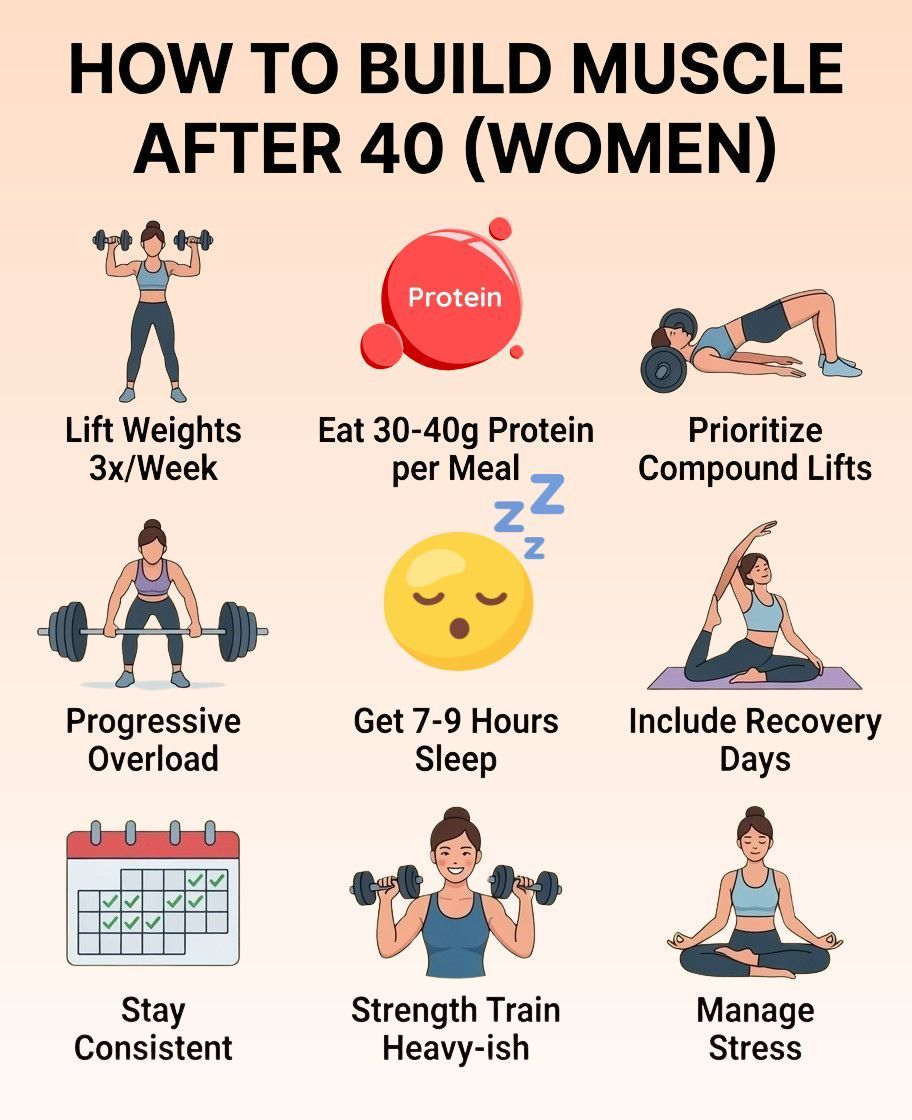
1. Lift heavy-ish 3x/week
2. Consume 30-40g protein per meal
3. Prioritize sleep and recovery
You can build (or rebuild) muscle in your 40s, 50s & beyond.
Who's ready to get stronger after 40?
#MuscleAfter40
#WomensHealth
#StrengthTraining
Source:
Journal of Cachexia, Sarcopenia and Muscle. 2026;17(1). doi:10.1002/jcsm.70232
HINDI SAPAT ANG HEARSAY O COORDINATED NARRATIVES, DAPAT TOTOONG, PERSONAL, AT NABEBERIPIKANG EBIDENSYA
Malinaw sa pahayag ng NBI at Ombudsman na mahalaga ang personal knowledge at corroborated evidence, at hindi sapat ang hearsay o coordinated narratives.
Kailangang individual ang affidavits para matukoy ang kredibilidad ng bawat testigo at maiwasan ang magkakahalong salaysay.
Sa hustisya, hindi kwento ang basehan—kundi totoo, personal, at nabeberipikang ebidensya.
🪠 How to Clean Your Brain (Literally) — New Research
I’m always excited by simple ways to protect brain health.
New Penn State research in Nature Neuroscience reveals a built-in “hydraulic pump”:
Your brain gently sways with movement, acting like a rinse cycle that flushes cerebrospinal fluid through brain tissue to clear metabolic waste (the stuff linked to cognitive decline).
Here’s how the brain pump works:
• Abdominal/core contractions increase pressure in spinal vessels.
• This creates rhythmic swaying of brain tissue.
• The motion squeezes fluid through the brain — like wringing out a dirty sponge.
Best part? No gym required. Everyday movements trigger it.
Brain Flush Protocol — 3 Easy Ways:
Rhythmic Walk — 10+ minutes brisk walking. Steps + natural core engagement optimize the sway.
Micro-Bracing — When you stand from sitting, lightly engage your abs. Small but powerful pressure shift.
Standing Desk Shifts — Shift weight side-to-side or do occasional calf raises. Keeps the pump active all day.
Pro Tip: Pair with diaphragmatic breathing — it amplifies thoracic pressure changes for even better flow.
Small daily movements aren’t just exercise — they’re brain maintenance.
Protect your cognition one step (and brace) at a time.
Have you noticed clearer thinking after walks? What’s your favorite low-effort movement habit? 👇
#BrainHealth
#Neuroscience
#Longevity
Source: Guenette, J. P., et al. (2024). Body-to-brain hydraulic signaling flushes the neural interstitium. Nature Neuroscience.
Babies are born with LOW vitamin K on purpose — it’s not a flaw. It’s God’s perfect design.
Cord blood is packed with stem cells specifically meant to repair the physical stress and micro-trauma of birth.
Low vitamin K keeps the blood naturally thin so those stem cells can flow freely and travel exactly where they’re needed — to heal tissues, support organ repair, and jumpstart the newborn’s developing systems without premature clotting getting in the way.
God made it this way so the baby’s own cord blood stem cells can circulate optimally in those critical first moments and hours.
Thin blood = maximum mobility for healing. High clotting factors right at birth would slow or trap those precious stem cells, interfering with their God-given job.
Benefits of lower vitamin K at birth (by design):
• Stem cells & cord blood: Allows unrestricted travel of hematopoietic stem cells throughout the body to repair birth trauma, reduce inflammation, and support tissue regeneration.
• Immune system: Cord blood stem cells help establish and strengthen the newborn’s naive immune system. Low vitamin K ensures they reach the bone marrow, thymus, and other sites without clotting interference.
• Neurological & organ protection: Stem cells can migrate to the brain and vital organs to protect against the oxidative stress of labor and delivery.
• Natural timing: Colostrum (that first “liquid gold”) is rich in natural vitamin K — delivered orally, slowly, and gently through breastfeeding exactly when the baby needs it. God’s perfect dose at the perfect moment.
Instead, we cut the cord early (stealing up to 30-40% of the baby’s blood volume and those vital stem cells), then inject synthetic vitamin K loaded with polysorbate 80, propylene glycol, benzyl alcohol, and sometimes aluminum — straight into an immune system that’s barely online.
Why are we “fixing” what God already designed perfectly?
Think about it before you consent.
Nature doesn’t make mistakes. God doesn’t either.
Delay cord clamping. Keep the cord blood. Trust colostrum. Respect the design.
Your baby’s body was fearfully and wonderfully made. ❤️
Want to feel 10 years younger without expensive, over-marketed supplements or extreme diets?
These 9 simple daily habits deliver results without the price tag:
1.10-12 hour eating window (finish dinner early)
2.Post-meal walks + daily movement snacks
3.Daily silence/meditation/prayer
4.Morning sunlight + consistent sleep timing
5.Leafy greens every single day
6.Rigorous oral hygiene + tongue scraping
https://t.co/0JTtNTi47W breathing or HRV practice
8.Genuine human connection (put the phone down)
9.Polish your mindset — more gratitude & kindness
Small habits, compound effects on energy, inflammation, and longevity.
Which one are you tackling first?
#Longevity
#HealthyHabits
Genuinely heartbroken to hear of the passing of Anthony Stewart Head. To Whedonverse fans, he'll always be Rupert Giles-mentor, father figure, librarian, Watcher, and one of the very heartbeats of Buffy the Vampire Slayer.
Rest in peace, Anthony.🖤#Buffy#AnthonyStewartHead#RIP
Very saddened to hear of the passing of the excellent Anthony Head, who brilliantly brought to life the smooth-talking sky god, Hercules Shipwright.
Keep flying high, captain.
And remember… You simply must have the most awfully lovely, super-scrumptious flight.
STATEMENT OF FORMER SENATE PRESIDENTS ON SENATE BROUHAHA
We, former Presidents of the Senate of the Republic of the Philippines, speak at this difficult moment out of our shared moral duty to the institution we once had the honor to lead.
Those of us who once held the gavel know that the highest duty of a Senate President is not to cling to office but to leave the institution stronger, more respected, and more firmly bound to the rule of law than when he or she found it.
We call on all incumbent senators, regardless of bloc or affiliation, to de-escalate public rhetoric that demeans the Senate and weakens confidence in it; to confine their disagreements to the floor and to the proper forums, where the arguments and the votes can be scrutinized by the public; and to prioritize the urgent work before the Senate (the economy, food and energy security, and justice) over internal maneuvering.
We urge all members of the chamber to resolve this crisis swiftly, within the bounds of the Constitution, the rules, and long-standing practice. The country cannot afford an unstable Senate at a time of mounting economic pressures, security threats, and growing public distrust in institutions.
SOLID BLOC 11: THIS IS NOT SENATE INDEPENDENCE BUT A BOYCOTT OF DUTY
The Solid Bloc 11 minority senators were present today for the 5 p.m. resumption of session, ready to work, ready to vote on pending bills and ready to keep the Senate running, but the majority led by SP Cayetano chose not to show up.
They did not even have the courtesy to inform us when they ignored the rules, and could not extend the basic decency of telling the minority that they had no intention of convening.
Let us focus on the work, because the Senate has serious business before it, and if the majority wants to protest, deliver privilege speeches or defend its position, the proper place to do that is on the floor, not by making the chamber stand still.
Ang Senado ay hindi pag-aari ng iisang may hawak ng gavel. Institusyon ito ng taumbayan at napakadaming mahalagang panukala ang nabibinbin dahil sa drama ng mayorya.
Important measures were left hanging because of the majority’s boycott, including the Magna Carta of Barangay Health Workers, the Anti-Hospital Detention Bill, the confirmation of generals before the Commission on Appointments and the bills granting Philippine citizenship to Bennie Boatwright III and Matthew James Ramos.
Let us call this for what it is: the claim that this is about Senate independence is false, because what happened today was about the rule of law, public accountability and a lawful process before the Ombudsman and the Sandiganbayan that no senator, no bloc and no presiding officer controls.
This is a boycott because of the arrest of Senator Jinggoy Estrada, and the public should not be asked to believe another convenient line from a leadership that has repeatedly twisted the truth.
Today was a step toward accountability in a controversy that the public has long demanded action on, and after years of people asking why nothing was happening in flood control investigations, it is unacceptable to suddenly call the rule of law an attack on the Senate.
Is Senate President Alan Cayetano now questioning the rule of law?
Sa totoo lang, ang gusto nila ay kampihan, hindi prinsipyo. Gusto nila sumama kami sa boycott, patahimikin ang Senado at gamitin ang minority para manatili ang Senate President sa puwesto habang iniiwasan ang tunay na test of numbers sa floor.
This may be the first time in decades that Senate work stopped because the presiding officer himself refused to work, because even during typhoons and the height of the pandemic, work was suspended only because of necessity or because systems still had to be set up, not because the leadership chose a boycott of duty.
The public has every right to ask whether SP Cayetano is repeating what he did in the House of Representatives, when questions were raised about a leader refusing to step aside, refusing to convene and holding up proceedings when the numbers were no longer certain.
The question now is just as serious: will they do this again for the next two session days, and will they keep the Senate idle simply to avoid facing the numbers on the floor?
The Senate should open its doors, call the session to order and return to work, because no Facebook post, no appeal to institutional pride and no political drama can erase the basic duty of senators to show up, follow the law and serve the people.
And lastly, we call on the Filipino people to watch the Senate closely, because when an institution refuses to work, public vigilance becomes the people’s first line of defense.
Take the word "rice." Add "South Asian." A computer hands back curry leaf, lentils, and fenugreek. You can add and subtract cuisines like numbers. One team got this working by feeding a program four million recipes, and it quietly taught itself the world's kitchens.
The team never told the program what Italian, Indian, or Mexican food was. They handed it millions of recipes and let it watch one thing: which ingredients keep turning up together.
That was enough. Curry leaf, lentils, and fenugreek drifted into one corner. Over in another, cotija cheese settled in next to poblano peppers. Basil and oregano found each other too. The program never heard the words "Indian" or "Mexican" or "Italian." It noticed what gets cooked with what, and the cuisines sorted themselves.
The grouping comes down to simple bookkeeping. Every ingredient gets a long list of numbers, like map coordinates, except with three hundred directions instead of two. Foods that show up in the same dishes get parked near each other. Onion and garlic end up next-door neighbors. Wasabi sits way across town. It is the same plain idea that, more than a decade ago, taught computers that "king" and "queen" belong together just from reading text. Aim it at recipes instead of books and the pantry falls into order.
Then comes the part the researchers most wanted to pin down. What culture a dish comes from tells you far more about its ingredients than whether the food is a grain, a vegetable, or a meat. Roughly twice as much. Your grandmother's recipes carry more useful signal than any nutrition label.
Since every food now sits at its own spot, you can walk between them. Start at rice and head for the South Asian corner, and you reach curry leaf, lentils, and fenugreek. Switch to corn, drift toward Latin America, and you hit tomatillo, fresh cheese, and corn tortillas. Or take plain chicken and wander toward Mexican cooking, and partway there it hands you cotija cheese, poblano peppers, and ancho chiles, foods the word "chicken" alone would never point you to.
About the line everyone keeps quoting, "all of cooking in two megabytes." The reason it's that small is almost dull. Give 1,790 ingredients three hundred numbers each, save the file, and it weighs about two megabytes, roughly one photo on your phone. No recipes live inside. Only a single dot for each ingredient on this shared map of flavor.
One honest catch. Nine of every ten recipes it learned from were English or Chinese, so it knows those kitchens inside out and turns shaky on the ones it barely saw, like Ethiopian or Peruvian. The team also hasn't shared the code yet.
The trick under the hood is over a decade old. Turn things into numbers, put the related ones close, then step back and watch the shape appear. Run it across the world's recipes and the borders between cuisines draw themselves.
I sometimes wonder if SenRi has the reverse effect of pretty privilege: where the masa assume she is elitist and unrelatable bec she looks, speaks and behaves so beautifully elegant.
Simple lang ito.
Yung kay Leila panahon ng Covid at siya ay nakakulong dahil nag surrender siya sa mga autoridad at nirespeto ang arresting officers. Law abiding.
Si Bato. Walang Covid ngayon, nagtatago at tinakasan ang mga autoridad. Law breaker.
Hindi dapat kinokonsinti ang law breaker.
Huwag magpaloko sa mga nagkukumpara ng langka sa durian.
Tigilan na ninyo ang mga paninira at mga kasinungalingan ninyong mga trolls na mga bayaran ng mga kurakot na pulitikong nasa likod ninyo.
Hindi nyo na kaya lokohin ang taumbayan.
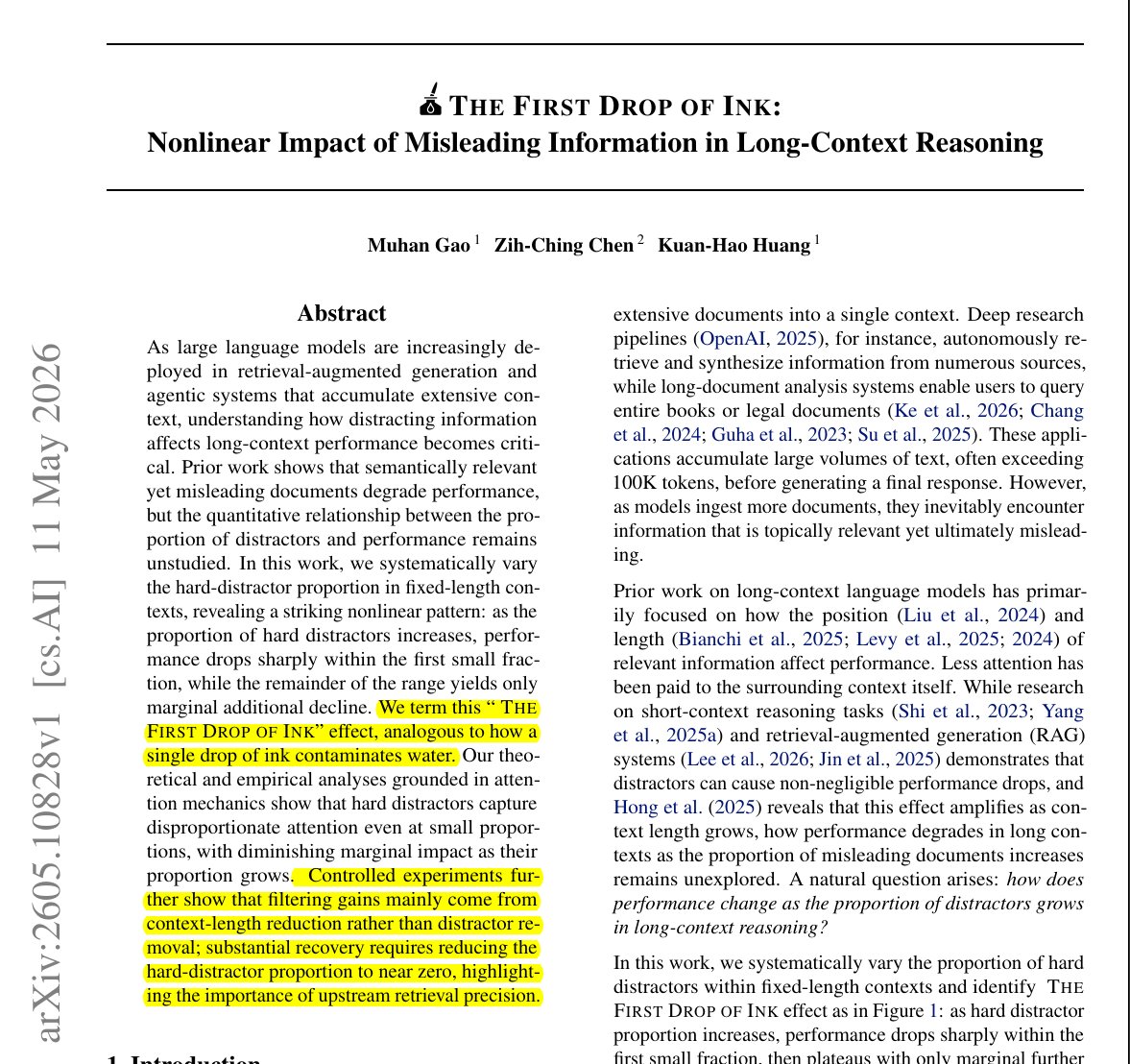
A long-context AI can be poisoned by a few plausible wrong passages, not gradually worn down by many.
At just 10% bad context, the damage is already almost done.
“THE FIRST DROP OF INK ” effect, analogous to how a single drop of ink contaminates water.
The mistake is to picture context as storage.
In a long prompt, the model is not calmly filing facts into separate boxes; it is running a competition over which pieces of text deserve attention when the answer is generated.
Hard distractors are dangerous because they are not random junk.
They are close enough to the question to look useful, but wrong enough to pull the model away from the gold evidence.
In the authors’ setup, if performance loss were proportional, the first 10% of hard distractors would explain about 10% of the total damage, but in one 128K-token Qwen2.5 setting it explained 58%.
The mechanism is simple once you see it: softmax attention rewards relative closeness, so a misleading passage that sits near the answer in logit space can crowd the denominator far more than irrelevant filler.
At only 10% hard distractors, they can already account for about 97% of the distractor pressure.
This also changes how we should read filtering results.
If removing documents helps, the benefit may come less from removing “bad” content than from shortening the whole battlefield.
For long-context systems, the safest misleading passage is the one that never enters the prompt.
---
Link – arxiv .org/abs/2605.10828
Title: "The First Drop of Ink: Nonlinear Impact of Misleading Information in Long-Context Reasoning"
Hippocrates was 2,000+ years ahead of modern medicine.
The Father of Medicine dropped these timeless truths that still hit hard today:
“All disease begins in the gut.”
“Walking is man’s best medicine.”
“Food should be our medicine — and our daily choices shape our future health.”
“The greatest medicine of all is teaching people how not to need it.”
“Everything in excess is opposed by nature.”
Ancient wisdom that still beats most modern health advice.
Which one resonates with you the most? 👇
Tag someone who needs this reminder.
#Hippocrates
#NaturalHealth
Oh, perfect, so after Trump blew billions playing Rambo, got 13 Americans killed, along with Iranian babies, and spiked gas prices just to “own Obama,” he’s now crawling back to the same deal he called the worst ever? Master negotiator strikes again! The art of the deal was apparently “tear it up and beg for it back later.” Truly the greatest comeback in history, folks.