“People have different ratios.” — @TheEconomist
Fact: In the Gaza war, Israel has demonstrated a historically low combatant-to-civilian casualty ratio (1:1.5 or 1:1) when compared to any urban warfare history with even remotely similar conditions, especially urban-centric wars, not isolated battles.
Wars such as the Korean War (approximately 1:4, with roughly 2 million civilians killed), the Iraq War (approximately 1:2 to 1:4, with conservative civilian death estimates of 200,000–350,000), and even battles with more refined data such as Manila (approximately 1:6, with around 100,000 civilians killed) illustrate this clearly. Mosul likewise reflects a modest ratio of approximately 1:2, despite it taking more than a year after the battle for credible civilian casualty figures to begin to emerge. Numerous battles and wars show the historic low ratio achieved by Israel.
Fact: Israel has implemented more civilian harm mitigation measures than any military in history. These include advance notifications, daily humanitarian pauses, roof knocking, communication techniques with civilians to include evacuation maps/drones/speakers, withholding or aborting strikes, layered targeting approval processes, technological tools to track civilian presence, restrictions on the use of force, and more.
Not true: “People have different valid ratios.” Rather than providing an evidence-based analysis, which would in fact be impossible in real time during an ongoing war, interviewers and commentators often reference “other ratios” without understanding the fundamental lack of validity behind most of them.
Any serious evidence-based analysis would quickly discover that only two organizations have the practical capability to produce casualty estimates or ratios in Gaza: Hamas (through the Gaza Health Ministry) and Israel.
Let’s start with the Hamas-run Gaza Health Ministry. Even if one accepts its publicly cited figure of approximately 71,000 total deaths at face value, and deducts only a modest number for reporting errors, deaths from illness, natural causes, or pre-existing conditions, the number of deaths attributable to direct wartime action would already be lower.
The analysis must then turn to combatant versus noncombatant status. Hamas intentionally does not attempt to classify known combatants, even though it could do so (for example, by identifying members of its organized armed wing or those engaged in hostilities). It does not, because doing so would undermine its primary information warfare tactic: attributing all deaths in Gaza, regardless of cause, to Israeli military action. This includes deaths of combatants, civilians killed by Hamas or other armed groups, accidental deaths, and natural causes.
Other groups frequently cited as providing alternative “ratios,” such as Lancet-linked estimates, Action on Armed Violence, or reporting by +972 Magazine or The Guardian, rely on statistical extrapolations and methodological assumptions rather than direct casualty identification. Some claim Hamas is undercounting deaths by including bodies “under the rubble,” even though Hamas has, at times, added names of the reported missing without verification. Others falsely imply low combatant death numbers by citing Israeli databases of identified Hamas members killed, while omitting the reality that many combatants die unidentified during combat, a lie of omission.
Some methodologies even involve calling into Gaza and asking residents whether deceased family members were Hamas members and, if the answer is no, automatically classifying those individuals as civilians. That is not a credible method of casualty classification.
This raises the central issue, even if Hamas’s numbers were accepted wholesale: Who is a combatant and who is a noncombatant? It is not possible to answer this by age or sex alone. Hamas is well documented as using child soldiers, and women have participated directly in hostilities.
This leads to one of the most fundamental misunderstandings of modern war: what constitutes participation in hostilities under the law of armed conflict.
After Hamas and other armed groups invaded Israel and committed thousands of war crimes against Israeli civilians, Israel was no longer conducting episodic counterterrorism operations. It was at war with the governing authority of Gaza, Hamas. Members of Hamas’s organized armed groups are lawful military targets by virtue of membership alone. But the law goes further. Lawful targeting is not limited to uniformed fighters actively firing weapons at the moment force is applied. The law of armed conflict is explicit that civilians lose protection from attack when, and for such time as, they take a direct part in hostilities.
Direct participation includes far more than pulling a trigger. It encompasses collecting, reporting, or transmitting intelligence on enemy movements; acting as lookouts, spotters, or early-warning personnel; transporting weapons, ammunition, explosives, or fighters; storing or concealing military equipment; preparing or emplacing improvised explosive devices; providing operational logistics such as fuel, vehicles, communications, or safe houses; guarding military objectives, tunnels, or hostages; and assisting in command, control, holding hostages, or coordination of attacks.
Civilian police or security personnel who are integrated into, subordinated to, or acting in support of military operations likewise lose their protected status for the duration of that participation.
The law does not require an individual to wear a uniform, be continuously armed, or be engaged in kinetic action at the precise moment they are targeted. What matters is function and conduct, not job titles or civilian cover. In Gaza, Hamas has deliberately fused its military operations with civilian infrastructure and governance, embedding fighters, logistics, intelligence, and command functions within the population. As a result, participation in hostilities is often widespread, episodic, and intentionally concealed.
Reducing lawful targeting to a simplistic count of named Hamas fighters is not a legal argument. It is a distortion of the law of war that ignores both its text and its purpose and collapses under even basic scrutiny of how armed conflict actually functions in an urban, insurgent-controlled environment.
Focusing exclusively on Hamas fighters further misrepresents the battlefield by erasing the role of other armed organizations operating in Gaza, including Palestinian Islamic Jihad and numerous smaller factions that joined Hamas in the October 7 invasion and continue to participate in hostilities. These groups are not incidental actors. Their members are active participants in the conflict and are subject to the same legal standards governing lawful targeting.
The lies, damned lies, and statistics of the Gaza war are not new. I have dealt with body-counting organizations and casualty estimation debates for years. I have seen their data collection methods and statistical manipulations firsthand. I have stood in United Nations and human rights forums from 2014 to the present where the claim that “90 percent of wartime casualties are civilians” is routinely cited, including by the UN Secretary-General (January 2022), the ICRC (2024), the UN Security Council (May 2022), and groups such as Airwars, Center for Civilians in Conflict.
This 90 percent (or 1:9) claim is not true. It originates from an outdated and discredited statistic from the late 1990s and has been reinforced through selective aggregation of conflicts, particularly post-2014 battles against ISIS, using methodological shortcuts involving explosive types, strike-to-casualty ratios, and speculative modeling.
To be clear, while civilian harm in war is real and tragic, the 90 percent claim is false. Yet it continues to be used by UN bodies and advocacy organizations as a rhetorical tool to support policy agendas, condemnations, and misinformation campaigns.
Again, Israel’s combatant-to-civilian casualty ratio is historically low in urban warfare, even accounting for the unprecedented scale of Hamas’s force, its deliberate use of human shields, extensive tunnel networks, Egypt's blocking of civilian evacuations, and the dense urban environment of Gaza. This remains true even without comparison to some of the most destructive conflicts of the modern era, such as Chechnya, Syria, Yemen, Ukraine, or Sudan.
Here is a simple test of statistical manipulation.
What was the combatant-to-civilian casualty ratio in the Battle of Rafah? Was it 100:1? Higher? Or was it effectively all combatants, with civilian deaths limited to a handful or none at all? The precise number is beside the point. What matters is that depending on how analysts aggregate or disaggregate data, the same conflict can be portrayed as either overwhelmingly civilian or overwhelmingly military. A discrete battle like Rafah, involving intense fighting against organized armed groups with minimal civilian casualties, disappears when data is aggregated across time, geography, causes of death, and attribution standards.
This is exactly how narratives are constructed. Battles with overwhelmingly combatant casualties are merged into broader datasets. Civilian deaths from unrelated causes are folded into wartime totals. Combatants are reclassified as civilians through age, sex, or self-reporting proxies. The result is not analysis but statistical storytelling.
Rafah exposes the flaw. If casualty ratios can swing from near-total combatant deaths in one battle to claims of 90 percent civilian casualties in the same war, the issue is not reality on the battlefield. It is how the numbers are being manipulated to fit a predetermined conclusion.
Rather than assessing Israel’s strict adherence to the law of armed conflict, including its obligation not to intentionally target civilians and its use of precautionary measures that go well beyond what the law requires, critics resort to statistical warfare. Numbers are aggregated, disaggregated, reclassified, and selectively framed to produce a narrative rather than an analysis.
The irony is that even when relying on Hamas’s own false or unverified numbers, Israel’s combatant-to-civilian casualty ratio remains historically low by any serious comparison to urban warfare. The data, stripped of manipulation and advocacy, does not support claims of indiscriminate or unlawful conduct. It demonstrates the opposite.
So no, there are not multiple “valid” ratios. There are assertions, advocacy numbers, and statistical narratives, but only one conclusion supported by historical comparison, law, and military reality.
"If you are a fundamental moralist—if you believe that the way you think things should be, or that the way you should live, is a moral imperative—then it is very difficult to have a liberal democracy."
I grew up admiring the moral stands of Soviet dissidents like Sakharov, and what I saw as the beacon of individual freedom, America. My guest this week, foreign policy expert George Friedman, instead talks interests and analysis in our conversation: https://t.co/5ipAY5zz61
Ein Moment, der Hoffnung macht:
Ein Palästinenser fragt einen Israeli auf dem Tomorrowland-Festival:
„Darf ich dich umarmen?“
Und sie tun es.
Menschlichkeit.
❤️🙏💫 So einfach. So stark. So nötig.
Quelle @N12News
Anderthalb Wochen nach dem Aktionstag gegen „Hass und Hetze“ fand in Berlin am Wochenende mal wieder eine Islamistenkundgebung statt, bei der „Tod den Juden“ gerufen und die Errichtung eines Kalifats gefordert wurde. Einem Staat, der bei Netzbeleidigungen gegen Politiker die Muskeln spielen lässt und gleichzeitig dem anwachsenden Antisemitismus auf den Straßen nichts entgegensetzen kann oder will, sind die Maßstäbe abhanden gekommen. Jeder einzelne dieser Vorfälle ist zudem ein Fanal einer komplett gescheiterten Migrations- und Integrationspolitik. Wenn wir weiter das Anwachsen solcher totalitärer und menschenfeindlicher Gruppen achselzuckend akzeptieren, wird das freiheitliche Fundament unserer Republik bröckeln. WK
Sorry, wenn das jetzt ein bisschen wehtut, aber:
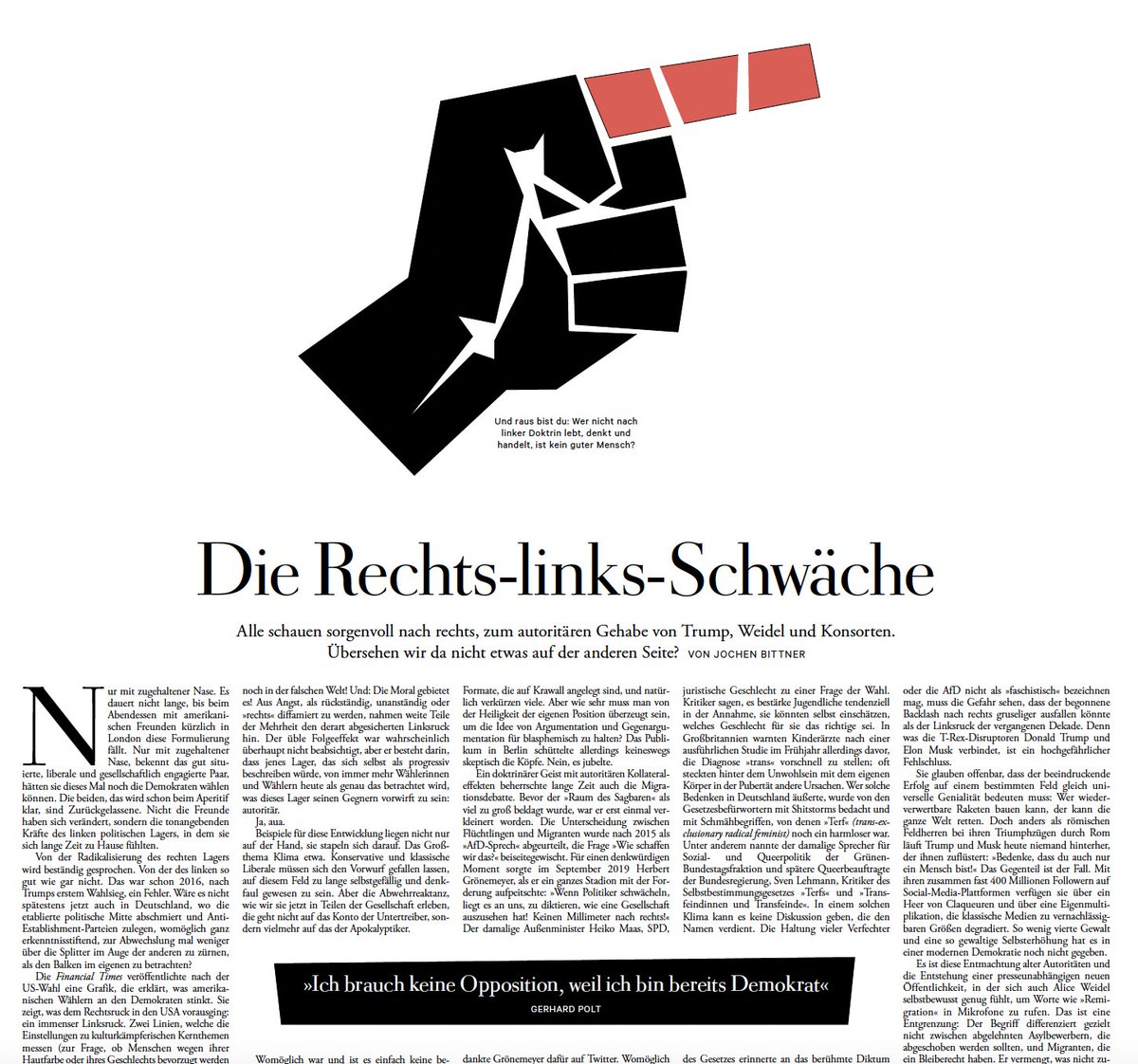
Das Lager, das sich selbst gerne progressiv nennt, wird von immer mehr Wählern als genau das betrachtet, was es seinen Gegnern vorwirft zu sein: autoritär.
Jetzt erleben wir den Backlash.
https://t.co/LknkSOScLv