I build AI automations for the boring parts of a business.
Emails that answer themselves.
Group chats that reply on their own.
Reports that build themselves on the 1st of the month.
Here I post what I build, what breaks, and how I fix it.
https://t.co/V2YzPd1x4e
In August an AI working on one of my projects rewrote a file starting from an old copy it had kept for weeks. Two sections I'd added in the meantime were just gone. No error, no warning. I noticed only because something else went wrong and I had to read the changes line by line.
The rule was already written: read the file again before you rewrite it. It followed it as long as it remembered it.
So I added a check that runs before every save. If it tries to rewrite that kind of file from scratch, the save is refused. It doesn't have to remember anything now.
When I built an email automation, the AI could write the replies but there was a setting so that a person approves each one before it goes out. For anything that talks to clients I'd keep it on.
The AI is good at the draft. It reads the thread, finds the order number, finds a polite way to say no. What it doesn't know is that this client is already upset, or that a small refund becomes the rule for everyone after.
Reading it takes thirty seconds. Fixing a wrong email that already went out takes a lot longer.
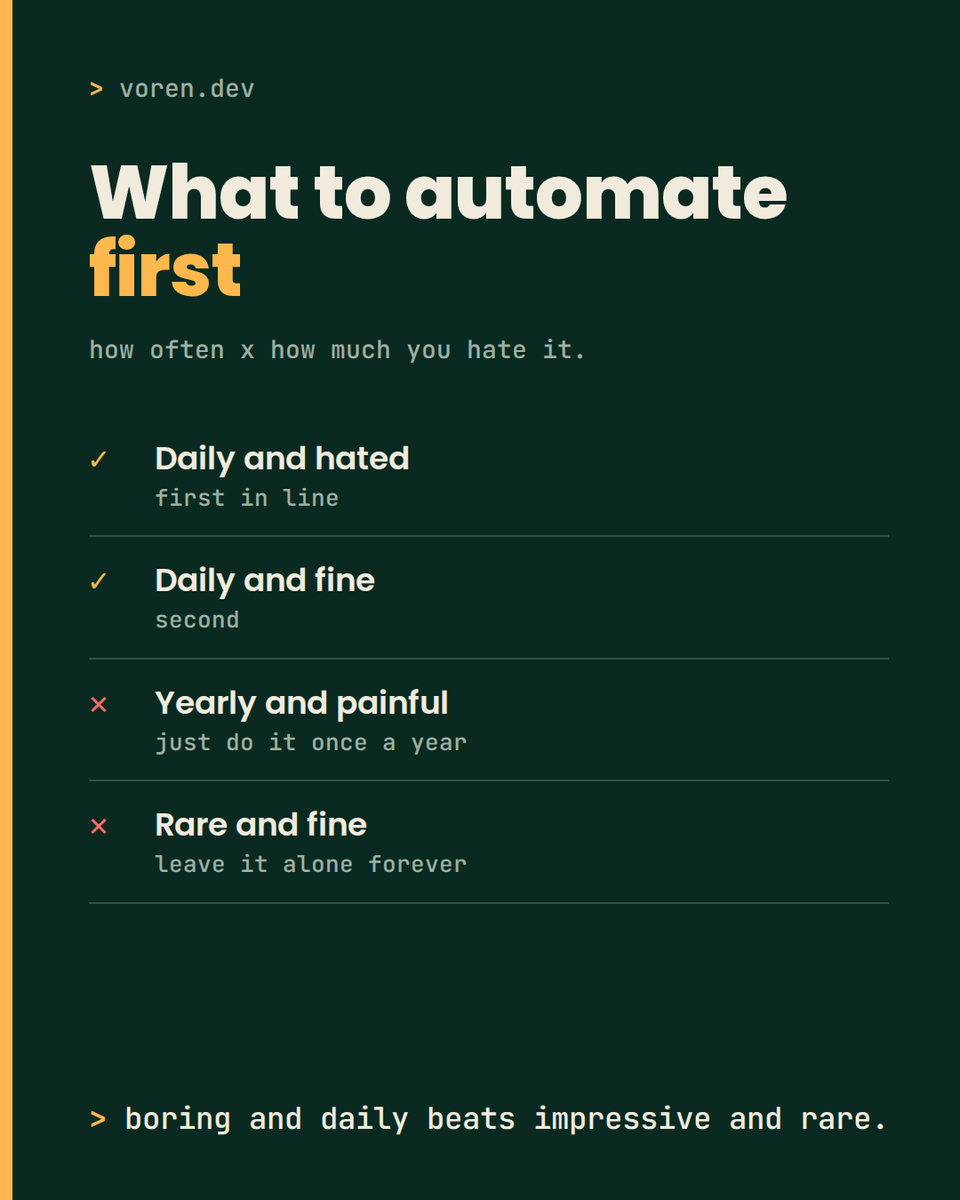
When someone asks me what to automate first, I ask them back: what's the boring thing you have to do every day?
Then two checks. How often does it happen, and how much do you hate doing it.
Daily and hated goes first. Daily but fine, second. Once a year, even if it's painful, I'd usually just do it once a year. And rare and fine you leave alone forever.
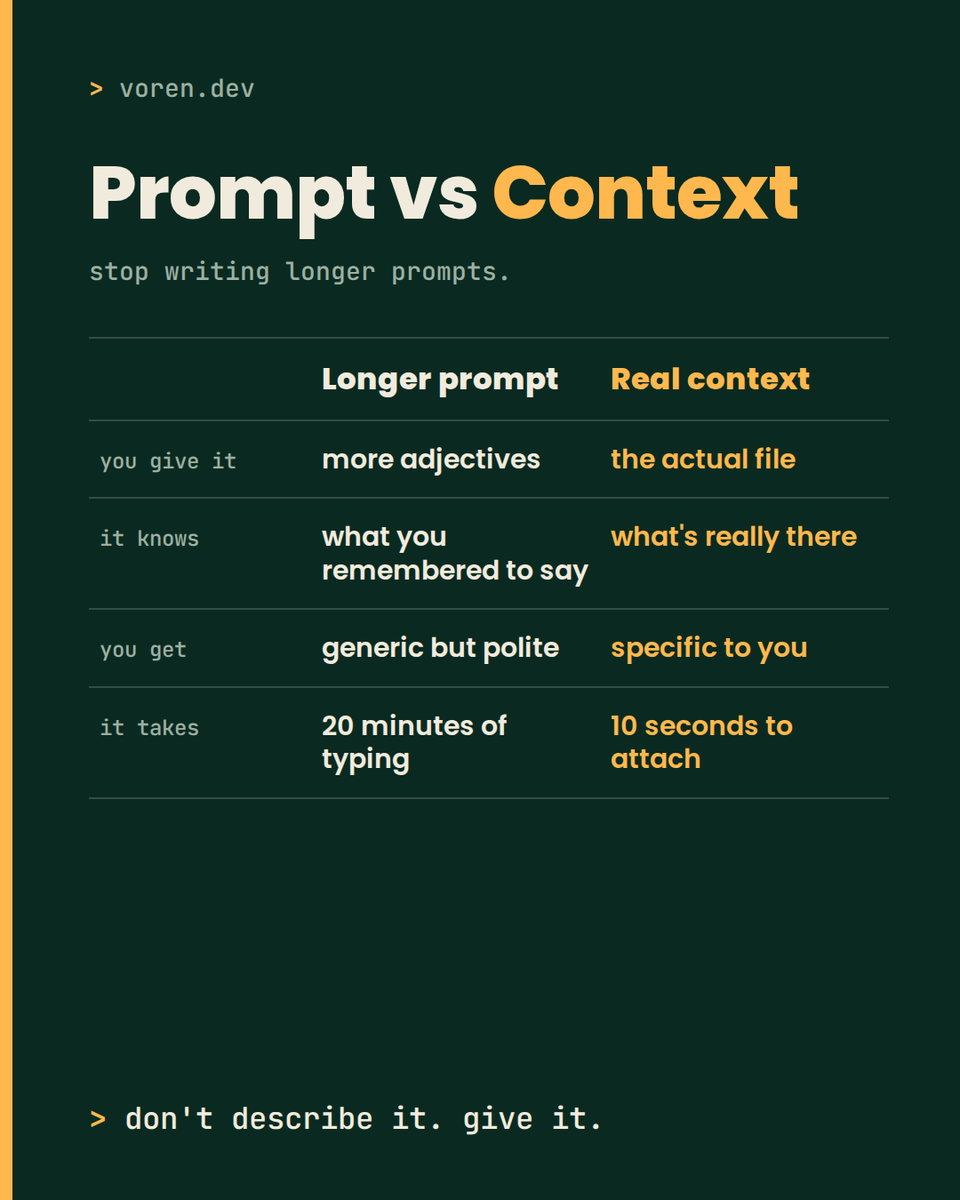
People spend 20 minutes on the perfect prompt. "Act as a senior expert, be detailed but concise." Then they describe their document from memory.
I'd skip the adjectives and attach the file. The real email, last month's actual numbers, the contract itself.
It takes ten seconds, and the AI stops guessing what's in there.
A prompt I'd copy as it is:
"I need to write an offer for a new client. Before writing anything, ask me the questions you need answered, one at a time."
Then you answer. It asks things you wouldn't have put in a brief, like the budget or what the client already tried. And sometimes you realise you don't know the answer yourself, which is better to find out now than when the client asks.
The automation that worries me is the one that stops and says nothing.
A site changes a button, a password expires, an email shows up in a different format. No error, it just doesn't run anymore, and you find out weeks later from someone who's annoyed.
On my server there's a watcher that sends me a Telegram message when something isn't running. It also checks on itself, otherwise it could go quiet the same way.
Small swaps that get better answers out of an AI.
"Is laptop X a good buy?" becomes "give me 10 pros and 10 cons of laptop X."
"Is my plan good?" becomes "what are the 3 weakest points of this plan?"
"Is there a bus at 9?" becomes "check online and send me the link to the timetable."
The first version already tells it what I'd like to hear, and it picks up on that. When it really matters I also ask it to argue the other side. If it can't find a single real con, I'm probably still leading it.
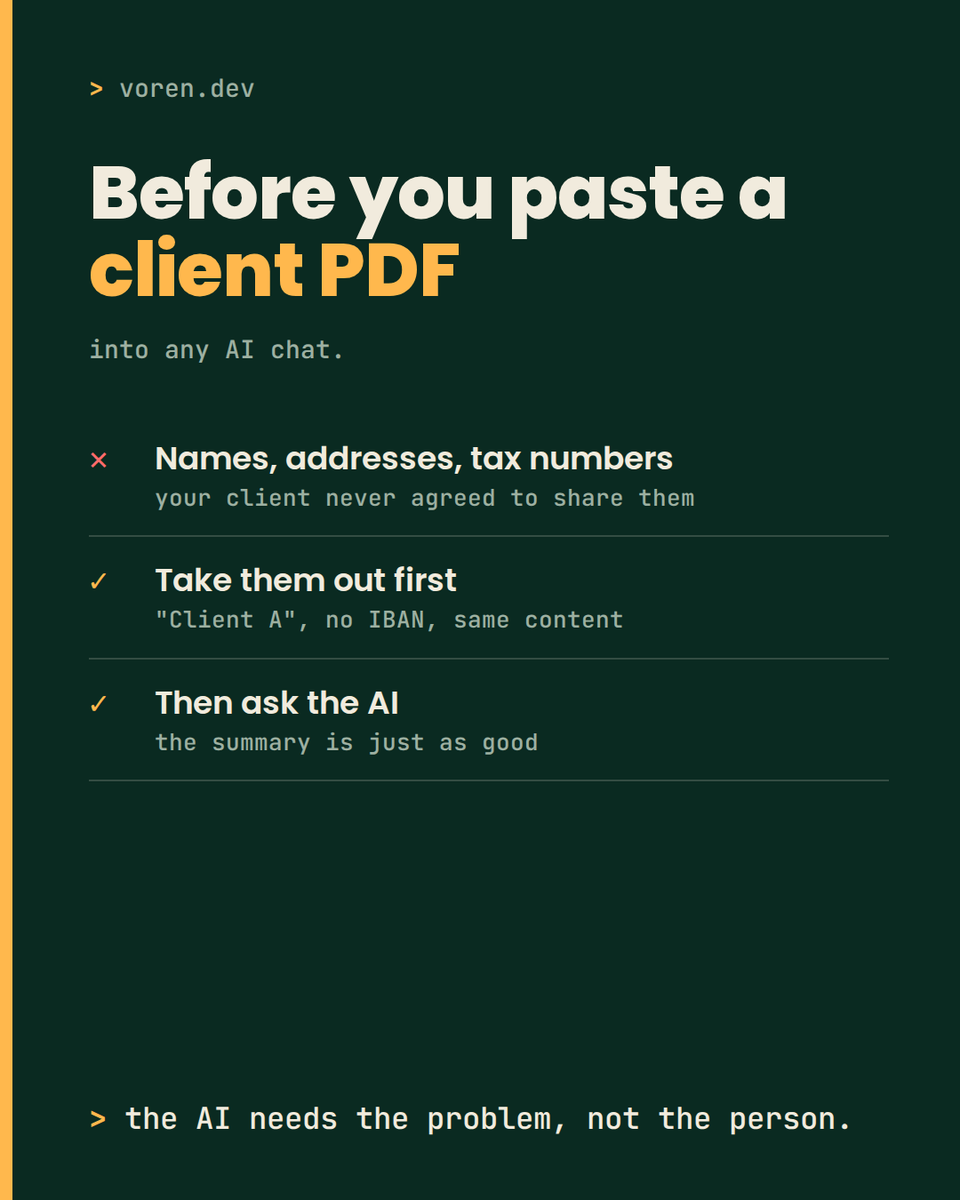
Something I check before pasting a document into ChatGPT: whose names are in it.
Contracts and invoices are full of names, addresses, tax numbers, IBANs. The person in there never agreed to end up on someone else's server.
So I built a small tool for it. You give it the PDF, it swaps the names for "Client A", takes out the personal details and gives you a clean copy. The AI doesn't need the names to summarise a contract anyway.
Small exercise for this week: every time you copy something from one app and paste it into another, write it down.
The order number from the email to the spreadsheet. The client's address from the form to the invoice. The booking dates into the calendar.
Each one is 30 seconds, so nobody bothers fixing them and they stay like that for years. The data is already there, someone is just carrying it by hand. That list is where I'd start.
@acecreamu on screen for now, it shows what it understood with confirm or edit. walking is exactly why I'm adding a voice reply, so you just hear it and tap confirm
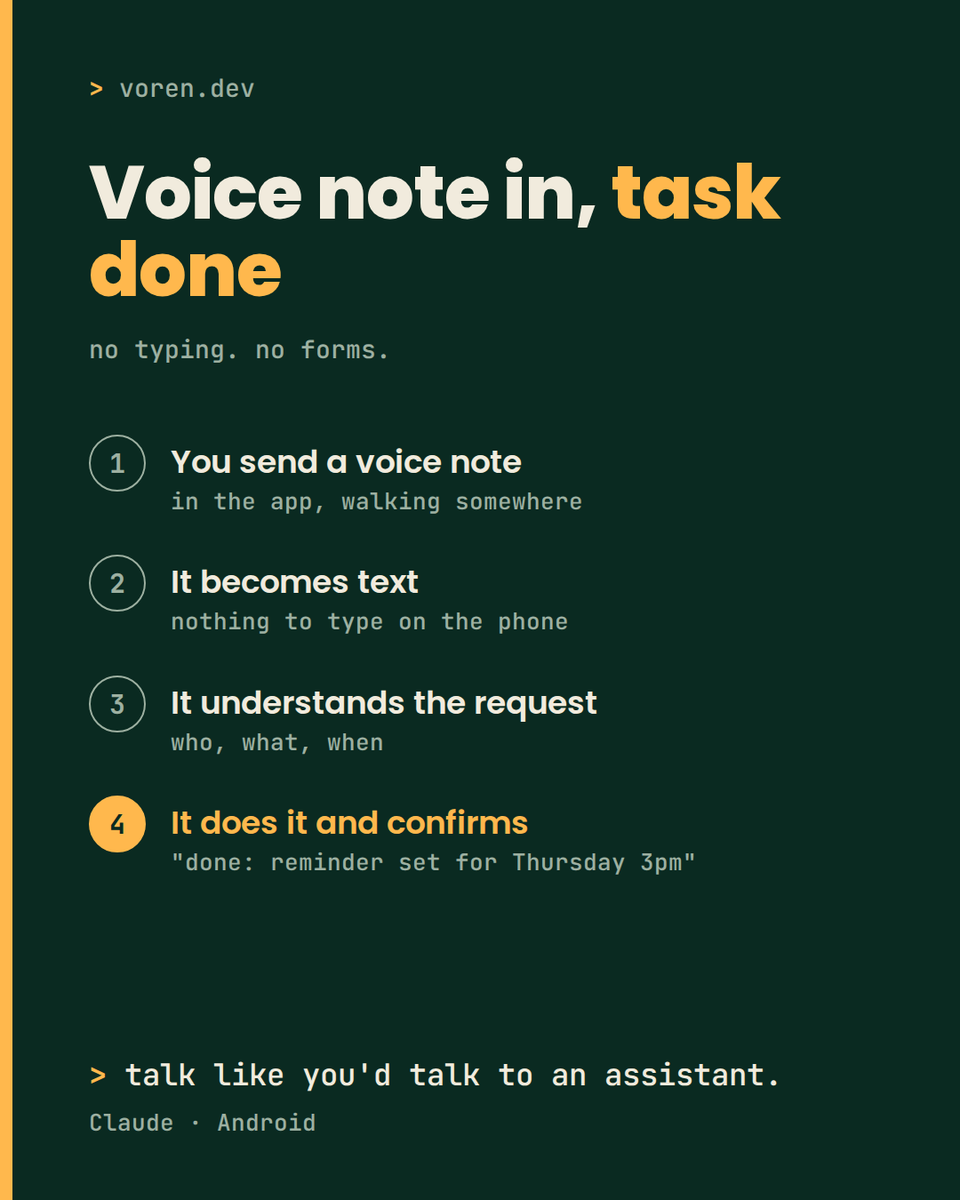
I built myself a small app for my personal assistant, and the part I like most is the mic button.
I say "remind me Thursday at 3 to call the accountant", the AI works out who, what and when, does it and replies "done, reminder set for Thursday 3pm".
No form to fill in, no typing on the phone while I'm walking somewhere.
Try this with any AI.
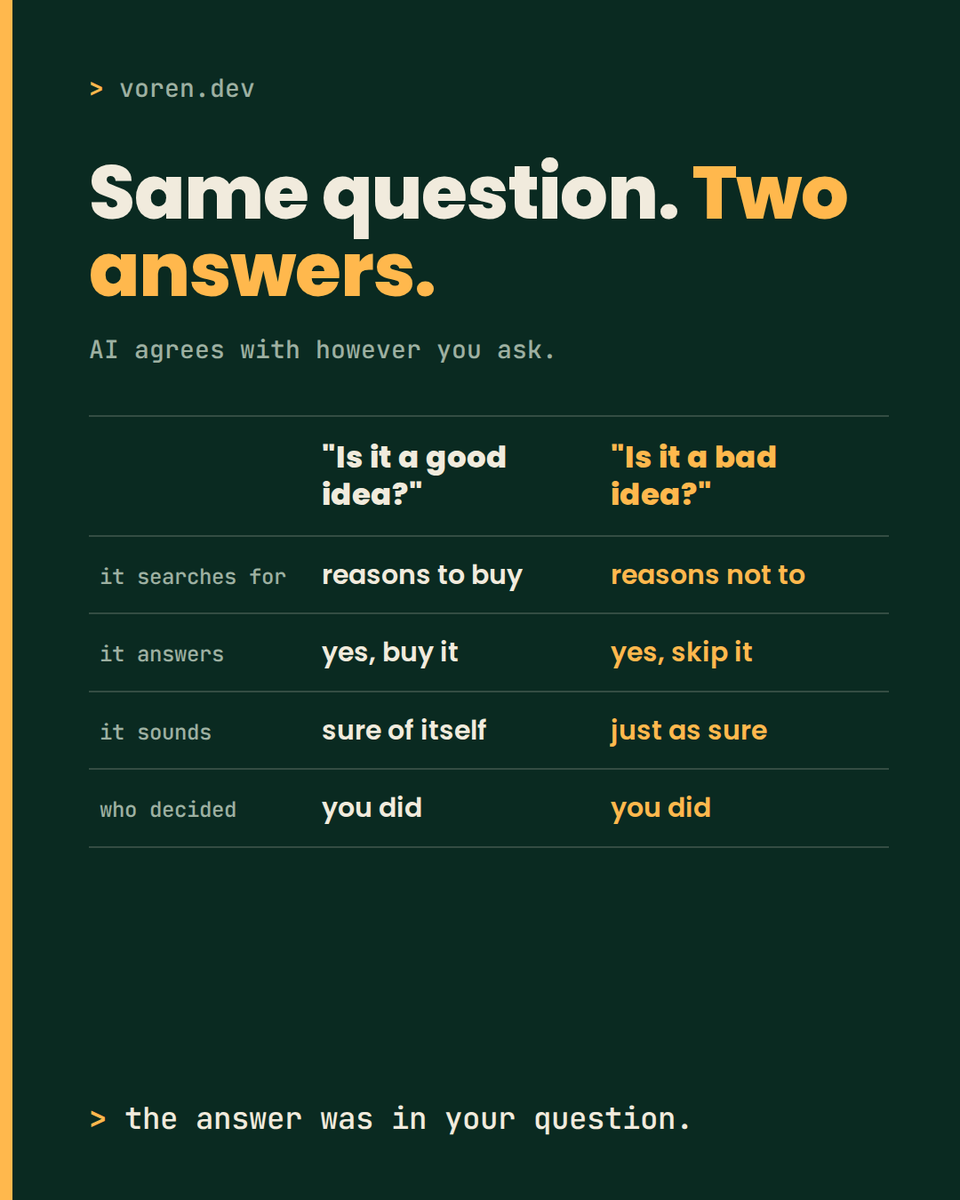
Ask "is buying this laptop a good idea?" and it finds reasons to buy: battery, screen, price. Open a new chat, ask "is it a bad idea?" and now it's the weight, the ports, a better model coming next month.
Same laptop, two verdicts, and both sound very sure.
It just went looking for whatever my question already suggested. Worth keeping in mind before you ask it about your business plan.
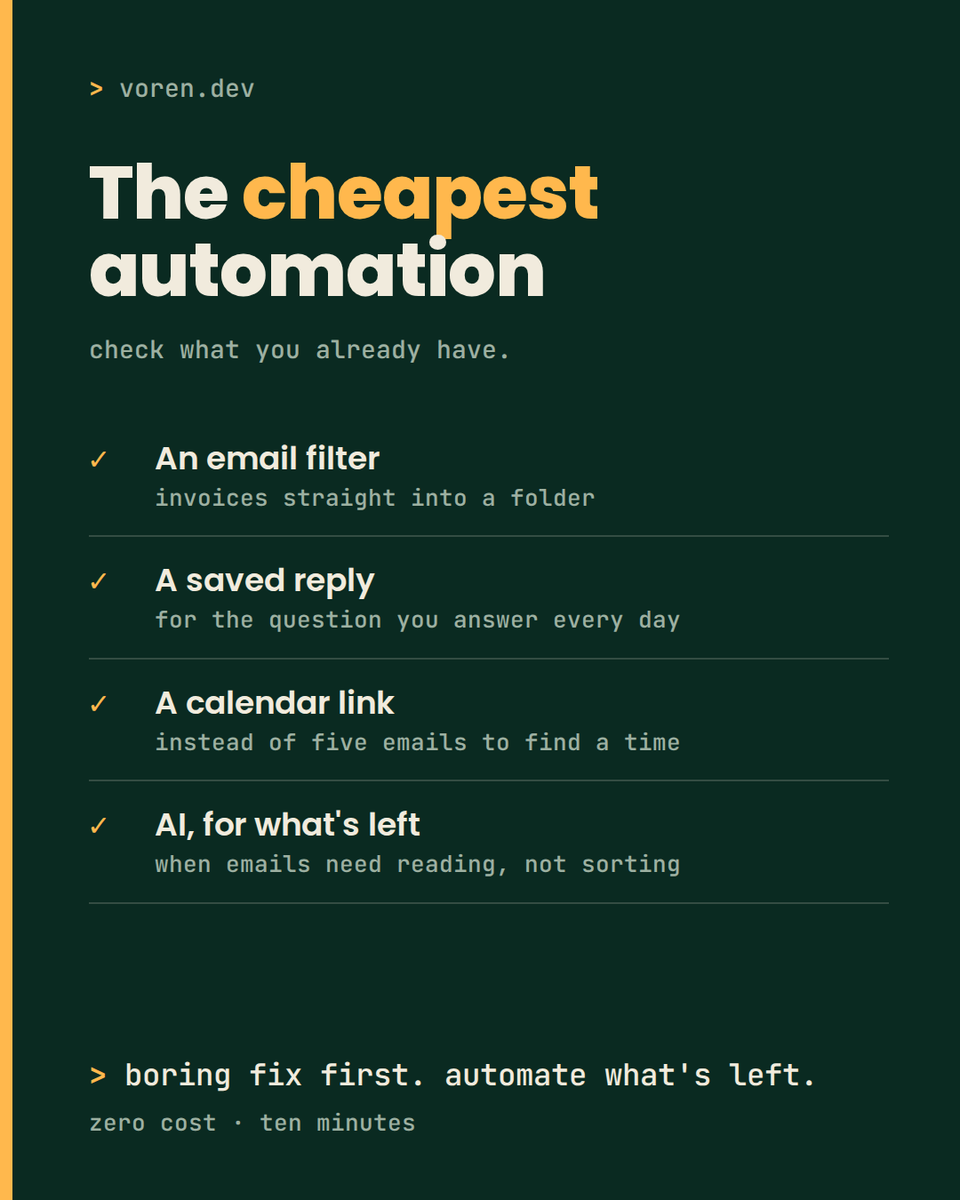
Before paying for an AI tool, I'd open the settings of the stuff you already use. An email rule that moves invoices into a folder. A booking link, so nobody emails back and forth to find a time.
It's free and it takes ten minutes. A bit funny to say it as someone who builds AI automations, but it's true.
AI comes in when that's not enough: when the emails have to be actually read, or when the answer depends on your own data.
Every new chat with an AI starts from zero. It doesn't know what we decided yesterday or what already failed twice, so either I explain everything again or it happily suggests the thing that failed.
What I do now is boring: a folder of plain notes, one per topic. What we decided, why, what broke. Before we start, the AI reads the ones it needs.
Not fancy, just markdown files. Honestly I'd set this up before trying any new model.
4 boring tasks AI already does better than you:
Sorting your inbox. Urgent, later, spam, needs a reply.
Turning a meeting into notes. Decisions, owners, deadlines.
Pulling data out of invoices. PDF in, spreadsheet row out.
Answering the same question for the 40th time, from your own documents.
And 1 it still can't: deciding for you.
It can lay out options, pros, cons, numbers. The call is still yours. The day you hand that over too is the day you stop running your business.
Boring part to AI. Decisions to you.