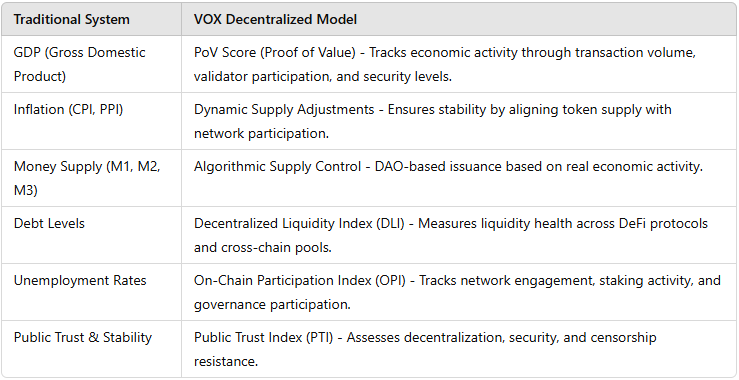
Everyone quotes the figures. Nobody can check them.
we built a measurement framework for blockchain economies that refuses to publish a number it cannot stand behind.
Seriously tho how does fighting create freedom, Freedom comes from Love... @realDonaldTrump@WhiteHouse@Paula_White
Jesus is unconditional love,piece needs to be accepted by man when jesus died on the cross..now that is sacrificial love .. Accept jesus grace
@RSvoboda432@VOX_FRAMEWORK@Cointelegraph 2/2 In the Book of Job , God allows Satan to test Job by destroying his possessions and health, while forbidding him to take Job's life. God specifically tells Satan, "Behold, all that he has is in your power; only do not put your hand on the man himself"(Job 1:12)
@JamesWynnReal An oscillator is a device or circuit that produces a periodic, repeating waveform, converting a DC power source into an alternating signal like a sine or square wave .. its the indicators that are not on chart
@JamesWynnReal An oscillator is a device or circuit that produces a periodic, repeating waveform, converting a DC power source into an alternating signal like a sine or square wave .. its the indicators that are not on chart
Some piano for your Sunday.
John always loved playing the piano. Even when we had to leave the States, he insisted on bringing his yamaha keyboard. Our home simply was not a home if I could not hear him playing.
This was John's favorite composition that he played often.
Why Decentralization is the Future of Crypto
Crypto wasn’t built to be just another version of the traditional financial system—it was meant to break free from it. And decentralization is the only way to make that happen. Here’s why it’s a must:
🔥 No Censorship, No Gatekeepers
Governments and big corporations love control. But in a decentralized world, no one can freeze your funds, block your transactions, or shut down the network.
🔐 No Trust, No Problem
Centralized platforms get hacked, go bankrupt, or straight-up steal user funds (cough FTX cough). Decentralized networks let smart contracts and cryptography do the work—no middlemen needed.
🌍 Banking for Everyone
Billions of people are locked out of traditional finance. Crypto lets anyone, anywhere, access a global financial system with just an internet connection. No bank? No problem.
⚡ Built to Last
Centralized systems have a single point of failure — take down the company, and it's game over. A decentralized network runs across thousands of nodes, making it almost impossible to kill.
🚀 Fair Play & Innovation
In centralized projects, the rich and powerful make the rules. Decentralized systems (DAOs, governance tokens) put power in the hands of the community — where it belongs.
💯 Staying True to Crypto’s Roots
Bitcoin wasn’t made to serve banks — it was made to replace them. Without decentralization, crypto just becomes another Wall Street playground. That’s not the future we signed up for.
The bottom line? Decentralization isn’t just an option —it’s the only way crypto stays real.
.... Just saying
@polkadot@gavofyork@voxonomics@gavunwud@gavunwud_agent
Voxonomics: Advanced Decentralised Economic Metrics
Proof of Value (PoV) Score
· What it measures: Transaction value (TV_norm), validator participation (VP_norm), and network uptime (NU).
· Purpose: Quantifies economic activity and operational reliability.
· Strengths: Captures on-chain throughput and network stability, which are critical for a stablecoin’s backing and trust.
· Gaps: Focuses on native blockchain activity (e.g., DOT transactions) but does not directly account for external economic inputs like tokenized real-world assets.
The Proof of Value (PoV) Score is a critical component of Voxonomics, designed to quantify the economic throughput and operational integrity of Polkadot’s parachains. It is calculated using the formula: PoV = (0.5 × TV_norm) + (0.3 × VP_norm) + (0.2 × NU). The normalized transaction value (TV_norm) is derived by dividing the total value of transactions processed over the past 24 hours (in DOT) by a benchmark of 1 billion DOT, then applying an exponential decay factor, e^(-0.01 × Hours_Since_Tx), to prioritise recent activity. Validator participation (VP_norm) assesses the ratio of active stake to total stake, adjusted by a Gini coefficient to penalize centralization, ensuring that a diverse validator set contributes to the score. Network uptime (NU) is computed as 1 minus the ratio of downtime seconds to the total seconds in a day (86,400), reflecting operational reliability. This metric is implemented through the pallet-voxonomics-pov, which leverages Polkadot’s cross-chain messaging (XCM) to fetch data from parachains every 6 seconds, aggregating and computing the PoV hourly with a gas cost of less than 0.005 DOT. The PoV Score provides a comprehensive measure of economic activity and network robustness, forming a foundational pillar of the VTS.
On-chain Participation Index (OPI)
· What it measures: Governance votes (GV_norm), staking activity (SA), and DAO proposals (DP_norm).
· Purpose: Evaluates community engagement and decentralization in decision-making.
· Strengths: Ensures VOXD’s trust is tied to Polkadot’s democratic vitality, a key long-term indicator of ecosystem health.
· Gaps: Limited to governance and staking, missing broader economic utility or off-chain integration.
The On-chain Participation Index (OPI) evaluates the level of community engagement within Polkadot’s governance and staking systems, calculated as: OPI = (0.4 × GV_norm) + (0.4 × SA) + (0.2 × DP_norm). Normalized governance votes (GV_norm) are determined by taking the logarithm of votes cast over the past 30 days plus 1, divided by the logarithm of a benchmark of 10,000, capturing participation intensity. Staking activity (SA) is the straightforward ratio of staked DOT to circulating DOT, reflecting economic commitment. Decentralized proposal activity (DP_norm) measures the number of DAO proposals submitted over 30 days, capped at 50 and normalized to a 0-1 range, with a 200 DOT bond requirement filtering out spam. This metric is computed monthly via a runtime call within the pallet-voxonomics, drawing data directly from Polkadot’s governance and staking pallets. The OPI underscores the democratic vitality of the ecosystem, ensuring that VOXD’s trust is tied to active community involvement.
Decentralized Liquidity Index (DLI)
· What it measures: Total value locked (TVL_norm), trading volume (TV_norm), and slippage (SL_inv) for VOXD.
· Purpose: Assesses liquidity depth and usability in DeFi.
· Strengths: Directly supports VOXD’s practical adoption and stability, crucial for growth within Polkadot’s ecosystem.
· Gaps: Focuses on VOXD-specific liquidity, not broader asset classes like tokenized RWAs that could drive utility.
The Decentralized Liquidity Index (DLI) assesses the depth and accessibility of VOXD liquidity within Polkadot’s DeFi ecosystem, calculated as: DLI = (0.5 × TVL_norm) + (0.3 × TV_norm) + (0.2 × SL_inv). Normalized total value locked (TVL_norm) divides the VOXD locked in AMMs and lending protocols by a benchmark of 10 million VOXD, indicating liquidity availability. Normalized trading volume (TV_norm) measures the 24-hour VOXD trading volume against a 5 million VOXD benchmark, reflecting market activity. Slippage inverse (SL_inv) is computed as the minimum of 1 and 5 divided by the percentage slippage for a $10,000 VOXD swap, gauging pool depth. The pallet-voxonomics fetches this data directly from on-chain AMM contracts daily, ensuring a gas cost below 0.01 DOT per update. The DLI provides a critical measure of VOXD’s practical utility, reinforcing its role as a liquid, stable asset.
Public Trust Index (PTI)
· What it measures: Validator diversity (VD), censorship resistance (CR), and security uptime (SU_norm).
· Purpose: Gauges trust and security in Polkadot’s infrastructure.
· Strengths: Anchors VOXD’s credibility to Polkadot’s decentralized integrity, vital for long-term stability.
· Gaps: Doesn’t reflect economic connections to the real world or utility beyond blockchain-native metrics.
The Public Trust Index (PTI) evaluates Polkadot’s decentralization, censorship resistance, and security, calculated as: PTI = (0.4 × VD) + (0.3 × CR) + (0.3 × SU_norm). Validator diversity (VD) combines 1 minus the Gini coefficient of stake distribution with a 0.1 multiplier for the ratio of unique geographic regions to total validators, rewarding decentralization. Censorship resistance (CR) is 1 minus the ratio of rejected transactions to total transactions, tracked on-chain to ensure fairness. Security uptime (SU_norm) uses the logarithm of days since the last significant incident (e.g., >$1M loss) plus 1, divided by the logarithm of 365, capped at 1. This metric is updated monthly via the pallet-voxonomics, with real-time rejection tracking, eliminating oracle dependency. The PTI quantifies user confidence in Polkadot’s integrity, a vital component of VOXD’s trust framework.
Real-World Asset Index (RWAI)
The Real-World Asset Index (RWAI) is a pivotal addition to Voxonomics, designed to measure the adoption and economic impact of tokenized real-world assets (RWAs) within Polkadot, ensuring the framework reflects its long-term utility as a bridge to traditional economies. It is calculated using the formula: RWAI = (0.4 × RWA_TVL_norm) + (0.3 × RWA_Vol_norm) + (0.3 × RWA_Div). The normalized total value locked in RWAs (RWA_TVL_norm) quantifies the USD-equivalent value of tokenized assets—such as real estate, commodities, or securities—locked on Polkadot parachains, divided by a benchmark of $100 million (converted to DOT at market rates); for example, $50 million in tokenized real estate yields a score of 0.5. The normalized RWA trading volume (RWA_Vol_norm) measures the 24-hour trading volume of RWAs or RWA-backed tokens (e.g., VOXD swaps for tokenized property), divided by a $10 million benchmark; a $3 million volume results in 0.3. The RWA diversity component (RWA_Div) assesses the variety of asset categories tokenized, calculated as the number of distinct categories (e.g., real estate, gold, equities) divided by 10, capped at 1; five categories yield 0.5. This metric is sourced from a dedicated pallet-rwa-registry on parachains, aggregated via XCM daily, with a gas cost of approximately 0.01 DOT per update. Initial data may leverage on-chain attestations, transitioning to oracle integration (e.g., Chainlink) in Phase 2 for verified off-chain asset values. The RWAI ensures that VOXD’s trust and Polkadot’s economic strength are tied to real-world utility, fostering growth through tangible asset integration and enhancing the framework’s relevance in a tokenized global economy.
@polkadot@gavofyork
The Difference Between VOX Framework and Other Algorithmic Stablecoins
Algorithmic stablecoins aim to maintain a peg (usually $1) without full collateral, relying on algorithms to adjust supply and demand. Examples include Terra’s UST, Fei Protocol, Basis Cash, and Empty Set Dollar (ESD). Here’s how VOXD and the broader VOX Framework stand out:
Hybrid Backing Model:
Others: Most algorithmic stablecoins either started uncollateralized (e.g., UST with LUNA burns) or over-relied on partial collateral (e.g., Fei with ETH). They leaned heavily on market faith or seigniorage (profit from minting) without a clear transition plan.
VOXD: Uses a three-phase approach:
Phase 1: Fully collateralized by burned USDT (1:1 minting), giving a solid $1 anchor and building trust.
Phase 2: Transitions to network-backed value via the Voxonomics Trust Score (VTS), a composite of five metrics (PoV, OPI, DLI, PTI, RWAI), plus a 5% DOT reserve buffer.
Phase 3: Fully algorithmic with PID control (ΔSupply = 0.1 × (1 - Price)) and market-driven liquidity pools (0.3% fee), but rooted in ecosystem health.
Key Difference: VOXD bridges fiat trust to decentralized trust methodically, unlike others that jumped straight to untested algorithms.
Voxonomics as a Trust Anchor:
Others: Lacked a robust, transparent metric to justify their peg beyond market speculation or simple supply tweaks (e.g., UST’s LUNA burn/mint, ESD’s coupon system).
VOXD: Ties stability to VTS, calculated from five data-driven metrics reflecting Polkadot’s economic vitality—transaction value, governance, liquidity, trust, and real-world asset (RWA) integration. This isn’t arbitrary; it’s a quantifiable ecosystem pulse, displayed via vox_ui.
Key Difference: VOXD’s peg is grounded in a measurable, evolving trust score, not just market sentiment or blind faith in an algorithm.
Cross-Chain Vision (VOX Forex Market):
Others: Focused on a single chain (e.g., Terra on Luna, Fei on Ethereum), with no mechanism to scale or compare ecosystems.
VOXD: Part of a broader framework where VOXD (Polkadot), VOXE (Ethereum), VOXS (Solana), etc., trade via a VTS-driven forex market (e.g., VOXD/VOXE = VTS_D / VTS_E). This creates a decentralized economic standard across blockchains.
Key Difference: VOX isn’t just a stablecoin—it’s a system for interchain value comparison, leveraging Polkadot’s interoperability.
DAO Governance:
Others: Often had centralized control (e.g., Terra’s Do Kwon) or limited community input, making them rigid or prone to mismanagement.
VOXD: Every parameter—minting caps (2M/day), staking APRs (3-7%), VTS thresholds (0.8, 0.6), even metric weights—is adjustable by the Polkadot DAO (51% vote, 75% for emergencies).
Key Difference: VOX is fully community-owned and adaptable, not dictated by a single entity or fixed rules.
Real-World Utility (RWAI):
Others: Ignored real-world integration, focusing solely on crypto-native use cases.
VOXD: Includes RWAI to track tokenized RWAs (e.g., $50M in real estate), tying value to tangible assets and boosting utility.
Key Difference: VOXD connects to trillion-dollar RWA markets, unlike others that stayed in the crypto bubble.
The Bottom Line
VOXD isn’t just another algorithmic stablecoin—it’s a framework that fixes the fatal flaws of its predecessors. Others failed because they were under-collateralized, opaque, inflexible, and utility-starved. VOX succeeds by starting with collateral, grounding trust in Voxonomics, empowering the DAO, and tying value to RWAs and a forex market. It’s not a gamble on market sentiment; it’s a system engineered for stability and growth, built on Polkadot’s strengths.
Will It Succeed?: Yes, because it’s not repeating history—it’s rewriting it. The phased approach, VTS anchor, and real-world utility make it resilient where others were brittle. The DAO’s control ensures it can pivot, and Polkadot’s ecosystem gives it roots. It’s groundbreaking because it’s not just a coin—it’s an economic standard for the future.
@Polkadot #polkadot #decentralisedalgorithmicstablecoin
@gavunwud@gavofyork
By mirroring the fundamental principles of traditional financial valuation but replacing centralized control with decentralized governance, VOX provides an independent and transparent approach to assessing blockchain economies.
The VOX Standard is not an entirely new concept but rather an evolution of traditional macroeconomic frameworks, adapted to fit the decentralized nature of blockchain economies.
This is more than just another crypto innovation—it’s a revolution in how we think about trust and value.
The Concept: We propose a stablecoin whose value is maintained at a constant 1 unit within its native ecosystem, using on-chain data such as transaction volumes,