@YGandelsman@SCherian5734 Thanks to GLM, I can now clear a massive codebase of bugs in days, which would have taken months of auditing before.
There are more defenders than attackers.
Ask any software engineer, these safeguards do *much* more harm than good because they tilt the odds towards attackers.
FreeBSD today is more relevant then ever and it just gains new features and is still a lot more simple then Linux while offering more features.
Details here:
https://t.co/crRG53vOYY
@zodl_app Neat! Carrying seed material just to visualize wallet history is a risk!!
I personally have been using Pendrake for watch-only on desktop :3 https://t.co/nXAQ5Xdz21
Finally, tight security for practical SNARKs in the standard model!
We give the first efficient expected-time reduction that covers almost all practical SNARKs, and a matching lower bound on rewinding.
https://t.co/zqVHO74mJn with Ale, @kleptographic and Yuetian 🥰
Our massive overhaul of the AOSP Messaging app has reached the Stable channel in our App Store after 3 releases. It's well on the way to becoming our own high quality GrapheneOS Messaging app instead. There are still parts of the interface to overhaul including widgets and important features to add.
Full support for RCS with all of the additional features it brings including proper group chats, media, opt-in read receipts and much more is going to be the largest project. We'll also be adding RCS end-to-end encryption via Messaging Layer Security (MLS) compatible with Google Messages and iOS.
RCS support will be provided via an optional dependency on sandboxed Google Play for activation. In the longer term, we plan to make a fully standalone implementation requiring the carrier to support it. We probably won't make an alternate implementation of using Google's own system for this.
Finishing the user interface overhaul, resolving many minor issues and adding important features including search are going to be the priority before getting to RCS. In the meantime, Google Messages is already fully supported on GrapheneOS including RCS with E2EE via MLS:
https://t.co/xN2cOehK16
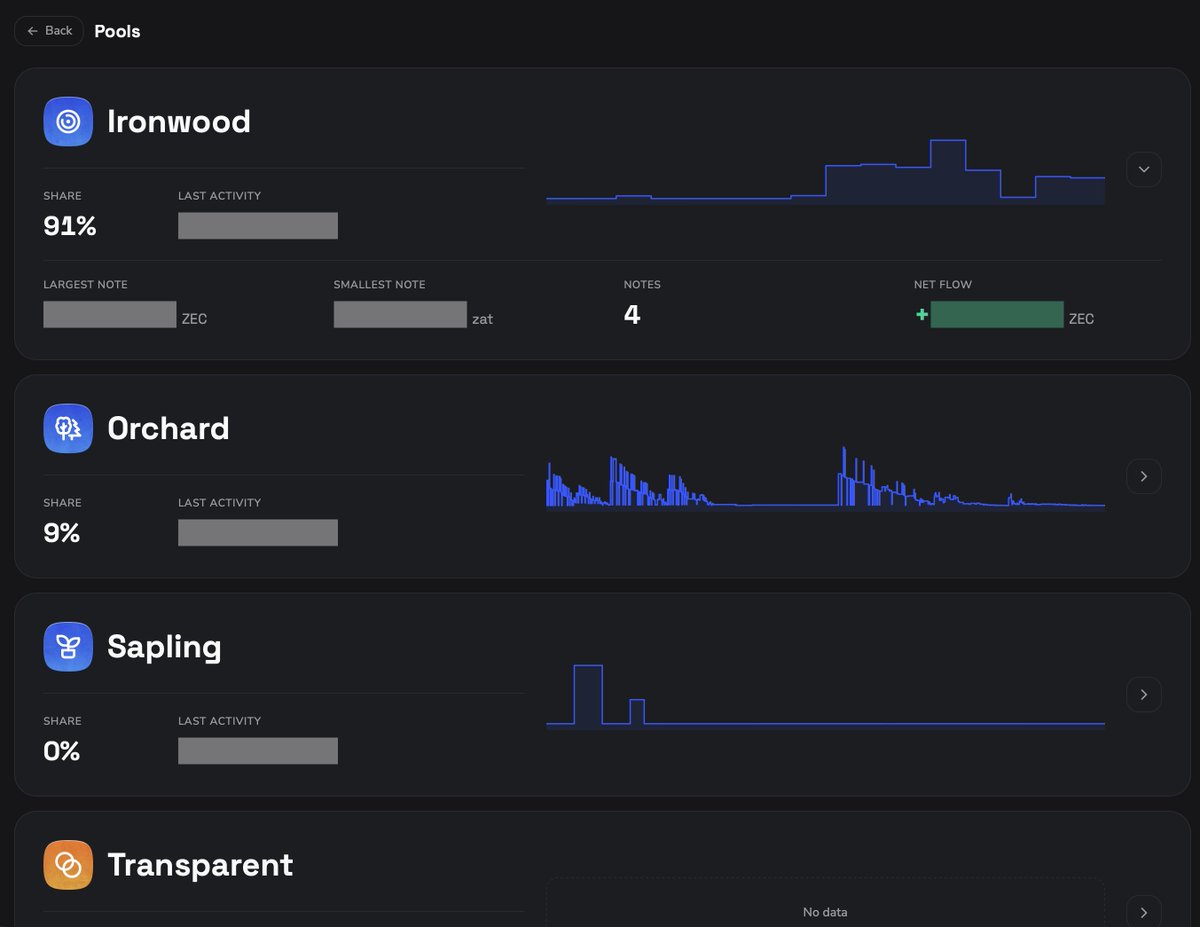
Heya! Some time after @ZecHub's Hackathon, I'm excited to announce a new Pendrake release! You can check it out here: https://t.co/HH6V8RNlDQ.
Special thanks to @dismad8 for having contributed to this <3
This release includes:
- Multi accounts
- Ironwood support
- IPC improvements
- Bugfixes
Here's how they look 👇
Nym mixnet now live in Zcash wallets
🛡️Zcash's shielded transactions hide what you send.
🌀The Nym mixnet hides the person sending it.
https://t.co/YEeVXFSKab
Say what you will about Windows (OS), but the NT kernel really is an engineering marvel that still puts Linux to shame in many ways.
The quickest way to describe it for a programmer, is NT was more like an object-oriented language, with a strong security model from day one, whereas Linux is very…not.
A lot of the “good” features in Linux feel bolted-on (SELinux, Capabilities, Namespaces) because…well they were. I love to imagine an alternate history where NT won.
IMO, Microsoft *should* have made an “Open NT” in the early 2000s; not fully GPL-style open, but one where a large org could say…swap out a memory allocator for their own. (they sorta did this with limited source access, but it was too restrictive)
You could imagine say…an early Amazon forking OpenNT to create an “AmazonNT” for EC2, where they have a modified scheduler, network stack, whatever. But, the security+compatibility contract keeps a stable baseline on the Microsoft side.
Controversial take, but if we enter this era where users are giving AI agents increasingly higher levels of access control; the Linux kernel is legitimately a poor fit. Think about it; answer the question “What exactly is this AI agent allowed to do?”
On Standard Linux, it’s disgustingly messy with lots of overlap.
Do you use UIDs? GIDs? ACLs? CGROUPs? Policies? SELinux? Filesystem modes? There’s not a singular coherent graph of capabilities you can point to. Too many ways you can escape an initially narrow scope.
NT, by comparison, can go the route of explicitly typed resources, and then you could have these really strong centralized audit trails when an agent goes haywire…etc.
I know I’m rambling, but the point is…if you were greenfielding an OS kernel from scratch, in 2026, with the intent of being forward-looking, it would *not* look like Linux. Frankly, it’d probably look a lot closer to NT, or even a BSD fork…
Following Jev? Laya-MLX is worth a look.
It's an open-source MLX port of Laya for Apple silicon. You give it text and possible actions; it returns probabilities for each, with zero output tokens.
I ran its Snake demo on my Mac Studio M4 Max and recorded the clip below. Around 11 decisions/sec, all inference on my Mac.
The demo calls the model for each move, with a planner and safety layer assisting.
Credit to @mizorewww for the MLX port.
Repo in reply 👇
The inspiration behind the @nym mixnet is back!
Don't forget that the reason @nym exists is due to discussions over the new threat model AI surveillance and the possibilities of cryptocurrency funding between @JulianAssange and @harryhalpin back in 2017-2018.
Long live @JulianAssange!
636606729769440499166579950236036751749912014371509557713570027508971809534551913252252094954941974952859310861988904737359709200557919
is a factor of RSA-896
https://t.co/yGWyEC8RpZ