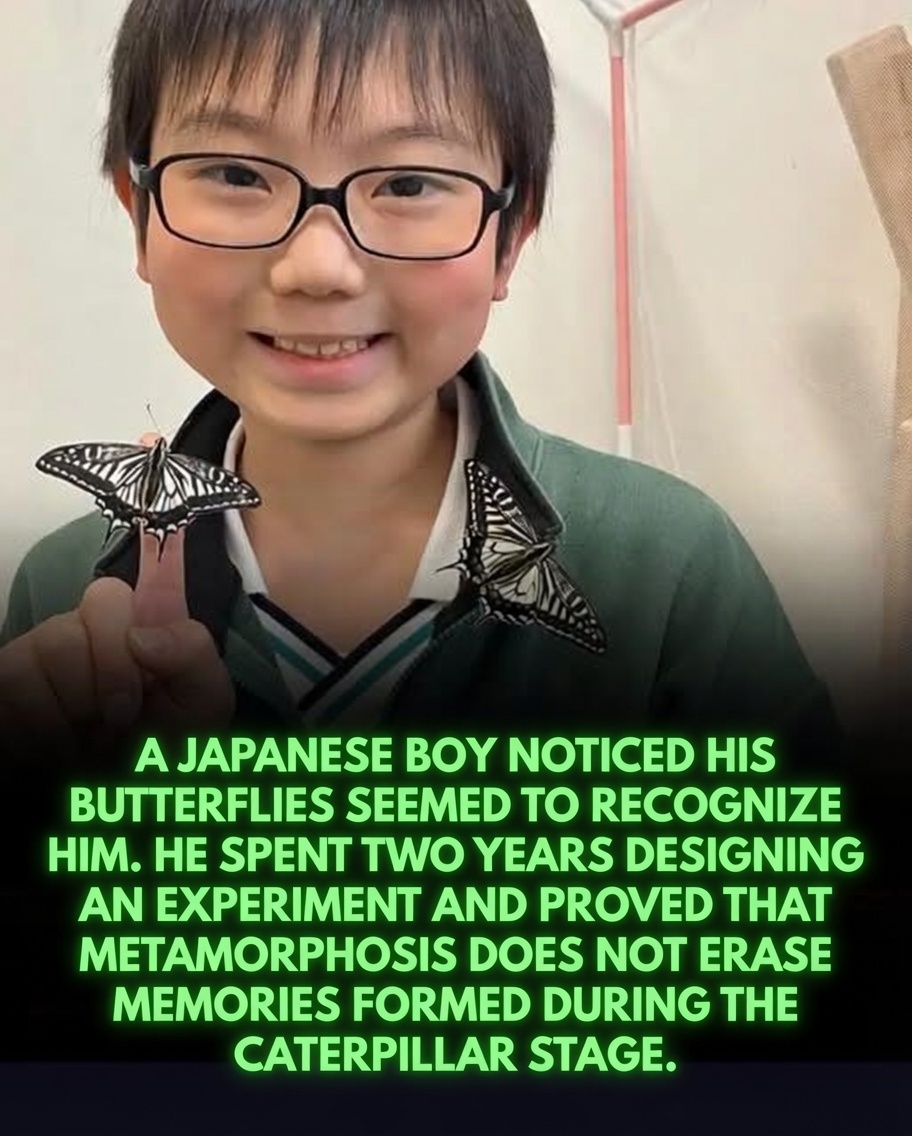
A 10 year old child’s experiment demonstrated that memories can be inherited across generations.
The story started when Jo Nagai, a second grader from Kobe, Japan, observed that swallowtail butterflies he had raised by hand appeared to recognize him, whereas wild butterflies would flee.
Motivated to uncover a scientific explanation, he contacted Georgetown University entomologist Dr. Martha Weiss, who had previously shown that moths retain memories despite the extensive cellular reorganization during metamorphosis.
Encouraged by her research, Jo suggested conducting a similar study with butterflies. This led to a remarkable international collaboration. Using a simple setup created at home, Jo conditioned caterpillars to link a gentle vibration with the smell of lavender.
Remarkably, after their brains were entirely reconstructed inside the chrysalis, 70 percent of the adult butterflies still avoided the lavender scent, demonstrating that their memories had endured the transformation.
The most surprising result emerged when Jo bred these conditioned insects. Neither the offspring nor the grandchildren had ever encountered the vibration, yet both generations displayed an instinctive aversion to the lavender scent.
At the age of ten, Jo compiled his groundbreaking observations into a 33 page paper and presented them alongside Dr. Weiss at the International Congress of Entomology in Kobe. This discovery of transgenerational memory challenges conventional views of genetics and inheritance while illustrating how a child’s curiosity can push the frontiers of scientific understanding.
In a remarkable act of generosity, Graham Walker, former CEO of Fibrebond Corporation in Louisiana, sold his company for $1.7 billion and shared the success with his employees in an extraordinary way.
When the company was acquired by Eaton, Walker made it a non-negotiable condition of the deal that $240 million be distributed as bonuses to all 540 full-time employees. He wanted the people who had helped build the company to directly benefit from its success.
Bonuses were calculated based on years of service, with many long-term employees receiving six-figure payouts. Workers were stunned when they opened their letters — some initially thought it was a prank. The generous windfall transformed lives overnight and highlighted Walker’s strong belief that loyalty and hard work deserve to be richly rewarded.
Erling Haaland paid $134,000 for a 430-year-old Viking kings manuscript, then gifted it to his hometown. He said: “I’ve never been a big reader, but I want people to read about those who came from my area.”
Erling Haaland and his father, Alf-Inge Haaland, quietly acquired one of Norway’s greatest literary treasures at auction: a 1594 edition of Snorri Sturluson’s Kongesagaer. Translated by Mattis Størssøn from Old Norse into Danish, it was the first printed history of Norway and helped preserve the stories of the nation’s medieval kings for generations.
Widely regarded as one of the most significant works in Norwegian literary history, the copy purchased by the Haalands was the only complete edition still in private ownership. It sold for 1.3 million Norwegian kroner (about $134,000), setting the record as the most expensive Norwegian book ever sold at auction.
Instead of keeping the rare volume in a private collection, the Haalands donated it to the library in Time Municipality, where Erling grew up. The book is now on public display, and the donation also funded a reading competition to inspire local children and young people to discover Norway’s history and literary heritage.
U.S. farmers are intentionally flooding their fields to revive ancient "prairie potholes," creating temporary "pop-up" wetlands that deliver a huge boost to migratory birds while improving soil health.
In regions like California's Central Valley and the Mississippi Delta, innovative programs—most notably BirdReturns (launched by The Nature Conservancy in 2014)—pay farmers to strategically flood low-lying or post-harvest fields at precise times during bird migrations. These short-term wetlands mimic the natural prairie potholes and seasonal marshes that once dotted the landscape but were largely drained for agriculture.
By timing floods to align with peak migration periods (e.g., spring and fall for shorebirds, waterfowl, and sandhill cranes), farmers provide essential stopover habitat: shallow water, mudflats, and abundant food for millions of birds traveling along flyways like the Pacific Flyway. The approach has transformed tens of thousands of acres of working farmland into critical refueling stations, with studies showing dramatic increases in bird use and numbers—sometimes 3.5 times higher in these managed pop-up wetlands compared to standard fields.
Farmers also gain practical benefits. Seasonal flooding enhances soil structure, boosts nutrient cycling (as bird activity and water help break down residues), recharges groundwater, reduces erosion, and supports long-term land productivity—often without hurting crop yields in subsequent seasons.
This win-win model proves that modern agriculture and wildlife conservation can reinforce each other, turning productive farmland into flexible ecological assets that sustain both birds and resilient farming systems.
[The Nature Conservancy. BirdReturns: Creating Dynamic Habitat for Migratory Birds. The Nature Conservancy California]
This clip, from Larry David's new show "Life, Larry, and the Pursuit of Unhappiness" is one of his FUNNIEST ever.
Awesome to have Rob Reiner as George Washington in possibly one of his final on-screen performances.
Cameo by Kimmel is chef's kiss.
RIP, Rob Reiner.
BREAKING: CNN just aired a devastating montage of all the times that Donald Trump accused others of using their public office to make money. Donald Trump's net worth has almost tripled since he took office. Everything he accuses others of is an open admission.
Twelve-year-old Rebecca Young was named one of TIME Magazine's "Girls of the Year" for inventing a solar-powered, wearable heated blanket designed to protect homeless individuals from freezing temperatures.
The invention, developed with engineering support from Thales, utilizes flexible solar panels and a battery-powered heating system, with prototypes currently undergoing testing by local charities.
The young innovator from Kelvinside Academy came up with the idea at age 11 after seeing rough sleepers struggling through freezing winters in her hometown. Her portable invention, which folds directly into a backpack, collects solar energy during the day using small flexible panels and stores it in a compact battery pack. At night, this stored energy powers internal copper wiring to provide up to eight hours of emission-free warmth without requiring access to mains electricity.
The design initially won the prestigious MacRobert Commendation Medal in the UK Primary Engineer Leaders Award competition, standing out among more than 70,000 entries.
Impressed by the concept, the global engineering firm Thales turned her school drawing into a fully functional, waterproof, and flame-retardant prototype. The first batch of functional blankets has already been distributed to local charities, including Homeless Project Scotland, to help vulnerable individuals stay warm during extreme weather.
A small Canadian town has officially granted trees the status of living beings with legal rights.
Terrasse-Vaudreuil, located roughly 40 miles (64 km) west of Montreal, unanimously passed a resolution on June 9 declaring that trees possess “the right to life, natural growth, integrity, and regeneration.” The town is among the first in Canada to endorse the Universal Declaration of the Rights of the Tree.
Mayor Michel Bourdeau credited the initiative in part to filmmaker André Desrocher, whose work helped shift local perspectives on trees from mere scenery to vital living entities. “A tree is like a human being,” Bourdeau told CBC. “It breathes, it lives, it takes in water. It protects us from all sorts of things.”
Facing repeated flooding in recent years, the municipality views trees as critical infrastructure. They cool urban areas, sequester carbon, purify air, support biodiversity, mitigate heat islands, and assist with stormwater management.
The resolution calls for a review of local bylaws to strengthen tree protection and ensure proper replacement when removals occur.
This step reflects the expanding global “rights of nature” movement, which seeks legal personhood for ecosystems, much like corporations already enjoy. A notable precedent in Quebec is the 2021 granting of legal personhood to the Magpie River by a regional government and the Innu Council of Ekuanitshit.
Advocates believe such recognition could reshape development decisions, enhance climate resilience, and transform urban planning. In Terrasse-Vaudreuil, the message is clear: trees are not simply property, they are living systems essential to human communities.










![Rainmaker1973's tweet photo. U.S. farmers are intentionally flooding their fields to revive ancient "prairie potholes," creating temporary "pop-up" wetlands that deliver a huge boost to migratory birds while improving soil health.
In regions like California's Central Valley and the Mississippi Delta, innovative programs—most notably BirdReturns (launched by The Nature Conservancy in 2014)—pay farmers to strategically flood low-lying or post-harvest fields at precise times during bird migrations. These short-term wetlands mimic the natural prairie potholes and seasonal marshes that once dotted the landscape but were largely drained for agriculture.
By timing floods to align with peak migration periods (e.g., spring and fall for shorebirds, waterfowl, and sandhill cranes), farmers provide essential stopover habitat: shallow water, mudflats, and abundant food for millions of birds traveling along flyways like the Pacific Flyway. The approach has transformed tens of thousands of acres of working farmland into critical refueling stations, with studies showing dramatic increases in bird use and numbers—sometimes 3.5 times higher in these managed pop-up wetlands compared to standard fields.
Farmers also gain practical benefits. Seasonal flooding enhances soil structure, boosts nutrient cycling (as bird activity and water help break down residues), recharges groundwater, reduces erosion, and supports long-term land productivity—often without hurting crop yields in subsequent seasons.
This win-win model proves that modern agriculture and wildlife conservation can reinforce each other, turning productive farmland into flexible ecological assets that sustain both birds and resilient farming systems.
[The Nature Conservancy. BirdReturns: Creating Dynamic Habitat for Migratory Birds. The Nature Conservancy California]](https://pbs.twimg.com/media/HMc0HrdW8AA3WjV.jpg)


