We often celebrate results without knowing which decisions drove them.
Making decisions visible can transform how outcomes actually appear.
Explored in the latest article.
Most organizations track results, but few can explain which decisions actually produced them.
Discover why making strategic choices visible changes how outcomes emerge.
Read more: https://t.co/LY8wkeRzOV
We often talk about “lessons learned,” but the real question is:
are we deciding differently next time?
Reflection alone doesn’t prevent repetition.
Curious? Check out our latest article.
Most organizations think they’re learning.
They hold retrospectives, document insights, update dashboards… yet the same mistakes resurface.
Real change only happens when decisions themselves evolve.
Read more: https://t.co/PA2E9vaJw1
I’ve seen it too often: teams “aligned” on paper, yet decisions clash and results surprise.
Alignment isn’t shared dashboards. It’s making compatible choices when priorities collide.
Our latest article digs into this tension.
Most orgs think teams are aligned because they share goals & KPIs. Yet decisions collide silently, and impact is inconsistent.
True alignment isn’t words or numbers. It’s compatible choices under tension.
👉 Explore more in our new article: https://t.co/EtSv61H7m2
Most organizations don’t struggle with ambition.
They struggle with saying no.
When every initiative stays alive, priorities stop being strategic … they become political.
That’s the tension explored in the new article.
When everything is urgent, everything gets funded, protected, and defended.
That may feel like commitment. It’s often avoidance.
Strategy begins where priorities force trade-offs.
Read our new article: https://t.co/zC0iJwm1Zj
Strategy can be perfectly clear … and still fail in practice.
Not because people disagree, but because no one knows how decisions should actually be made.
Clarity without decision structure leads to drift.
This is what the new article explores.
Strategy looks clear. Priorities are defined. Alignment seems real.
Yet decisions stall or drift.
Clarity isn’t the issue … decision-making is.
When no one knows how to decide, strategy stays theoretical.
Read our new article: https://t.co/uEuX61oKuG
We trust what “works.” We scale it. We defend it.
But when results aren’t decision-traceable, success becomes guesswork.
The risk isn’t failure … it’s not knowing what to adjust when things shift.
This is the core idea behind the new article.
What “works” is often where you’re most exposed.
If results can’t be traced back to decisions, they can’t be repeated … only protected.
That’s not strength. That’s fragility.
Read our new article: https://t.co/wbLPGc8BAf
Most transformations look successful… until they scale.
That’s when decisions fragment, alignment weakens, and outcomes drift.
It’s not complexity. It’s that the logic behind the transformation doesn’t hold.
New article explores why.
Transformations don’t usually fail at the start.
They fail when they try to scale.
What worked in a pilot begins to break across the system.
Not because of execution, but because the underlying decisions don’t hold.
Read our new article: https://t.co/bJ7QnfAxBT
We focus on decisions that matter.
Too often, leaders spend time on choices that barely move the needle.
New article explores what high-impact decision-making really looks like.
Most teams aren’t failing because they don’t decide.
They’re failing because most decisions they make don’t matter.
Discover why activity doesn’t equal impact in our latest article: https://t.co/H0iyXakZXy
We often blame strategy when results stall.
But what if the real issue is how daily decisions drift away from it?
Small trade-offs, repeated under pressure, reshape outcomes.
I explore this in our latest article:
Strategy Isn’t Failing. Your Daily Decisions Are.
Your strategy probably isn’t failing. It’s being diluted by small, daily decisions made under pressure.
Execution gaps don’t start with bad plans. They start with unnoticed trade-offs.
Read more: https://t.co/uNTpTBwtnR
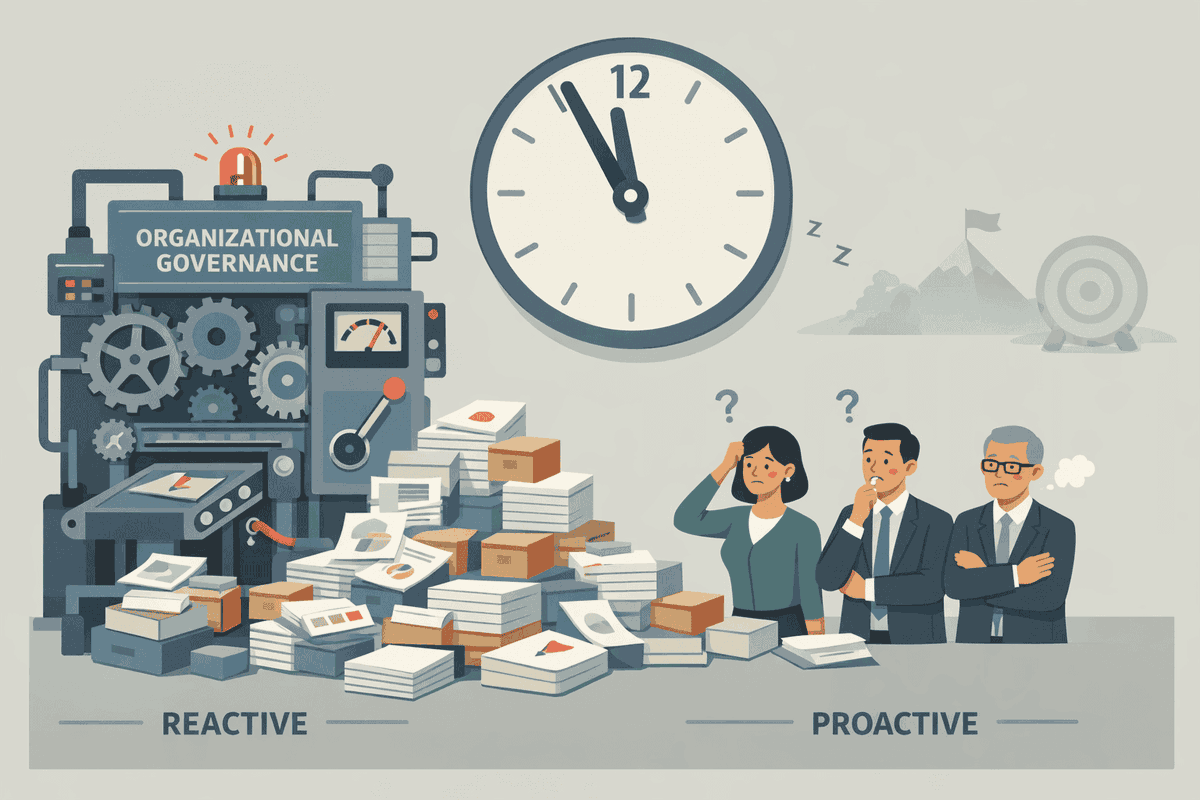
Governance works perfectly… after everything went wrong.
Great reports, clear explanations, solid lessons learned.
But real damage happens earlier … at the decision level. And governance doesn't operate there.
That tension is at the core of the article I’m sharing today.
Governance often appears when results disappoint. It explains failure instead of preventing it.
Most systems audit outcomes, not the decisions that made them inevitable.
And that’s why organizations keep learning too late.
👉 Read our new article here: https://t.co/YL4BixTliz
I’ve seen teams deliver relentlessly yet business impact barely moves.
Not because people aren’t capable - but because output isn’t connected to real decisions, learning, and sustained value.
That is the tension behind the article I’m sharing today.
Teams deliver outputs. Business barely moves.
Delivery alone doesn’t create impact.
Without connecting decisions, learning, and value, productivity may add up to little strategic change.
👉 Read the full article here:
https://t.co/2n1yWc4ItB
I’ve seen transformations declare success after early wins.
Energy rises, dashboards turn green - but real change often stops.
That tension sits behind the article I’m sharing today.
Early wins are celebrated as proof of transformation.
But they often reward visible activity, not real change - and can lock organizations into shallow success.
👉 Read the full article here:
→ https://t.co/YQVXSc87Pb
I’ve seen many organizations with “great strategies”.
People work hard, make reasonable decisions, and still miss the outcome.
Not incompetence.
Strategy was never translated into real decision rules.
This is the tension behind the article I’m sharing today.
Most organizations don’t fail because of poor strategy.
They fail because strategy never becomes a real decision system.
We’ve launched a new content silo:
From Strategy to Sustainable Results.
https://t.co/ARRNyzReDo
[Webinar] Kanban: Implementar Retroalimentación
La sexta práctica de Kanban se trata de la necesidad de recibir comentarios de personas fuera de tu sistema.
Accede al webinar: https://t.co/oZzp6xzu1d.
[Webinar] Experiencia del Cliente - Cultura
Tu Cultura organizacional debe reflejar los valores que se alinean con las experiencias deseadas de los clientes para que tengas éxito.
Accede al webinar: https://t.co/AenS0KoOez.
[Webinar] Kanban: Mejorar y Evolucionar
La quinta práctica de Kanban es la que hace que este marco sea más interesante y más complicado de implementar.
Accede al webinar: https://t.co/FM22seA5kQ.
[Webinar] Scrum: Sprint Review
El propósito de la Revisión del Sprint es que el Equipo Scrum muestre a los participantes el trabajo que ha realizado durante el Sprint.
Accede al webinar: https://t.co/WcO3tn6NiP.
[Webinar] Lean Startup: Fase Aprender
Las organizaciones que no pivotan hacia una nueva dirección se pueden quedar atascadas en la tierra de los muertos vivientes.
Accede al webinar: https://t.co/yiAWxhYHLp.
[Webinar] Design Thinking - Probar
Las pruebas que realices con tus usuarios no solo te ayudan a permanecer centrado en ellos. También tiene buen sentido desde el punto de vida del negocio.
Accede al webinar: https://t.co/z9SYY5Gozy.
[Webinar] Experiencia del Cliente - Gobierno
El Gobierno de la Experiencia del Cliente es el conjunto de políticas que permiten el seguimiento de dicho Programa por parte de los miembros ejecutivos de una organización.
Accede al webinar: https://t.co/jHsLBYIuQe.










![2reirl's tweet photo. [Webinar] Kanban: Implementar Retroalimentación
La sexta práctica de Kanban se trata de la necesidad de recibir comentarios de personas fuera de tu sistema.
Accede al webinar: https://t.co/oZzp6xzu1d. https://t.co/t065MKSUgM](https://pbs.twimg.com/media/GYjsmX0XkAAdqm7.png)
![2reirl's tweet photo. [Webinar] Experiencia del Cliente - Cultura
Tu Cultura organizacional debe reflejar los valores que se alinean con las experiencias deseadas de los clientes para que tengas éxito.
Accede al webinar: https://t.co/AenS0KoOez. https://t.co/stx7h2IVgX](https://pbs.twimg.com/media/GXWc6BOWcAA928B.jpg)
![2reirl's tweet photo. [Webinar] Scrum: Sprint Review
El propósito de la Revisión del Sprint es que el Equipo Scrum muestre a los participantes el trabajo que ha realizado durante el Sprint.
Accede al webinar: https://t.co/WcO3tn6NiP. https://t.co/elIJ1UW67U](https://pbs.twimg.com/media/GWOPt-BWEAMIaJi.jpg)
![2reirl's tweet photo. [Webinar] Lean Startup: Fase Aprender
Las organizaciones que no pivotan hacia una nueva dirección se pueden quedar atascadas en la tierra de los muertos vivientes.
Accede al webinar: https://t.co/yiAWxhYHLp. https://t.co/DZC4m9onfB](https://pbs.twimg.com/media/GVqZ24VXkAAjW_e.jpg)
![2reirl's tweet photo. [Webinar] Design Thinking - Probar
Las pruebas que realices con tus usuarios no solo te ayudan a permanecer centrado en ellos. También tiene buen sentido desde el punto de vida del negocio.
Accede al webinar: https://t.co/z9SYY5Gozy. https://t.co/NNgBey3av2](https://pbs.twimg.com/media/GVGmF83WQAAzWf8.jpg)
![2reirl's tweet photo. [Webinar] Experiencia del Cliente - Gobierno
El Gobierno de la Experiencia del Cliente es el conjunto de políticas que permiten el seguimiento de dicho Programa por parte de los miembros ejecutivos de una organización.
Accede al webinar: https://t.co/jHsLBYIuQe. https://t.co/PvDyCaeYOq](https://pbs.twimg.com/media/GUiNWydXoAABAIK.png)


