Marketing sees 2-3x Win Rates when aligned around buying groups. #EdTech must-dos:
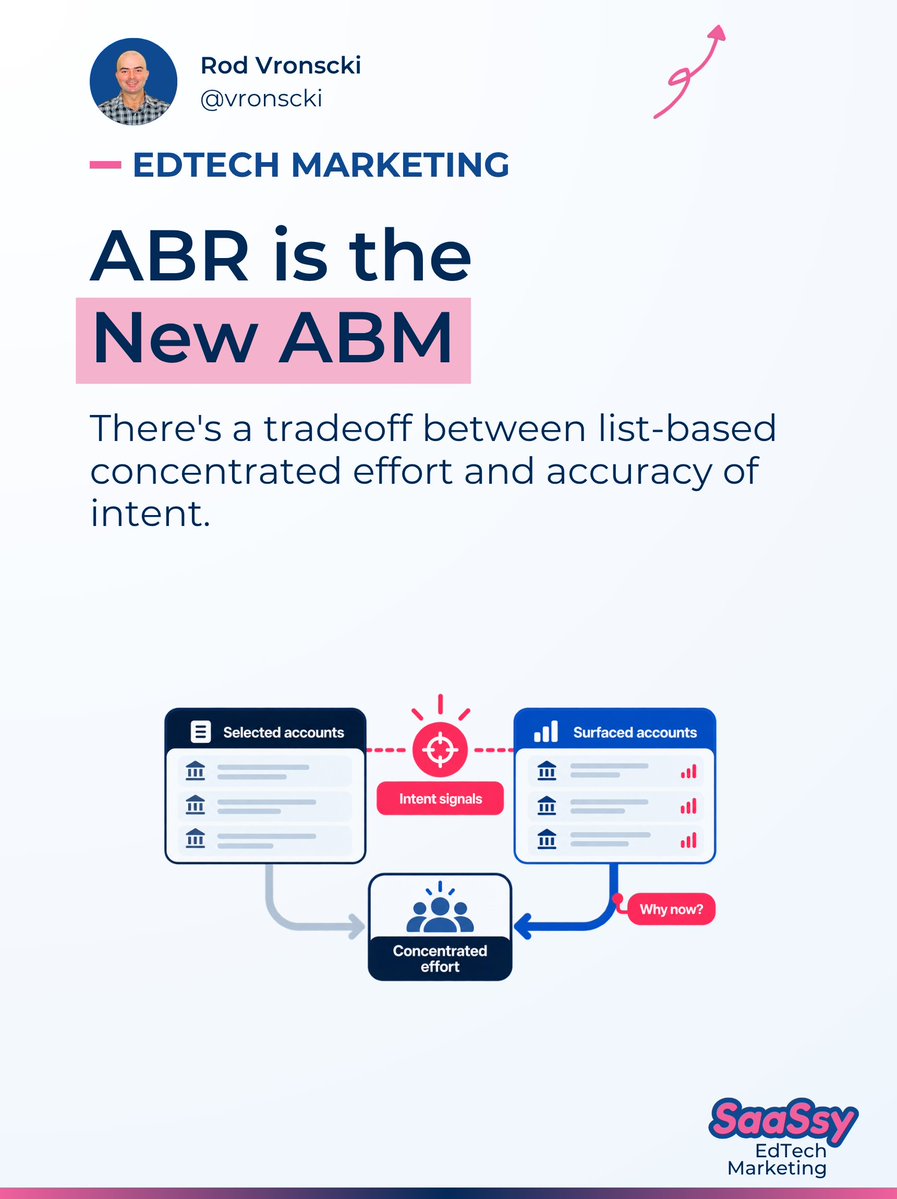
The standard ABM model starts by deciding which accounts deserve disproportionate attention.
- Build the list
- Then concentrate research, content, advertising, and Sales effort on those accounts
Concentrating effort is the basis of any account-based activity.
The questionable part is deciding:
Who deserves it before you've seen what the market is doing.
I'd rather start with demand across the ICP and let account behavior expose where something is happening:
1. An institution starts engaging repeatedly around a problem.
2. Another relevant person appears.
3. They move from general content into something closer to evaluation.
Now there is a reason to concentrate effort:
- Research the account properly
- Find the relevant buying roles
- Bring those people into the campaign
- Give Sales the context if the signals become strong enough
I think about this less as Account-Based Marketing and more as:
Account-Based Response / Retargeting or ABR.
The account doesn't get more attention because Marketing put it on a spreadsheet three months ago.
It gets more attention because the account earned it through observable behavior.
This matters in EdTech, where you can know every district, university, or organization that fits your ICP and still not know which ones are moving on intent.
ABM is very good at concentrating effort.
Intent signals can tell you where to concentrate it.
And it's why Saassy's Buying Group Intelligence is part of an activation layer:
- surface the accounts already giving you a reason to look closer
- then decide how much attention they deserve
https://t.co/KDOJyZWHWn
Would you rather start with 100 accounts you chose, or the 20 that are already showing you something?
* source: Demandbase 2026 research
#EdTech #Marketing #Education #K12 #HigherEducation #HigherEd
The #EdTech conundrum: Sales enablement starts as buying-group activation
Check these recent stats:
Higher Ed AI procurement: 94% of Technology and 85% of Cybersecurity & Privacy teams are involved early.
72% of tech buyers set their decision criteria before they even make a shortlist.
94% of buying groups rank vendors before talking to Sales.
Procurement is involved from the start in 53% of B2B buying cycles.
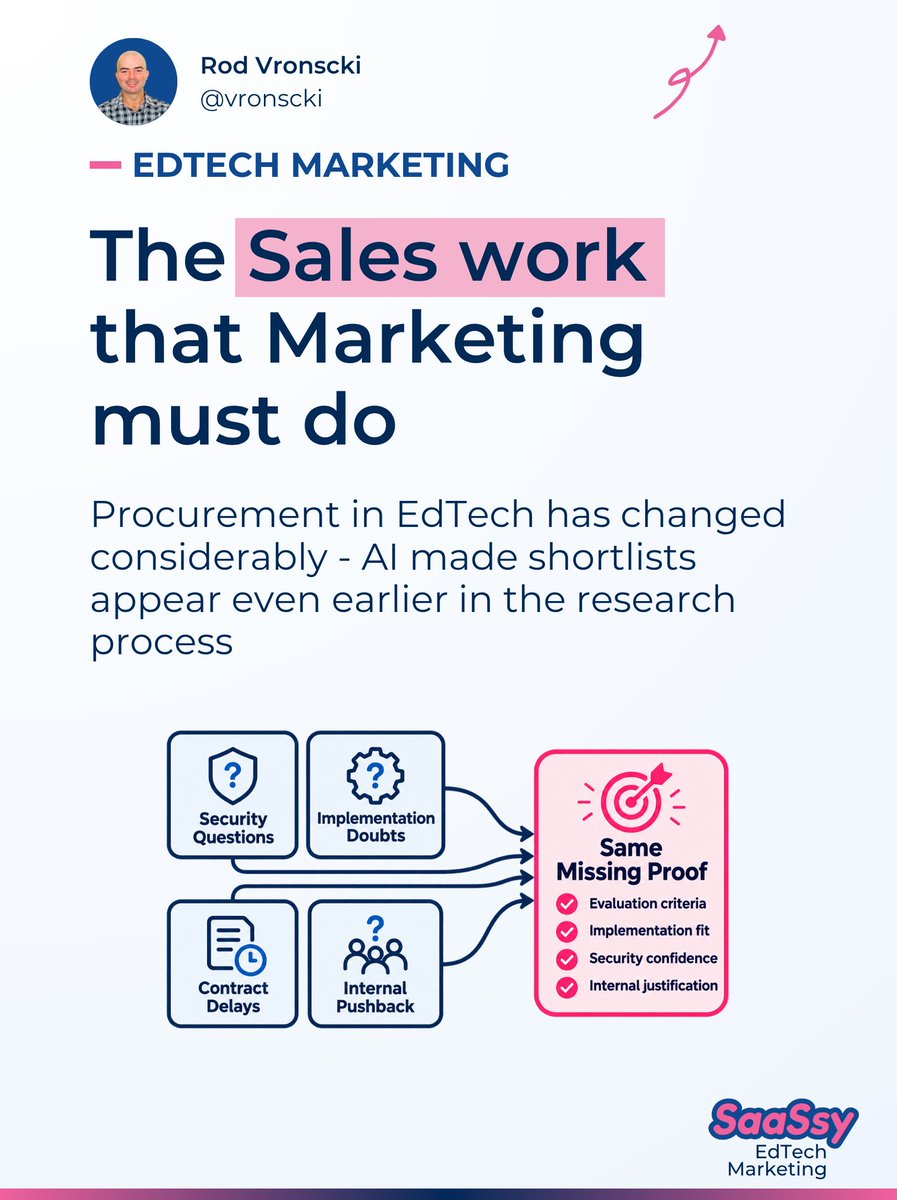
I keep seeing the gap in EdTech ad and content libraries:
- There is plenty to help someone like the product.
- But when the buying process gets serious, suddenly Sales has to explain everything Marketing never prepared for.
The product page explains what it does.
The case study proves somebody else bought it.
Then questions start appearing around implementation, security, internal approval, or the criteria the institution will eventually use to compare options.
And those questions get treated as late-stage Sales problems.
That's too late.
By the time procurement is formally involved, preference has already kicked in.
People inside the institution have been deciding:
- What would implementation actually require?
- What could create risk?
- How will we justify this internally?
- What should we insist on when we evaluate vendors?
These are questions that help shape the RFP, not only for the response.
So when I look at an EdTech content library, I ask:
Which question that could slow or stop the purchase are we waiting for Sales to answer later?
If security repeatedly becomes an obstacle, Marketing can address the concern before the security review appears.
If implementation creates uncertainty, buyers shouldn't have to wait for a demo to understand what adoption involves.
If the internal champion will eventually need to justify the purchase, give them something they can work with before the formal buying process starts.
This doesn't mean publishing your procurement documentation to everyone.
It means noticing which late-stage objections are predictable enough to influence earlier.
Because the RFP isn't always where those questions begin.
Sometimes it's just where they finally become visible.
Which objection does your team still treat as "Sales will handle that later"?
* source: #EDUCAUSE, TrustRadius, 6sense, Forrester
#EdTech #Marketing #Education #K12 #HigherEducation #HigherEd #B2B
78% of B2B measure Buying-Group engagement. Why is #EdTech behind?
Marketing reports MQLs.
And the Leadership asks for Opportunities Created.
Completely misaligned questions.
More qualified leads is good.
And for a long time, lead volume was one of the few ways Marketing could show that it was contributing.
That used to make sense when a strong inbound lead could start a meaningful Sales process.
But an EdTech deal can spend months moving before a new opportunity appears in the CRM.
Imagine you could track an institution that first appeared as a contact starts returning around the same problem.
Then, other relevant people from the account become visible.
Now Sales has enough context to act on the account instead of starting from a name and an email address.
Then, later, that account becomes an opportunity.
If the report only records the original lead and the eventual opportunity, all of that movement in between disappears.
And this is where “more qualified leads” becomes an incomplete standard for proving Marketing’s contribution.
Here's how I get the evidence to build in stages:
1st: did Marketing create or identify meaningful account activity?
2nd: did that activity broaden or deepen across the institution?
3rd: did it create a reason for Sales to act?
4th: did those accounts move into opportunities later?
This gives leadership something more useful than a bigger lead number.
It shows whether Marketing is helping accounts progress toward revenue.
So we replace "How many MQLs did Marketing generate?"
with "What changed inside the accounts Marketing influenced?"
Lead volume still matters.
It just stops being the whole proof model.
What does your Marketing report show between lead and opportunity?
* source: 6sense's 2025 Marketing Attribution & Contribution Benchmark
#EdTech #Marketing #Education #K12 #HigherEducation #HigherEd #B2B
CRM Intel = 2.6x Commercial Growth. Here's the lesson for #EdTech
When Sales says the leads are not good enough, Marketing responds by adding more fields on the form and enrichment in the CRM.
Maybe they reevaluate the lead score, improve a dashboard, or add a few extra columns for the SDR.
But still the question remains: "Why should I contact this account now?"
That's the gap in most of the Marketing-Sales handoffs:
- The rep doesn't need every piece of information Marketing can collect.
+ They need enough context to make a decision.
For EdTech clients, I want the CRM to answer four things:
1. Why is this account a priority?
What happened recently that made it worth attention?
2. What problem(s) are they researching?
Not simply which PDF they downloaded, but what that behaviour suggests they are trying to work through.
3. Who is involved? Has the buying group been surfaced?
Is this one interested contact, or are other relevant roles from the institution appearing as well?
4. What does that mean for the next move?
Is there enough context for a call, should the rep start with email or LinkedIn, or should Marketing keep developing the account?
Now the whole of the information becomes knowledge: Intelligence.
It changes prioritisation, the reason to reach out, and sometimes it tells reps not to call yet - or at all.
That's very different from handing over a contact with 18 populated CRM fields and calling it a better lead.
The handoff doesn't improve because the record contains more data.
It improves when the rep can look at the record and make a better decision because of it.
This is also the gap SaaSsy's Buying Group Intelligence is meant to close:
> Turning the signals Marketing already has - but maybe not collecting - into account, problem, stakeholder, and timing context inside the CRM.
If Sales opened one of your Marketing leads today, could they answer why this account, why now without doing their own research first?
* source: Gartner 2026 CSO Survey
#EdTech #Marketing #Education #K12 #HigherEducation #HigherEd #B2B
#EdTech Closed-Won deals need 2x as many buyers as lost deals
The apparent account champion can be doing everything that makes the account look warm:
- Opening emails
- Returning to product pages
- Downloading the buyer's guide
- or Joining the webinar
And it's tempting for us to read that engagement as "they're warming up"
But we need an answer before deciding what to do next:
> Which important question still has nobody behind it?
Imagine the active person is convinced the product solves the problem.
But the purchase still needs someone to be comfortable with data security.
If nobody from that part of the institution has engaged, another five visits from the champion do not resolve the security question.
The same applies anywhere an important approval is still unrepresented.
So I would separate two things:
- Depth
How strongly are the people we know engaging?
- Coverage
Are the roles needed to resolve the purchase questions actually involved?
That changes the next action.
If the champion is highly engaged but an important approval role is missing, I would not simply push the champion harder.
I would try to bring that missing role into the account: the relevant content, proof or conversation for the person who owns it.
Now, when the necessary roles are already engaging around their respective concerns, that same level of activity means something completely different.
This is why Buying-Group Readiness cannot be reduced to whichever contact has the highest score.
The important missing person can matter more than the most active person.
That's the distinction SaaSsy's Buying Group Intelligence is designed to surface:
> Not only who is engaging, but which relevant buying roles are involved, which are absent, and whether the account has enough context for the next Sales action.
For an account your team considers warm, try this:
- What concern could still stop the purchase?
- And have you seen the person related to it yet?
* source: Gong's 2025 research
#EdTech #Marketing #Education #K12 #HigherEducation #HigherEd #B2B
Surface intent and buying groups inside your #EdTech HubSpot. Here's how
We built SaaSsy Intel to reveal the buying groups forming around a purchase by uncovering the invisible intent signals that Marketing campaigns can’t see and the account context missing from the CRM.
EdTech Marketing has changed.
And the old marketing playbook doesn't work anymore:
- diminishing campaign returns
- higher ad costs
- creative fatigue
- prospects crowded by competitors
- leads and RFPs arrive too late
For one of our clients, we surfaced 2,356 of which 12% became fit for outreach in under 120 days.
+ 921 buying group contacts were uncovered, enriched, targeted, and prepared for outreach.
+ an indirect result beyond revenue: time-to-close dropped from 10months to 140 days.
If you're an EdTech company already generating demand but UNABLE to see which accounts, people, and signals deserve action, you need this intelligence in you CRM.
Other great advantages of the intelligence:
+ little to no configuration on your end
+ Marketing & Sales depts work in alignment
+ no hiring or stack overhead: SaaSsy builds, maintains and runs it for you
Here's what you get:
. Ready-to-install Google Tag Manager container
. Configured HubSpot account
. Configured automation workflows
. Account discovery
. Buying-group and role mapping
. Auto buying group contact discovery
. Auto HubSpot enrichment
. Account stages and sales-readiness rules
. Recommended Sales actions
. Sales-ready account summaries
. Audience updates for LinkedIn, Meta, and Google channels
. Ongoing operation and reporting
BEFORE
- Campaigns with dimishing returns
- Sales waits for qualified leads
- RFPs arrive late and steered toward another solution
- Low engagment nurture
- Demos run for one person
- Sales fights to enable buying groups
AFTER
- Same campaigns, but you see the invisible signals
- CRM drives informed outreach to interested accounts
- You influence committees and RFIs/RFPs
- Segment nurture by role/interest/responsibility in the buying group
- Demos run for the whole buying group
- Activate and enable buying groups before they arrive to Sales
Here's how we do it:
+ Account & Visitor discovery
We discover the institutions interacting and engaging with your campaigns, website, landing pages, emails
+ Account intent scoring
We create with you a rule-based scoring that aligns Marketing & Sales depts
+ Buying-group and role mapping
We find your key personas in the institutions that crossed a scoring threshold
+ Contact discovery
We find the exact people in those roles
+ Auto CRM enrichment
Those contacts are enriched emails, phones, profiles
+ Next-best action
Internal marketing actions and sales recommended actions
+ Auto Linkedin/Meta Audience updates
Audience updates for LinkedIn, Meta, and Google when connected
+ Auto CRM audience segmentation
Role/persona-based segmentation for enablement
Request your 15min Demo
https://t.co/6KVRmtdWpK
Only 3% of website visitors identify themselves through a form. hashtag#EdTech is no different
The CRM says buyer intent started on Aug 17.
That’s when the demo form was submitted.
Clean timestamp. Known person. Easy to route.
And, for years, that was a practical place for Marketing and RevOps to start measuring intent.
But the form is not where the journey started.
It is where the buyer finally identified themselves.
A pre-form journey could look like this:
Week 1: Someone from the institution reads an article about the problem.
Week 3: The account comes back and looks at a solution page.
Week 5: Someone checks integration or implementation information.
Week 7: Another relevant person from the same institution starts researching.
Week 8: Demo request.
The demo request is just evidence that arrives too late.
By then, your demo request might just be an assurance action that the institution already chose a suitable solution with your competitor.
Therefore, we must stop asking “When did this lead convert?”
And move to “What was happening at the account before the conversion?”
It doesn't mean calling every page view buyer intent.
A couple of visits still tells you very little.
But repeated visits, movement from problem content into product-specific research, deeper implementation questions, and engagement spreading across the institution tell you more than the form timestamp alone.
Your job is to interpret the pattern.
Because if your CRM only starts paying attention after the form, all of that earlier research becomes invisible when you decide how warm the account is and what action to take (reach out or ignore as unqualified).
By the time the demo request arrives, the buyer can already be well into the research process.
So the form should not be the starting trigger for intent tracking.
It's a late signal in a journey that was already happening.
What is the earliest pre-form signal your team actually uses?
* source: 6sense’s 2025 Buyer Experience
#EdTech #Marketing #Education #K12 #HigherEducation #HigherEd #B2B
81% of reps have lost #EdTech deals because of bad, premature Demos
The problem is not the demo. It’s the stage of awareness the prospect was at when the demo came in.
A problem-aware ad says: "Still struggling with [problem]?"
The button underneath says: Book a demo.
The logic sounds reasonable. A demo is the action closest to a sale, so why send someone somewhere else first?
That works when the buyer is already evaluating vendors.
But if the ad has only helped them recognize a problem, the demo asks them to make a decision they have not reached yet.
Imagine the same EdTech product:
- Prospecting
The buyer recognizes the problem but is still working out what solving it involves.
A smart next step could be a buyer's guide, evaluation checklist, or a product comparison that helps them continue the research and tells you something about what they are interested in.
- Retargeting
The buyer already knows the product and has returned to product, integration, or implementation pages.
Now "Book a demo" can make perfect sense.
The demo button did not change.
The buyer’s situation did.
This is where I think the idea of a "strong CTA" gets confused.
The strongest CTA is not the action closest to revenue.
It is the next action that matches what the buyer already knows and is ready to do.
EdTech Marketing has changed.
We need to match the new buyer's journey.
For the same product, what do you ask from prospecting traffic versus retargeting traffic?
*source: Reprise Sales Demo Report 2025
#EdTech #Marketing #Education #K12 #HigherEducation #HigherEd
If #Edtech resources are measured by downloads alone, the bigger view is missing:
The problem with most back-to-school downloadables is that they're directed to teachers; and
The majority of EdTech pipelines need distance from them as although they might be the end user, they don't influence purchases.
Therefore, downloads is the wrong metric to use.
To arrive at the right metrics, you need to first create a resource that can:
- Move the pipeline
- Raise an active pain
- Surface buying intent
- Be used in SDR conversations
Here's the 11-Point Framework to create assets that turn downloads into Buying-Group Readiness:
https://t.co/xZ73ccSPEW
Use it as a checklist to turn your current downloadables into more sales opportunities.
#EdTech Ads and Emails fail due to two reasons:
Too Hard & Too Soon
Every week I see the Ad Library of EdTechs pushing bottom-of-funnel messages too hard, too soon.
The ad says: Discover
The landing page says: Request a Demo
The ad says: Empower
The landing page says: Talk to Sales
There’s a clear Misalignment between what grabbed the attention and the desired action.
This misalignment happens when we don’t spend enough time digging down into what really clicks with that persona in different stages of their awareness.
You know what I usually don’t see in the Ad Libraries?
Problem-aware Ads for Prospecting; and
Solution-aware Ads for Retargeting
All this confuses the target audience:
A. The EdTech wants me to discover what they do with a big commitment conversation
B. The EdTech mentions a problem I have in the ad, but nothing in the landing page mentions how to solve that, other than purchasing
Then we see:
- Wasted Budget
- Few Qualified Leads from Campaigns, mismatching the amount of clicks the ads had
- Pushy Forms that don’t tell the Sales team anything that a 2min research wouldn’t say
To solve this, you can Reverse-Engineer your Ads and Emails
Use the EdTech Message Quality Scoreboard.
https://t.co/PrDNLkbb1D
It’s based on a 14-point Message Guide benchmark I run with my clients
To understand where your message mismatches the awareness level,
Score the Awareness Fit and CTA Fit criteria of your Ads
https://t.co/PrDNLkbb1D
Cheers,
Rod
-----
Hi, I’m Rod 👋
I share marketing and sales strategies for EdTech leaders.
Scale your pipeline and drive more demos and trials – no overhead.
DM me to start a conversation.
Something's missing in your ads and nurture emails that just can't get this job done
I know this sounds accusatory, but I’m not trying to get you against the wall.
I promise you will be able to easily see this for yourself.
Why? Because I see this happening to 80%+ of the hashtag#EdTech companies.
The problem is:
The Simplification of the Messaging…
… to the point ads, emails, pages try to talk to everyone at the same time.
And this is the sure way to lose people.
It’s easy to see when we put roles side-by-side with their concerns.
K-12
Director of Curriculum & Instruction
- Teaching quality, student learning outcomes, standards alignment, teacher adoption
District CIO / IT Director
- Integrations, data security, rostering, implementation, support burden
HIGHER ED.
Provost / VP Academic Affairs
- Academic quality, student success, institutional strategy, accreditation
Registrar
- Course data, programme rules, catalog accuracy, workflows, compliance
B2B
VP Sales / CRO
- Pipeline, conversion, forecast confidence, revenue impact
CFO / Finance Lead
- Cost, ROI, budget risk, efficiency, payback
So why do EdTechs stop at this level?
The ROOT CAUSE is an incomplete Message Guide…
… be it for the Brand or for the Campaign.
And most people think that going through a message guide is painful…
… but I promise you it’s not.
If you read up to this point, you probably know that
the Solution to combat the “one message to all”
is Rewriting the current messaging to fit the persona.
Here are two ways. You can either:
1. Start from scratch and go through a 14-point message guide per persona
Or
2. Reverse engineer from already-running campaigns
If you preferred #2, here’s the EASIEST WAY to do it:
Just take any ad, email, page, or post and quickly run it through the
EdTech Message Quality Scoreboard
https://t.co/zAK1YxKbh4
It will not only give you a full rewrite to reach the persona you need to;
It will also give you a 16-criteria check explaining:
- what’s the likely buyer reaction with the current copy
- what’s working
- what’s missing
- why
- how to fix
This is not another AI hallucination tool.
I personally created this using my 14-point message guide benchmark to keep this grounded in the marketing literature and specific to EdTech marketing.
https://t.co/zAK1YxKbh4
Check whether your message fits the buyer role you’re targeting and fix it
Cheers,
Rod
Here’s how I captured a trend (for the 2nd time)
Background
Every year, a famous higher education ranking is released, and little information is provided until the release date.
I created content that people were craving and added extra value.
Here’s how you can do it too:
👇
Results in one day
35 new leads
of which
21 ICP leads
16 ICP leads in regions of interest
Not a bad addition to a 2-year long pipeline.
♻️ REPOST if you think this can help others (including helping me grow my following! 🙏)





![vronscki's tweet photo. 81% of reps have lost #EdTech deals because of bad, premature Demos
The problem is not the demo. It’s the stage of awareness the prospect was at when the demo came in.
A problem-aware ad says: "Still struggling with [problem]?"
The button underneath says: Book a demo.
The logic sounds reasonable. A demo is the action closest to a sale, so why send someone somewhere else first?
That works when the buyer is already evaluating vendors.
But if the ad has only helped them recognize a problem, the demo asks them to make a decision they have not reached yet.
Imagine the same EdTech product:
- Prospecting
The buyer recognizes the problem but is still working out what solving it involves.
A smart next step could be a buyer's guide, evaluation checklist, or a product comparison that helps them continue the research and tells you something about what they are interested in.
- Retargeting
The buyer already knows the product and has returned to product, integration, or implementation pages.
Now "Book a demo" can make perfect sense.
The demo button did not change.
The buyer’s situation did.
This is where I think the idea of a "strong CTA" gets confused.
The strongest CTA is not the action closest to revenue.
It is the next action that matches what the buyer already knows and is ready to do.
EdTech Marketing has changed.
We need to match the new buyer's journey.
For the same product, what do you ask from prospecting traffic versus retargeting traffic?
*source: Reprise Sales Demo Report 2025
#EdTech #Marketing #Education #K12 #HigherEducation #HigherEd](https://pbs.twimg.com/media/HPXxcUbXkAASA9W.jpg)