This week's CPI, PPI and retail sales all point in the same direction: inflation moderating but still outrunning paychecks. Real wage growth has slowed across the entire income distribution, and lower-income workers feel it most.
Read more: https://t.co/2K6v2Pp5Xg
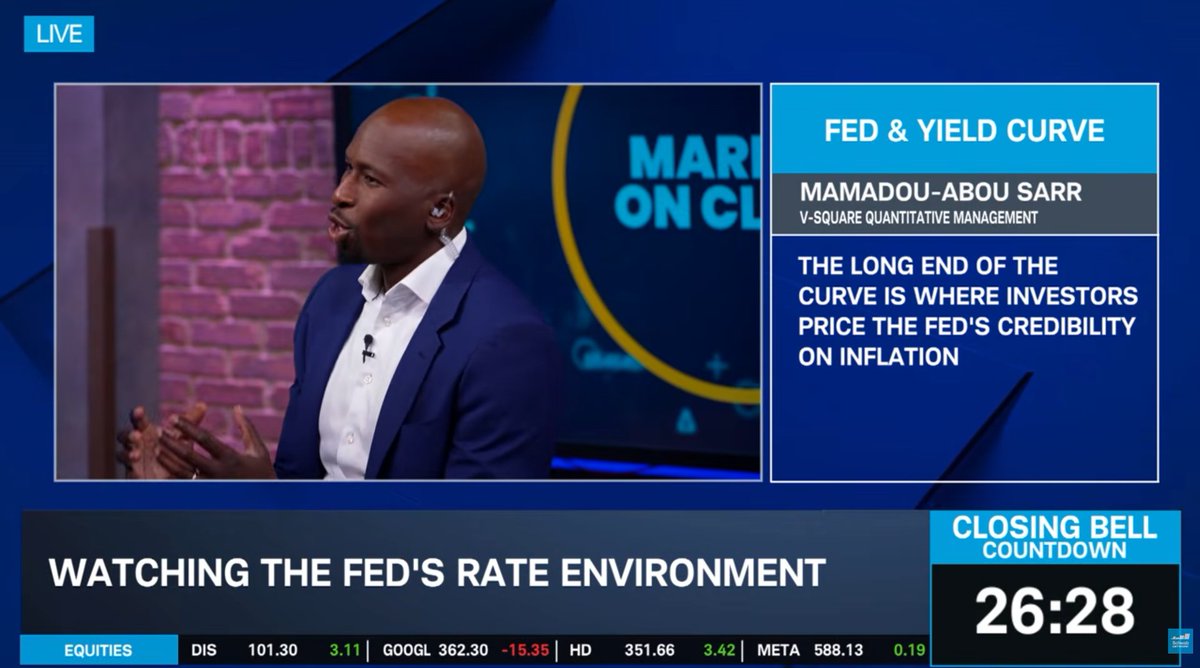
The long end of the curve is where investors price the Fed's credibility on inflation. The Fed held in July; the 30-year sits near 5.2%, its highest level since 2007.
Thank you to @MarleyKayden and @sam_vadas, and the @SchwabNetwork team for having me on the program again. Full segment below:
https://t.co/WXA212P4cl
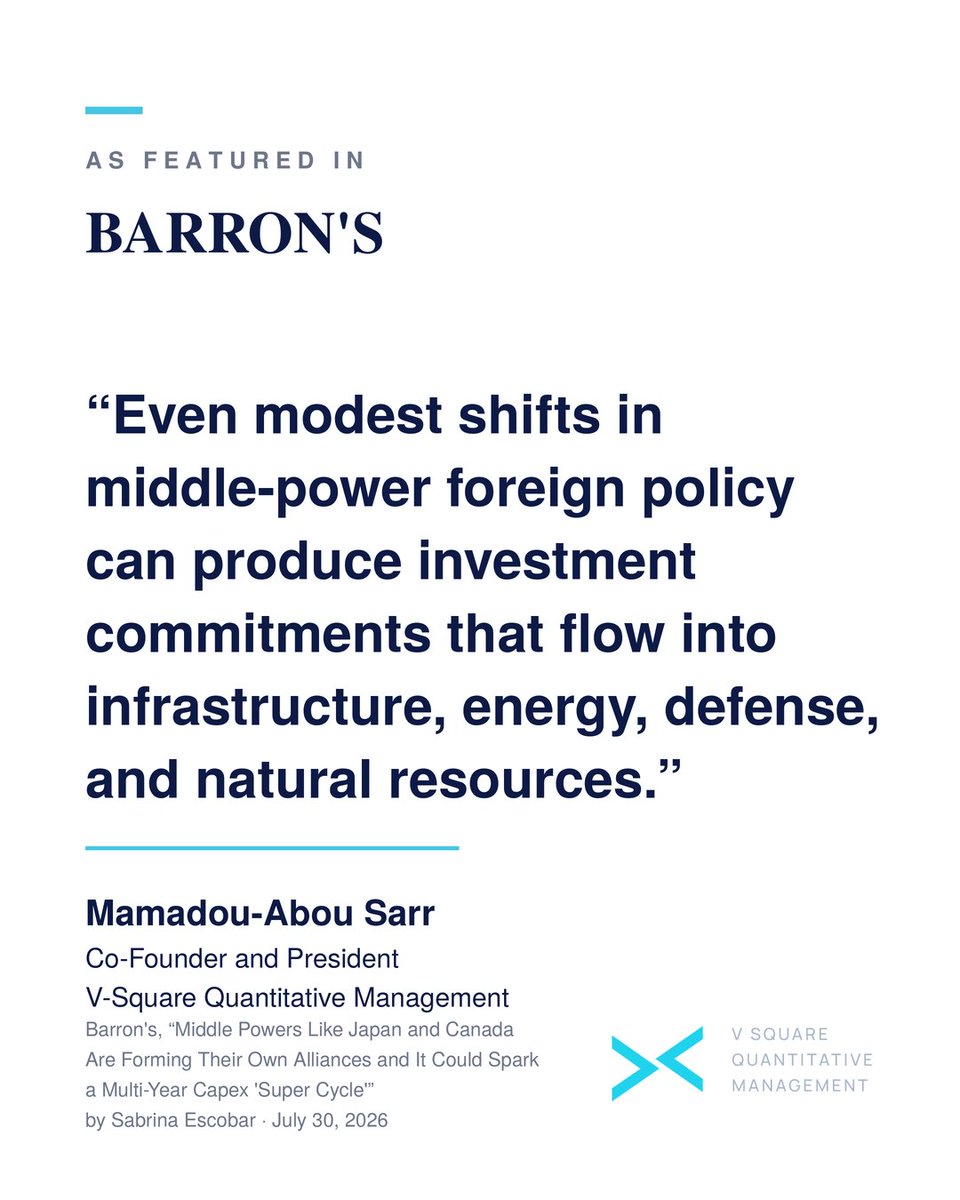
I recently had the opportunity to speak with @sabrinaescobarm for @barronsonline 's Global Signals about the emergence of middle-power alliances and what they could mean for investors.
My view is that while these alliances are an important geopolitical development, capital doesn't move on rhetoric alone. What matters is whether countries move beyond communiqués and into tangible investment commitments.
We're already beginning to see examples of that. Australia's and Japan's critical minerals partnership includes nearly $1 billion in Australian government funding, alongside an additional $256 million from Japan, with capital already being deployed into individual projects. Those are the kinds of developments investors should be watching, as they often materialize in infrastructure, energy, defense and natural resources well before broad capital flows or benchmark allocations begin to shift.
Thank you, Sabrina, for the thoughtful conversation.
Read the full piece in Barron's Global Signals: https://t.co/Emh11DI20h
Enjoyed the conversation on @bsurveillance with @ptsweeney & @isabelletanlee this morning.
S&P at an all-time high and up ~10% year to date. Yet Strip out future earnings growth and the earnings yield barely beats the 10yr Treasury. The equity cushion has nearly vanished.
Semis are now ~18% of the index vs ~2% a decade ago. The S&P has become an AI bet.
Full video here:
https://t.co/P4e0QfE8Qd
We are seeing growing momentum behind real assets as investors look for income, diversification, and inflation resilience.
As I shared with @DebbieCarlson1 for @TheDailyUpside Upside, returns from real assets tend to be more directly linked to underlying economic activity. This makes them a compelling complement in today’s portfolios, especially as the traditional 60/40 model shows signs of strain, a dynamic we recently highlighted in our Chart of the Week.
Check out the full piece here: https://t.co/RkZ9ZuvTTK
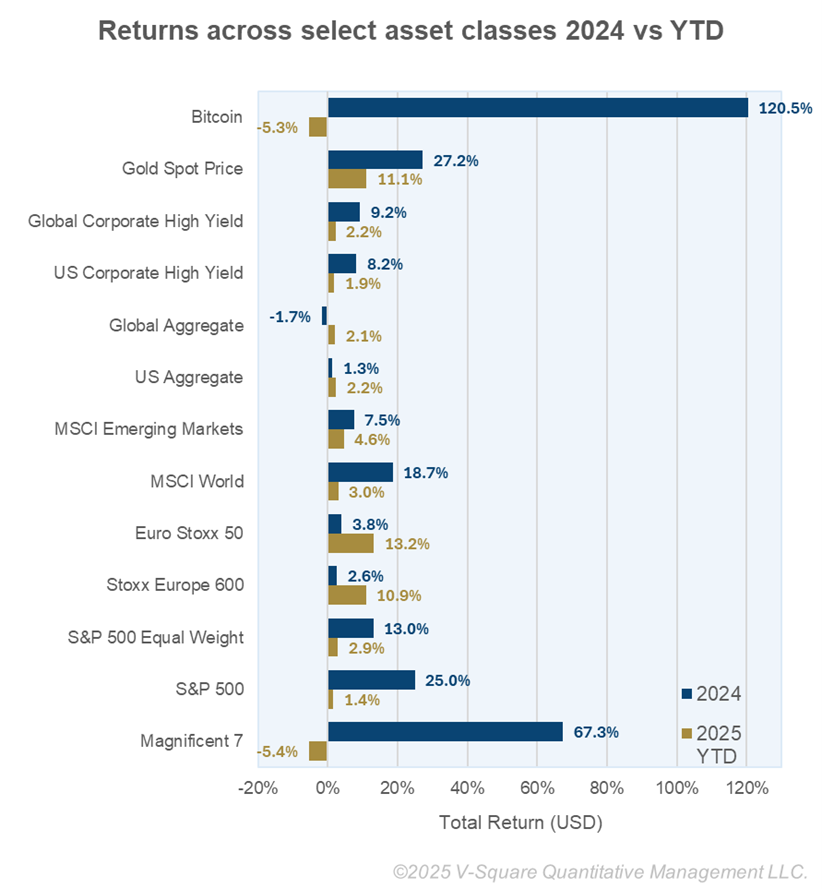
YTD Market Moves: A Shift in the Tide?
#chartoftheweek
Two months into 2025, we’re seeing a notable shift from last year’s strong market performance.
Perhaps most striking, the Magnificent Seven’s rally appears to have lost steam, with the group posting one of the few negative returns in our snapshot. Nvidia stands out—with significant volatility YTD—after a blockbuster 2024. Concerns over chip demand, AI-driven valuations, and a more competitive semiconductor landscape than previously thought have weighed on investor sentiment. Meanwhile, Bitcoin is showing signs of beginning to cool off, posting a modest decline after a strong 2024 as sentiment normalizes.
In contrast, European equities have started 2025 on a strong note after a relatively muted 2024, as reflected in the Stoxx Europe 600 and Euro Stoxx 50 indexes. While part of this rally stems from currency dynamics—the USD strengthened against the Euro in 2024 but has weakened so far in 2025—it’s also supported by expanding P/E ratios, suggesting investors may be looking to Europe for relative value after last year’s European underperformance versus U.S. markets.
On the fixed income side, aggregate bond returns remain subdued for both 2024 and early 2025. As we noted in our December analysis, high-yield spreads tightened to historically low levels—a key driver of total returns. However, with spreads now at extreme lows, investors may want to tread carefully in this space.
The Ongoing Distress in Commercial Real Estate: Persistent Challenges for the Office Sector
#chartoftheweek
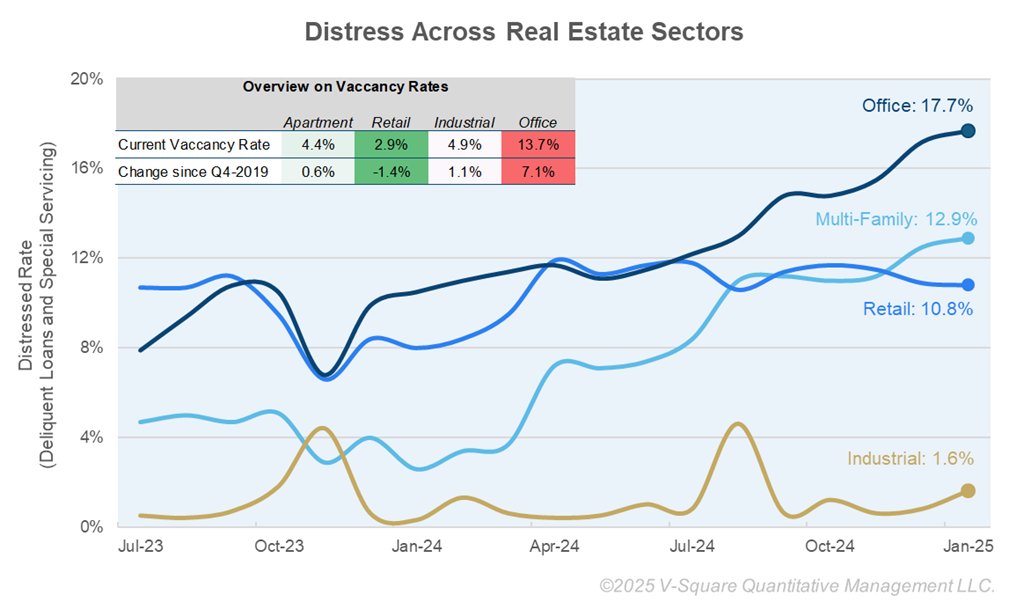
Over the past 18 months, distress in commercial real estate has continued to climb across office, multifamily, and retail sectors—while industrial real estate has remained relatively stable. The office real estate sector stands out, with distress rates reaching 17.7% in January 2025 and vacancy rates approaching 14%, marking a significant upward shift since the onset of the COVID-19 pandemic.
While media attention on office distress has faded compared to the peak concerns of 2020-2022, the vacancy rates have continued to rise. The current challenges facing office real estate—ranging from shifting work patterns to refinancing pressures—may be considered structural rather than cyclical, raising questions about long-term valuations and recovery prospects.
With corporate bond spreads at historically low levels, some are turning to commercial real estate debt in search of higher yields. This strategy comes unique trade-offs ranging from liquidity constraints to sector-specific risks. As distress continues to reshape the market, disciplined underwriting and a deep understanding of structural trends will be critical for those navigating this evolving landscape.
Looking at eggs and beef inflation of the past 10 years, bread remains a good hedge!
#chartoftheweek
Over the past several years, inflation has hit household staples hard, with many groceries seeing price increases. Driven by bird flu outbreaks in 2022 and again in 2025, eggs have been volatile—up 170% over the past five years. Impacted by rising feed costs and droughts, beef prices have climbed 45% in the same period.
While still seeing a notable increase, bread prices are up ‘only’ 40%, perhaps solidifying its place in the basket.
Grocery prices, and commodities more broadly, have surged across the board.
Disclaimer:
This chart displays prices between 1/1/2015 through 12/31/2024 for beef, eggs, and bread. Sources - the U.S. Bureau of Labor Statistics and Fred, Federal Reserve Bank of St. Louis. It is not possible to invest directly in an index. Past performance does not guarantee future performance.
Consumers' Bullish Sentiment Hits Record High—What Comes Next?
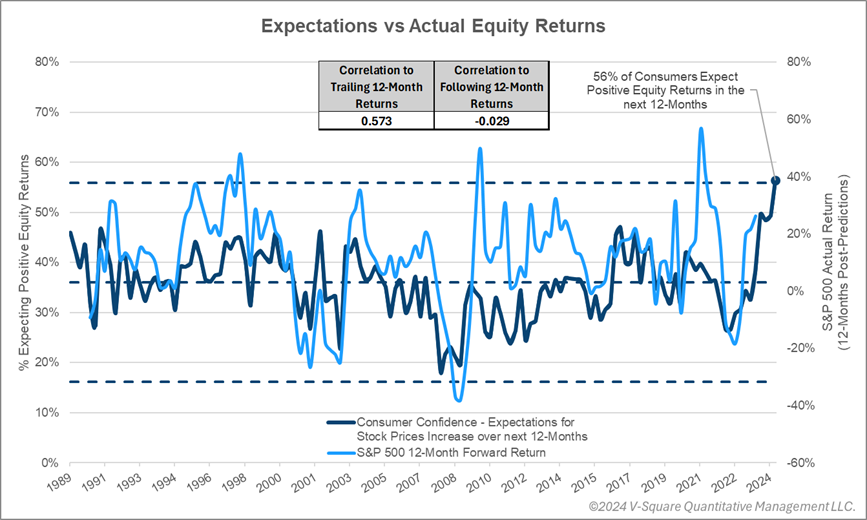
Following strong equity market performance in 2024, 56% of consumers now expect stocks to rise over the next 12 months (as measured by the Conference Board’s Consumer Confidence Survey) —a record-high and 3-standard deviation event for the metric. This notably bullish sentiment has garnered attention in recent weeks, appearing in reports and publications.
While optimism is high, history suggests caution: consumer expectations show a strong correlation (0.573) to trailing12-month returns (i.e., consumers often predict past 12-month market conditions will continue) but virtually no correlation (-0.029) to future market performance.
Rather than trying to time rallies or sell-offs, investors may benefit more from staying invested in well-diversified portfolios that are intentionally constructed to capture long-term risk premiums.
Disclaimer: https://t.co/u0UR6kftB0
Let’s keep the momentum?
Thus far in 2024… strong equity markets and the momentum factor have shown standout performance.
As seen in the chart below, the S&P 500 and Bloomberg's US Pure Momentum Portfolio indexes have trended upwards in 2024. While some portfolios have benefitted from the momentum factor, other portfolios have not fared so well. With momentum reaching its highest level in more than a decade, it important to note that historically momentum has been prone to sharp reversals. It’s a good moment to assess your portfolio’s exposure to the momentum factor – pun intended.
Disclaimer: https://t.co/yctBpPo8Hh
Did you say Election Boost?
Over the past two decades, the S&P 500 has navigated through various presidential terms, facing both economic crises and periods of growth. This chart highlights the S&P 500’s annual returns, showing the impact (or lack thereof) of political shifts.
After four years and $1B in AUM, how does @VSQUANT continue to grow?
co-Founder & President @MamadouAbouSarr joins @LanceGlinn Inside the ICE House to discuss how the firm is plotting its future for the next decade.
📺: https://t.co/WIdNHP83Ly
🎧: https://t.co/5oyvZFaI0B
"When you are thinking about things that are not yet there."
@VSQUANT co-Founder & President @MamadouAbouSarr joins @LanceGlinn Inside the ICE House to discuss his passion for innovation & its purpose in asset management.
📺: https://t.co/k5IdTcGrle
🎧: https://t.co/L8DFiCahZp
We planned for growth while staying agile. In asset management boutiques, growth hinges on two key levers: talent acquisition and platform scalability. Staying lean, investing in tech and earning the right to grow is how we succeed. @ICEHousePodcast@NYSE
During a time of crisis, @VSQUANT was built and its identity shaped. Four years and $1B in AUM later, co-Founder & President @MamadouAbouSarr joins @ICEHousePodcast to share the journey & the state of asset management: https://t.co/GjfjC1S2yU
Building an investment firm from scratch during a time of crisis required us to adapt to new challenges and embed a mindset of agility and resilience into our DNA. Enjoyed sharing sharing our story with @ICEHousePodcast@LanceGlinn
At V-Square, we often receive questions about our investment style. We’ve created a short video that delves into our unique quantitative and thematic investment approaches.