PUBLIC ADVISORY
In view of reports of a proposed march to Parliament by CJP on 20.07.2026 (Monday), Delhi Police hereby categorically clarifies that no permission has been sought or granted for any such protest march/procession.
Prohibitory order under Section 163 BNSS (erstwhile section 144 CrPC) is in force in the New Delhi District. *Accordingly, protest marches, processions, demonstrations and assemblies of five or more persons are strictly prohibited*, except at the designated protest site at Jantar Mantar, with prior permission.
As Parliament session is commencing from 20 July, strict security arrangements are in place to ensure public safety, security of protectees, and the protection of vital government installations.
Any person violating these prohibitory orders shall be liable for prosecution under Section 223 BNS and other applicable provisions of law.
Delhi Police appeals to all citizens to respect the law, refrain from participating in any unauthorised gathering or march, and cooperate in maintaining public peace, safety and security.
@LtGovDelhi@DelhiPolice@CJP_for_India
The science behind the Hydrogen train is wild.
It is a train that drinks hydrogen and breathes out plain water. No smoke, no diesel, no fire inside it.
Once you understand how that actually works, it starts sounding like magic that happens to be real.
Let me build it up from the very beginning.
First, what happened. On 17 July 2026, PM Modi Ji flagged off India's first hydrogen train. It runs between Jind and Sonipat in Haryana, an 89 km stretch.
India is now the sixth country in the world to run one, after Germany and a few others.
Now the science.
Every train needs power to move.
Old trains burned coal. Then diesel trains burned diesel. Both work by burning something, which means smoke and pollution.
Electric trains are cleaner, but they need those wires hanging over the track, and the power in those wires still often comes from burning coal in a power plant somewhere.
A hydrogen train does something completely different. It makes its own electricity on board, out of thin air and a gas.
No burning. No smoke. No wires needed.
Like I said, the science behind it is genuinely beautiful.
You need to remember one thing from school. Water is H2O. Two hydrogen atoms stuck to one oxygen atom. That is what water is made of.
A hydrogen fuel cell just runs that fact backwards.
Instead of splitting water into hydrogen and oxygen, it takes hydrogen gas stored in tanks on the train, and oxygen from the normal air around us, and lets them join back together to form water.
And here is the trick. When hydrogen and oxygen come together to make water, they release energy. In a fuel cell, that energy comes out as electricity.
So the machine is basically doing this.
> Hydrogen plus oxygen goes in.
> Electricity comes out to run the motors.
And the only leftover, the only waste, is water.
Clean water and a little warm air.
Now let me explain the fuel cell itself.
Imagine a sandwich. On one side you push in hydrogen. On the other side you let in air, which carries oxygen. In the middle there is a special thin sheet called a membrane.
That membrane is picky. It lets tiny bits of the hydrogen sneak through in one particular way, and that sneaking sets up a flow of electric charge. That flow of charge is electricity.
Once the hydrogen gets to the other side, it meets the oxygen, they hold hands, and they become water.
No flame. No explosion. No bang. Just a chemical handshake that leaks out electricity.
That is the part people find hard to believe. It looks like nothing is happening, and yet it is powering a 10 coach train.
Now why this particular launch is a proud engineering moment.
Most hydrogen trains in the world are tiny. Two or three coaches. They run on short countryside routes carrying a few hundred people.
India did not build a toy. India built a 10 coach trainset that can carry around 2,600 passengers. The design has two power cars, one at each end, holding the hydrogen tanks and fuel cells, and eight passenger coaches in between. It is built to run at up to 110 kmph.
That is the biggest, or one of the biggest, hydrogen train efforts anywhere.
We did not just copy a small foreign version. We scaled it up to Indian crowd size.
And it was built here in India.
The coach came out of the Integral Coach Factory in Chennai. A dedicated hydrogen plant was set up in Jind to make and fill the fuel.
This is Make in India in the truest sense, not an imported train with a sticker on it.
Now, hydrogen is not free magic. There is a catch, and it is important.
To get hydrogen gas, you have to make it, usually by splitting water using electricity. If that electricity comes from burning coal, then you have just moved the pollution from the train to the power plant.
It is only truly green if the hydrogen is made using solar or wind power. India is building that, but we are not fully there yet.
Hydrogen is also expensive to produce right now, and the tanks and fuel cells cost a lot. So for the next few years, this will be pricier than a normal train.
This one route is a pilot. A test. A place to learn before spreading it wider.
And storing hydrogen safely needs serious engineering, because the gas is very light and very flammable. To their credit, the train has multiple safety layers that sniff for leaks, heat, flames and smoke.
So, this is not the finished revolution.
It is the first real step, and a genuinely big one.
A country of 1.4 billion people just built one of the largest hydrogen trains on Earth, that turns a gas and air into electricity and gives back only water. :)
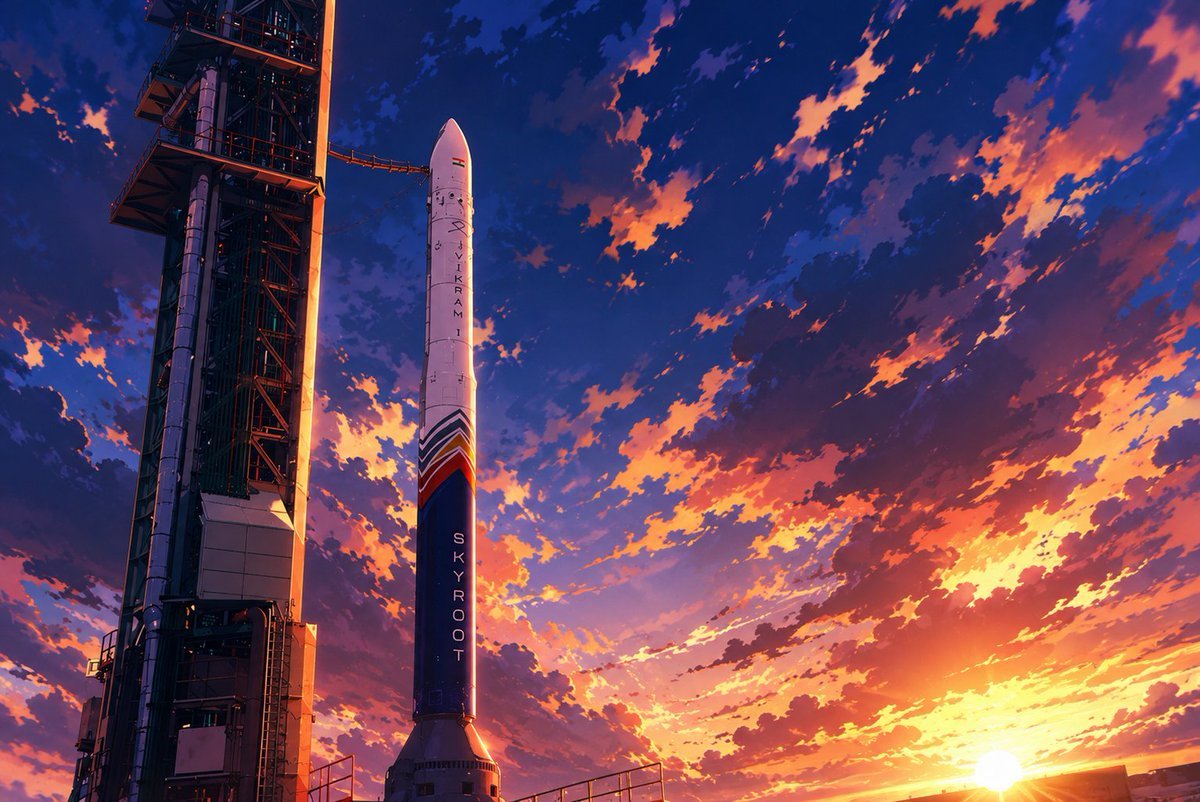
It’s official. 🚀
July 18. 11:30 AM IST.
Vikram-1. Test Flight-1. Mission Aagaman.
India’s first private orbital launch from the historic First Launch Pad at SDSC-SHAR, Sriharikota.
The countdown begins. 🇮🇳
#Vikram1#MissionAagaman#SkyrootAerospace#OpeningSpaceForAll
India is probably the only major military power that proudly displays Russian tanks, French fighter jets, and Israeli radars as symbols of its strength.