Volt-Test is a native performance testing tool for developers. Run load, stress, and scenario-based tests easily. Built for developers. Fast. Simple. Powerful.
Every PHP stress testing tool you find wants you to write tests in a different language.
k6 in TypeScript.
JMeter in XML in a GUI.
Locust in Python.
Your app is in PHP. Your team thinks in PHP. Why should your stress tests live in a separate toolchain?
That question keeps bugging a lot of PHP developers. So we put together a guide we wish existed when we first tried to stress test a PHP app.
It covers the real trade-offs between the popular tools — no "best tool ever" nonsense, just what fits which team. k6 is genuinely great if your team already lives in JavaScript.
JMeter has unmatched protocol breadth. Apache Bench is perfect for a quick single-URL sanity check.
But if you're a PHP developer and you want your stress tests living right inside your project — written in PHP, installed with Composer, version-controlled alongside your application code - that's the gap VoltTest fills. A Go engine handles the concurrency. You stay in your same codebase.
On Laravel it gets even simpler, one Artisan command to hammer an endpoint, or a test class sitting in your app directory with automatic CSRF handling.
The guide also covers something easy to get wrong early on: reading results. An average latency of 74ms looks safe. But if your P99 is 2,000ms, one in every hundred users is waiting two full seconds, and the average never told you.
Tool comparison, plain PHP setup, Laravel setup, reading your numbers, and the common mistakes that make results misleading, all in one guide.
Read the full guide in reply 👇
500 virtual users, 10 minute runs, free.
After months of building (and a lot of testing the tester 😄 ), the VoltTest Cloud closed beta is now open, and that's what every account starts with.
It's enough load to surface the problems that only show up under concurrency: connection pool exhaustion, N+1 queries, the tail-latency spikes your averages hide.
VoltTest is load testing that stays in PHP. You write scenarios in plain PHP with the SDK - or run them straight from Laravel with one artisan flag:
php artisan volttest:run CheckoutTest --cloud
One line switches execution from your laptop to managed cloud infrastructure. No JMeter XML, no JavaScript DSL, no servers to provision.
Results land in your dashboard: throughput, P95/P99 latency, error breakdowns, and side-by-side run comparison.
Getting in takes a minute, no credit card: create your account, verify your email, and you're on the waitlist. we're approving access in waves.
And if 500 VUs is holding you back, email [email protected] . we're upgrading serious beta testers to higher packages while pricing is finalized.
Full announcement and how access works👇.
#PHP #Laravel #LoadTesting #PerformanceTesting
How do you know your Laravel app is actually getting faster? We just built the answer. 🔍
Volt-Test Cloud's new Comparison UI takes the guesswork out of optimization.
⚡️ Side-by-side metric deltas (+/- %)
⚡️ Overlaid time-series charts
⚡️ Automated "Fastest Run" winner badges
Stop guessing and start measuring. Secure your spot for Early Access.
https://t.co/S7khuJjBOR
#PHP #Laravel #VoltTest #BuildInPublic
I’ve been building a load testing tool for PHP & Laravel apps.
Today, we pushed it to 100,000 virtual users.
17.3M requests in ~5 minutes
110K req/s peak
…and this is where things get interesting 👇
Volt-Test Cloud is cooking 🏭
Run large-scale load tests
without infra headaches
or k8s complexity.
Write your test -> run it -> get real insights.
Early access is open
(special discounts inside).
https://t.co/f2v726JYi6
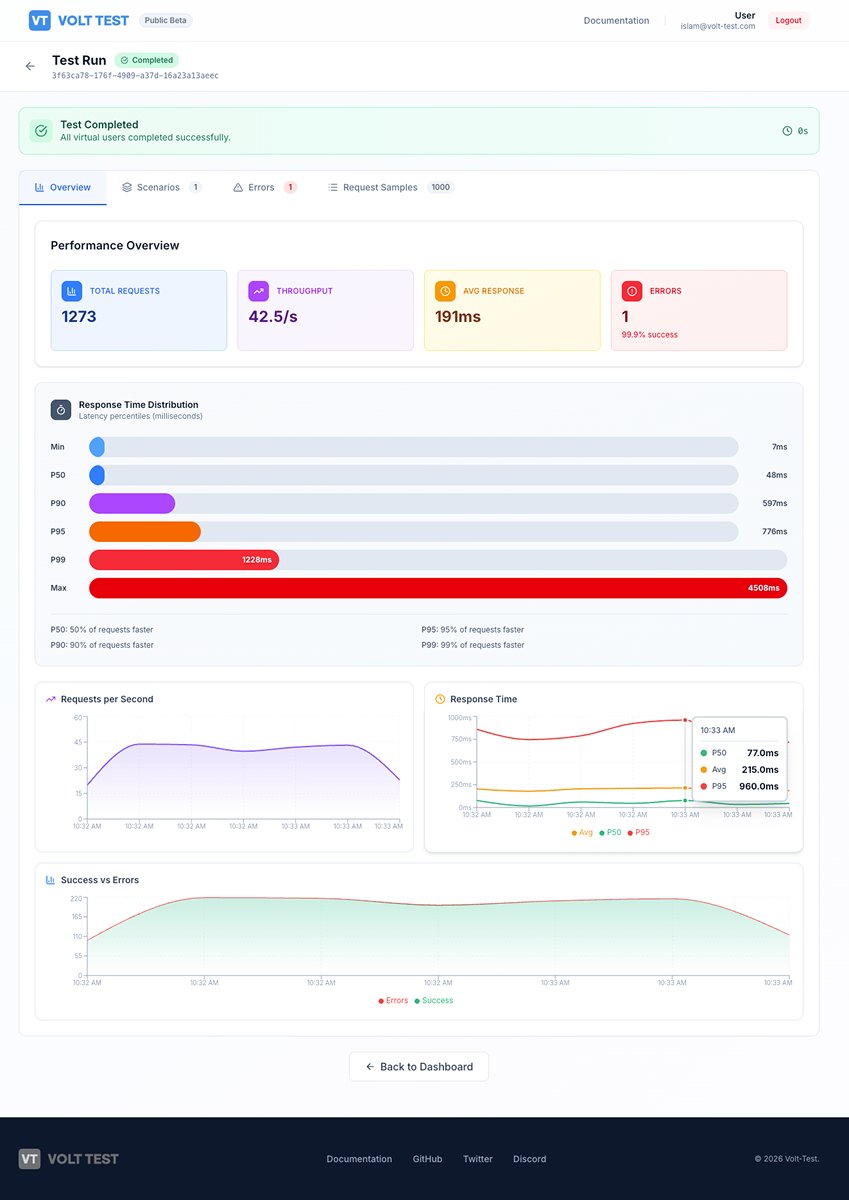
1,273 requests. 32s. 99.9% success.
The Cloud MVP is evolving. Our goal: performance testing that lives inside your code, not just your browser.
Scaling Laravel just got easier. ⚡️📈
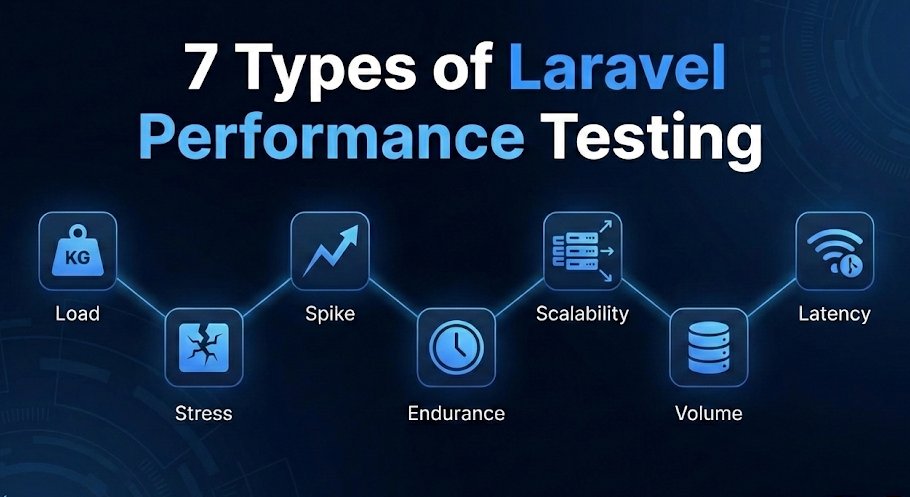
Knowing which test to run is half the battle for a Senior Developer.
We wrote a deep dive on how to apply these 7 types specifically for Laravel using Volt-Test.
Read the full guide here:
https://t.co/xozjc9jeFN
#Laravel#PHP#WebDev#PerformanceTesting
"Performance Testing" is not just one command. 🐘
If you're only checking the homepage, you're missing 90% of potential Laravel bottlenecks.
Here are the 7 types of performance tests every PHP/Laravel developer should know. 🧵👇
7. Latency Testing: How does your app perform under bad network conditions? A 100ms response on your local machine is great, but what about a user with 20% packet loss? You need to measure data transmission delays.
It automatically handles the request loop and reporting.
It’s the fastest way to turn your local terminal into a load generator.
Try it out on your local environment today. 🐘
https://t.co/hTC8wIvKmR
#Laravel#Performance
You don't always need a Scenario Class.
If you want to quickly check how your GET /dashboard handles 100 concurrent users, just run:
php artisan volttest:run https://t.co/0cwElx6TsT --users=100
Why do this? CI/CD.
Add this to your pipeline. If a PR makes the API 200ms slower, the test fails, and the merge is blocked.
Catch performance regressions before production.
Read the full tutorial: https://t.co/NnHoqvn4K3
#DevOps#QualityAssurance#Laravel
Did you know you can run load tests directly inside your PHPUnit suite?!
Stop treating performance testing as a separate "ops" task.
With Volt-Test, you can assert response times just like you assert database records.
Here is how. 🧵
#Laravel#PHP
This is the best part: Performance Assertions. ⚡️
You don't need to parse complex JSON reports. Just use the fluent assertions you already know:
$this->assertVTSuccessful($result, 95);
$this->assertVTP95ResponseTime($result, 500);
Clean. Readable. Native.