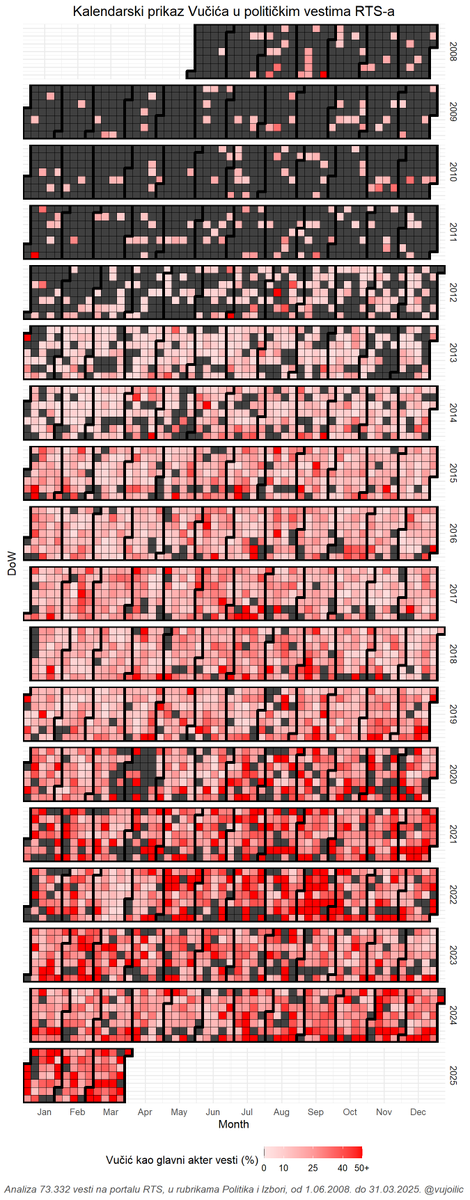
Šta se desilo s RTS-om? Ovaj grafikon pokazuje 73.332 vesti na portalu RTS od 2008 do 2025 i % onih u kojima je Vučić glavni akter, dan po dan. Pokazuje kako se stropoštalo političko izveštavanje RTS-a, kako je postalo servilno, personalizovano, u službi jednog političkog aktera.
Institut za filozofiju i društvenu teoriju danas se oprašta od prof. dr Dragoljuba Mićunovića, svog dugogodišnjeg saradnika i jednog od osnivača i upravnika Centra za filozofiju i društvenu teoriju, iz koga je proistekao Institut.
Tokom svoje akademske i bogate javne delatnosti, Dragoljub Mićunović ostao je prepoznat kao angažovani intelektualac i važan akter političkog i društvenog života Srbije. Svojim filozofskim radom, javnim delovanjem i doslednošću u zastupanju demokratskih vrednosti ostavio je trag u savremenoj političkoj i intelektualnoj istoriji naše zemlje.
Život i delo Dragoljuba Mićunovića podsećaju na važnost dijaloga, građanske odgovornosti i angažovanja u javnom prostoru.
Zahvalan,
kolektiv IFDT
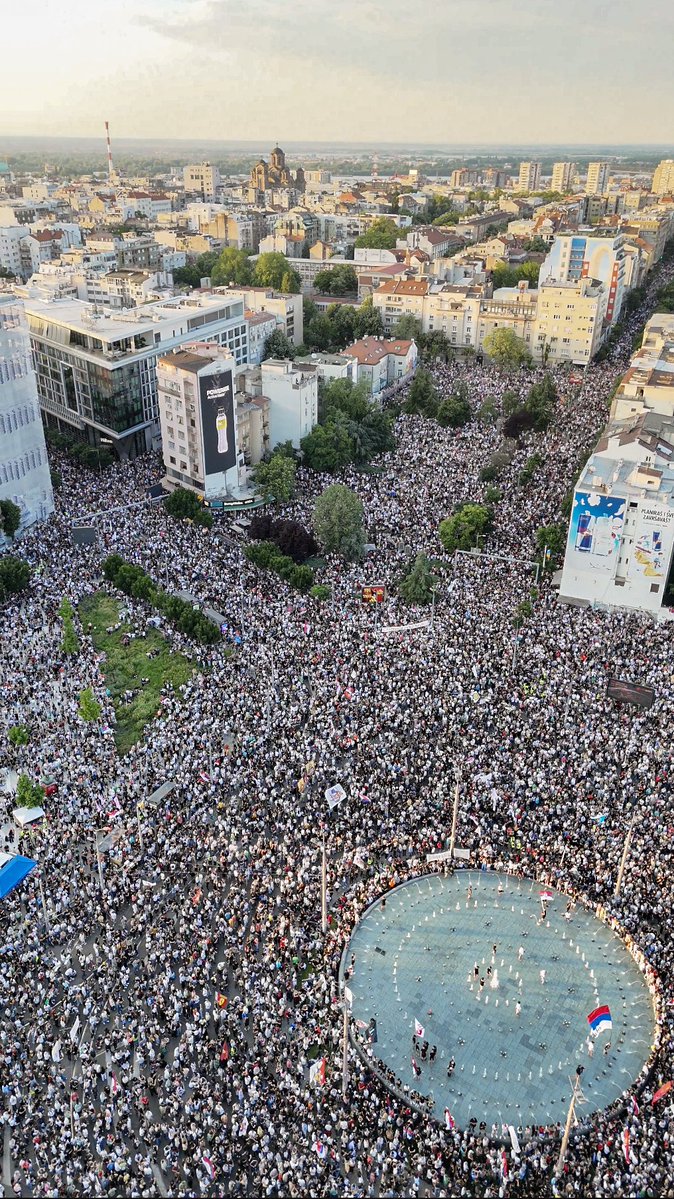
Belgrade, May 23: Between 180,000 and 190,000 people attended the "You and I, Slavija" protest. APA estimate based on a measured crowd surface of 107,000 m² and mean density of ≈1.7 p/m². Second largest protest in Serbia since the fall of Milošević.
Photo: Nikola Jovanović
National Parliament Election in Hungary today 🇭🇺 🇪🇺
Our election dashboard features:
• Turnout (opposition vs. government strongholds)
• Live results
• Capital & abroad vote
• Demographic polling
• Electoral history
Explore: https://t.co/KDpnWSKkZ5
💥What we’ve all feared is happening: Hungarian Russia expert András Rácz wrote three days ago about a potential Russia-backed false flag attack in Serbia targeting the gas pipeline to Hungary. The same information had already reached multiple journalists, including myself, weeks earlier, from sources connected to Hungarian government circles.
Now Viktor Orbán has announced that Serbian president Aleksandar Vučić informed him about “explosives of devastating power” found at the gas pipeline connecting the two countries. Orbán and his propaganda machine are already amplifying the news everywhere, with the prime minister convening his security cabinet.
It remains unclear what measures the government might take using this alleged false flag operation as a pretext. But if the second part of the information we received also proves true, Orbán could declare a state of emergency, significantly affecting the election campaign—which he is currently losing—and potentially disrupting the organization of the April 12 election.
The opposition Tisza Party has been widening its lead to 15–20 points, if not more. Orbán accuses them of being "Ukrainian agents" for months. His propaganda would very soon link the Serbian false-flag both to Ukraine and the Tisza Party, I have no doubts about that.
I encourage all foreign reporters covering the Hungarian election to pay close attention and not fall for the government’s propaganda or the narratives pushed by its pundits on the Orbán government payroll, including here on X.
The situation could soon be very serious.
Full transcript of today's historic speech by the Rector of the University of Belgrade, Vladan Đokić:
“Dear citizens of Serbia,
At noon today, members of the Criminal Police entered the building of the Rectorate of the University of Belgrade. Without prior notice. Without a clear legal explanation. Without respect for the autonomy of the oldest and most distinguished educational institution in Serbia.
They seized computers and servers. They are searching offices. They are looking for documents.
And while they were doing this, regime television broadcast it live. They did not come to investigate. They came to humiliate. They came to tell every professor, every student, every citizen: this is what happens to those who do not remain silent.
Let us clearly state what happened today.
A young woman died on Thursday. A tragedy that deserves a dignified, independent, and thorough investigation. The University of Belgrade immediately called for such an investigation. We offered full cooperation.
Instead, we received a police raid in front of cameras.
The Rectorate’s computers contain no information relevant to the investigation of the death of a student at the Faculty of Philosophy. Everyone knows this. But that is not the point. The point is the image: police in the Rectorate. The rector under investigation. The university on its knees.
That image is meant for you. To make you afraid. To make you think: if they can do this to the University, what can they do to me?
But let us look at another image.
As the police entered through one door, students arrived through another. Thousands of them. Spontaneously. Without party calls, without organization, without buses.
They came because they know what is happening. They came because this is their university. They came because they are not afraid.
That is the real image of today. Not the police in the Rectorate, but the students in front of it.
To the authorities who ordered this, I say:
You can take the computers and servers. You cannot take the truth.
You can search offices. You cannot search the conscience of the people.
You can send the police. But for every patrol you send, a thousand students will come.
Sixteen people died in Novi Sad. No one was held accountable. No one was dismissed. No servers were seized. No offices were searched.
But when a rector stands with students, then the police arrive.
That tells you everything you need to know about this government. They are not afraid of crime. They are afraid of education.
To the students, I say:
You saw what happened today. You saw the police in your University. You saw cameras broadcasting it as if it were a victory.
It is not a victory. It is an admission of defeat. When a government sends police to a university, it means it has lost all arguments. When it seizes computers instead of answering questions, it means it has no answers.
For fifteen months you have stood in the streets. In the rain. In the sun. In the cold. They said you would give up. You did not. They said you were terrorists. You are not. They said you were foreign mercenaries. You are not. Now they are sending police to your University.
And you will not give up now either.
To the citizens of Serbia, I say:
What happened today at the University of Belgrade is not an attack on me personally. This is an attack on the idea that there is anything in Serbia that the government cannot control. The University is the last institution still standing upright. That is why they came.
But the University does not stand upright because it has walls. It stands because it has people. Professors who refuse to remain silent. Students who refuse to be afraid.
Citizens who refuse to forget the sixteen lives lost in Novi Sad.
They can take the computers and servers. But what makes this University, honor, knowledge, truth, they cannot put in a box and carry out of the building.
On the investigation:
The University of Belgrade fully respects the rule of law. We support every lawful investigation. But what happened today has nothing to do with an investigation. It has to do with intimidation.
I repeat the call: we demand an independent investigation, and if necessary one under international supervision, into the circumstances of our student’s death. We demand forensic experts, not political operations. We demand truth, not punishment for those who seek it.
To the international community:
Today, police entered the University of Belgrade. This is being broadcast live as a political spectacle. This is not an investigation. This is a crackdown on freedom of thought.
I call on universities across Europe, the European Commission, the European Parliament, and all who believe in academic freedom: to speak out. Today Belgrade. Tomorrow any other university in Europe that dares to stand with its students.
I will conclude as I began - with the truth.
This government is not attacking the University because we have done something wrong.
It is attacking us because we have done something right.
We stood with the students. We stood with the truth. We stood with Serbia.
And we will continue to do so. With servers or without them.
Power lies not in malice, but in knowledge"
🛑 Fotoreporterku Zoricu Popović šutirali su u stomak maskirani muškarci, duplo veći od nje, isti oni koji su teško povredili Lazara Dinića i Ivana Bjelića.
📢Svedoči o preživljenom hororu, režiranom preko telefona, preko kojeg je neko usmeravao huligane
https://t.co/Jk9P8X1Nn0
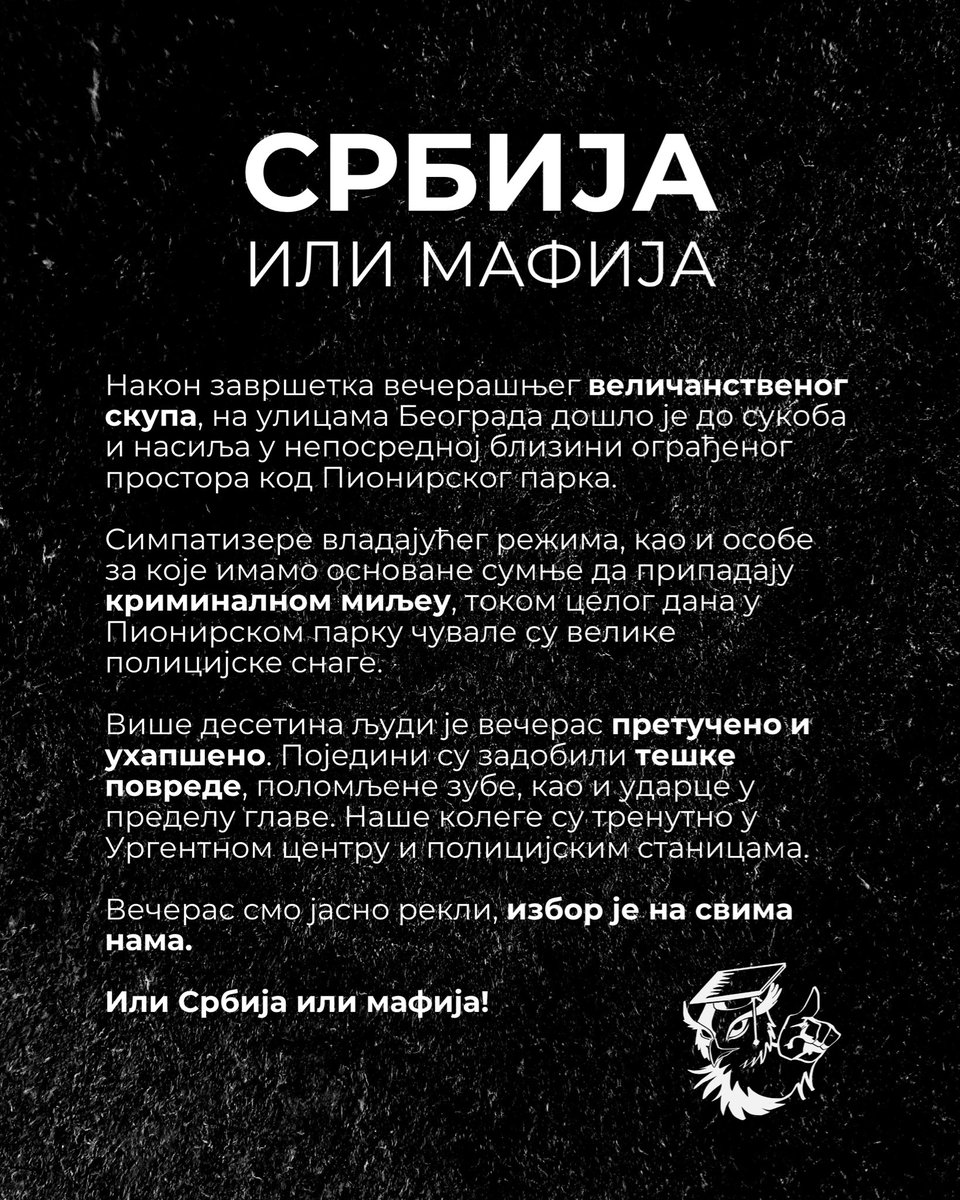
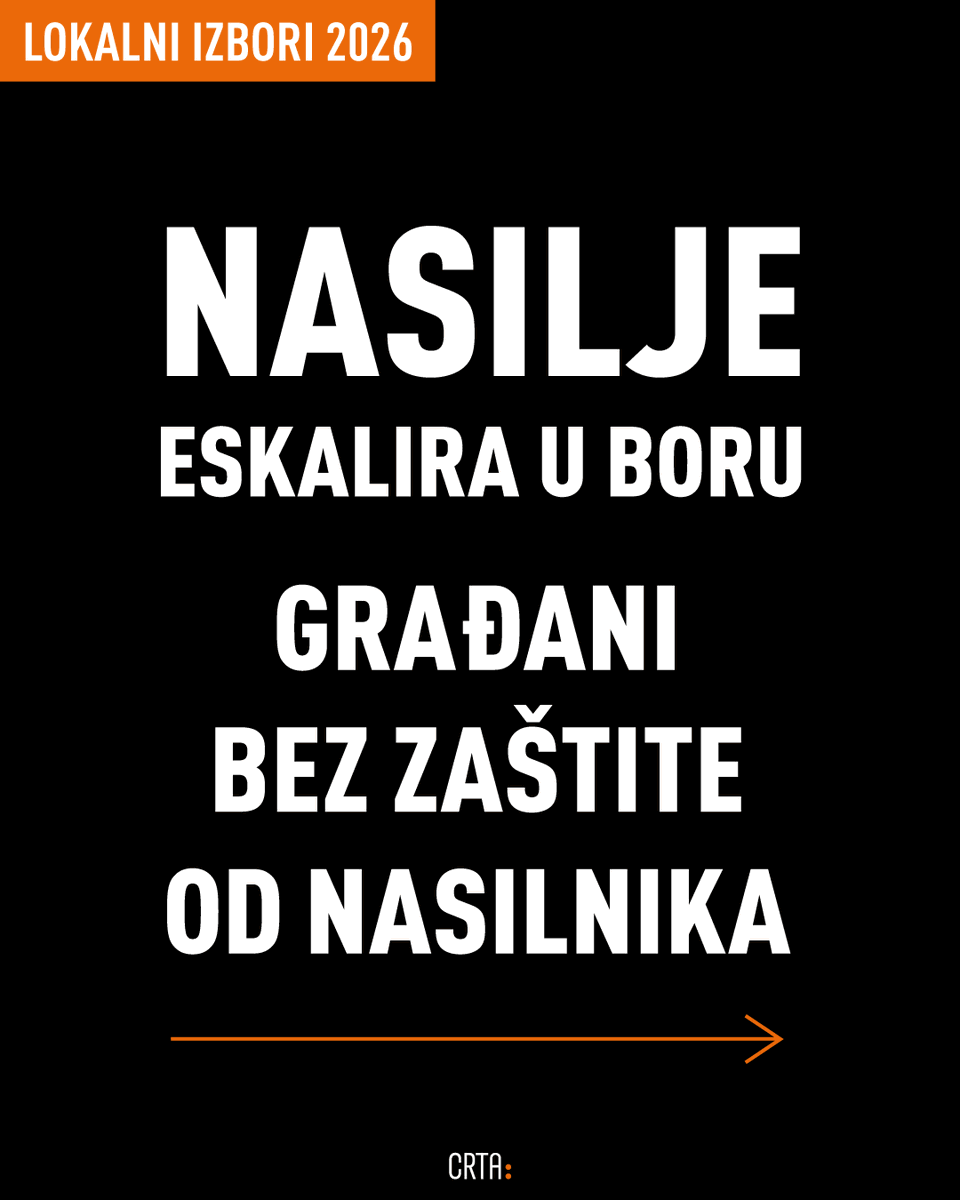
Intenzitet nasilja u Boru od jutros kontinuirano raste i kao glavno obeležje izbornog dana izdvaja se teror nad biračima i učesnicima u izborima, koji se sprovodi fizičkim napadima i zastrašivanjem. Situacija je posebno dramatična zbog činjenice da policija uglavnom ne interveniše protiv nasilnika.
🚨Претучена два члана мобилног тима🚨
У Бору у близини ПИО фонда су нападнути чланови мобилног тима бибер спрејем у присуству полиције. Упркос наређењу полицијског службеника нападачима да сачекају долазак полицијске екипе батинаши су напали два члана мобилног тима приликом чега су они задобили повреде главе које захтевају хитно ушивање. Полиција их тако крваве држи на клупи на месту напада док нападачи стоје у непосредној близини.
Prof. dr Jelena Kleut najavila je tužbe nakon što je prošireni Senat UNS odbio njen prigovor, koji je uložila jer nije izabrana u zvanje redovnog profesora.
Ovom odlukom Senata, Kleut ostaje bez posla na Filozofskom fakultetu, na kom je od 2009. godine zaposlena kao asistentkinja, a od 2020. kao vanredna profesorica.
U pitanju je, prema njenin rečima, presedan.
Dmitry Pozhidaev – Rast bez razvoja: Srbija u 2025.
BDP je postao opsesija, propagandni rekvizit, a za autoritarne režime često i ključni izvor legitimnosti. Kada demokratski kredibilitet izostane, preostaje da se legitimitet proizvodi kroz brojke.
https://t.co/wcRonxhfPs
📸 BBC fotograf Irfan Ličina jedan od laureata konkursa za najbolju medijsku fotografiju
📸 Priznanje za fotografiju koja je obeležila studentski protest u Kraljevu, održan u aprilu ove godine
👉 https://t.co/dKXVczrN3t #pressphotosrbija
Major preprint just out!
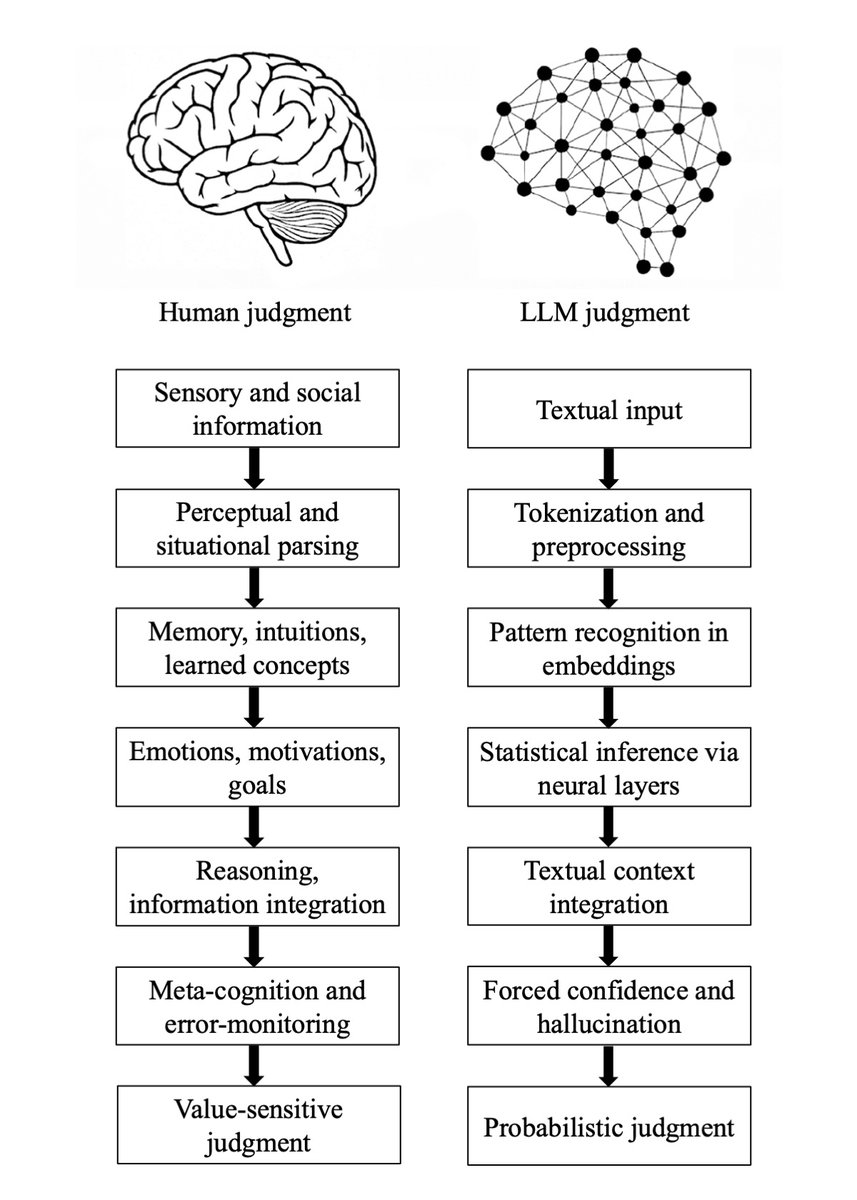
We compare how humans and LLMs form judgments across seven epistemological stages.
We highlight seven fault lines, points at which humans and LLMs fundamentally diverge:
The Grounding fault: Humans anchor judgment in perceptual, embodied, and social experience, whereas LLMs begin from text alone, reconstructing meaning indirectly from symbols.
The Parsing fault: Humans parse situations through integrated perceptual and conceptual processes; LLMs perform mechanical tokenization that yields a structurally convenient but semantically thin representation.
The Experience fault: Humans rely on episodic memory, intuitive physics and psychology, and learned concepts; LLMs rely solely on statistical associations encoded in embeddings.
The Motivation fault: Human judgment is guided by emotions, goals, values, and evolutionarily shaped motivations; LLMs have no intrinsic preferences, aims, or affective significance.
The Causality fault: Humans reason using causal models, counterfactuals, and principled evaluation; LLMs integrate textual context without constructing causal explanations, depending instead on surface correlations.
The Metacognitive fault: Humans monitor uncertainty, detect errors, and can suspend judgment; LLMs lack metacognition and must always produce an output, making hallucinations structurally unavoidable.
The Value fault: Human judgments reflect identity, morality, and real-world stakes; LLM "judgments" are probabilistic next-token predictions without intrinsic valuation or accountability.
Despite these fault lines, humans systematically over-believe LLM outputs, because fluent and confident language produce a credibility bias.
We argue that this creates a structural condition, Epistemia:
linguistic plausibility substitutes for epistemic evaluation, producing the feeling of knowing without actually knowing.
To address Epistemia, we propose three complementary strategies: epistemic evaluation, epistemic governance, and epistemic literacy.
Full paper in the first reply.
Joint with @Walter4C & @matjazperc