Academics. Particularly concern about energy resilience, climate change and sustainability issues. Author of "Sains Perubahan Iklim", Bumi Aksara (2021).
This is Suleiman Al-Obeid, a Palestinian football player who was murdered by Israel.
As the world watches the World Cup, this is a reminder that Israel has murdered at least 810 professional athletes in Gaza since October 7th, 2023.
Kata siapa tuh negara untung gara-gara rokok👀
Pemerintah rugi Rp 184 triliun dari rokok. Bahkan berencana tidak menaikkan tarif cukainya hingga 2027 dan malah menambah kategori cukai baru dengan tarif lebih rendah.
Kamu setuju?
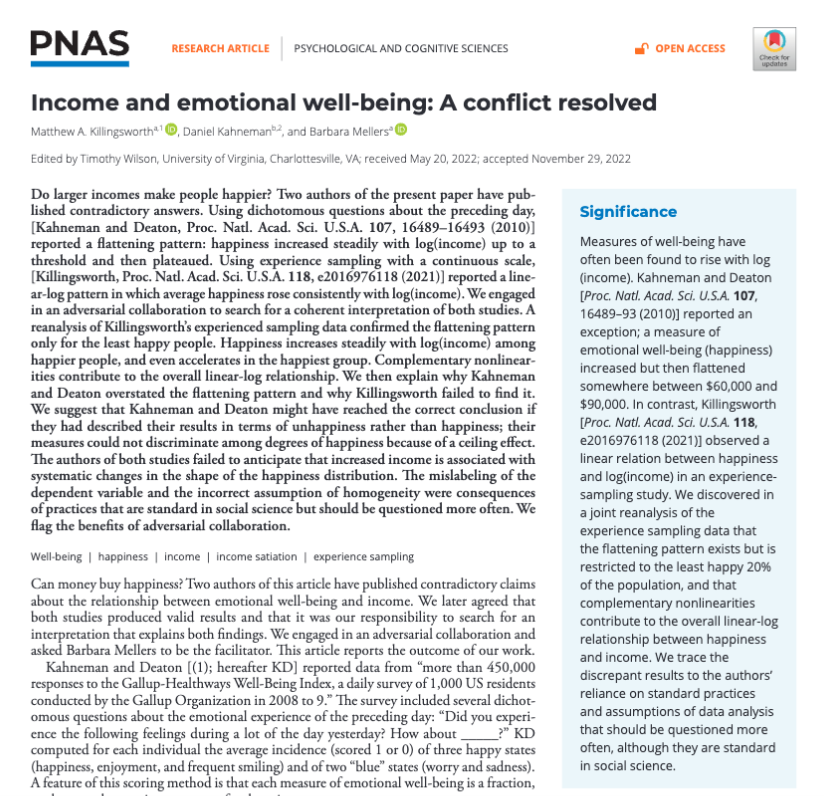
Does money buy happiness? A Princeton Nobel laureate said no above $75,000. A Penn researcher with 1.7 million data points said yes. The day they sat down together to settle the fight, the answer they reached should change how you think about your own life.
The Nobel laureate is Daniel Kahneman. The Penn researcher is Matthew Killingsworth.
The fight between them lasted 13 years, and the way it ended is one of the cleanest examples in modern science of two smart people being wrong in opposite directions about the same question.
In 2010 Kahneman and his Princeton colleague Angus Deaton published a paper that became one of the most quoted findings in the history of social science.
They analyzed 450,000 responses to the Gallup-Healthways Well-Being Index and concluded that emotional well-being rose steadily with income up to about $75,000 a year, and then flattened out completely. Above that line, the extra money was not buying any more daily happiness.
The headline traveled around the world. Every news outlet ran the number.
A CEO in Seattle famously cut his own salary to raise his employees to that exact threshold. The 75,000 dollar figure became cultural shorthand for the idea that the rich are not actually any happier than the rest of us once basic needs are met.
For 11 years almost nobody seriously challenged it. Kahneman had a Nobel Prize in Economics, the sample size was massive, and the conclusion was emotionally satisfying in a way that made everyone feel a little better about not being wealthy.
Then in 2021 a 33 year old researcher at the University of Pennsylvania published a paper that quietly destroyed the entire finding. His name is Matthew Killingsworth.
He had spent the previous decade building a smartphone app called Track Your Happiness that pinged users at random moments during their day and asked them a simple question.
How do you feel right now, on a scale from very bad to very good. The app was designed to catch happiness in the act, not to ask people to recall it later.
By 2021 he had collected over 1.7 million real-time happiness reports from 33,000 adults. When he plotted income against in-the-moment well-being, there was no plateau anywhere.
The line just kept rising. People earning $200,000 were happier on average than people earning $100,000. People earning $400,000 were happier than people earning $200,000. The curve flattened slightly but never stopped climbing.
The famous $75,000 ceiling that the world had been quoting for 11 years simply did not exist in his data.
Now there were two Nobel-quality findings sitting in direct contradiction with each other. One of them had to be wrong, and neither researcher was willing to walk away.
What happened next is the part of the story almost nobody knows.
Kahneman called Killingsworth and proposed something rare in academic science. He called it an adversarial collaboration. The two of them, joined by Penn psychologist Barbara Mellers as a neutral referee, would sit down together and reanalyze the raw data from both studies, line by line, until they figured out which one of them was wrong.
The paper they co-authored was published in March 2023 in the Proceedings of the National Academy of Sciences. And the answer they reached was not what either of them had expected.
Both of them had been right at the same time. They had been measuring two different populations without realizing it.
When the team broke Killingsworth's 1.7 million data points apart by baseline happiness, the picture clarified completely. For the happiest 70 percent of people, more money kept buying more happiness all the way up to $500,000 a year, with no sign of slowing down.
For people in the middle, the same pattern held. But for the bottom 20 percent of the sample, the ones who were already unhappy before the question of money even came up, the curve flattened almost exactly where Kahneman's original paper had said it would. Above roughly $100,000 a year, adjusted for inflation, more money did nothing for them.
This is the finding that changes how the question should be asked.
If you are not already unhappy, money keeps buying happiness for a much longer stretch than Kahneman's original paper suggested. The runway is wider than the world has been telling itself for a decade.
If you are already unhappy, money does almost nothing past a certain point. There is a ceiling, but the ceiling is not about income. It is about the underlying state of the person collecting it.
The deeper insight in Killingsworth's original research, the one almost nobody talks about, is the part that should sit with you longer than the income numbers. The Track Your Happiness app had been telling him for years that the single biggest predictor of in-the-moment well-being is not money at all. It is whether your mind is on the thing you are doing.
His most cited paper, written with Daniel Gilbert at Harvard, is titled A Wandering Mind Is an Unhappy Mind. The data from the app showed that people are mentally absent from what they are doing 47 percent of the time, and that mental absence is one of the strongest predictors of unhappiness in the entire dataset. More predictive than income. More predictive than the activity itself. More predictive than almost any demographic variable you could measure.
Which means the unhappy 20 percent that Kahneman's plateau actually described were probably not unhappy because they did not have enough money. They were unhappy for reasons that more money could not reach.
The reason the curve flattened for them at $100,000 a year is the same reason it would have flattened at $300,000 or $700,000. The thing they were missing was not buyable.
The most uncomfortable line in the entire 2023 paper is the one that nobody on the internet quotes. The authors note that the relationship between income and happiness, while real, is much weaker than the relationship between attention and happiness. A person earning $40,000 who is fully present in their own life will, on average, report higher in-the-moment well-being than a person earning $400,000 whose mind is somewhere else.
The fight about money was the wrong fight the entire time.
The two researchers spent 13 years arguing over whether the dollar ceiling was at $75,000 or $500,000, and the data from Killingsworth's own app was sitting there the whole time saying the ceiling was not about dollars at all. The ceiling is whether you can hold your attention on the life you actually have.
You can run the experiment yourself the next time you catch your mind drifting. Stop. Put your phone down. Look at the room you are in, the person across from you, the food in front of you, the work you are actually doing. That is the part the apps cannot sell you and the salary cannot buy you.
The data has been clear for over a decade. The plateau is not in your bank account. It is in your attention.
Pengingat dari almarhum Edward Said (Professor di Colombia University) untuk semua civitas akademika. Musuh utama kita adalah rasa TAKUT dan dorongan untuk MENGHINDAR dari kebenaran. Lawan yuk! 😉🫶🏼
‼️ What’s happening around Kamal Adwan Hospital is pure madness.
The army of the most powerful state in the region is besieging a hospital packed with civilians and a small group of medical staff, preparing to destroy it with everyone inside.
Today, once again, those trapped inside the hospital witnessed explosive-laden robots surrounding its gates with barrels of explosives, paving the way for what could become the crime of the century, the deliberate bombing of a medical facility along with its patients and staff.
Don’t believe for a moment that international or humanitarian agreements can protect anyone. In moments like this, the true nature of the world we live in becomes painfully clear.
Speak up for them, because right now, their only voice is ours to amplify their plight.
#SaveNorthGaza #GazaGenocide
In the photo, you see Dr. Hani Badran, a cardiologist known not only for his medical expertise but for the boundless warmth and kindness he extended to everyone around him. He had a smile that could soften even the hardest day, a laugh that brightened his patients’ spirits, and a heart so open that it seemed as though he held the weight of others’ suffering as his own.
Dr. Badran was the kind of doctor who treated everyone like family. He was as gentle as he was strong, as compassionate as he was wise. To him, medicine wasn’t just a profession; it was a way to bring relief, hope, and dignity to others. He often spoke of his dream of one day living peacefully with his family, free from the shadows of war, a simple wish, really, to feel safe, to watch his children grow in a world where they didn’t have to fear the sky above.
On the first day of the ground invasion in northern Gaza, he sent a quiet message to a private group of fellow doctors. He asked if any ambulances or international organizations were evacuating trapped civilians. He wanted to protect his family, to take them somewhere safe. But no one could answer. In Gaza, we don’t have the luxury of escape.
Today, that same sky he had hoped would one day be peaceful came crashing down on his home. An airstrike targeted his house, killing 17 members of his family. Seventeen people. Gone. In one moment.
The image you see now is a still from a video showing Dr. Badran mourning the ones he held dearest. His face bears the look of a man who has given all of himself to others, only to have the most precious pieces of his life taken from him. His grief is a grief that no words can capture, a pain so vast it feels as if the world itself might break.
Seeing him like this, it shatters the heart. There’s no justice in this, no logic, no sense. Dr. Hani Badran was a healer, a friend, a father, a husband. He wanted nothing more than to live in safety. And yet, safety is the one thing that remains out of reach for so many in Gaza.
This isn’t just his story; it’s the story of thousands who only wish for a chance to live and love in safety.
#SaveNorthernGaza #GazaGenocide
saya share point of view dari orang yang udah lebih dari seperempat tahun tinggal di gunung. kalo mimpi kalian cuma punya homestay di gunung please leave us alone 😭😭
homestay daerah pegunungan ini bikin akses air buat oetani kecil susah
#TempoThread
Pidato Hashim Djojohadikusumo jadi pusat perhatian di COP29 Baku..
Alih-alih ngomongin pengurangan emisi, ia malah menawarkan proyek baru🤷♀️
Utas~