Following up on the earlier UK budget note:
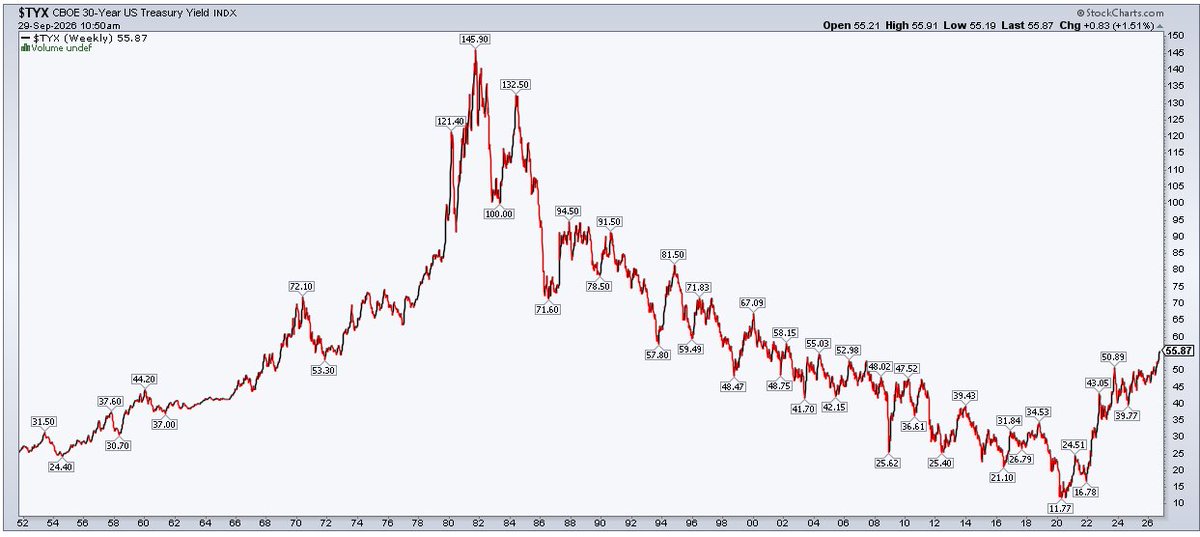
The 30-year gilt yield now carries a 6% handle, reaching its highest level in 28 years.
#economy#markets#bonds#uk#yields
Capital is voting with its feet.
South Korea stocks are up 97% in 2026.
Taiwan stocks are up 86%.
China stocks are down 12%.
One of the widest performance gaps we've ever seen.
Here is how Cathie tries to gaslight everyone in this video and provides us with a useful case to analyse how it works.
Her defense of ARKK is a great example of how you can make an awful long term record sound great by carefully choosing the denominator ("end point, as she calls it"), comparison group and time periods.
Her claim is that ARKK ranks in the "top 5% to 10% of the Morningstar database within its category over 1 year, 3 years, 10 years and since inception".
She then argues that comparing ARKK with QQQ is "incorrect" because ARK invests in technologically enabled innovation across all sectors.
It sounds compelling until you actually look at the numbers.
1. Watch the qualifiers. They are doing almost all the work.
Cathie is not saying ARKK ranks in the top 5% to 10% of investment alternatives available to investors.
She says it ranks there within its Morningstar category.
That is a very different statement.
Morningstar is one of the world's largest and most established investment research and data providers. Its fund database, classifications and ratings are widely used by investors, financial advisers and institutions.
The issue is that being highly ranked within a peer group tells you nothing about whether investors would have been better off simply buying an obvious passive alternative.
For example, I am a grown man. Put me in the diaper league of soccer and I would probably rank in the top 5% to 10%. Sounds impressive, provided you don't know what the diaper league is. Now expand the peer group to all soccer players, including the Premier League, and suddenly my “top 5% to 10%” ranking disappears rather quickly. That is the point: a percentile ranking is only as impressive as the peer group you are being ranked against.
If you are the best runner in a slow race, you are still running slowly.
Investors do not spend Morningstar percentile rankings. They spend money.
And then there is the wording:
"Top 5% to 10%". Interesting.
If you are comfortably in the top 5%, you normally say:
"Top 5%".
You do not say "top 5% to 10%."
That wording creates the psychological impression of "top 5%" without actually saying it. Convenient.
2. Even more conveniently, Cathie skipped five years.
Cathie specifically highlighted:
1 year. 3 years. 10 years. Since inception.
Notice anything missing?
Five years.
And five years happens to be an absolute horror show for ARKK.
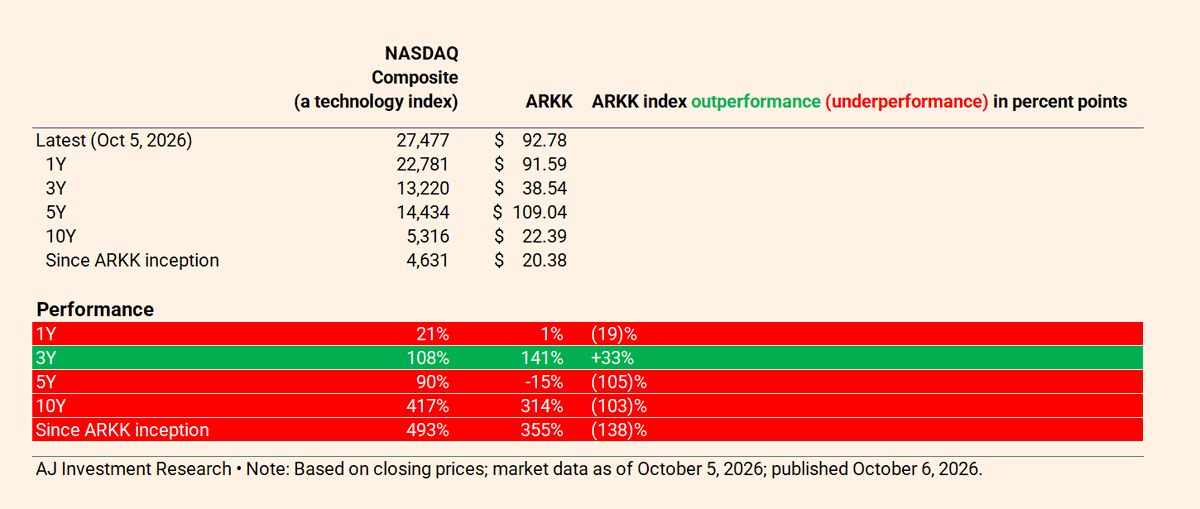
Over the last five years, the NASDAQ gained approximately 90%. ARKK lost approximately 15%.
That is 105 percentage points of underperformance.
Read that again. The technology index gained 90%.
Cathie Wood's innovation fund lost money.
And somehow five years was the period that did not make it into her performance defense.
What a coincidence. (She obviously prepared for this)
3. Even using Cathie’s own selected periods, the record is terrible versus the NASDAQ.
Look at our attached table. Over one year, ARKK trails the NASDAQ by approximately 19 percentage points.
Over ten years, it trails by approximately 103 percentage points. Since inception, it trails by approximately 138 percentage points. ARKK wins over the last three years by 33 percentage points.
And we will happily give Cathie that win.
We have no interest in doing the same cherry picking we are criticizing her for. ARKK has materially outperformed over the last three years. Good.
But one winning window does not erase the rest of the record. Since ARKK's inception, the NASDAQ is up approximately 493%. ARKK is up approximately 355%.
That is 138 percentage points of underperformance over the life of the fund.
4. Cathie got an exceptional starting point.
This part is particularly important when she advertises ARKK's "since inception" return. ARKK launched in 2014. That was an exceptional time to start the clock for an "innovation fund".
We do not even need some complicated macroeconomic study to demonstrate this.
Just look at the NASDAQ. It is up nearly 500% since ARKK's inception!!! This was an incredible bull run for technology/innovation. That is f**king enormous (excuse my French but this is epic).
Cathie launched an innovation fund immediately before one of the greatest periods for technology and growth investing in history.
Software exploded. Cloud exploded. Semiconductors exploded. Digital advertising exploded. Electric vehicles exploded. AI exploded.
The largest technology businesses became THE largest and most profitable companies the world has ever seen.
If you wanted to launch a fund whose entire marketing proposition was based around technological innovation, you could hardly have asked for a better decade.
And yet, ARKK still underperformed the NASDAQ by roughly 138 percentage points.
Think about how absurd that makes the "since inception" victory lap. 🤦♂️
A +355% return sounds fantastic if you present it without context.
It sounds substantially less fantastic when the obvious technology index sitting next to it returned approximately 493%. Cathie had the theme, she had the sector, she had the timing, she had an incredible bull market behind her, AND STILL lost investors money relative to the tech index which the key hurdle for every tech equity investor.
5. Calling the NASDAQ or QQQ comparison "incorrect" is nonsense.
Nobody claims ARKK and QQQ are identical portfolios.
Of course they are not. ARKK invests across multiple conventional sectors, owns smaller and less mature businesses, and runs a concentrated actively managed portfolio. QQQ tracks the Nasdaq 100. Our comparison uses the broader Nasdaq Composite. Fine.
But Cathie takes:
"These portfolios are different." And magically turns it into: "Therefore you cannot compare their investment outcomes." is bulls**t.
An investor interested in technology, innovation, secular growth and businesses benefiting from technological disruption had an obvious alternative:
Buy freaking the NASDAQ, buy QQQ, and pay close to nothing relative to ARKK. And, do nothing. That is the opportunity cost.
The investor's question is not merely:
"How did ARKK perform relative to a collection of other actively managed funds Morningstar put in the same category?"
The relevant question is:
"What did I get for taking all of this additional risk instead of owning the obvious passive alternative?"
If Cathie thinks the NASDAQ is the wrong benchmark, fine. Give us the right benchmark.Pick a transparent, investable benchmark and compare ARKK against it consistently over all relevant periods.
But you cannot dismiss an uncomfortable benchmark as "incorrect" and then hide behind whichever peer group produces the prettiest percentile ranking.
That is not performance analysis. That is benchmark shopping.
6. The additional risk makes ARKK’s record worse, not better.
ARKK is not a boring diversified index. It is an actively managed, concentrated portfolio of highly volatile growth companies. Investors therefore must accept substantially greater stock specific risk, and other risks. That additional risk is supposed to have a purpose, ie upside. Taking more risk is not an achievement. Generating enough additional return to compensate investors for that risk is. Over the last three years, ARKK did. Whether it's enough, given the extra risk, is up for debate. Personally, given ARKK's massive volatility (which is a sign of a fund manager's immaturity), 33% wasn't enough for me over three long years while every other period underpefromed.
Over five years, ten years and since inception versus the NASDAQ, it obviously did not.
Cathie, you do not deserve applause for taking enormous risk and then underperforming a diversified index. Do not pretend it would be any other way. That's dishonorable.
The entire purpose of taking that additional risk was supposed to be to beat it.
7. Lastly, there is the Morningstar part. This one is comedic and makes Cathie's comments so ridiculous.
Cathie cites Morningstar as the authority validating ARKK's supposed excellence. Fine. Let's use Morningstar.
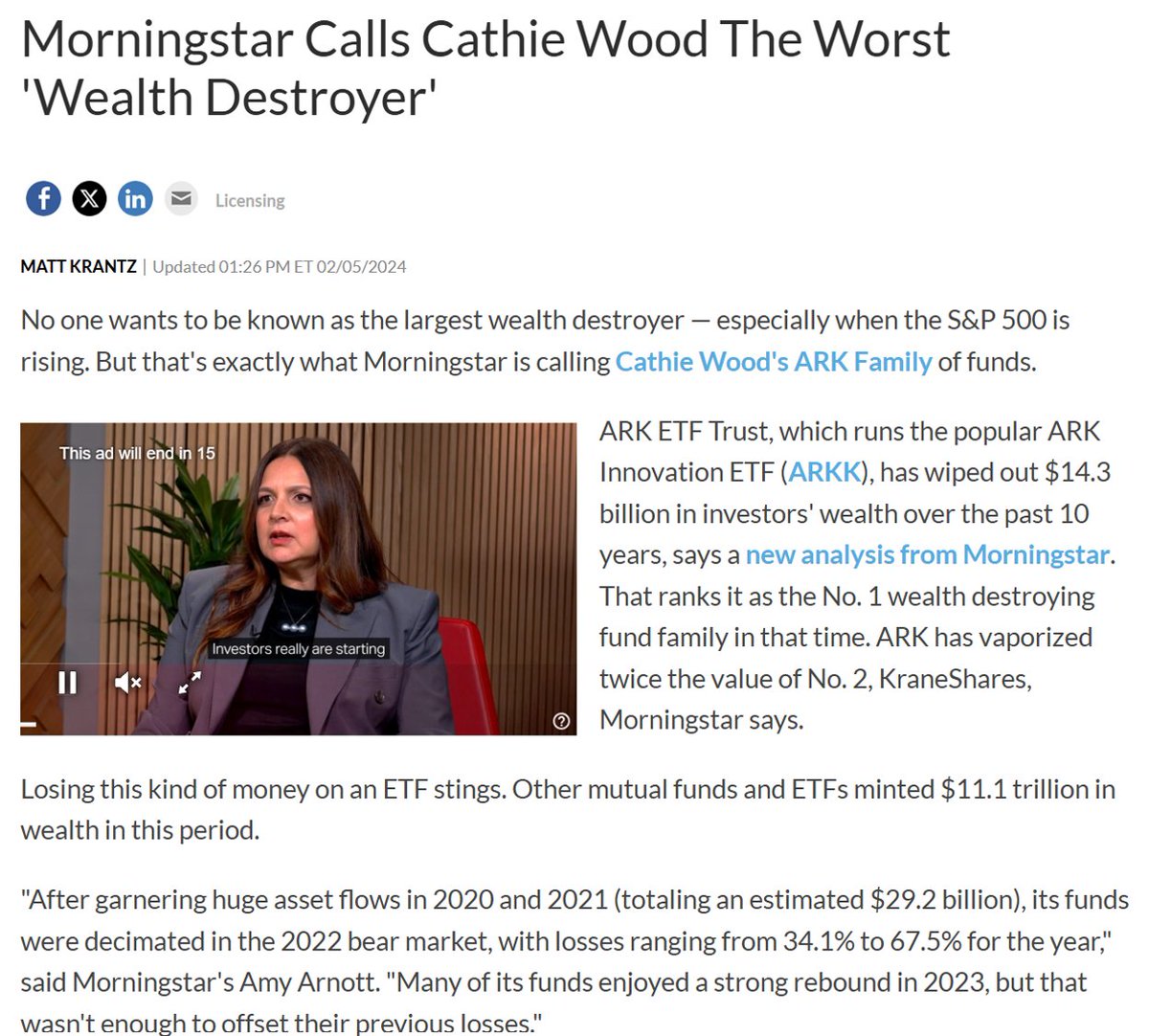
Two years ago, Morningstar analyzed shareholder wealth creation and destruction across fund families (see attached screenshot). Guess who came out dead last, as the largest wealth destroyer in the study?
ARK.
Morningstar estimated that ARK funds had destroyed approximately $14.3 billion of shareholder wealth over the preceding decade.
ARKK alone accounted for roughly $7.1 billion.
Why can a fund have positive point to point performance while destroying enormous amounts of shareholder wealth? Because investors do not all invest on inception day, obviously.
Huge amounts of money flooded into ARK after its spectacular rise, when prices were already extremely elevated. Those investors then participated in the collapse.
So while Cathie likes quoting a hypothetical return beginning in 2014, Morningstar looked at something very different: What actually happened to the dollars investors put into these funds? The answer was devastating and countless investors told me their horrific anecdotes and how they pulled their funds out after sustaining massive losses.
This is the same Morningstar Cathie now cites as validation of ARKK's performance.
Apparently, Morningstar is an authoritative source when its percentile ranking makes ARKK look good.
Then it should probably also count when its analysis puts ARK at the very top of the wealth destruction leaderboard.
You cannot cite the referee only when you like the call.
Bottom line
Cathie is answering a different question from the one investors should care about.
Her question is:
"How highly does ARKK rank within its Morningstar peer category?"
Our question is:
"Did investors get adequately compensated for taking the enormous additional risk of ARKK instead of simply buying an obvious technology heavy passive alternative?" The answer from the numbers is pretty ugly. ARKK trails the NASDAQ by approximately 19 percentage points over one year, 105 percentage points over five years, 103 percentage points over ten years and 138 percentage points since inception.
It wins over three years by 33 percentage points.
That is the record.
And the since inception result is arguably the most damning of all because Cathie started the clock in 2014, immediately before an extraordinary era for technology and innovation stocks. The NASDAQ went up almost 500%. ARKK still couldn't beat it.
And if Cathie wants Morningstar to referee this debate, we are perfectly happy with that. Just don't forget that Morningstar already put ARK at number one on a very different leaderboard: wealth destruction.
***
Personal note: Why does AJ spend time on this?
Because this is exactly why AJ Investment Research exists. We are hardcore investors who became completely fed up with the noise, the bulls**t, the pumping and the endless: "I scratch your back by pumping your stock if you scratch my back by promoting me" on social media. You get rich and powerful business leaders on your podcast or get them to repost your stuff, and this will bring in AuM/fees:
Everybody wants access.
Everybody wants relationships.
Everybody wants to be invited back.
Everybody has something to sell.
And therefore almost nobody calls bulls**t when bulls**t deserves to be called bulls**t.
We set out to do the opposite. Call BS where others will not. Professional investors understand perfectly well what ARKK's record looks like. They understand the drawdowns, the risk, the benchmark problem and the enormous destruction of investor capital.
Privately, many of them will tell you exactly what they think. Publicly? Well, not so much since they have no upside in doing so. Professional etiquette and business interests kick in.
You do not call anoher fund manager's product a joke. You say things like "we have a different investment philosophy" or "we would use a different benchmark" or some other corporate nonsense. We do not have that problem.
We are meta investors. We look through the bulls**t and exploit it for our advantage.
1/3
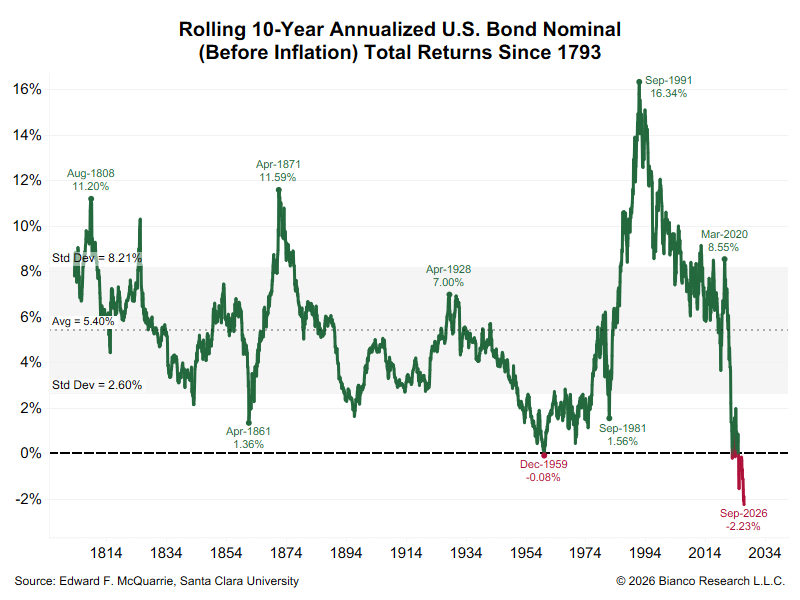
Here's the chart back to 1793, courtesy of Ed McQuarrie at Santa Clara.
The past 10 years have been the worst since 1803.
Read that carefully.
Bonds WERE the worst investment in American history. It says nothing about what they do next.
Remember when Germany had billions of euros trade surplus with China, did any European say global trading systems was reaching a breaking point? Rather cynical world I guess
Vingt-cinq ans après l’entrée de la Chine à l’OMC, Pascal Lamy estime que le système commercial mondial arrive à un point de rupture.
Face au « maximalisme industriel » chinois, il appelle l’Europe à se doter enfin d’un véritable plan B.
https://t.co/jeBFJGLiZF
@Brad_Setser That was such a bad reason to justify it…
So round 1 means it was a good act, and China using its leverage was a bad act as a retaliation for U.S. tariffs 😂😂 how does it stack up in any logical sense
Action, reaction -- China's position in the rare earths supply chain will give it a veto over all trade action (unacceptable) absent moving towards a framework that seeks to deter the use of supply restrictions --
2/2
@JohnHuber72 Not too mention, if every one becomes more productive, the competition may become worse, no more revenue and profit for everyone. Return on that investment may actually worsen, not to mention improvement.
Less than 2 years after Berlin tried to get other capitals to vote against tariffs on Chinese EVs, it is now demanding a mechanism that could cut China off from the EU market altogether. Who had this on their bingo card?
We are not in Kansas any more!
Mark Zuckerberg told Trump Meta would spend $600 billion through 2028.
He said wasting $200 billion would be less dangerous than arriving three years late.
A few days later, he was asked the obvious question: what if AI is a bubble?
Zuckerberg did not deny it.
Railroads and internet fiber attracted too much money. Companies borrowed billions, built faster than demand grew, and collapsed. The infrastructure survived. Someone else bought it for almost nothing.
Meta is preparing for the same possibility.
Nobody knows whether superintelligence is three years away, five years away, or longer. If Meta builds for three and needs five, it may waste hundreds of billions of dollars.
But if Meta prepares for five years and AI arrives in three, Zuckerberg believes the company could miss the most important technology shift in history.
The difference is that Meta can survive being early. Its existing business already makes enough money to fund the buildout. OpenAI and Anthropic still depend on investors continuing to fund theirs.
Zuckerberg is not spending $600 billion because he knows exactly when AI will arrive.
He is spending it so Meta cannot arrive late.
Would you risk $200 billion—or risk being three years behind?
🇪🇺🇨🇳 France, the spearhead of European protectionism against China, is reportedly set to release a proposal with Germany to equip the EU with a “red button” that would allow it to cut off all trade with China within 24 hours.
Such a tool, if it were to take effect, would be a strike force similar to the U.S. Section 301: a unilateral tariff barrier.
To overcome policy differences among European nations—which rarely see eye to eye on this issue—the Franco-German proposal would establish the principle of “reverse qualified majority”: to speed up the response time, sanctions proposed by the Commission would automatically take effect unless an absolute majority of member states expressly opposes them.
Long reluctant to jeopardize its close trade ties with Beijing, Germany has radically shifted its stance in the wake of historic crises affecting its industrial giants (notably the layoff plans at Volkswagen). The German Association of the Automotive Industry (VDA) now supports the EU’s adoption of defensive measures, even though it was still opposed to them just a few months ago.
The EU is taking a harder line just as the US is rethinking its approach and softening its relations with Beijing—at least temporarily.
The standoff initiated by the EU is based on the assumption that China needs access to the European market more than the EU needs the Chinese supply chain.
The United States lost that same bet in 2025.
The reasons behind this Franco-German optimism that they can succeed where the US failed remain a mystery, and it appears to be yet another attempt to bluff Beijing.