Today's apps are "invisible" by design, but shouldn't personal software—your music player, notes app, browser—be about pleasure and fun too?
On nostalgia, DIY software, and why we need more character in our tools 🎵
https://t.co/m29d6zO80n
People eventually trusted what seemed like sketchy websites with their credit cards in the early days of e-commerce because the convenience far outweighed the “risk”.
It takes time, maturity, and early adopters to begin to make people feel comfortable with it. As it matures in consumer experiences and more people start using it, others will try it too. When they do, they’ll realize how the convenience and magic of it outweighs the “risk”.
History and behavior are again repeating itself.
@gt I've used instinct for just a week and I am already thinking of giving it a card/account. Agentic commerce is going to be biggg. Nobody will want to open an app, learn its ux, deal with all the promotions, popups etc.
@SeijinJung@finkd@alexandr_wang I started using Instinct recently and it's already adding groceries to cart for me. I can very much give it an account with a budget cap. Will this not reduce impulsive buying as I won't be interacting with the apps, ads and their upselling?
@sankalpdomore Have been thinking about it!
Did you migrate your old figma files to paper as well? Or are you doing something else for maintaining your old works?
Many years ago, during my time studying South Asian studies at Johns Hopkins University in the US, my professor solved a long-standing mystery for me: Why do Indians constantly emphasize "purity," yet their public sanitation is so poor?
The answer lies in the fact that what many Indians mean by "purity" is actually ritual compliance, not physical cleanliness. Consequently, a cup of water that looks greasy and filthy can be considered supremely "pure" simply because it was drawn from a specific sacred site, by a specific holy person, at a specific auspicious hour.
Once you grasp this distinction between ritual purity and physical cleanliness, it becomes easy to understand the attitude of many Indian scholars toward democracy. Just as they are willing to ignore physical grime and actual hygiene for the sake of ritual purity, they are equally willing to disregard tangible governance performance for the sake of democratic formality.
This explains why, in the classic debate comparing China and India, whenever outsiders point out that "India lags behind China" based on sheer common sense, the most common and lazy copium is: "We are simply unwilling to compromise our principles."
This is clearly a highly satisfying answer for many, for it allows them to claim the moral high ground while dodging the objective gap in actual performance.
However, the harsh reality is that if a cup of water is contaminated, anyone who drinks it will get very sick, no matter how ritually pure it is deemed to be.
By the same token, no matter how self-gratifying the obsession with democracy is, if it fails to deliver tangible performance, it will be exposed as an illusion the moment it faces a true test of hard power.
@pifafu I was a huge Evernote user before. I loved what they had done with Notebooks. But after a while their product started to stagnate and felt tedious as I created more and more notes.
@geoffreylitt I think it's also because our brains remember entertainment better than dry facts. It's not just in TV. I recently read a science history book that had stories and proofs. All i remembered after a few weeks were the stories.
@paulg Kepler thought that a planet’s orbit will be a circle but after he got the data and plotted it, it turned out to be an ellipse. He was surprised how could God use such an imperfect shape.
What if married couples in India were allowed to file a Joint Income Tax Return instead of two separate individual returns? 🤔
Right now, under the new regime, an individual can end up paying zero tax up to ₹12 lakh. But what if the total family income, considering both spouses, could be tax-free up to ₹20 lakh or even ₹24 lakh?
Let's dive in! 🧵
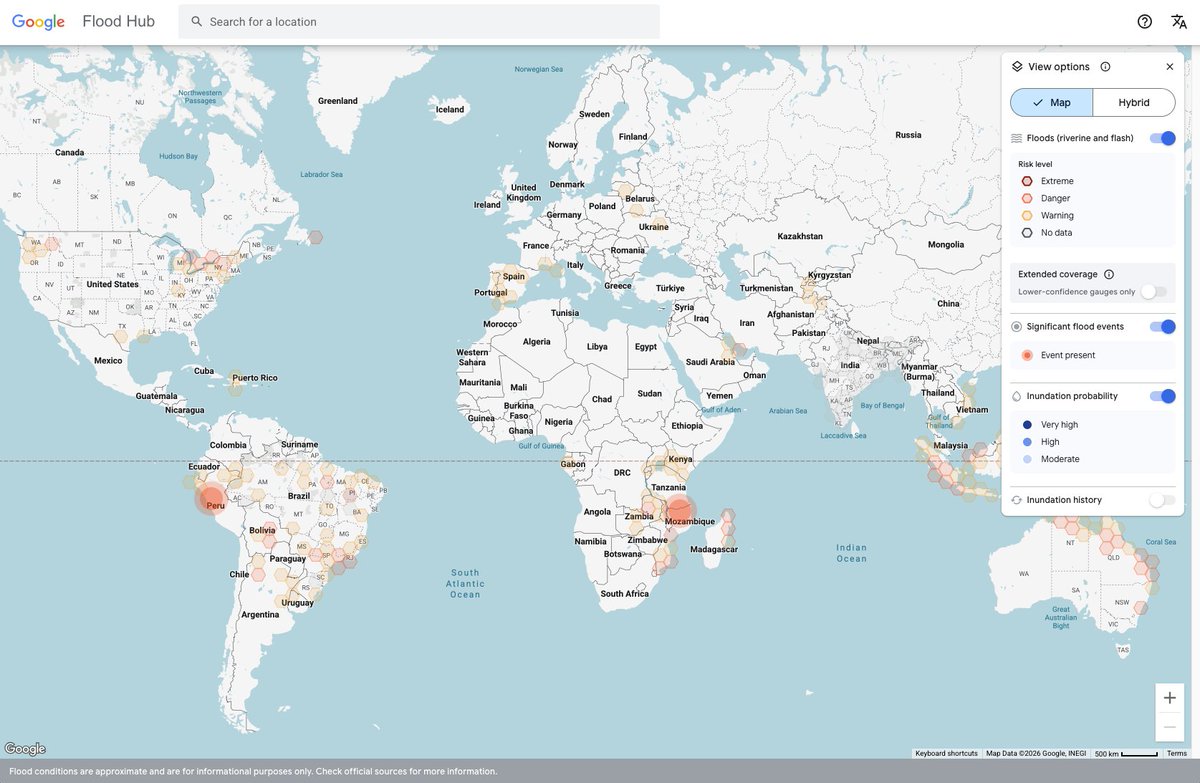
We trained a new flood forecasting model designed to predict flash floods in urban areas up to 24 hours in advance.
To help address a flash floods data gap, we created Groundsource: a new AI methodology using Gemini to identify 2.6M+ historical events across 150+ countries.
We’re open-sourcing this dataset to advance global research, and urban flash flood forecasts are live now in Flood Hub to help communities stay safe.