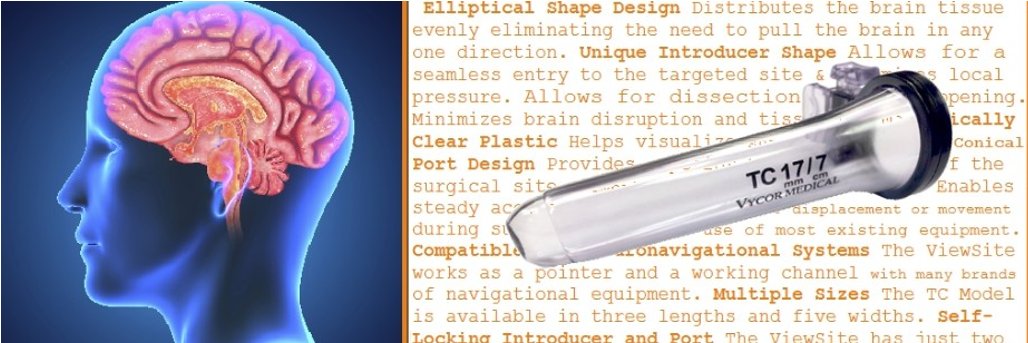
Vycor Medical ($VYCO) manufactures minimally-invasive surgical devices committed to making neurosurgical brain and spinal procedures safer and more effective.
Neurological Vision Loss (NVL) is a type of vision loss that results from a stroke or brain injury that can often go unnoticed in the recovery period after traumatic events. Patients who suffer from NVL may experience a variety of vision-related symptoms, such as loss of central vision, blurry vision, and more. The wide variety of symptoms contributes to the issue of NVL going unnoticed, as many patients never even realize they are suffering from it.
An article from NovaVision, the vision rehabilitation division of Vycor Medical, explains how NVL differs from physical eye conditions. Physical eye conditions are often easier to treat because they are more easily detected visually than NVLs, which often have no visual indication. Most physical eye conditions are also more commonly known than NVLs, so they are more easily detected and treated. This is why it is important to understand the difference between NVLs and physical eye conditions, so patients can better communicate with their doctors.
The article then goes on to describe some common physical eye conditions that are not related to NVL but are still quite common, such as Glaucoma and Cataracts. Unlike some physical eye conditions, NVL cannot be treated with corrective lenses or glasses, as the damage is not in the eye itself but rather in the way the brain processes information. NVLs typically require specialized therapy to create new neural pathways and re-train your brain to significantly improve vision. It is important to address any possible visual impairments with your doctor as soon as possible for the best chance of a full recovery. If you have recently suffered a stroke or other brain injury, specifically request a visual field examination from a medical professional.
Read the full article here: https://t.co/TQ5optjbhX
Learn more about NovaVision’s therapies at https://t.co/7JoXmBurwO or contact us at https://t.co/aqPiSzxRF5
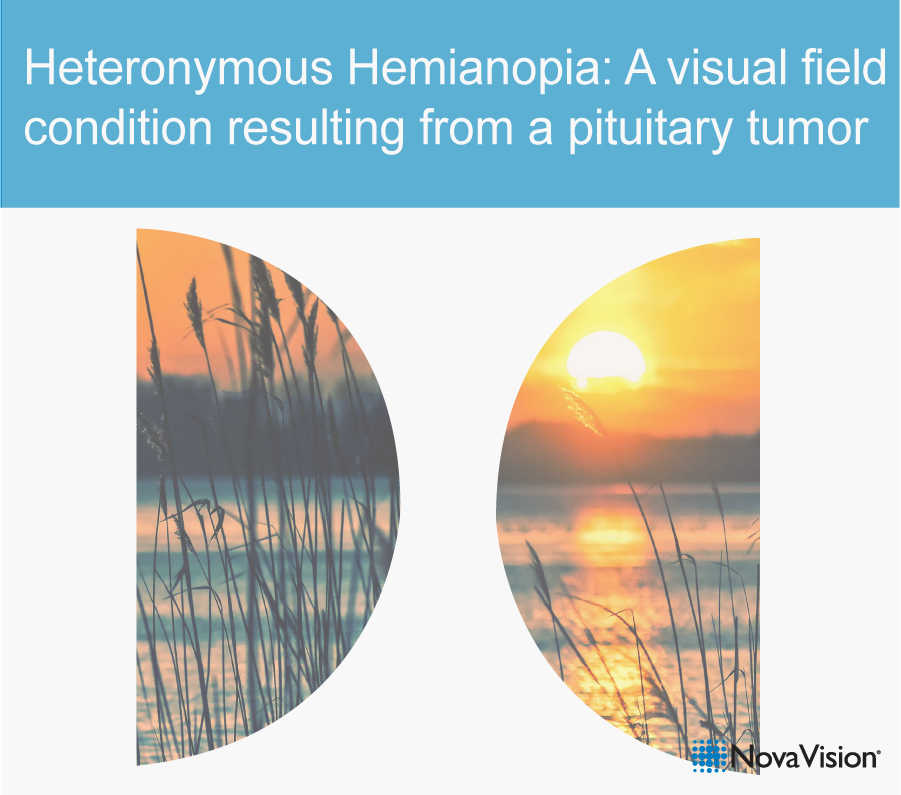
Heteronymous Hemianopia is a medical condition causing the loss of half of the visual field on different sides in both eyes. It is typically caused by a tumor on your pituitary gland exerting pressure on the Chiasma Opticum, the area above the gland where both optic nerves converge to send signals to the brain. This is a major highway for all visual stimuli, so anything that affects it will have major implications for the visual field, despite the relatively small size of the pituitary gland.
A new article from NovaVision, the vision rehabilitation division of Vycor Medical, explains how a pituitary tumor can cause major disorders like Heteronymous Hemianopia. The article goes into detail on what the disorder may look like to those that are afflicted by it and how it can affect a patient’s daily life. Several images are included to better highlight how vision is affected by this condition.
The article also gives some examples of different types of Heteronymous Hemianopia, as there are variants that affect different visual fields. While debilitating for those affected, the article concludes by saying that these symptoms typically subside after successful tumor treatment. However, if vision loss symptoms remain even after treating the tumor, NovaVision’s Vision Restoration Therapy could be the tool needed to bring that vision back to the levels they should be.
Read the full article here: https://t.co/2SVS9p7pfN
Learn more about NovaVision’s therapies at https://t.co/7JoXmBurwO or contact us at https://t.co/aqPiSzxRF5
Saccadic eye movements are the jerky, simultaneous movements of both eyes that shift the point of focus from one place to the next. While many therapies work on aspects of saccadic eye movements, clinical data suggests the following: interventions should be evidence based, should be designed specifically for the clinical condition present, and intervention should be supervised. It is these three aspects that NovaVision’s NeuroEyeCoach was designed to address.
A new article from NovaVision, the vision rehabilitation division of Vycor Medical, goes in depth on how NeuroEyeCoach was designed to address critical issues like lack of evidence-based therapies and the need for a therapy that specifically treats these saccadic eye movements. These programs include systematically designed protocols specific to neurologically visually impaired patients that automatically adjust to the patient’s needs, eliminating the need for improvisation and removing the aspect of physician interpretation.
Most importantly, NeuroEyeCoach is thoroughly vetted by clinical studies, which all point to its effectiveness in the field. According to the article, “NeuroEyeCaoch led to improvements for home-based and clinic-based patients in both objective measures of visual function… as well as reduced subjective reports of disability.” While other programs may have merit in relation to areas of vision, they lack several key aspects that NeuroEyeCoach demonstrates. In addition to these considerations, NeuroEyeCoach’s final advantage is its flexible delivery method; it can be done both in the clinic as well as at home. All of these aspects make NeuroEyeCoach the more attractive option for patients who need saccadic therapy.
Read the full article here: https://t.co/Kdpukm7mbU
Learn more about NovaVision’s therapies at https://t.co/7JoXmBurwO or contact us at https://t.co/aqPiSzxRF5
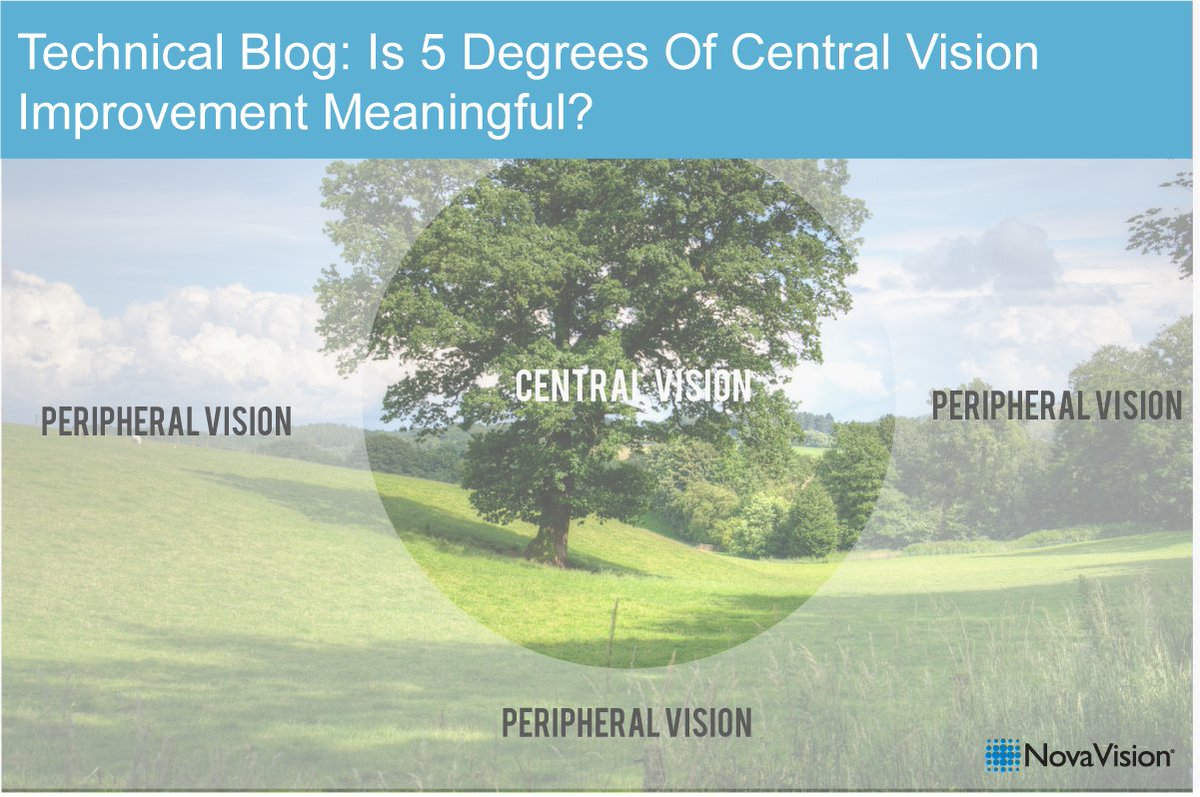
When undergoing therapy for complex issues like vision loss, it can be hard to tell when meaningful progress is being made. While there are many metrics to consider, one that has a profound effect on a patient’s ability to see is known as “degrees of visual angle.” Several clinical studies confirm that NovaVision’s Vision Restoration Therapy (VRT) points to an enlargement of the visual field by an average of 5 degrees after 6 months of therapy.
But how much is 5 degrees of visual angle improvement, really? A new article from NovaVision, the vision rehabilitation division of Vycor Medical, goes in depth on how visual angle improvements are calculated and what these improvements may look like in meaningful examples. The article explains how distance and focus affect the visual field, and the “optimally usable visible field,” the field where focus allows you to read and write, is actually quite a bite smaller than you may expect.
All of this evidence strongly points to their conclusion: “that a 5-degree visual angle improvement following VRT can have a very meaningful impact on one’s daily activities.” They go on to say that improvements to the central area of vision, where VRT targets, can have a significant impact on daily activities like reading, cooking, or working on the computer. These are activities that most take for granted, yet the visually impaired struggle with daily. And while everyone reacts to therapy differently, it is certain that many patients have achieved significant improvement to their vision and their quality of life.
Read the full article here: https://t.co/APavt4eb5c
Learn more about NovaVision’s therapies at https://t.co/7JoXmBurwO or contact us at https://t.co/aqPiSzxRF5
Visual field loss is an often-overlooked aspect of strokes or other brain injuries. While not as dramatic as full vision loss, visual field loss is a serious issue that many patients may not even realize they suffer from. It is especially difficult to find information on visual field loss, resulting in more confusion and potential complications.
A new article from NovaVision, the vision rehabilitation division of Vycor Medical, explains five common misconceptions about neurological field loss and seeks to clear up these misconceptions. These misconceptions range from how the visual field differs from the concept of vision, the ability to drive, and what visual field loss actually looks like to the person affected.
The biggest misconception that NovaVision seeks to combat in this article is that visual field loss is untreatable. They assert that recovery is possible, but the vast majority of patients will require specific therapeutic intervention, which their Vision Restoration Therapy (VRT) and the NeuroEyeCoach therapies are designed to treat. Included in this post is a free eBook which was written to help patients understand their vision loss and how NovaVision’s therapies work to restore their vision.
Read the full article here: https://t.co/j6jfaKEYiS
Learn more about NovaVision’s therapies at https://t.co/7JoXmBurwO or contact us at https://t.co/aqPiSzxRF5
Dr. Scott Rahimi, Professor and Neurosurgical Director, Comprehensive Stroke Center
at the Medical College of Georgia, Augusta recently shared his clinical experience with Vycor’s ViewSite Brain Access System (VBAS) and how it enables safer surgical access to complex brain tumors.
Among the key points Dr. Rahimi highlighted about VBAS were:
· The Medical College of Georgia has been a designated comprehensive stroke center since 2013, the only institution in the state to have obtained that designation and only the second in the southeast.
· Dr. Rahimi and his fellow surgeons are strong proponents of the merits of VBAS, due to its overall effectiveness and ease of use
· There are no start-up capital costs and no requirement for bespoke capital equipment.
· There is no need for specialized OR training due to the device simplicity of use.
· Dr. Rahimi believes that VBAS lends itself well to the evacuation of hemorrhages, in his experience resulting in 90% reduction in hemorrhage volume using VBAS
· With surgeon experience gained over just a few cases, surgical times are reduced to approximately 60 minutes, which is critical in keeping anesthesia time down for acutely ill patients.
· Importantly the patients experience decreased total hospitalization and reduced time in the neuro ICU, thus improving patient outcomes and reducing hospital costs.
· Dr. Rahimi finds the device atraumatic during insertion, while it dissects the plane toward the target, avoiding shearing injuries.
Dr Rahimi concluded by stating that “This is a very simple and effective device for any neurosurgeon in any practice. If you're interested in incorporating this in your practice, we'd be happy to share our experiences and our cases with you”.
Watch the full video here: https://t.co/7OnxMAu4RI
Vision loss following a stroke is a complex issue which does not have one concrete solution. Often, a patient may need several therapies and treatments to maximize their desired outcomes. With so many options, it can be challenging to understand which therapies work together to give the best chances of success.
A new article from NovaVision, the vision rehabilitation division of Vycor Medical, explains how their dual therapies work together to restore vision and orientation. NovaVision’s comprehensive therapy suite offers an unprecedented opportunity for patients to achieve realistic therapeutic goals, especially when both are used effectively.
NovaVision offers both the NeuroEyeCoach and Vision Restoration Therapy (VRT) so patients can fast track their path to clear vision. As the article puts it: "By combining both the NeuroEyeCoach and VRT therapies you will be provided with a comprehensive rehabilitation that will maximize the chances for you to improve your vision.”
Read the full article here: https://t.co/EzwHgyuzze
Learn more about NovaVision’s therapies at https://t.co/7JoXmBurwO or contact us at https://t.co/aqPiSzxRF5
Vision loss following a stroke or brain injury is not only disorienting but often confusing as well. With so much information and so many differing opinions from various sources, it can be hard to understand what advice is real and currently relevant, and what advice is misinformation or simply outdated according to modern understanding.
A new article from NovaVision, the vision rehabilitation division of Vycor Medical, looks to combat three of the most common misconceptions regarding therapies to restore vision. This article breaks down these misconceptions and sheds light on modern therapy practices.
Misconceptions regarding therapy and recovery are unfortunately all too common and dispelling these misconceptions is often the first step towards a full recovery. As the article puts it: "Exploring VRT is truly making an investment in your vision and your overall quality of life.”
Read the full article here: https://t.co/Pf2St8OiZu
Learn more about NovaVision’s therapies at https://t.co/7JoXmBurwO or contact us at https://t.co/aqPiSzxRF5
Vision loss following a stroke or brain injury is one of the most disorienting outcomes patients face, and one of the least understood in terms of what rehabilitation options are available.
A new article from NovaVision, the vision rehabilitation division of Vycor Medical, walks through how to evaluate whether Vision Restoration Therapy may be appropriate, how to prepare for a productive conversation with your physician, and how NovaVision can support this process with clinical materials and physician referrals.
Many patients are unaware that FDA-cleared, computer-based vision rehabilitation programs exist, for which they may already be a candidate. As the article puts it: "The right therapy is the one that fits your specific condition, your clinical picture, and a treatment plan developed with your medical team. NovaVision's role is to make that process easier."
Read the full article here: https://t.co/saxAJYG6ky
Learn more about NovaVision’s therapies at https://t.co/7JoXmBuZmm or contact us at https://t.co/aqPiSzypuD
Nearly one-third of stroke survivors are under age 65 and still working when their stroke occurs. Vycor’s NovaVision division supports this population through rehabilitation therapies that help patients address vision-related challenges that can affect workplace performance.
@vycormedical (OTCQB: VYCO) is a @b2idigital Featured Company. See the company’s complete profile at https://t.co/48RrxkrTNt.
This guide covers essential steps for returning to work after stroke or brain injury, including establishing formal accommodation agreements, understanding available workplace modifications, and connecting with resources that protect employee rights. As the article notes: “Understanding available accommodations and knowing your rights as an employee gives you a foundation for advocating effectively for what you need.”
Read the entire article here: https://t.co/qldU1Mq3AR
Vycor operates two divisions: Vycor Medical (ViewSite Brain Access System™ for neurosurgery) and NovaVision (vision rehabilitation therapies for stroke and brain injury patients). The company is led by CEO Peter Zachariou, President David Cantor, and CFO Adrian Liddell, each bringing extensive experience in medical technology, business development, and finance. More information is available at https://t.co/6b9dQf13DP.
For investor inquiries, please contact [email protected].
Disclosure: David Shapiro, CEO of B2i Digital, personally purchased and currently owns shares of unrestricted VYCO stock, in line with B2i Digital’s practice of investing alongside its Featured Companies. This post is not intended to solicit the sale of VYCO or any security, nor is it intended to offer any opinion on VYCO as an investment. Conduct your own research and consult with your own professional advisors prior to making any investment decisions. See the full disclosure in the Risks and Disclosures section of https://t.co/ljTVqQL4Si.
Sudden, temporary vision loss is easy to dismiss, especially when it resolves quickly. But as a new article from NovaVision, the vision rehabilitation division of Vycor Medical, explains, it can be one of the earliest warning signs of an approaching stroke. A transient ischemic attack, or TIA, often produces brief vision changes, including dimming or complete loss of sight in one eye, that can signal something more serious ahead.
@vycormedical (OTCQB: $VYCO) is a @b2idigital Featured Company. See the company’s complete profile at https://t.co/48RrxkrlXV.
The article explores how sudden vision changes can serve as early stroke warnings, what types of vision loss commonly follow a stroke, and what rehabilitation options are available. As the article notes: “If you experience sudden vision loss, whether in one eye or across part of your visual field, along with any other stroke-associated symptoms, seek medical attention immediately. Acting fast is the single most important thing you can do to reduce the impact of a stroke.”
Read the full article here: https://t.co/2eMMuhb9k9
Vycor operates two divisions: Vycor Medical (ViewSite Brain Access System™ for neurosurgery) and NovaVision (vision rehabilitation therapies for stroke and brain injury patients). The company is led by CEO Peter Zachariou, President David Cantor, and CFO Adrian Liddell, each bringing extensive experience in medical technology, business development, and finance. More information is available at https://t.co/6b9dQf0vOh.
For investor inquiries, please contact [email protected].
Disclosure: David Shapiro, CEO of B2i Digital, personally purchased and currently owns shares of unrestricted VYCO stock, in line with B2i Digital’s practice of investing alongside its Featured Companies. This post is not intended to solicit the sale of VYCO or any security, nor is it intended to offer any opinion on VYCO as an investment. Conduct your own research and consult with your own professional advisors prior to making any investment decisions. See the full disclosure in the Risks and Disclosures section of https://t.co/ljTVqQKx2K.
The brain's ability to reorganize after injury is well established, but there's a common misconception that this healing happens passively or that any 'brain training' app can drive it. A new article from NovaVision, the vision rehabilitation division of Vycor Medical, explains what neuroplasticity requires in a clinical setting and why generic approaches fall short.
Vycor Medical, Inc. (@vycormedical) (OTCQB: VYCO) is a B2i Digital (@b2idigital) Featured Company. See the company's complete profile at https://t.co/48RrxkrlXV.
The article covers what neuroplasticity is, why it matters for stroke and brain injury survivors, and what separates evidence-based rehabilitation from consumer "brain training" products. Neuroplasticity treatments need solid scientific evidence, must be tailored to each patient, and should be closely monitored, which negates the many over-the-counter brain-training apps that claim to help everyone.
Read the full article here: https://t.co/U5JaytHDxc
Vycor operates two divisions: Vycor Medical (ViewSite™ Brain Access System for neurosurgery) and NovaVision (vision rehabilitation therapies for stroke and brain injury patients). The company is led by CEO Peter Zachariou, President David Cantor, and CFO Adrian Liddell, each bringing extensive experience in medical technology, business development, and finance. More information is available at https://t.co/6b9dQf0vOh.
For investor inquiries, please contact [email protected].
Disclosure: David Shapiro, CEO of B2i Digital, personally purchased and currently owns shares of unrestricted VYCO stock, in line with B2i Digital's practice of investing alongside its Featured Companies. This post is not intended to solicit the sale of VYCO or any security, nor is it intended to offer any opinion on VYCO as an investment. Conduct your own research and consult with your own professional advisors prior to making any investment decisions. See the full disclosure in the Risks and Disclosures section of https://t.co/ljTVqQKx2K.
Vision loss following a stroke or brain injury is one of the most disorienting outcomes patients face, and one of the least understood in terms of what rehabilitation options are available.
A new article from @NovaVision3, the vision rehabilitation division of @vycormedical , walks through how to evaluate whether Vision Restoration Therapy may be appropriate, how to prepare for a productive conversation with your physician, and how NovaVision can support this process with clinical and other materials for your physician.
Vycor Medical, Inc. (OTCQB: VYCO) is a @b2idigital Featured Company. See the company's complete profile at https://t.co/48RrxkrlXV.
Many patients are unaware FDA-cleared, computer-based vision rehabilitation programs exist, which they may already be a candidate for. As the article puts it: "The right therapy is the one that fits your specific condition, your clinical picture, and a treatment plan developed with your medical team. NovaVision's role is to make that process easier."
Read the full article here: https://t.co/GsMO1Anh2F
Vycor operates two divisions: Vycor Medical (ViewSite™ Brain Access System for neurosurgery) and NovaVision (vision rehabilitation therapies for stroke and brain injury patients). The company is led by CEO Peter Zachariou, President David Cantor, and CFO Adrian Liddell, each bringing extensive experience in medical technology, business development, and finance. More information is available at https://t.co/6b9dQf0vOh.
For investor inquiries, please contact [email protected].
Disclosure: David Shapiro, CEO of B2i Digital, personally purchased and currently owns shares of unrestricted VYCO stock, in line with B2i Digital's practice of investing alongside its Featured Companies. This post is not intended to solicit the sale of VYCO or any security, nor is it intended to offer any opinion on VYCO as an investment. Conduct your own research and consult with your own professional advisors prior to making any investment decisions. See the full disclosure in the Risks and Disclosures section of https://t.co/ljTVqQKx2K.
The brain's ability to reorganize after injury is well established, but there's a common misconception that this healing happens passively or that any 'brain training' app can drive it. A new article from NovaVision, the vision rehabilitation division of Vycor Medical, explains what neuroplasticity requires in a clinical setting and why generic approaches fall short.
Vycor Medical, Inc. (OTCQB: VYCO) is a B2i Digital Featured Company. See the company's complete profile at https://t.co/WyaHBkd0jE.
The article covers what neuroplasticity is, why it matters for stroke and brain injury survivors, and what separates evidence-based rehabilitation from consumer "brain training" products. Neuroplasticity treatments need solid scientific evidence, must be tailored to each patient, and should be closely monitored, which negates the many over-the-counter brain-training apps that claim to help everyone.
Read the full article here: https://t.co/RLcMtT6cw0
Learn more about NovaVision’s therapies at https://t.co/7JoXmBurwO or contact us at https://t.co/aqPiSzxRF5
Dr. Ricardo Komotar, Professor and Surgical Director of the Brain Tumor Institute at the University of Miami’s Sylvester Comprehensive Cancer Center and an internationally recognized leader in the field, recently shared his clinical experience with Vycor’s ViewSite Brain Access System and how it enables safer surgical access to complex brain tumors
Among the key points Dr. Komotar highlighted about VBAS were:
• The University of Miami is one of the largest brain tumor treatment centers in the US, and the ViewSite system has become integral to the center’s practice, patient outcomes, and satisfaction
• The system allows surgeons to reach deep-seated tumors that would otherwise require much more invasive surgery, reducing the risk of damage to healthy brain tissue and other complications
• Miami’s team has published clinical studies showing the system can be used safely and effectively for several types of deep and difficult-to-reach brain tumors
• Patients experience shorter hospital stays, less pain, and fewer complications, with minimal to no hair shaving required
On the clinical impact of VBAS, Dr. Komotar noted: “Tumors that would otherwise carry a very high surgical morbidity without other treatment options are now much more accessible, much safer to remove, and the patients maintain their quality of life with minimal morbidity.”
Watch the full video here: https://t.co/gPD41mUDXx
Dr. Ricardo J Komotar MD, FAANS, FACS is the Surgical Director of the University of Miami Brain Tumor Institute, Director of Surgical Neuro-oncology at the University of Miami, Director of the UM Neurosurgery Residency Program, and Director of the UM Surgical Neuro-oncology Fellowship Program. Dr. Komotar’s main clinical interests are surgical and radiosurgical (Gamma Knife) treatment of primary and metastatic brain tumors, as well as meningiomas and pituitary lesions https://t.co/KDwCOpDPY3
@Ricardokomotar
Vision loss after stroke varies widely among survivors, even when strokes occur in similar brain locations. Vycor’s NovaVision division works with this variability by offering vision rehabilitation programs tailored to each patient’s specific pattern of vision challenges.
@vycormedical Inc. (OTCQB: VYCO) is a @b2idigital Featured Company. See the company’s complete profile at https://t.co/48RrxkrlXV.
A recent blog post explains why vision outcomes differ so significantly among stroke survivors and describes the common patterns patients experience. As the article notes, “Two people with strokes in similar locations may experience quite different vision outcomes because of these variables. This variability explains why some stroke survivors notice profound vision changes while others experience minimal or no visual symptoms despite having strokes of comparable size or location.”
Read the entire article here: https://t.co/Nf0dc5jRGE
Vycor operates two divisions: Vycor Medical (ViewSite Brain Access System™ for neurosurgery) and NovaVision (vision rehabilitation therapies for stroke and brain injury patients). The company is led by CEO Peter Zachariou, President David Cantor, and CFO Adrian Liddell, each bringing extensive experience in medical technology, business development, and finance. More information is available at https://t.co/6b9dQf0vOh.
For investor inquiries, please contact [email protected].
Disclosure: David Shapiro, CEO of B2i Digital, personally purchased and currently owns shares of unrestricted VYCO stock, in line with B2i Digital’s practice of investing alongside its Featured Companies. This post is not intended to solicit the sale of VYCO or any security, nor is it intended to offer any opinion on VYCO as an investment. Conduct your own research and consult with your own professional advisors prior to making any investment decisions. See the full disclosure in the Risks and Disclosures section of https://t.co/ljTVqQKx2K.
Vision loss after stroke varies widely among survivors, even when strokes occur in similar brain locations. Vycor’s NovaVision division works with this variability by offering vision rehabilitation programs tailored to each patient’s specific pattern of vision challenges.
A recent blog post explains why vision outcomes differ so significantly among stroke survivors and describes the common patterns patients experience. As the article notes, “Two people with strokes in similar locations may experience quite different vision outcomes because of these variables. This variability explains why some stroke survivors notice profound vision changes while others experience minimal or no visual symptoms despite having strokes of comparable size or location.”
Read the entire article here: https://t.co/on2igxcNi3
Learn more about NovaVision’s therapies at https://t.co/7JoXmBuZmm or contact us at https://t.co/aqPiSzypuD
Vision changes after a stroke can develop gradually and go unnoticed during recovery. Vycor’s NovaVision division provides a free online visual field screening tool that help stroke survivors check for potential changes and support informed conversations with their healthcare providers.
@vycormedical Inc. (OTCQB: VYCO) is a @b2idigital Featured Company. See the company’s complete profile at https://t.co/48RrxkrTNt.
In a new blog post, Vycor discusses five practical reasons online screening can be valuable, including accessibility and convenience, as well as early awareness of issues. As the article notes: “Screening results give you concrete information to discuss with your healthcare team. Rather than describing vague concerns about your vision, you can share screening results that show specific patterns.”
Read the entire article here: https://t.co/FlMOp6okjf
Vycor operates two divisions: Vycor Medical (ViewSite Brain Access System™ for neurosurgery) and NovaVision (vision rehabilitation therapies for stroke and brain injury patients). The company is led by CEO Peter Zachariou, President David Cantor, and CFO Adrian Liddell, each bringing extensive experience in medical technology, business development, and finance. More information is available at https://t.co/6b9dQf13DP.
For investor inquiries, please contact [email protected].
Disclosure: David Shapiro, CEO of B2i Digital, personally purchased and currently owns shares of unrestricted VYCO stock, in line with B2i Digital’s practice of investing alongside its Featured Companies. This post is not intended to solicit the sale of VYCO or any security, nor is it intended to offer any opinion on VYCO as an investment. Conduct your own research and consult with your own professional advisors prior to making any investment decisions. See the full disclosure in the Risks and Disclosures section of https://t.co/ljTVqQL4Si.
Vision changes after a stroke can develop gradually and go unnoticed during recovery. Vycor's NovaVision division provides a free online visual field screening tool that help stroke survivors check for potential changes and support informed conversations with their healthcare providers.
In a new blog post, Vycor discusses five practical reasons online screening can be valuable, including accessibility and convenience, as well as early awareness of issues. As the article notes: "Screening results give you concrete information to discuss with your healthcare team. Rather than describing vague concerns about your vision, you can share screening results that show specific patterns."
Read the entire article here: https://t.co/LhNGdOozrd
Learn more about NovaVision’s therapies at https://t.co/7JoXmBurwO or contact us at https://t.co/aqPiSzxRF5