@cremieuxrecueil Not enterprise value though, yet
Add the corporate debt and big pharma is still ahead, just barely. NVDA’s debt is ~10bn so NVDA market cap ≈ EV, whereas the pharmas have over half a trillion of debt between them (~ 30-70bn each for the larger ones)
@DriverlessR@wintonARK The treasury teams of some of the banks might be among the securitization investors, but if a single bank were going to be the main investor you wouldn't bother to pay all the fees associated with securitization and distribution, you'd do a private deal bilaterally.
@DriverlessR@wintonARK These transactions typically have multiple investment banks acting as distributors. E.g. the most recent (Sept) used Citi, Santander, HSBC, Credit Agricole & TD Securities, the one before (Jul) used Goldman, Morgan Stanley, Wells Fargo, Deutsche Bank and SocGen.
@DriverlessR@wintonARK Improving lease payments is marginal, it's mostly not becoming a bank. Every time Tesla builds a car but leases it instead of selling it, it ties up cash. Tesla isn't a bank, their role is not to buy cars and lease them out. It's a role for specialty auto-lease and ABS investors.
@GerberKawasaki Whose EV sales are you looking at when you make this statement?
$LCID horrible, $RIVN ok but they’re the only ones and still losing a fortune on every car sold.
$F, $GM rolling back investments and cutting factory shifts. Others entirely MIA.
@TJC_ALPHA@robmaurer And if you’re asking who bought the securitisation notes, that’s a question Tesla and their bankers know the answer to, but securitisations are only for “qualified institutional buyers” so assume it’s banks, insurance cos, pension funds, etc (often through investment advisors)
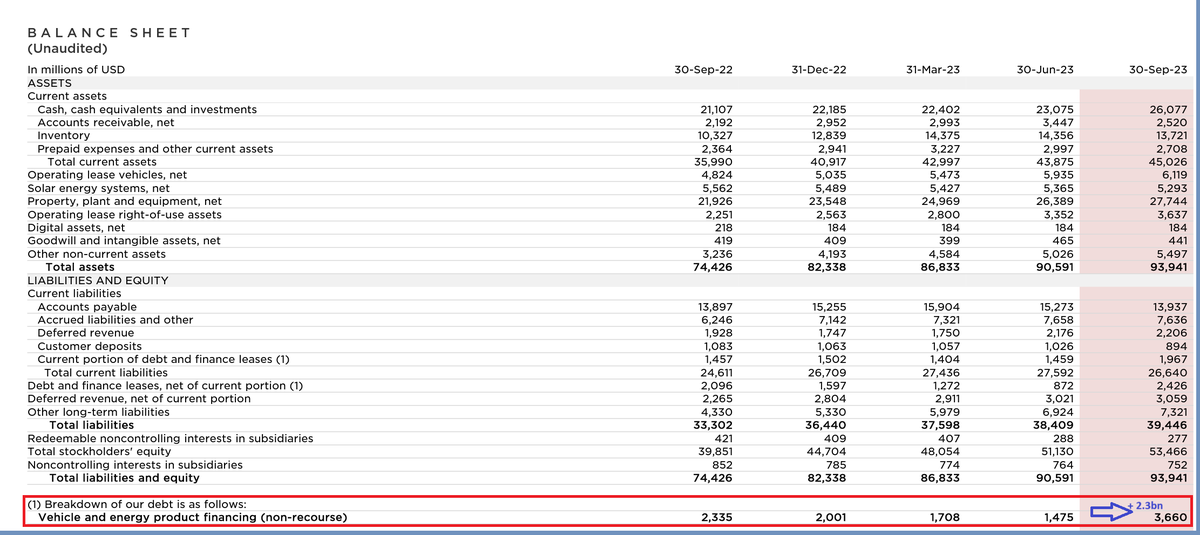
$TSLA @robmaurer Q3 earnings release: 2.3bn cash from financing activities? A quick🧵
Tesla completed two securitization transactions in 2023, one in July for $1.25bn and one in September for $1.27bn, these were its first securitizations since September 2021.
@TJC_ALPHA@robmaurer If you’re asking where on the balance sheet you’d see the reduction in lease assets, you wouldn’t because the securitisation is consolidated for accounting purposes. Both the (sold) leases and the (non-recourse) debt continue to show up on the financial statements.
And by regularly tapping the securitization market, Tesla is cultivating an institutional investor base which buys auto lease ABS. Frequent issuance and a broad investor base helps lower the spreads Tesla pays, which in turn helps lower the APR it has to charge car buyers.
By securitizing the leases, Tesla frees up cash for other uses e.g. R&D, and transfers most of the lessor-default-risk to specialized credit investment/lending firms. Securitization financings are non-recourse to Tesla so note buyers - typically insurers, banks, take the risk.