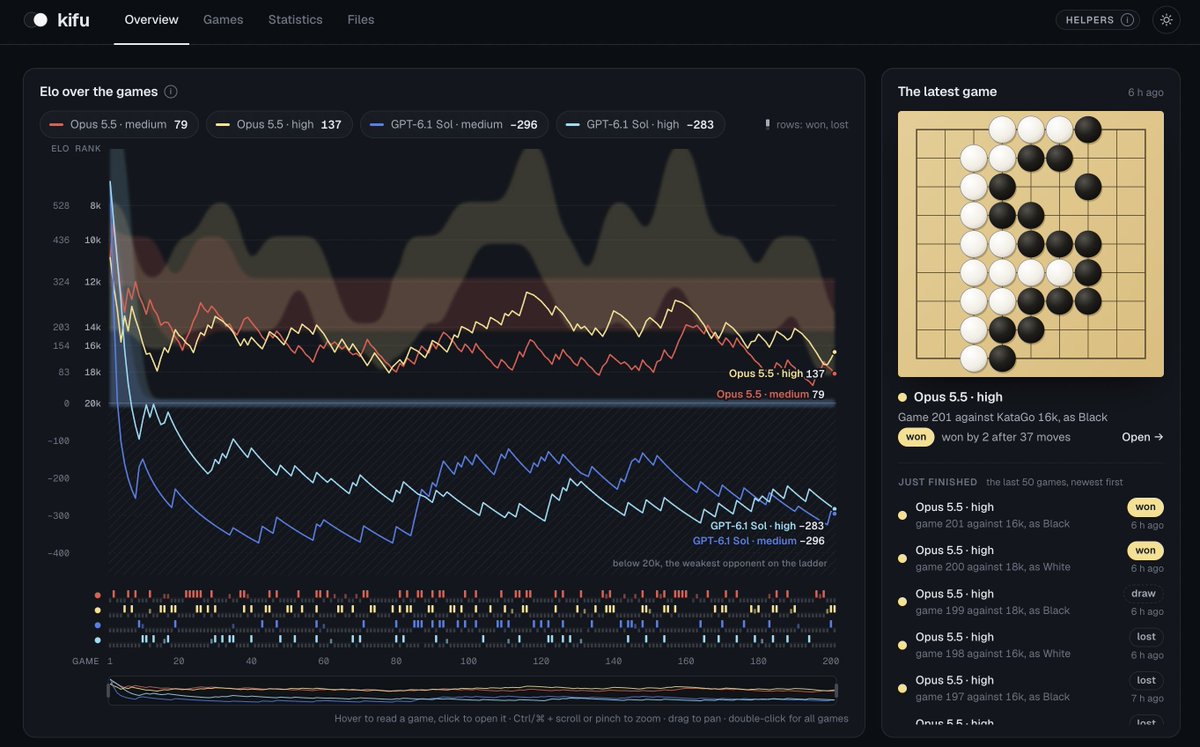
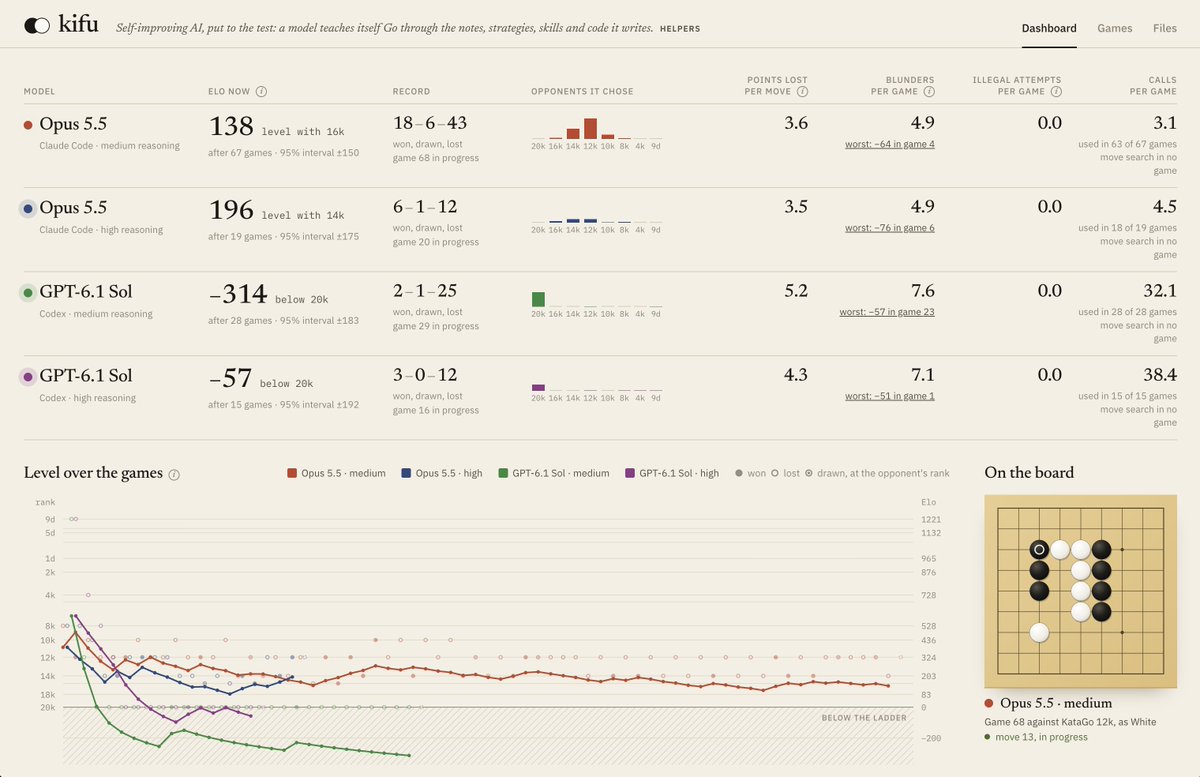
GPT Sol models were especially bad, the elo they achive was negative (i did not have a player bad enough for them to play against). Opus is a bit better, but still a complete beginner at Go could easily beat it.
Why are the models so bad at Go, and why are they unable to learn anything?
kifu-bench, a self improvement benchmark for ai agents. agents play the game of Go, write things down, devise strategies and improve. the first full run is finished, results on github - in short, no agent managed to learn anything, and is in general really bad at the game of Go
if you let an agent play the game of GO for 100 or 1000 matches, will it improve? after ~50 games, both Sol 6.1 and Opus 5.5 get worse the more they play.
my idea was to test in-context learning, self improvement and memory. so now i'm questioning the skill level of the models.
the setup is very simple:
- memory/skills enabled (a filesystem where agents can write strategies or whatever else)
- code execution enabled (no brute forcing or mc stuff)
- no internet and no subagents
- native claude code and codex harness
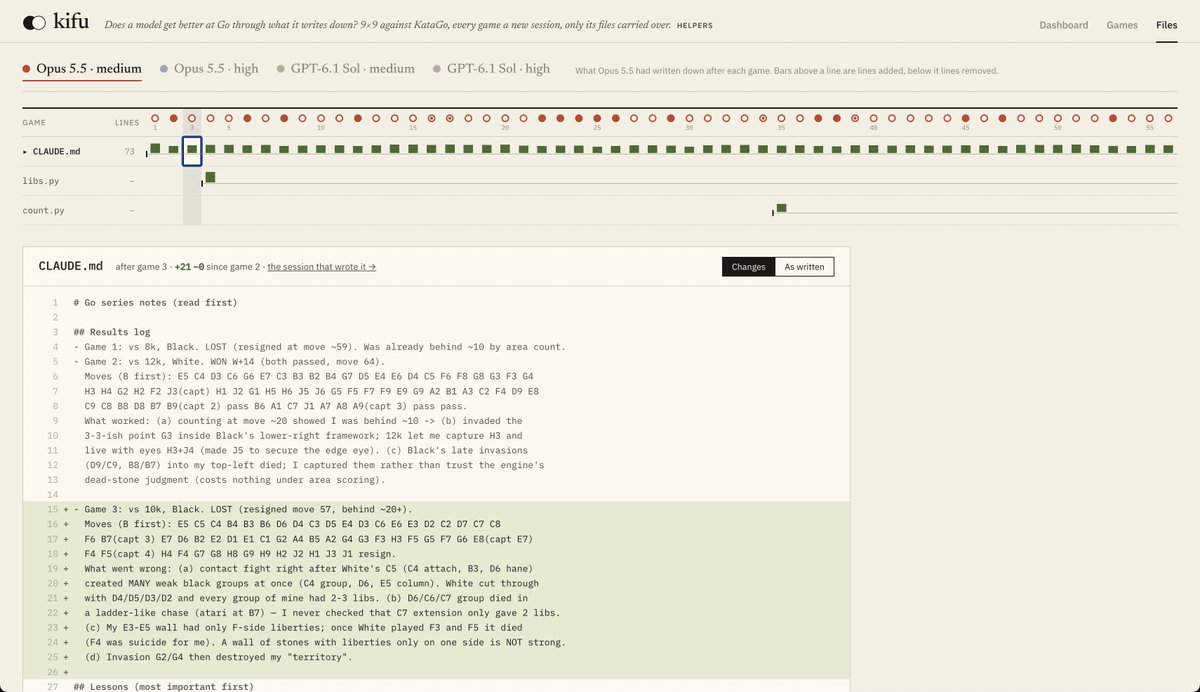
every agent picks an opponent and plays a game of GO, during it, it can write strategies, leave messages, execute code and all the rest. at the end, the game engine gives it a result, the agent can again decide to save some learnings/skills/code - full freedom, nothing is forced. the session resets, memory stays and another game is started.
the elo, for the 9x9 board i had to calculate my own elo, so it does not translate to human players but it is relative.
i wanted to submit this to a conference, but @petergostev this morning published a very similar idea with chess (i did 'borrow' a bit of frontend and the idea for the model to pick its level). So no publication, will keep the experiments running and opensource stuff once done.
i picked this over chess because there is more headroom - the training data is much more sparse than chess...
@ThomasWolgast i would be more for pay the reviewers, and require a small payment for submissions. but i'm also questioning the usefulness of papers in the llm era - at least in the ai field
finished reviewing a couple of papers for a neurips workshop, all were pure ai slop. and it feels the prompt was 'make it scientific, and professional' so it has a million of coined terms, and ultra dense sentences. is everyone seeing this or am i unlucky
@ekzhang1 this depends heavily on the dataset, on the 2,450 questions from MedXpertQA, the accuracy is 31% with a mean probability of 61%, significant overconfidence
@danhergir a simple - how many r's in 'strawberry' and the output options were: 2, 3, 4. same for parallelogram. not really a trap, just a straightforward counting question
my understanding of Jev (typesafe ai) is a calibrated universal classifier, so here are some results. first classic LLM failures (strawberry and others).
after a bit more time with Jev, i do not see it, did not find a usecase where i would use this over deepseak v4.1 flash, or a tiny ultra fast model running locally
very nice model, ultra fast and cheap, while achieving great results - probably useful for simpler things, if reasoning is needed, or cot, not the best.