Lessons from Brazil & Serbia Elections
Brazil has 130 million registered voters. They went to elect their President yesterday & the results were out immediately polls closed! No other country in the world does what Brazil does. President Lula, 80, was re-elected for record 4th time. His campaign recommitment is to end Corruption, Impunity & Militias (goons). And Lula kept his previous election promises.
In Serbia, university students formed only two months ago, its political party called Studentska lista (student List). The students in yesterday’s elections, defeated the party of strongman Vucic that was formed 18 years ago! There are indications the students will choose their university professor, Srdanovic to be the new leader of Serbia.
Therefore, winning elections isn’t about the age of the Party or of the Party’s Presidential candidate. It is, who resonates with the voters!
The High Court held that a lender cannot repossess and sell a vehicle secured by a logbook loan without first properly serving the borrower with a proper written default notice.
📚 Momentum Credit Ltd v Idd [2026] KEHC 15896 (KLR)
Not legal advice.
Are secret recordings admissible in evidence?
Secret audio and video recordings are admissible in evidence in Kenya, provided they satisfy statutory requirements for electronic records and survive constitutional scrutiny regarding privacy and fairness. The legal framework governs admissibility across three main thresholds: statutory electronic evidence rules, constitutional limitations, and the emerging judicial balancing test.
Under the Evidence Act (Cap 80), secret recordings constitute electronic records, and their admissibility turns primarily on Section 106B. When an electronic record—such as an audio file, tape, or video capture—is tendered using secondary media rather than the original recording device itself, it must be accompanied by a formal Section 106B certificate. This certificate must be executed by a person holding a responsible position regarding the operation of the device or the management of the relevant activity, whether that is the individual who captured the footage, the system administrator who retrieved it, or a forensic analyst. The party adducing the evidence must demonstrate that the recording device was operating properly, that the file has remained free from tampering, selective editing, or splicing, and that an unbroken chain of custody has been maintained from the moment of capture to its presentation in court.
Beyond technical statutory compliance, secret recordings must overcome a rigorous constitutional hurdle anchored in Article 31 and Article 50(4) of the Constitution of Kenya. Because covert surveillance inherently infringes upon the right to privacy, the court must apply the exclusionary rule under Article 50(4), which mandates the exclusion of evidence obtained through a violation of the Bill of Rights if admitting it would render the trial unfair or otherwise be detrimental to the administration of justice. However, privacy is not an absolute right.
Under the limitation principles of Article 24, Kenyan courts routinely weigh individual privacy expectations against overriding public interests, such as exposing corruption, unraveling financial crimes, or preventing grave criminal conduct. Where an individual uses private quarters to orchestrate unlawful acts, courts have consistently held that the expectation of privacy cannot serve as a constitutional shield for wrongdoing.
This balancing approach is reflected across Kenyan jurisprudence. In criminal proceedings, as seen in Republic v. Philip Kilonzo & Another and various anti-corruption trap operations prosecuted by the Ethics and Anti-Corruption Commission, judges retain discretion to admit secretly obtained recordings where their probative value significantly outweighs any procedural prejudice and serves the broader interests of justice. In civil and commercial litigation, courts continue to draw upon the foundational principle that relevance dictates admissibility, subject to the court’s overriding discretion to exclude unfair material and the strict fulfillment of electronic certification rules.
Ultimately, the successful admission of a secret recording requires establishing five interconnected elements: logical relevance to a fact in issue, strict technical compliance through a Section 106B certificate, positive identification of the voices or faces captured, forensic proof of authenticity and custody, and satisfaction of the constitutional proportionality test ensuring that the admission does not undermine the integrity of the judicial process.
Graduated Top of my Class- the first ever Catholic University of Eastern Africa Master of Laws (LL.M.) candidates.
This took place while surrounded by loving family, relatives and close friends spaning from primary school all the way to the Kenya School of Law. #cuea45
🚨 Court holds that a borrower cannot reverse a bank auction simply by proving the land was worth more than it fetched.
This is Thomas Nganda Njuguna versus Kenya Commercial Bank Limited and another, decided by the Court of Appeal at Nakuru. Here is what it means.
The borrower had charged approximately 306.5 acres to Kenya Commercial Bank to secure a loan of KShs 750,000. He repaid about KShs 300,000, then defaulted, and the default went uncured for years. The bank eventually sold the property by public auction for KShs 7 million. The borrower challenged the sale, arguing that the land was worth about KShs 27.6 million and alleging defective notice, an irregular auction, gross undervalue and fraud.
The Court of Appeal rejected every limb of the challenge. The statutory notice had been issued and served. The default had remained uncured for years. The property had been publicly advertised and genuinely auctioned. And the KShs 7 million price was supported by forced sale valuation evidence, including one valuation placing the forced sale value at KShs 5.5 million and an independent valuation at about KShs 10.05 million.
A forced sale value, the price a property is expected to fetch under the pressure of an auction, is ordinarily lower than its open market value, so the gap between the sale price and the borrower's own figure did not, on its own, prove anything improper.
More importantly, the Court held that a borrower cannot simply point to a higher valuation and declare the auction fraudulent. Fraud must be specifically pleaded and strictly proved. Where a genuine public auction takes place and the purchaser is shown to have acted without fraud or collusion, section 69B of the Transfer of Property Act protects that purchaser's title. Even where the power of sale may have been exercised improperly or irregularly, the statutory scheme points the aggrieved borrower to a remedy in damages against the person who exercised that power, not to the automatic cancellation of an innocent purchaser's title. The appeal was dismissed.
The legal dispute worth noting:
On one side stands the borrower. A charge is meant to be security for a debt, not a forfeiture of the whole asset. Selling 306 acres for KShs 7 million, against a claimed value many times higher, looks like a windfall for the buyer and a disaster for the owner, and the law should discourage lenders and auctioneers from disposing of property for far less than it is worth.
On the other side stands the integrity of auction sales and the protection of the innocent purchaser. If any disappointed borrower could unwind a completed auction merely by producing a higher valuation, bidders would stay away, buyers could never be confident of their title, and the security that makes lending possible would weaken. The statute deliberately protects the purchaser and sends the borrower's grievance to a claim in damages against the lender.
Key takeaway: Default on a loan secured by land carries consequences that can place the property permanently beyond reach. Once an innocent buyer acquires it through a lawful auction, showing that the land was worth more is rarely enough to recover it. The borrower's protection lies in curing the default in time, and failing that, in a claim for damages against the lender, not in cancelling the sale.
👉 Follow @Lexken_EMSLaw for practical legal insights on charged property and auction sales
MoH says Kenya’s first Ebola case “fell ill about a month ago,” was treated in several DRC hospitals, then road-tripped to Kampala, flew Jambojet on Oct 3, cleared airport screening, and died in Nairobi on Oct 5.
That is not the Ebola clock. CDC: fatal cases usually die days 6–16 of symptoms. West Africa data: mean onset-to-death ~10 days; ~88% of deaths in the first two weeks. Survivors tend to turn the corner around day 6, not still be in wet hemorrhagic disease a month later and then board a plane.
Either the “month” is wrong, or this story is.
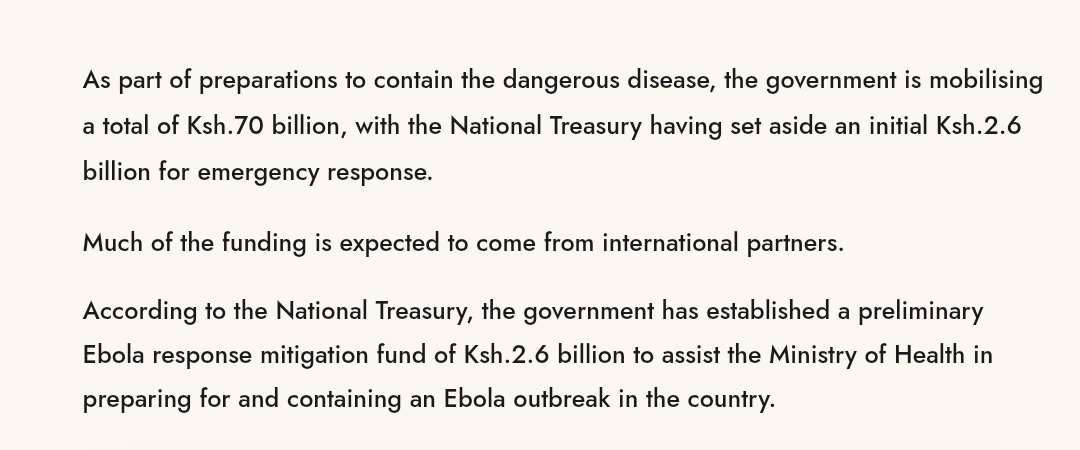
Very interesting that the government has quickly done the math and determined that Kenya needs KES 70B to deal with Ebola, with 96% of it expected to come from international donors.
Passed all those security checks, and everything came back negative. Proceeds to Nairobi Hospital, negative. Proceeds to KEMRI, positive, then dies.
And immediately, the Health CS wants to tour the illegal isolation facility. 💀
Arrest the script writer 2/10.
I am wondering: a Kenyan who has lived in the DRC for 7 years catches Ebola. He is hospitalized for one month in that country. He travels many km to Kampala. Catches a plane to Nairobi. He is driven to hospital after landing. Is admitted and dies. Is this logical?
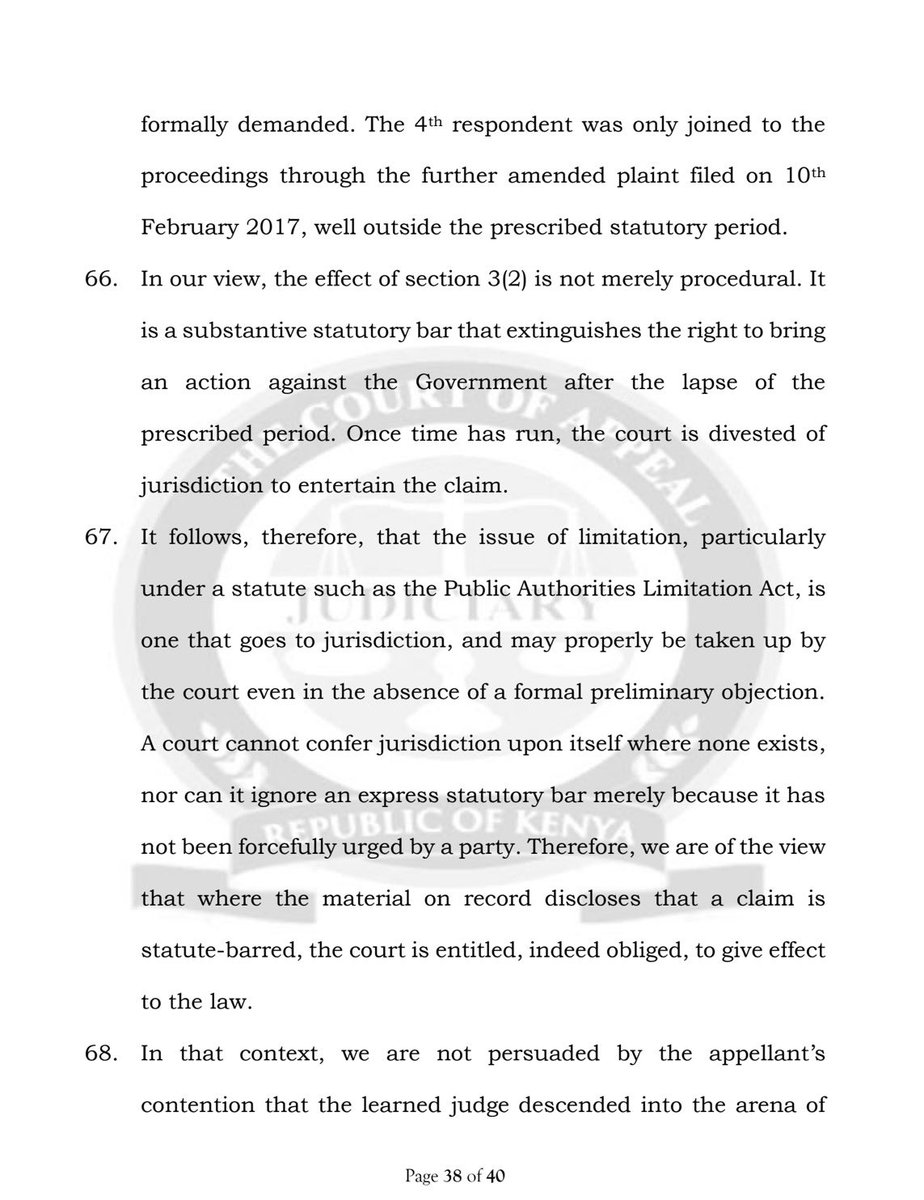
🚨 Court holds that work done under a public contract that broke procurement law cannot be paid for, even where the services were delivered and the public clearly benefited.
This is Royal Media Services Ltd v Independent Electoral and Boundaries Commission and 3 others, Civil Appeal No. 239 of 2019 [2026] KECA 268 (KLR). Here is what it means.
Ahead of the 2013 general election, Royal Media Services says it carried out emergency voter mobilisation broadcasts and roadshows on the strength of verbal requests, stamped booking sheets from Commission officials, and funding assurances from the National Treasury. It later sued to recover KSh 182 million. The court accepted that the services were actually rendered and benefited the public. It still dismissed the appeal in full, with costs.
There was no valid formal contract, and the engagement broke the mandatory rules of the Public Procurement and Disposal Act. In law, a contract made in breach of those rules is not merely irregular. It is illegal, void and unenforceable. And the duty to follow procurement law does not rest with the public body alone. Under section 27 of the Act, the supplier carries it too, and cannot treat the entity's non-compliance as somebody else's internal problem.
The claimant then asked to be paid on a fairer basis, for the value of the work actually done, a remedy the law calls quantum meruit. The court refused. Under the long standing rule that no one can build a claim on an illegal foundation, equitable remedies cannot rescue a transaction the statute prohibits. The claim against the Treasury was also out of time, and the court held that a limitation period against a public authority goes to its very power to hear the case, so it can raise that bar on its own. The individual officials were not personally liable either, because they acted within their official roles and not in bad faith.
On one side is the public interest in clean procurement. If courts paid out whenever work was done, the mandatory rules that guard public money would mean little, and quiet side arrangements would replace open tendering. On the other is the hardship to a party that delivered real value in good faith and now carries the whole loss, while the public keeps the benefit. The law has chosen the first, and it is a hard choice to sit with.
Key takeaway: with any public contract, the paperwork is the deal. A verbal request, a stamped booking sheet or a comfort note from a ministry is not a procurement contract, and doing the work first will not turn it into one.
Before you deliver for a public body, can you point to a procurement process that was actually followed?
👉 Follow @Lexken_EMSLaw for practical legal insights on public procurement and contracts.
Tebu, ama ni mimi ndo sielewi sheria.
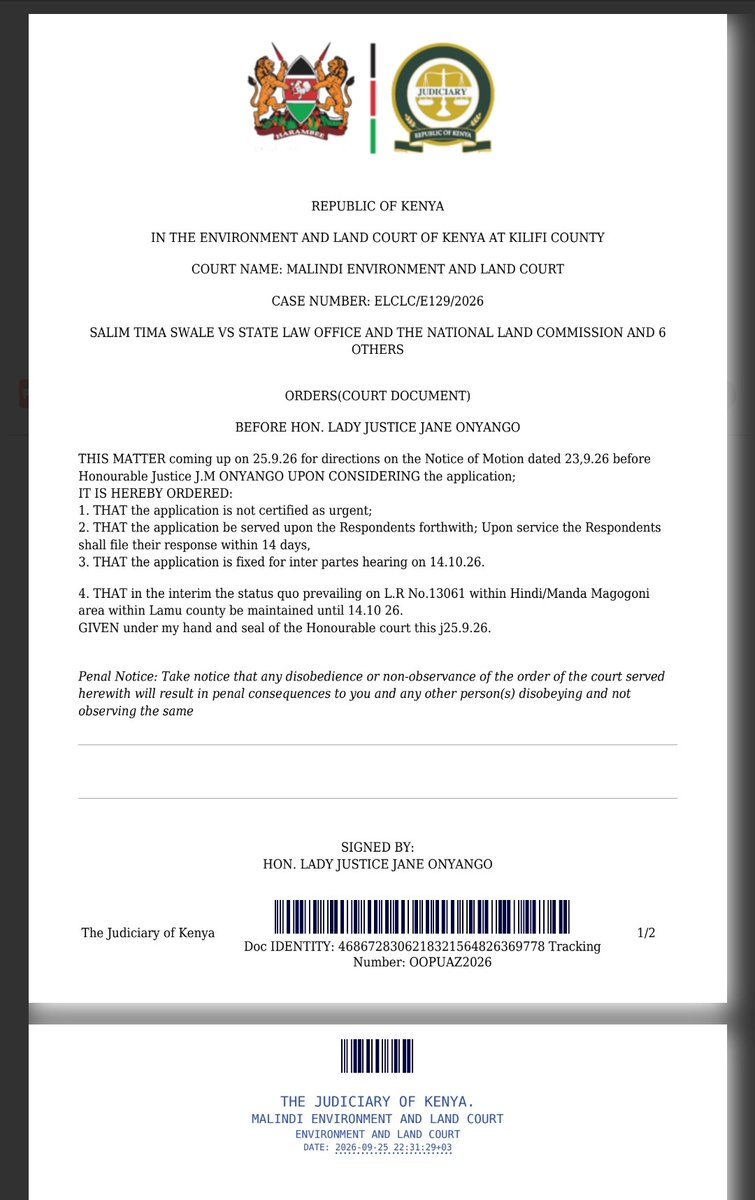
Si Hon Onyango ordered status quo be maintained on the Lamu project until 14-10-2026?
The status quo as at the date the order was issued was that no groundbreaking had happened.
Why has groundbreaking proceeded?
Are the parties in contempt or the orders were vacated na sijui?
Ama ni mimi ndo sielewi maana ya status quo be maintained?
Or the land they've broken is not 13061?
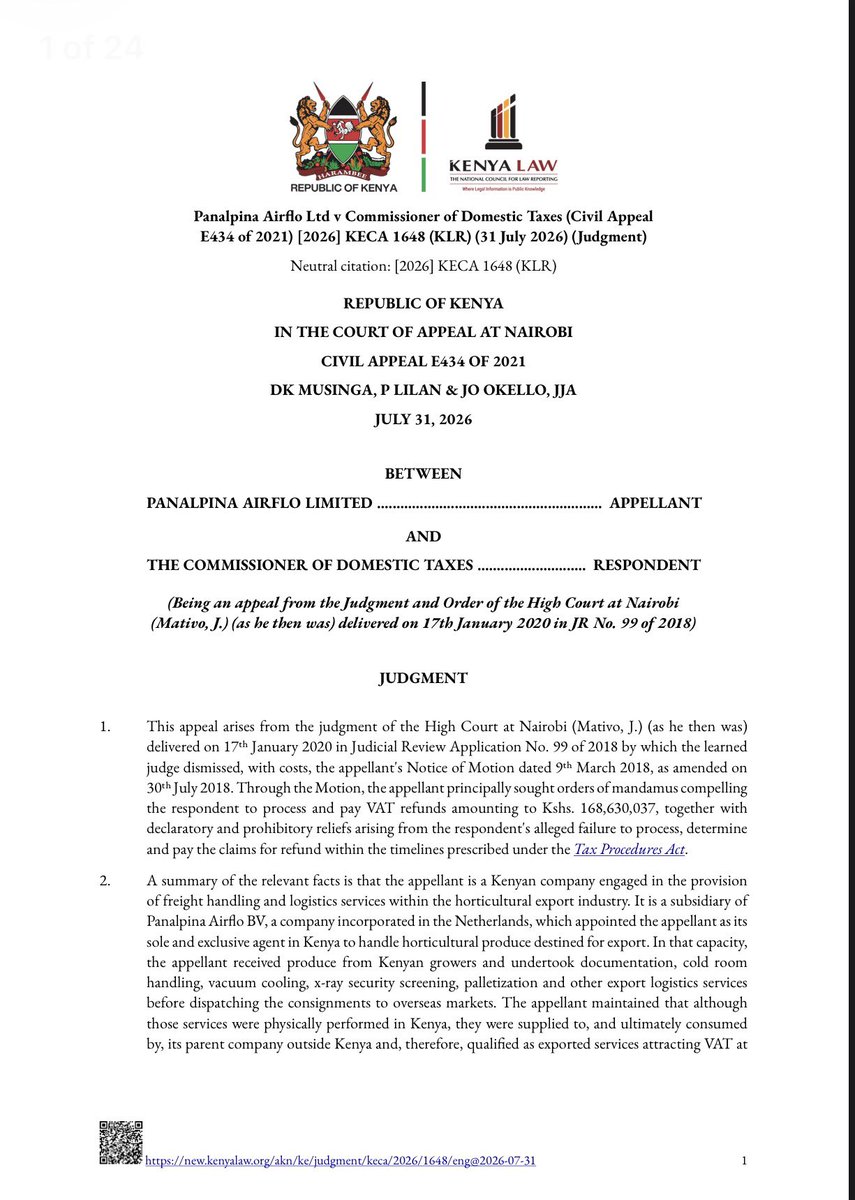
🚨 Court of Appeal holds that when KRA simply sits on your tax objection and does nothing, you can go straight to the High Court, and the taxman's silence can hand you victory by operation of law. This is a landmark for tax disputes, and it resolves a real jurisdictional tension. Here is the analysis.
The case Panalpina Airflo Ltd v Commissioner of Domestic Taxes, settles three connected propositions that every taxpayer and adviser should understand.
First, judicial review and statutory appeals do different jobs. A statutory appeal to the Tax Appeals Tribunal tests the merits, whether the assessment is right or wrong. Judicial review tests the legality of the process, whether KRA acted lawfully, followed mandatory procedures, and observed statutory timelines. The Court held these are distinct and independent routes. Where the complaint is about how KRA behaved, not whether the tax is correct, judicial review remains available.
Second, statutory timelines are mandatory and self-executing. Under Section 51(11) of the Tax Procedures Act, if the Commissioner fails to make an objection decision within 60 days, the objection is deemed allowed by operation of law. The Court held this is an automatic legal consequence that KRA cannot suspend or vary for administrative convenience or because other proceedings are pending. Silence has a price, and the law imposes it automatically.
Third, exhaustion does not bar judicial review where there is no decision to appeal. The doctrine of exhaustion normally requires a taxpayer to use the Tribunal before running to court. But the Tribunal's jurisdiction is triggered by a decision. Where KRA has made no decision at all, has simply failed to act, there is nothing to appeal, and the appellate route is ineffective. In that administrative limbo, the High Court's supervisory jurisdiction is the proper forum.
On one side is the exhaustion doctrine, which protects specialised tribunals from being bypassed and keeps the High Court from becoming a court of first resort for every tax grievance, a principle the courts guard carefully, and one that, in this very dispute's earlier chapter in 2019, saw an earlier judicial review dismissed for offending exhaustion. On the other side is the constitutional right of access to justice under Article 48 and fair administrative action under Article 47: a taxpayer cannot be trapped in limbo, denied both a decision to appeal and a court to turn to, simply because the regulator refuses to act. The Court of Appeal has reconciled the two by confirming that exhaustion is not absolute, its exception applies precisely where the statutory remedy is ineffective, and administrative inaction is a paradigm case of ineffectiveness.
This is consistent with a well-established Kenyan line. In Republic v Commissioner of Domestic Taxes ex parte Fleur Investments, and in the wider jurisprudence on exhaustion (including the Mombasa Court of Appeal's Night Rose Cosmetics line), the courts have repeatedly recognised that judicial review lies despite an alternative remedy where that remedy is inadequate, or where there is an abuse of power or breach of natural justice. Panalpina sharpens this specifically for tax: no decision means no effective appeal, which means the High Court's door stays open.
👉 Follow @Lexken_EMSLaw for practical legal insights on tax, judicial review and administrative justice.
Salaried Partners in trouble as court says being called a “Partner” can cost you employee protections.
In Miriam Nzilani Mweu v Kiptiness & Odhiambo Associates, an advocate was promoted from Associate to Fixed Remuneration Partner, earning a fixed remuneration, bonuses and a share of the firm’s profits. She later went to court over the termination of the relationship.
The Court held that she was a Partner, not an employee, and therefore the ELRC had no jurisdiction. Why? Section 8(2) of the Partnerships Act says a partnership shall not employ a partner as an employee. The court struck out her case. Your title at work may therefore determine whether you can even sue for unfair termination.
🚨 The Communications Authority has proposed a standalone licence for data centres.
The CA proposed removing co-location data centres from the Network Facilities Provider Tier 2 category, where they currently sit, and creating a dedicated Data Centre licence, with the public given 30 days to comment. The stated aim is regulatory clarity and investment in Kenya's fast-growing digital-infrastructure sector.
The commercial case is sound. But two legal disputes deserve scrutiny.
The first is jurisdictional, and it is the objection operators themselves raised. The CA's authority to license flows from the Kenya Information and Communications Act, which governs telecommunications. Yet a co-location data centre, at its core, provides space, racks, power and cooling. It is closer to specialised commercial real estate than to telecommunications connectivity. Operators have argued, with force, that they are not telecommunications providers at all. This raises a real question: how far can a telecommunications regulator's mandate stretch before it is regulating something Parliament did not clearly place within its remit? A licence must rest on a lawful statutory foundation, and the fit between data centre and telecommunications is not self-evident.
The second dispute is about who guards the data. Data centres are where personal data physically resides. But personal data is the constitutional preserve of the right to privacy under Article 31, policed by a different body, the Office of the Data Protection Commissioner, under a different law, the Data Protection Act. Bringing data centres under the CA's licensing wing risks creating an overlap, or a gap, between two regulators: the CA overseeing the facility, the ODPC overseeing the data within it. Clarity about where telecommunications regulation ends and data-protection regulation begins is not a technicality; it determines who is accountable when the data in these facilities is breached, accessed unlawfully, or moved across borders. Overlapping mandates can mean duplicated burdens for operators, and, worse, confusion over responsibility when a citizen's privacy is violated.
There is a further constitutional dimension the consultation should address. If a Data Centre licence carries conditions on data localisation, government access, or lawful interception, those conditions engage Article 31 directly, and must satisfy the proportionality test in Article 24. A licensing regime that quietly expands state visibility into where and how data is held cannot escape constitutional scrutiny simply because it is framed as infrastructure regulation.
The 30-day comment window is where these questions must be raised. Data centre operators, cloud providers, privacy advocates and businesses that rely on this infrastructure should engage now, and press for two things: a clear statutory basis for the licence, and a clean demarcation between the CA's infrastructure mandate and the ODPC's data-protection mandate. Get that boundary wrong, and the cost is measured in both compliance confusion and constitutional risk.
👉 Follow @Lexken_EMSLaw for practical legal insights on technology, data protection and regulatory compliance.
🚨 Can an international court reach into a completed national criminal trial, without becoming a court of appeal over that country's own judges? The African Court has given a careful answer.
In Song Lei v United Republic of Tanzania, the applicant, a Chinese national convicted and imprisoned in Tanzania for wildlife-trophy offences, took his complaint to the African Court on Human and Peoples' Rights, alleging that his trial had violated his rights to a fair hearing, to equality before the law, to dignity and to an interpreter, protected under the African Charter and the International Covenant on Civil and Political Rights.
This raised a delicate jurisdictional question. An international human-rights court is not meant to sit as a fourth level of appeal, re-hearing cases that national courts have already decided. That would trample the sovereignty of domestic courts and turn the international body into a super-appellate court. So could it even look at what Tanzania's courts had done?
The Court drew the line with precision. It held that although it is not an appellate court over national courts, that does not prevent it from examining domestic judicial proceedings for the purpose of determining whether they complied with international human-rights standards. The distinction is subtle but crucial. The Court will not re-evaluate the evidence, or second-guess whether the accused was rightly convicted on the facts, that remains the domain of the national courts. What it will examine is the manner in which the proceedings were conducted: whether the trial was fair, whether the accused was heard, whether equality and dignity were respected, whether an interpreter was provided. It reviews the process against international standards, not the merits of the verdict.
Why does a Tanzanian case matter in Kenya? Because of Article 2(6) of our Constitution, which makes treaties ratified by Kenya part of Kenyan law. An accused person who alleges that their rights were violated during proceedings may, in appropriate circumstances, seek redress in the international human-rights sphere, and Kenyan proceedings can themselves be evaluated internationally for conformity with these standards.
The practical significance is twofold. For individuals: domestic remedies are not necessarily the end of the road; where a trial breached fundamental fair-trial guarantees, an international avenue may exist. For courts and the State: how a trial is conducted, not just its outcome, can be scrutinised beyond our borders, which is a powerful incentive to ensure every proceeding meets international fair-trial standards from the outset.
The principle in a line: an international court will not retry your case, but it will examine whether you were tried fairly.
👉 Follow @Lexken_EMSLaw for practical legal insights on human rights, constitutional law and international law.
🚨 For the first time, large consumers in Kenya can bypass Kenya Power and buy electricity directly from independent producers. It is a landmark liberalisation, but beneath the commercial excitement sits a constitutional question few are asking: who is left to carry the grid when the biggest customers walk away?
The reform comes through the Energy (Electricity Market, Bulk Supply and Open Access) Regulations, 2026 (Legal Notice No. 79 of 2026). They end Kenya Power’s monopoly as the sole buyer and seller of bulk electricity, allowing consumers with at least 1 MVA of load on the distribution system, or 10 MVA on transmission, to contract directly with generators on one-to-ten-year terms, paying a “wheeling charge” for using the grid, with EPRA approving the pricing.
The commercial logic is welcome: competition, choice, and potentially cheaper, cleaner power for industry. But the legal tensions deserve as much attention as the opportunity.
The first is an equity question. Electricity is not an ordinary commodity; access to it underpins the dignity and development the Constitution values, and Article 27’s equality guarantee, read with the broader promise of shared national resources, assumes a system that serves everyone. Open Access, by design, benefits only the largest consumers, those who can meet the 1 MVA and 10 MVA thresholds. When big industrial users negotiate private deals and effectively leave the pooled system, the fixed cost of maintaining the national grid, the poles, lines and rural connections, falls on a smaller base of remaining customers: households, small businesses and the very consumers least able to absorb higher tariffs. Liberalisation for the few can quietly raise costs for the many, and that is a distributional and equality concern the regulator must actively manage, not assume away.
The second is the question of who guarantees supply. Kenya Power has long carried a universal-service obligation, the duty to connect and serve even unprofitable areas. As the market fragments and generators contract selectively with lucrative clients, that public-interest obligation must be deliberately preserved and funded, or it erodes. A market that serves the profitable and neglects the rest is not what constitutional access to a public good contemplates.
The third is regulatory and public-participation rigour. Since these regulations reshape a public good, EPRA’s approval of pricing and wheeling charges must itself meet the standards of fair administrative action under Article 47, transparent, reasoned and non-discriminatory, and the broader policy direction, now before Parliament as Sessional Paper No. 5 of 2026, must satisfy the Article 10 requirement of genuine public participation before it hardens.
The takeaway for businesses is to seize the opportunity Open Access offers, and contract early. But the takeaway for policymakers, and for all of us, is subtler: a liberalised electricity market is lawful and desirable only if it is structured so that opening the door for large consumers does not close it, or raise the price of entry, for everyone else. Efficiency and equity must be engineered to coexist.
👉 Follow @Lexken_EMSLaw for practical legal insights on energy, regulatory compliance and constitutional law.
🚨 How a lack of evidence cost a construction company a KSh 1.38 billion tax bill, even after it won a key point of law that many Kenyan taxpayers had quietly accepted for years.
The case is Jilk Construction Company Ltd v Commissioner of Legal and Board Services, and it proves a hard truth about tax disputes: cases are won on evidence, not arguments.
The contractor won an important legal point. The Revenue had disallowed subcontractor fees purely because the company failed to withhold tax on them, and the Tribunal held that this, by itself, is not a lawful basis for disallowing an expense. In its own words, had the matter rested there, the appellant's complaint would have carried force.
Yet the contractor lost every single item. Winning a point of law, it turns out, is not the same as winning an item, and what happened next holds a lesson every business, especially in construction, needs to understand.
We break down the two propositions this decision establishes, why the contractor still lost KSh 1.38 billion, and the evidentiary discipline that decided it, in a detailed analysis.
👉 Read the full blog on our website https://t.co/5LzDGsX249 and follow @Lexken_EMSLaw for practical legal insights on tax, dispute resolution and regulatory compliance.
🚨 The tender for the technology that will run Kenya’s 2027 election has been sent back to the drawing board. The procurement watchdog found the IEBC’s tender document flawed, and ordered it corrected and re-published before the process can go on. Here is what the decision means.
The Public Procurement Administrative Review Board, ruling on 3 September 2026, was considering a challenge by Galadirel Investments Limited to IEBC Tender No. IEBC/OIT/01/2026-2027, for the supply, installation and maintenance of the Integrated Elections Management System, the IEMS, and its hardware. The Board partially allowed the challenge.
Its findings went to the clarity and fairness of the tender itself. The Board identified material deficiencies in the technical evaluation criteria, the identification of applicable standards, the requirements for international bidders, and provisions on hardware and technology ownership. The core problem, it held, was that some requirements were unclear, incomplete or insufficiently objective, leaving room for evaluators to score bids inconsistently, and tender documents must clearly tell bidders what is required of them and how they will be judged.
The legal anchor is Article 227 of the Constitution, which demands that public procurement be fair, equitable, transparent, competitive and cost-effective, reinforced by the Public Procurement and Asset Disposal Act. Unclear or subjective criteria threaten exactly those principles, because they open the door to arbitrary or unequal treatment of bidders. The Board accordingly directed IEBC to correct, clarify and amend the affected provisions, publish a fresh compliant tender, and give bidders at least seven days to respond, and it may seek technical advice from the Public Procurement Regulatory Authority.
Crucially, this was a balanced decision, not a wholesale condemnation. The Board declined to cancel the procurement, finding the defects could be cured by revision rather than termination. It also rejected several of the applicant’s specific complaints, including the challenge to the tender-security requirement, and affirmed that a procuring entity is entitled to set the technical standards genuinely necessary for a specialised contract, provided the criteria are objective and applied equally.
Election technology sits at the heart of public trust in a poll, and getting the procurement right, transparent, competitive and above reproach, is part of getting the election right. This ruling shows the procurement-review system working as intended: not to obstruct, but to insist that even the most sensitive and urgent public tender is conducted lawfully before it proceeds. Correct process now protects the credibility of what follows.
👉 Follow @Lexken_EMSLaw for practical legal insights on public procurement, constitutional law and governance.