Hormuz non riapre. Il sistema si svuota
Il tempo è diventato la variabile chiave. L’ultimo carico partito prima della crisi ha lasciato Hormuz il 28 febbraio e arriverà a destinazione intorno al 20 aprile. Da quel momento, i barili “pre-shock” saranno completamente assorbiti dalla catena globale. È lì che finisce l’inerzia e inizia la realtà.
E la realtà è che il sistema ha retto finora non perché i flussi siano tornati, ma perché ha bruciato i propri cuscinetti. Circa 250 milioni di barili sono stati drenati da scorte pubbliche e private tra marzo e i primi dieci giorni di aprile. Non è aggiustamento. È consumo di emergenza.
Il dato più controintuitivo è altrove: i tagli alle raffinerie sono stati modesti. Fuori dal Medio Oriente parliamo di circa 2 mbd, con l’Asia che assorbe quasi tutto l’aggiustamento, Cina ~1 mbd, Giappone 0,4 mbd, il resto frammentato. Troppo poco rispetto ai 13 mbd mancanti dal Golfo. Il gap è stato colmato con scorte e distruzione forzata della domanda, non con un riequilibrio industriale ordinato.
Questo spiega perché il sistema ora entra nella fase più pericolosa. Se i tagli salissero a 3 mbd ad aprile e fino a 8 mbd a maggio, le scorte commerciali OCSE potrebbero reggere fino a fine maggio. Altrimenti, si rischia di toccare i minimi operativi già a inizio mese. A quel punto il mercato smette di assorbire lo shock: lo trasferisce.
La geografia del contagio è già visibile. L’Asia, dipendente per circa l’80% dal Golfo, è la prima linea: consegne quasi azzerate dal 1° aprile, prezzi dei carburanti fuori controllo, razionamenti diffusi. Filippine in emergenza energetica, Indonesia e Vietnam in work-from-home forzato, Thailandia che spegne la pesca per costi del fuel +250%. L’India protegge le famiglie bloccando il GPL commerciale. Il Giappone riduce trasporti pubblici.
L’Africa segue, con consegne in esaurimento dal 10 aprile e misure di emergenza che vanno dalla diluizione dei carburanti al razionamento elettrico. L’Europa è subito dietro: jet fuel razionato in Italia, ultime consegne tra il 7 e l’11 aprile, e un countdown di tre settimane prima di una crisi diffusa negli aeroporti. Gli Stati Uniti, come spesso accade, sono ultimi nella trasmissione dello shock: le consegne si fermano intorno al 15 aprile. Ma non sono immuni, solo in ritardo.
Il segnale più pulito arriva dal prezzo. Il Dated Brent, cioè il fisico, il barile che serve oggi, ha toccato i 144 dollari il 7 aprile mentre il future di giugno i 109 lo stesso giorno. Uno spread fuori scala rispetto alla norma storica di 1-2 dollari. Non è volatilità. È dislocazione.
Il mercato sta dicendo una cosa molto precisa: il problema non è il prezzo del petrolio. È il tempo necessario per averlo. E quando il tempo diventa scarso, il sistema smette di funzionare per ottimizzazione e inizia a funzionare per sopravvivenza.
🚨 FED WILL START U.S. DOLLAR INTERVENTION IN THE NEXT 24 HOURS!!
For the first time since 2011, the Fed is officially doing a market-stabilizing operation.
But last time they did it, markets crashed 30%.
Forget tariffs.
Forget gold and silver.
This is the REAL issue no one's telling you about:
The U.S. is stepping up to buy Yen.
They’re trying to save Japan… by crashing the dollar.
And that means one thing:
Intentional USD devaluation.
WHY THIS MATTERS (A LOT)
→ Japan’s bond yields are at multi-decade highs
→ The Yen keeps collapsing
That’s not normal.
It means the system is breaking.
And when markets break…
The Fed steps in to fix them.
Last week, the NY Fed did rate checks on USD/JPY.
That’s the exact step taken before real intervention.
No action yet.
But markets already moved.
Because history remembers.
THIS HAS HAPPENED BEFORE
1985. Plaza Accord.
The dollar was too strong.
US exports were dying.
Trade deficits were exploding.
So the US, Japan, Germany, France, and the UK made a deal:
→ Sell dollars
→ Buy other currencies
→ Weaken USD on purpose
The result:
→ Dollar index: -50%
→ USD/JPY: 260 → 120
→ Yen: Doubled
One of the biggest currency resets in modern history.
Why it worked?
Because when governments coordinate in FX…
Markets don’t fight them.
They follow.
We saw it again in 1998.
Japan alone failed.
US + Japan together succeeded.
The US sells dollars → buys Yen.
That means:
→ Dollar weakens
→ Liquidity rises
→ Global assets reprice
This is how it always works.
It sounds bullish at first.
BUT THERE’S A CATCH…
Stocks are already at All-Time Highs.
Gold is already at All-Time Highs.
Everyone’s already sitting on big profits.
And there’s still hundreds of billions tied up in the Yen carry trade.
When the Yen strengthens too fast:
→ Forced selling happens
→ Risk assets puke first
We saw it in August 2024:
A tiny BOJ move → Yen up → Bitcoin -23% in 6 days
$600B wiped from crypto.
Yen strength = short-term risk
Dollar weakness = long-term upside
Get ready for the most volatile market of our lifetime.
I’ve been calling major tops and bottoms for over 10 years.
I warned you before, and I’ll warn you again soon.
Follow and turn on notifications before it’s too late.
A lot of people will wish they paid attention earlier.
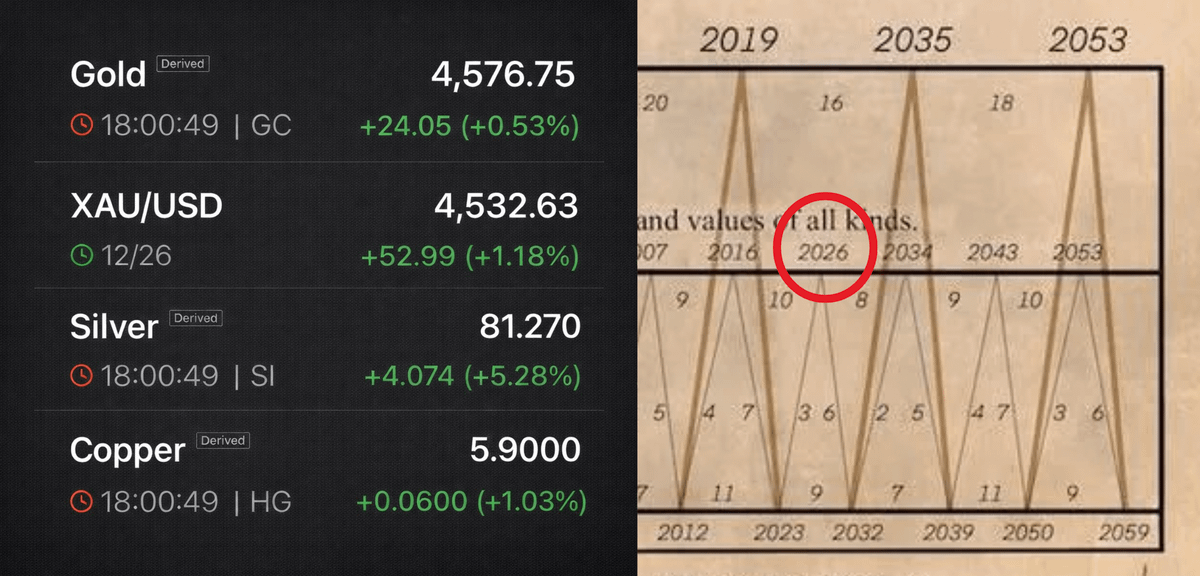
🚨 CONFIRMED: THE BIGGEST COLLAPSE IS COMING IN 2026
And it won’t start with a headline.
It will start with liquidity.
And you’ll notice it first in metals.
Gold is pumping.
Silver is pumping.
And now copper is moving too.
That is not “risk on”.
That is big money getting defensive while liquidity gets tighter and the real economy starts slowing down.
Now read the part that matters.
When gold leads, it usually means trust is fading.
When silver follows, fear is spreading.
When copper joins, it means real supply stress is showing up.
Same vibe, different metals.
Here is the simple takeaway.
When all three move together, it’s not a bullish flex.
It’s the system getting tighter in the background.
And when liquidity tightens, the chain reaction is always the same.
Bonds move first.
Stocks react later.
Crypto gets the violent moves first.
This is not about price.
This is about funding, confidence + collateral.
When liquidity cracks, people rush into hard assets.
And when that happens, everything else becomes a trap.
I’ve studied macro for 10 years and I called almost every major market top, including the October BTC ATH.
Follow and turn notifications on. I’ll post the warning BEFORE it hits the headlines.