Trick for optimizing your Grok usage:
Install @Zapier MCP and have Grok build automations instead of agents. In our modeling, using AI only for judgment steps cut workflow run costs by 71%
@tprupsys@stuartbrameld Yup still need somewhere to host it, maintain it, handle auth, etc. Plus, what happens when it breaks?
If it lives on your own server, that's on you. If it lives in Zapier, we fix it automatically
Zapier is a code product now.
Our users just never see the code.
Zapier grew up in the no-code era. For the longest time, that meant putting UI abstractions on top of APIs for humans who don't know how to write code.
Most of our early AI experiments didn't survive. The turning point was when reasoning models started one-shotting code. And we were like, okay, it's really here.
No-code was about abstracting away the toil of working with code. Now Zapier is actually going to write the code for you.
That's why @Zapier MCP is growing faster than the original Zapier ever. You install it into your agent of choice, and the AI builds the automations for you.
It turns out the best no-code product was always just an agent writing code for you in the first place.
Great question here. For a one-off task, your agent is enough. Use @Zapier when you have work that repeats, so you don't pay AI to do a task that cheap code or automation can handle.
Our research shows an AI agent running on a schedule costs about twice as much as a Zapier automation doing the same job.
@Noa__Legacy Someone still has to host it, handle auth, and fix it when it breaks at 3am.
A Zap is just code your agent writes and deploys to Zapier. We run and maintain it, plus it only uses AI for the steps that need judgment. That's a lot cheaper than using AI every time
@JohnForrester You can, and the first version will probably work.
But then you own the maintenance, API keys, etc. When an API changes or a login expires, you have to fix it.
Have CC or Codex deploy it to @Zapier and we fix it for you when it breaks
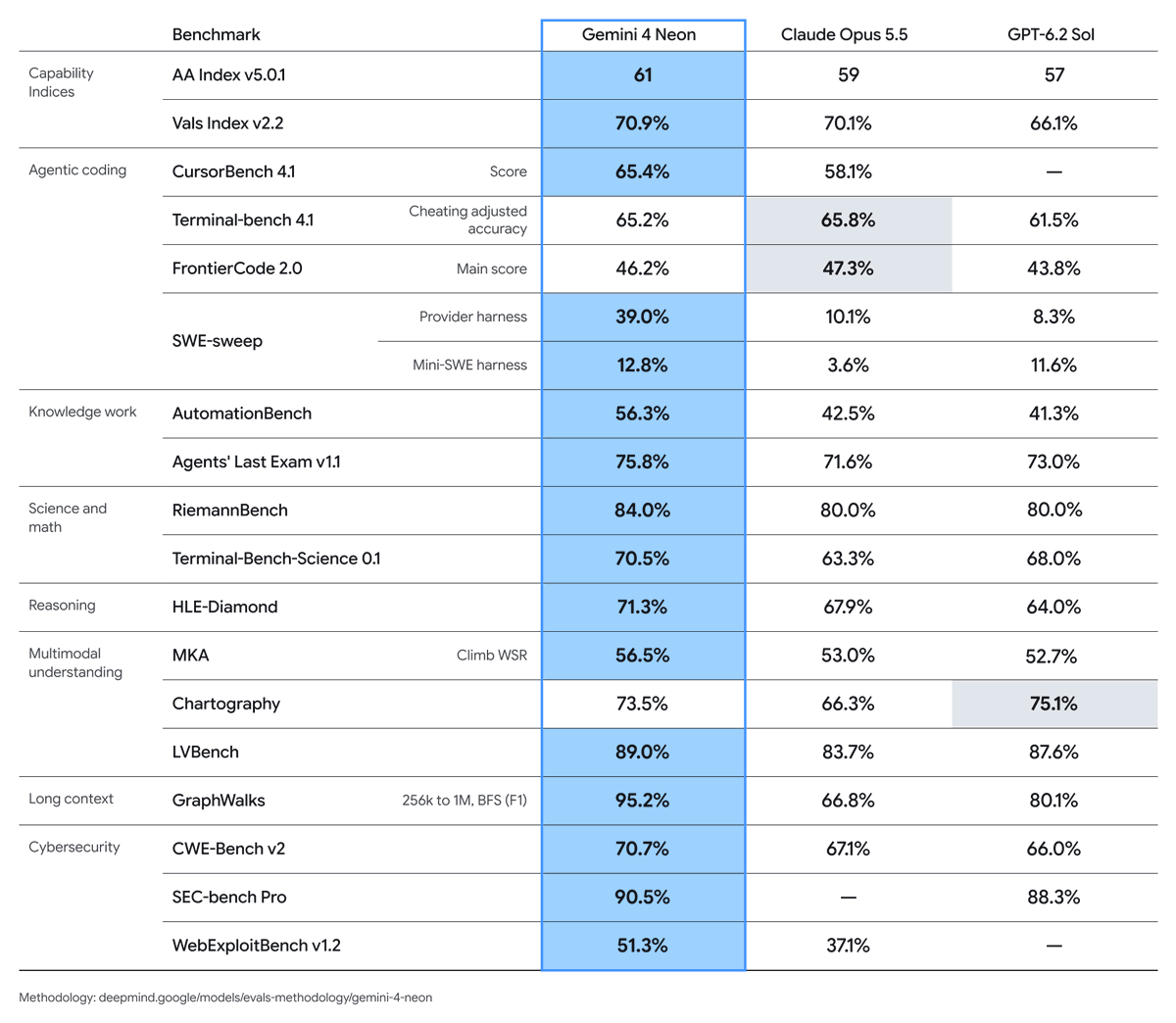
Gemini 4 Neon is rolling out now.
Sitting between Carbon and Hydrogen, it brings frontier intelligence and fast task completion for complex software engineering, knowledge work, and science.
Google just set the top score on @Zapier's AutomationBench, again.
That's 3 new records in 7 weeks, all from Gemini models.
@GoogleDeepMind's Gemini 4 Neon, out today, set the new high score of 56.3%. For context, on September 30, Gemini 4 Argon became the first model to pass 50%. On October 28, Gemini 4 Carbon raised it to 53.9%. Now Neon.
A lot of the AI conversation gets framed as OpenAI vs. Anthropic. Meanwhile, on real business workflows, Google has taken the top spot several times.
Gemini’s also making their models cheaper. Example: on high effort, Neon scores 54.3%, already above Carbon's record, for roughly half the price per task ($0.88 instead of $1.94).
Even Neon's lowest setting scores 49.6% for about $0.40 a task. In September, Argon scored 51.3% at about $1.63 a task. A score close to that old record now costs about a quarter as much.
I don't know who will hold the top spot next month. That's why we run every new model through @Zapier's AutomationBench, 657 real business workflows, to show which AI models work best for your business.
Choose the right model for each Zapier workflow, and change it easily when newer, cheaper models come out.
See how every model scores: https://t.co/4ylnVysHFq
Wade Foster, CEO of @zapier, on The Product Podcast:
“Turns out the best no code product was always just an agent writing code for you.”
Zapier grew up as the no-code company. It’s now a code product. Users just never see it.
Zapier has changed a lot to match this. If you still picture it as clicking through steps manually, you’re in for a surprise.
Connect @Zapier MCP to any AI and ask it to build and host a workflow: https://t.co/5EXo7haQZB
The future of no-code is code.
But now AI writes the code, so you don't have to.
"No-code" made a promise: you could get working software without writing it yourself. That's still true! But instead of clicking through boxes on a screen you have an agent write the code for you.
Now our customers do the same with workflows. More and more of them build a workflow just by asking their AI tool.
Asking an AI to build something feels like a different category from no-code. But the person on the other end gets the same result: working software from someone who doesn't write code.
My rule: the value of AI is having it build your automations, not run them. On the running side, run it with code. Code is deterministic, reliable, and cheap. Whereas AI automations are probabilistic and far too often break in strange and unexpected ways.
OpenAI released GPT-6.2 Sol and GPT-6.2 Astra today.
They matched their best on AutomationBench for an eighth of the cost.
Sol, the cheaper of the two, scored 41.2% on AutomationBench at High effort, for 21 cents a task. The September record, GPT-6 Astra, scored 41.4% at Max effort for $1.73 a task (close enough that I'm calling it a tie)
GPT-6.2 Astra, @OpenAI's new top model, scored 52.4% at Max effort for 83 cents a task. That's 11 points past the September record, at less than half the price.
Insane progress. But cheap only matters if the work comes out right.
In one of our finance tests, the tax team posted 3 changes to this year's 1099 rules in a team chat, and the written guide never got updated. Sol found the changes, held one contractor under legal review, and exempted another whose tax status had changed. The previous version of Sol never opened the chat and sent the tax director an overstated total.
That's why we track cost per finished task at Zapier, and why we built our own benchmark. Labs publish their own scores. I want to know, on work that looks like ours, which steps in a workflow need a model at all, and the cheapest model that gets those steps right.
In most of my personal workflows, code runs the trigger, the data pull, and the send. An AI model only handles the judgment call in the middle. That step is where new models like these pay off: Sol can now handle it at September's record score for about an eighth of the price.
Any workflow shelved because the model step cost too much is worth another look.
Try GPT-6.2 Astra and Sol in @Zapier today.
Google's Gemini 4 Hydrogen is out today.
Argon-level scores on @Zapier's AutomationBench, at Flash-level pricing.
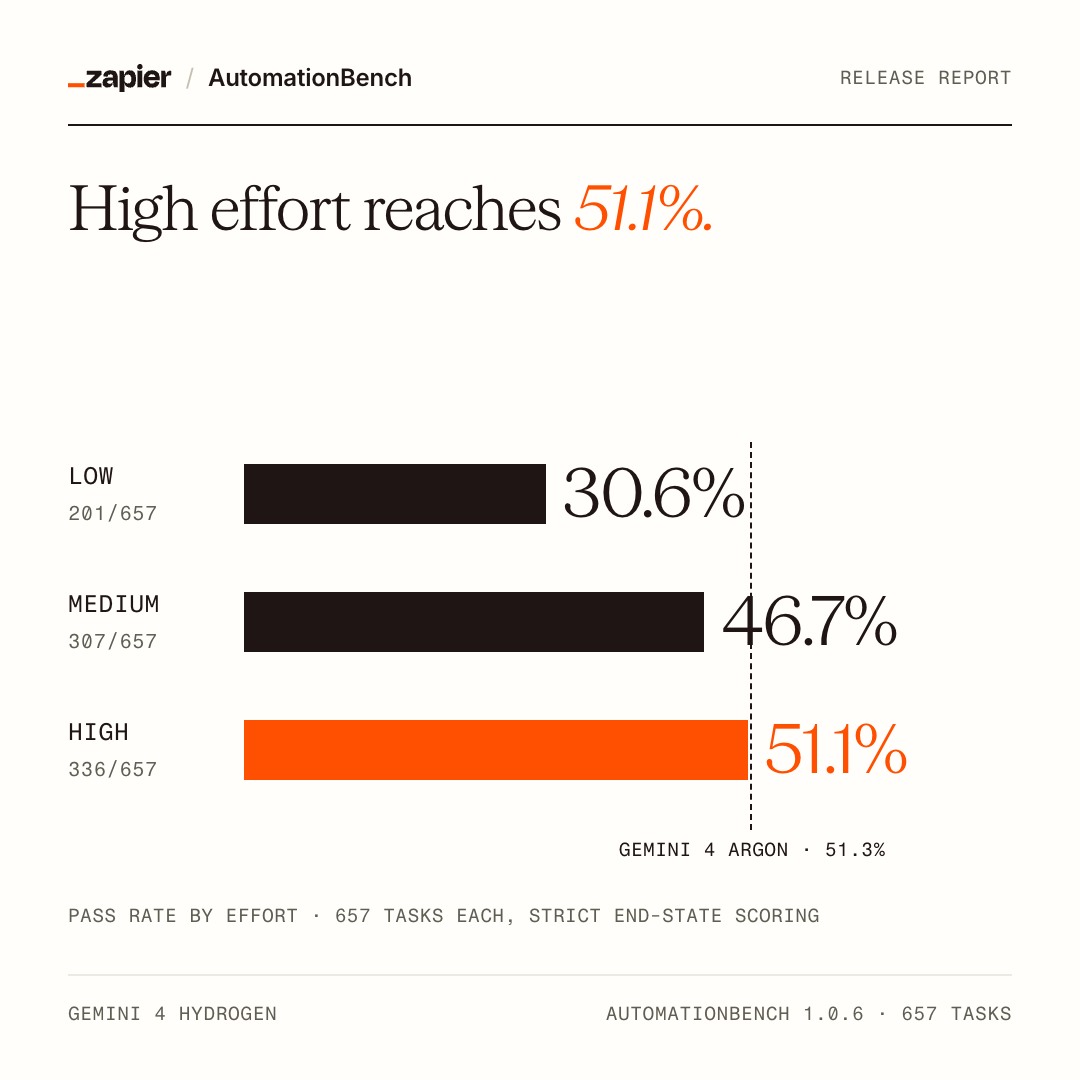
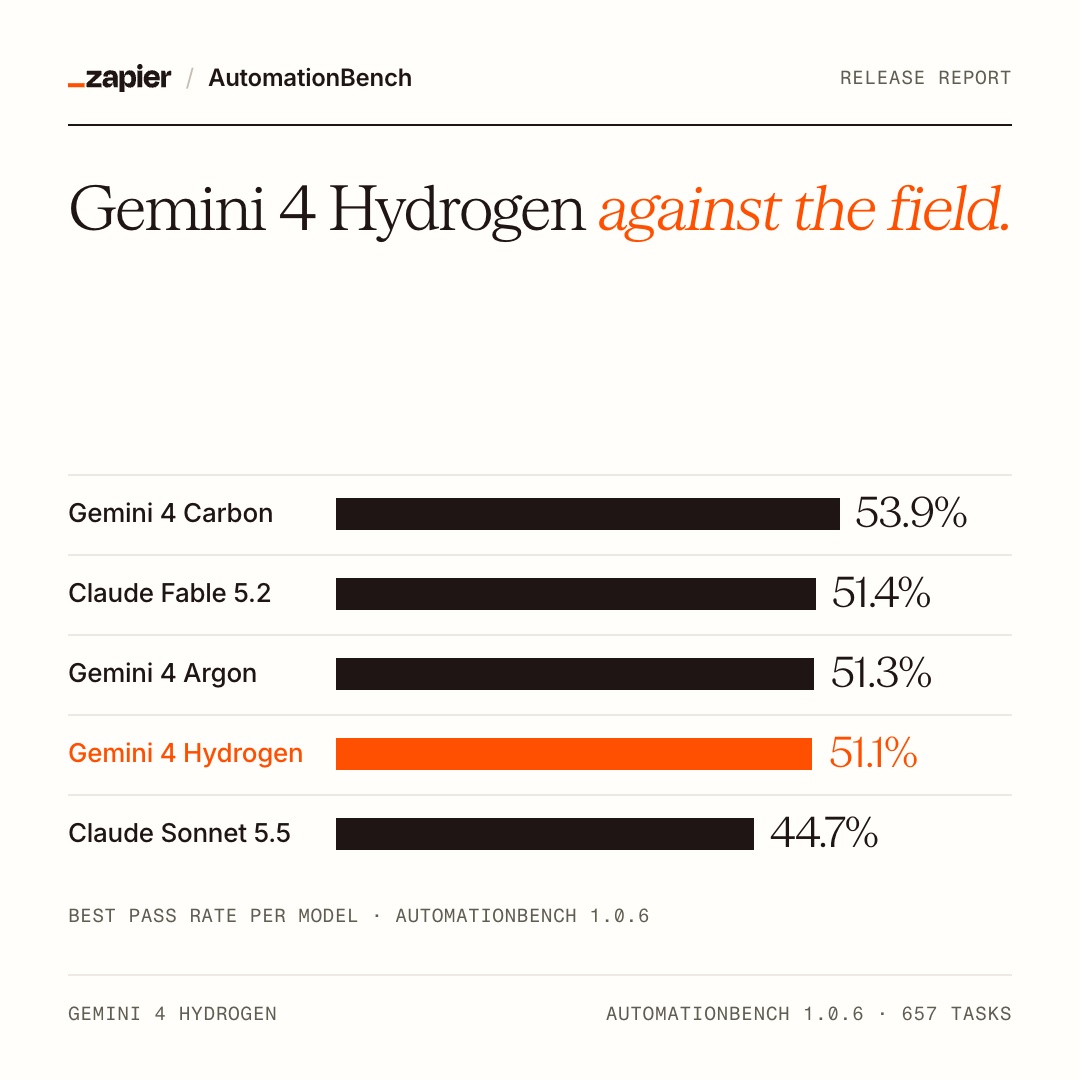
At high effort, Hydrogen scored 51.1%. Gemini 4 Argon scored 51.3%. Hydrogen costs about $0.82 a task to run, against $1.63 for Argon.
@GoogleDeepMind priced it the same as Gemini 3.8 Flash. Flash's best score is 29.7%, and Hydrogen beats that even on low effort (30.6%).
It's not the top scoring model. Gemini 4 Carbon (53.9%) and Claude Fable 5.2 (51.4%) still score higher. But they also cost more: about $1.94 a task for Carbon and $4.64 for Fable 5.2.
Best fit for Operations (64%) and Finance (59%). Weaker for Support (42%) and HR (34%).
In one sales workflow we tested, several urgent customer emails arrived at once, including a full production outage at one account. Hydrogen opened a high-priority case for the outage, alerted the account owner, and added a matching report to the existing incident instead of opening a duplicate. Gemini 3.8 Flash handled the first email and stopped. The outage never got a case, and nobody told the account owner.
If a workflow runs on Argon today, I'd test it on Hydrogen next. For high-volume work, Medium effort scored 46.7% at only $0.41 a task.
Zaps now fix themselves, with AI.
Build your workflow in Claude, ChatGPT, etc. Zapier keeps it running.
When it hits an error? An agent reads it, tests a fix, and ships a new version.
Small fixes ship on their own. Anything bigger, or anything touching a login, waits for your OK.
All part of the new @Zapier. Describe the workflow, let your agent build it & host it in Zapier. We'll fix it when it breaks.
Just connect your AI to Zapier MCP: https://t.co/MT6aSKGCPj
Agents now attempt my tasks before I even see them.
Email me, tag me, etc? My agent takes first crack at solving and responding.
I review (and often edit) every message, so it's still mine. Nothing goes out without my green light, and I'm saving a ton of time. Here's the setup:
- Anything where I get tagged or need to take action (Slack, email, Granola, etc) routes through a Zap into Todoist
- Each task kicks off a @Zapier cloud agent that's authenticated to all my tools: Slack, Gmail, Glean, Databricks, HubSpot, you name it
- It assigns an agent to attempt the task, propose what it thinks I'd do, and drafts the reply using a 'writing-as-Wade' skill I created.
- At my desk, I run a /sweep command in Cursor and blitz through all the low effort stuff: send, done, or edit.
- On my phone, I use a private Slack channel I created. "🚀" means send, "✅" means done, and a "🧵" reply means I have edits. The rest is usually voice-to-text, so I can handle stuff while I'm out.
It's my own agent factory, and it's working pretty dang good. But it only works because I worked really hard to make it sound like me. When AI dresses up a thought with the "veneer of smartness," it bugs me to no end.
I'd rather just get the sloppy human version of the output than the dressed up Claude version.
Fable 5.2 is here.
On Zapier workflows, it performs 2.3x better than Fable 5.1. It's the best
@AnthropicAI model we've tested to date.
At max effort, Fable 5.2 scores 51.4% on Zapier's AutomationBench.
@Claudeai's Sonnet 5.5, their previous best, scored 44.6%. Opus 5.5 scored 40.0%, and Fable 5.1 scored 22.4%. Huge jump over the previous Fable model, and a clear step past Sonnet and Opus too.
You don't need max effort to see the jump. Even at low effort, Fable 5.2 scores 39.7%, roughly the same as Opus 5.5 at max effort, for about the same cost per task ($1.30 vs $1.28).
Fable 5.2's biggest gains over 5.1:
1. Finance: from 16% to 53%
2. Sales: from 21% to 54%
3. HR: from 9% to 37%
Finance is also where it has the largest improvement over Opus 5.5 (36% to 53%)
Biggest difference with Fable 5.2 is how it works on each task. It averages about 97 tool calls per task, against 54 for Fable 5.1. It works harder and checks its work before it touches anything.
You do pay for that extra thoroughness. At max effort, Fable 5.2 averages about $4.64 per task, against $1.28 for Opus 5.5. So figure out which workflows need Fable 5.2, and run the rest on Opus 5.5 ($1.28 per task) or Sonnet 5.5 ($1.00 per task)
Fable 5.2 is live on @Zapier now.
@AnthropicAI@claudeai We run every new model through Zapier’s AutomationBench: 657 workflows across 6 departments, to tell you what AI to use for your business.
Read the full leaderboard here: https://t.co/pDq0DsIJXk
Fable 5.2 is here.
On Zapier workflows, it performs 2.3x better than Fable 5.1. It's the best
@AnthropicAI model we've tested to date.
At max effort, Fable 5.2 scores 51.4% on Zapier's AutomationBench.
@Claudeai's Sonnet 5.5, their previous best, scored 44.6%. Opus 5.5 scored 40.0%, and Fable 5.1 scored 22.4%. Huge jump over the previous Fable model, and a clear step past Sonnet and Opus too.
You don't need max effort to see the jump. Even at low effort, Fable 5.2 scores 39.7%, roughly the same as Opus 5.5 at max effort, for about the same cost per task ($1.30 vs $1.28).
Fable 5.2's biggest gains over 5.1:
1. Finance: from 16% to 53%
2. Sales: from 21% to 54%
3. HR: from 9% to 37%
Finance is also where it has the largest improvement over Opus 5.5 (36% to 53%)
Biggest difference with Fable 5.2 is how it works on each task. It averages about 97 tool calls per task, against 54 for Fable 5.1. It works harder and checks its work before it touches anything.
You do pay for that extra thoroughness. At max effort, Fable 5.2 averages about $4.64 per task, against $1.28 for Opus 5.5. So figure out which workflows need Fable 5.2, and run the rest on Opus 5.5 ($1.28 per task) or Sonnet 5.5 ($1.00 per task)
Fable 5.2 is live on @Zapier now.